St John Climacus on Mad Pride and Vainglory : Ladder of Divine Ascent, Steps 22-23
Ladder of Divine Ascent

St John Climacus on Mad Pride and Vainglory: Ladder of Divine Ascent, Steps 22-23

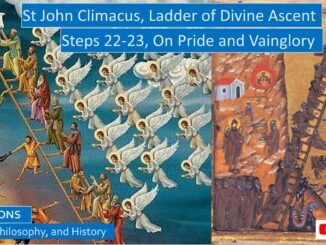
What is the difference between vainglory and pride? Today, vainglory is an archaic word that has not been replaced in common usage, so we usually consider them to be synonymous. Although St John Climacus concedes they are similar, except vainglory progresses to mad pride. He examines vainglory in Step 22, and mad pride in Step 23.
Let us compare the definitions:
Step 22.1. “Some like to distinguish vainglory from pride, and to give it a special place and chapter.” “The only difference between them” is like the difference “between a child and a man, between wheat and bread: for the one is the beginning and the other the end.”
Step 22.2. “With regard to its form, vainglory is a change of nature, a perversion of character, a note of blame. With regard to its quality, it is a dissipation of labors, a waste of sweat, a betrayal of treasure, a child of unbelief, the precursor of pride, shipwreck in harbor, an ant on the threshing floor which, though small, has designs upon all one’s labor and fruit. The ant waits for the gathering of the wheat, and vainglory for the gathering of the riches of virtue: for the one loves to steal and the other to squander.” […]

FDR’s Inaugural Address and St John Climacus, Ladder of Divine Ascent, on Fear & Cowardice, Step 21
Ladder of Divine Ascent

FDR’s First Inaugural Address and St John Climacus, Ladder of Divine Ascent, on Fear & Cowardice, Step 21

The chapter on fear is both one of the shortest and one of the most puzzling chapters of St John Climacus’ Ladder of Divine Ascent. In part, that is because there are many flavors of fears that spring from our most basal fears: the fear of the dark, the distressing, the dangerous.
More common are those fears that cause us to hesitate. Perhaps we fear what others think of us when we champion the good others do not see. Perhaps we fear rejection and failure. Perhaps we fear that past failures will rob us of future success. Perhaps we fear to do good when we are not encouraged. […]

St John Climacus on Insensibility, Sleep, Prayer, and Vigil: Ladder of Divine Ascent, Steps 18-20
Ladder of Divine Ascent

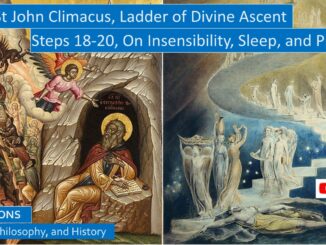
St John Climacus on Insensibility, Sleep, Prayer, and Vigil: Ladder of Divine Ascent, Steps 18-20

Father John Mack teaches us: “The labor of prayer is a labor with the thoughts. Our minds are far too lazy and undisciplined. Instead of directing our thoughts and controlling them, we allow them to run free, here and there, wherever they wish to go. So, during prayer, we find ourselves thinking about all kinds of other things.”
We are called to prayer during Divine Liturgy. Do we complain that the service is over an hour? Do we watch our watch rather than our soul? Are we attentive in prayer, are we attentive during Divine Liturgy, paying attention to our prayers, not letting our mind wander, trying not to let our mind wander? We are bidden by Jesus in his Agony of the Garden of Gethsemane to stay awake and pray. […]

St John Climacus, Ladder of Divine Ascent Steps 16&17 Avarice and NonPossessiveness
Ladder of Divine Ascent

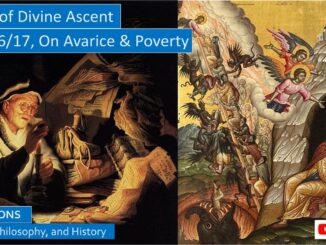
St John Climacus, Ladder of Divine Ascent, On Avarice and Non-Possessiveness, Steps 16 & 17

Avarice is the worst kind of drought and famine, for it is drought and famine in the midst of plenty. A Jewish story tells of a man taken on a tour of Hell, where he sees a huge banquet hall, with long tables lined with souls, each one ogling their plate heaped with roast beef, sausage, breads, fruits and pies. This sumptuous meal tormented each one, all were starving, for they had no elbows to feed themselves. Then he was shown the banquet hall in Heaven, same type of banquet hall, same meats, breads, fruits and pies, but here the mood was joyous. Like those souls in Hell, they had no elbows, but they were joyous because they were feeding each other. […]

St John Climacus on Love, Lust, and Marriage: Ladder of Divine Ascent, Step 15, on Purity & Chastity
Ladder of Divine Ascent

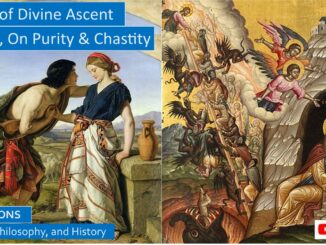
St John Climacus on Love, Lust, and Marriage: Ladder of Divine Ascent, Step 15, on Purity and Chastity

Laymen often wonder: How can those who are married be chaste? In his commentary on the Ladder of Divine Ascent, Father Vassilios Papavassiliou teaches us that “people tend to think of chastity in purely sexual terms as the virtue opposed to sexual depravity.” But just as the word concupiscence has a deeper meaning for Catholics, chastity has a deeper meaning for Orthodox Christians. “In the Orthodox marriage service, we pray that the newlyweds may live in chastity. But yet in the same service, we pray numerous times that they may have honorable children. How can a couple live in” “sexual purity, and yet have children?”
The simple answer is that chastity and sexual purity are not exactly the same. He points out that “a fuller, more accurate translation of the Greek term sphrosini is whole-mindedness, or harmony between the flesh and the spirit.” Father Vassilios teaches us that in the Church “the intimate union between husband and wife is a living symbol of the union between Christ, the Bridegroom, and the Church, His Bride,” which is why intimacy should be experienced by a man and his wife. […]

St John Climacus on Gluttony in Ladder of Divine Ascent, Eating for Health: DASH Diet
Ladder of Divine Ascent

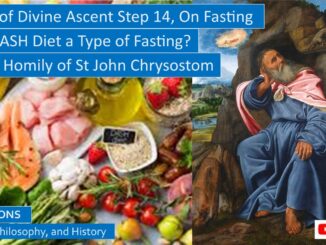
St John Climacus on Gluttony and Fasting, Ladder of Divine Ascent, Step 14, and Eating for Health: DASH diet

Earthly passions, if we do not control them, can lead us to selfishness, can lead us away from selflessness, can cloud the way to our salvation, and can prevent us from loving our neighbor as ourselves. St John Climacus teaches us that the primary passion is gluttony, the gluttony that keeps us from eating a healthy diet, that keeps us from eating in moderation. […]

Ladder of Divine Ascent Steps 8 9 SMALL Anger Remembrance of Wrongs
Ladder of Divine Ascent

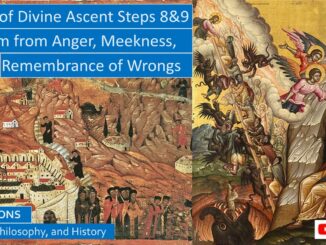
St John Climacus, Ladder of Divine Ascent, Freedom from Anger, Meekness, Remembrance of Wrongs, Steps 8 and 9

A recurring theme is the Ladder of Divine Ascent is the climb is not a one-time conversion vaulting us to the top of the ladder, but is rather a process, a changing of habits, that we practice for the rest of our lives, ever climbing, until we reach the great IMAX theater in the sky with screens forty feet wide and forty feet tall that replays  the major events in our lives at the end of days.
Step 8.23. “The beginning of blessed patience is to accept dishonor with sorrow and bitterness of soul. The middle stage is to be free from pain in the midst of these things. But perfection, if it is possible, is to regard dishonor as praise. Let the first rejoice; let the second be strong; blessed is the third, for he exults in the Lord.” […]

Ladder of Divine Ascent, SMALL Steps 6,7, 13
Ladder of Divine Ascent

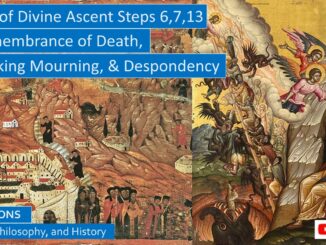
Ladder of Divine Ascent, Remembrance of Death, Joy Making Mourning, and Despondency, Steps 6,7, & 13

St John Climacus continues:
Step 6.3. “Fear of death” “comes from disobedience, but trembling at death is a sign of unrepented sins.” Those who fear death the most are the disobedient who live only to party, who live for today, who live for themselves, and do not live for others, they are the unrepentant who tremble at death’s gates. Even “Christ fears death, but does not tremble,” so He can show us that he is both God and man.
Step 6.24. “It is impossible, someone says, impossible to spend the present day devoutly unless we regard it as the last of our whole life.” […]

Ladder Of Divine Ascent Step 4 Obedience
Ladder of Divine Ascent

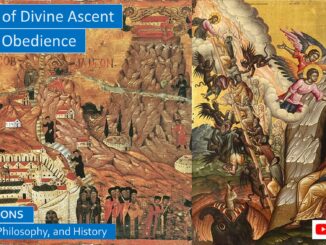
Ladder of Divine Ascent, St John Climacus, Rung 4 on Obedience

Obedience precedes repentance in the Ladder of Divine Ascent. Without obedience, there is no repentance. With repentance comes obedience. When we sinned, we did not obey; now we repent, and obey. It is interesting that in the Decalogue the commandment of honor our father and our mother, and all those in authority, connects the commands to Love God with all our heart and with all of our soul and with all of our everything to the commands to love our neighbor as ourselves.

Step 4.3 As John Climacus teaches us, in obedience we renounce our desires, what we want, what we need: “Obedience is unquestioning movement, voluntary death, a life free of curiosity, carefree danger, unprepared defense before God, fearlessness of death, a safe voyage, a sleeper’s progress. Obedience is the tomb of the will and the resurrection of humility.” […]

St John Climacus, Ladder of Divine Ascent, On Detachment, Exile, and Pilgrimage, Steps 2 and 3
Ladder of Divine Ascent

St John Climacus, Ladder of Divine Ascent, On Detachment, Exile, and Pilgrimage, Steps 2 and 3

St John Climacus wrote the Ladder of Divine Ascent as a handbook for monks living the monastic life, cut off from the world, in the isolation of the Egyptian desert monasteries, in a world before global communications where the monk could easily call his family on the monastery phone. In […]