St John Climacus on Mad Pride and Vainglory : Ladder of Divine Ascent, Steps 22-23
Ladder of Divine Ascent

St John Climacus on Mad Pride and Vainglory: Ladder of Divine Ascent, Steps 22-23

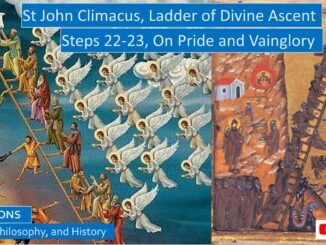
What is the difference between vainglory and pride? Today, vainglory is an archaic word that has not been replaced in common usage, so we usually consider them to be synonymous. Although St John Climacus concedes they are similar, except vainglory progresses to mad pride. He examines vainglory in Step 22, and mad pride in Step 23.
Let us compare the definitions:
Step 22.1. “Some like to distinguish vainglory from pride, and to give it a special place and chapter.” “The only difference between them” is like the difference “between a child and a man, between wheat and bread: for the one is the beginning and the other the end.”
Step 22.2. “With regard to its form, vainglory is a change of nature, a perversion of character, a note of blame. With regard to its quality, it is a dissipation of labors, a waste of sweat, a betrayal of treasure, a child of unbelief, the precursor of pride, shipwreck in harbor, an ant on the threshing floor which, though small, has designs upon all one’s labor and fruit. The ant waits for the gathering of the wheat, and vainglory for the gathering of the riches of virtue: for the one loves to steal and the other to squander.” […]
Seneca on Aging Death and Suicide
Aging

Roman Stoic Philosopher Seneca on Aging, Death, and Suicide

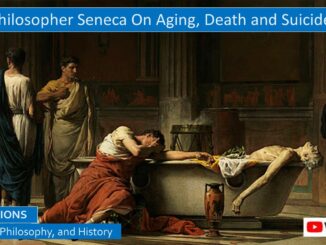
Seneca reminds us: “There is indeed a limit fixed to us,” “but none of us knows how near he is to this limit. Therefore, let us so order our minds as if we had come to the very end. Let us postpone nothing. Let us balance life’s account every day.” “Let us begin at once to live and count each separate day as a separate life.” What is important is “not how long you live, but how nobly you live. And often living nobly means that you cannot live long.” […]

Roman Stoic Philosopher Seneca on Aging, Retirement, and Death
Aging

Roman Stoic Philosopher Seneca on Old Age and Retirement

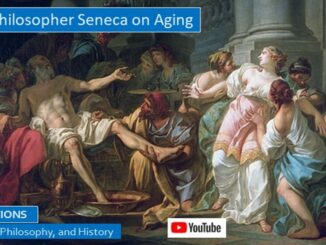
Seneca faces old age and death as only a Stoic could. “Old age is a time of life that is weary rather than crushed.” Nevertheless, I am thankful, “for age has not damaged my mind, though I feel its effects on my constitution. Only my vices” “have reached senility; my mind is strong,” “it is alert,” “it declares that old age is when it blooms.” “My mind bids me to consider how much this peace of mind and moderation of character I owe to wisdom and how much to my time of life; it bids me to distinguish carefully what I cannot do and what I do not want to do.” “There is only one chain that binds us to life, and that is the love of life.” […]

Major Roman Stoic Philosophers, My Favorite Maxims: Epictetus, Rufus, Seneca & Marcus Aurelius
Philosophy

Major Roman Stoic Philosophers, My Favorite Maxims: Epictetus, Rufus, Seneca & Marcus Aurelius

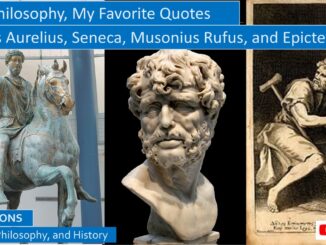
Many of the writings of the Stoics sound like passages from the Pauline Epistles. Indeed, Seneca was a contemporary of St Paul. There are epistles written between them, though nearly all scholars think they are spurious. Was St Paul inspired by the Stoic writings of Seneca? Although the Jewish rabbinic tradition was the primary source of inspiration for the Epistles and the Gospels, stoicism was an important secondary influence. In particular, stoicism deeply influenced the desert monastic tradition, which in turn influenced medieval monasticism. […]