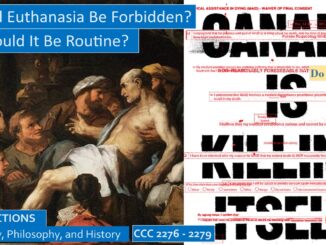
Should Euthanasia Be Forbidden? Or Should It Be Routine?
Command 6 Do Not Murder

Should Euthanasia Be Forbidden? Or Should It Be Routine?

Those of us whose years exceed twice-twenty will remember Doctor Death, Jack Kevorkian, who declared: “Dying is not a crime,” and who constructed the Thanatron, or Death Device, whose button his suicidal patients pressed to inject death-delivering drugs into their veins. After Kevorkian’s medical license was revoked, cutting off his deadly drug supply, he constructed the Mercitron gas mask, which dispensed carbon monoxide that his suicidal patients could use to breathe in their last breaths.[1]

The formerly Doctor Jack Kevorkian assisted in over a hundred suicides between 1990 and 1998. Between 1994 and 1997, he was tried four times for murder, with three acquittals and one mistrial. Finally, in 1998, the charges stuck: he was charged and soon convicted of murder, serving eight years of a ten-to-twenty-five-year sentence. […]
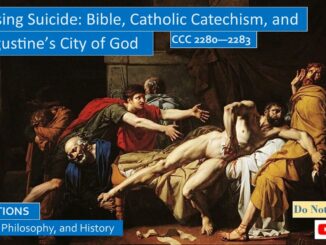
Opposing Suicide: According to the Bible, Catholic Catechism, and St Augustine’s City of God
Command 6 Do Not Murder

Opposing Suicide: Biblical Exhortations, Catholic Catechism, and St Augustine’s City of God

CCC 2281. “Suicide contradicts the natural inclination of the human being to preserve and perpetuate his life. It is gravely contrary to the just love of self. It likewise offends love of neighbor because it unjustly breaks the ties of solidarity with family, nation, and other human societies to which we continue to have obligations. Suicide is contrary to love for the living God.” […]

Q & A on Topic: Why Did You Leave Your Religion?
Biblical Interpretation

Q & A on Topic: Why Did You Leave Your Religion?

To the ancients who lived in a warrior culture, Stoic philosophy is very appealing. The Stoics don’t ask the question: Why do bad things happen to good people? Instead, they admit that good and bad things happen to everyone, that the rain falls on both the bad and the good. Bad things happen to good people, that is part of life. The real question is: How can God help us endure and prevail over our suffering? […]

Decalogue: Do Not Slander, Catholic Catechism 2465-2503, and St Thomas Aquinas
Command 8 Do Not Bear False Witness

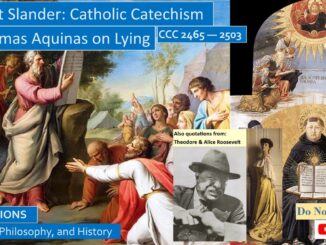
Decalogue: Do Not Slander, Catholic Catechism and St Thomas Aquinas CCC 2465-2503

The Eight Commandment in the Catholic Catechism exhorts, “You shall not bear false witness against your neighbor.” Many people shorten this commandment to, You shall not lie, and although lying is usually sinful, this is a shallow understanding of this commandment. The positive form of the commandment is we should guard the reputation of our neighbor, it is possible to slander someone while speaking the truth about them. Gossip can be harmful whether it is truthful or not. […]

Building Bridges Between Church and LGBTQ Community
Catholic Catechism

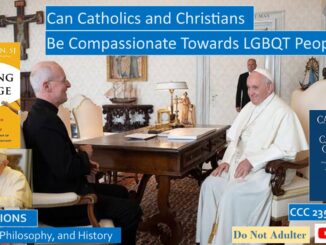
The Church, the Catholic Catechism, and the LGBT Community

How should this two-fold Love of God and love of neighbor affect how we enforce moral laws in our faith and civil communities? When should these be enforced?

Simply put, in the Judeo-Christian tradition, they should be enforced so they increase in our hearts the two-fold Love of God and neighbor. This certainly means we should discourage sexual abuse and punish serious sexual abuse that is proven. Certainly, it means we should seek to be compassionate rather than cruel, because compassion is loving, while cruelty is hateful. […]

Modern Catholic Popes

Ratzinger Report, by Future Pope Benedict XVI, Preparing for Catholic Catechism

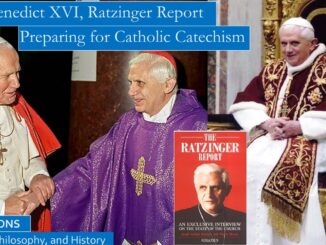
Cardinal Ratzinger teaches us: “Every council that bears fruit must be followed by a wave of holiness. Thus it was after Trent, and it achieved its aim of real reform for this reason. Salvation for the Church comes from within her,” not solely “from the decrees of the hierarchy. Whether Vatican II and its results will be considered as a luminous period of Church history will depend upon all the Catholics who are called to give it life. As Pope John Paul II said in his commemoration of Charles Borromeo in Milan, ‘the Church of today does not need any new reformers, the Church needs new saints.’” […]

History

How Did the Experiences of World War II Influence the Second Vatican Council?

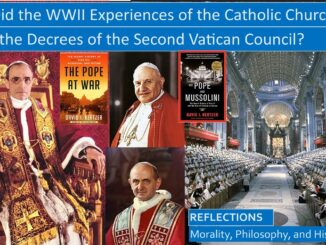
Vatican II marks a shift in the Church’s attitude towards the modern secular world. Gone are the anathemas of the Council of Trent and many other councils that condemn those who may disagree with the teachings of the church, instead Vatican II seeks dialogue with the modern world in with a pastoral rather than a condemning attitude. The Vatican II decree on religious freedom announced that democracy and freedom of religion and conscience were the friends of the church, that a totalitarian form of government could never be a trustworthy friend of the Catholic or Christian Church. […]

Book Reviews and Miscellaneous

Book and DVD Reviews on the Ten Commandments, or Decalogue

These are book reviews on the Decalogue, or Ten Commandments. Our first sources are the Lutheran and Catholic Catechisms, they discuss each of the Ten Commandments. Pope Benedict, aka Cardinal Ratzinger when footnotes for the sources used in the Catechism between the eastern and western church fathers, which means that this is an excellent study program for the writings of the Church Fathers for both the Catholic and Orthodox religious traditions. […]

Command 8 Do Not Bear False Witness

Do Not Slander: Church Fathers and Preachers, and Catholic Catechism, CCC 2464

The Church Fathers focus on our love for our neighbor when contemplating this commandment.  St Gregory Palamas in our English translation renders the commandment as, “You shall not accuse anyone falsely.”  We are warned that if we accuse anyone falsely, we may “become like the devil, who falsely accused God to Eve and was cursed by God.  Rather, we should conceal our neighbor’s offense, unless by so doing others may be injured; and in this way we will imitate not Ham, but Shem and Japeth, and so like them receive the blessing.”
[…]