Polycarp, Christian Martyrs, and Stoic Philosophers: Dying the Good Death
Epictetus and Rufus

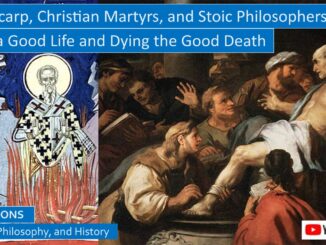
Polycarp, Christian Martyrs, and Stoic Philosophers: Dying the Good Death

Did the Christian martyrdoms and the Stoic view towards suicide both reflect the ancient Greek and Roman concern that the virtuous person should die the good death, facing death with courage, not fearing death?
What we are not concerned with is whether the Christian views towards martyrdom affected the Stoic views of suicide, or the reverse, or vice versa. How one influenced the other is both impractical to conjecture and impossible to prove.
We cannot assume that all Stoic philosophers enthusiastically condoned suicide. In the City of God, St Augustine opposed suicide in all cases. The Stoic Seneca obsessed about suicide because he spent his last few retirement years wondering when the evil Emperor Nero would send his sword-wielding soldiers to his estate to insist that he commit suicide. Like St Augustine, the Stoic philosopher Epictetus opposed suicide in most circumstances. […]

Psalm 71: Encouraging Us In Our Old Age
Biblical Interpretation

Psalm 71: Encouraging Us In Our Old Age

John Calvin speculates that David composed Psalm 71 after experiencing the trauma of losing the life of his son Absalom during his rebellion against him, which was sparked by the favoritism Davis showed towards his newly resented wife, Bathsheba. “The particular reference which David makes to his old age renders this conjecture not improbable.”
If so, this psalm should be a comfort to those who old age is lonelier due to mistakes, miscalculations or misfortunes occurring many years earlier. […]

Psalms 40 and 70: Deliver Both Young and Old from Suffering and Trials
Biblical Interpretation

Psalms 40 and 70: Deliver Both Young and Old from Suffering and Trials

St Ambrose rejoices: “Christ has heard the prayer of his own servants and has brought us out from the pit of misery and from the mire of dregs. We were drowning there; our whole flesh was clinging to the mire, trapped in the whirlpool of our sins. Our soul was powerless to save itself; fallen and ruined as it was by the multiplicity and dreadfulness of our offenses.”
St Ambrose continues: “Christ came to save us from the pit and slime of this world, from the mud and mire of this earth, from this body doomed to death.” “May that rock, which follows those who thirst, confirm the weak and unsteady; may that water never be lacking to those who long for it; and may that firm foundation never be wanting to those in danger of falling.” […]

My Favorite Commentaries on the Psalms
Book Reviews and Miscellaneous

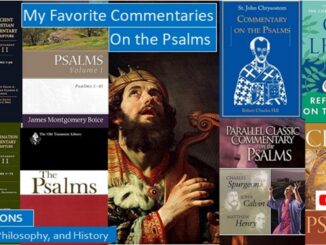
My Favorite Commentaries on the Psalms

One excellent example of reading the Bible allegorically is the verse in Psalm 137 where the Jews are encouraged to bash the brains of Babylonian babies against the rocks. The Church Fathers equate these babies with our small sins, that we should strive to be perfect, even as our Heavenly Father is perfect, bashing both our large and small sins.
We must remember that the Psalms are poetry, and Hebrew poets are like poets in any language, they sometimes use obscure words for better rhythm. This means the Psalms pose more translation problems than most of the books in the Bible. If you cannot make sense of a passage, it may be that scholars are not quite sure what the original passage meant. […]

Protestantism, Catholicism, Orthodoxy, and Judaism: Which Is True
christianity

Protestantism, Catholicism, Orthodoxy, and Judaism: Which Is True?

We agree with CS Lewis when, in his Preface to Mere Christianity, he states that “the reader should be warned that I offer no help to anyone who is hesitating between two Christian denominations. You will not learn from me whether you ought to become an Anglican, a Methodist, a Presbyterian, or a Roman Catholic.” CS Lewis compares his Mere Christianity to a central hall opening up to many rooms, representative of the various denominations, saying that this hall is a place to wait while you try the different doors.
CS Lewis continues: “There is no mystery of my own position. I am a very ordinary layman of the Church of England, not especially high, nor especially low, nor especially anything else.” […]

Homosexuality, the Bible, and the Church: The Zondervan Debates
christianity

Homosexuality, the Bible, and the Church: The Zondervan Debates

For better or worse, most of us choose our intimate partners, and build our world around that choice. If a homosexual couple is accepted by the clergy of your church, what good can come from telling them they are going to burn in hell if they do not repent? We are only responsible for our own personal salvation, it is not our job, particularly if we are laymen, to speculate on whether our neighbor will be saved. That is between them and Jesus, and nobody else.
My goal is not to change your mind about homosexuality. My goal is: If you do not accept that it is possible to be both a Christian and homosexual, that you will refrain from telling them they are damned to burn in hell, but would instead refer them to an Episcopalian Church, or other church where they would be welcome.
Jesus will judge us all in front of the great IMAX theater in the sky, where we will need to account for the decisions we made in our lives as they are displayed on that screen forty feet wide and forty feet tall. Jesus is the judge; we should not seek to do his job. Instead, we work out our own salvation, judging our own actions rather than our neighbors’. […]

Plato’s Republic, Book 1, Reflecting on Old Age, Morality, and Justice
Aging

Plato’s Republic, Book 1, On Aging and Morality, a Better Word for Justice

Reading Robin Waterfield’s translation was like breathing fresh alpine air. When I thought that Plato’s Republic was about justice, I reasoned that this was because Socrates sought to train Athenians to be better citizens in a direct democracy, a skill that would not be needed in the later totalitarian Roman Empire. But Robin Waterfield’s translation of the Republic makes more sense and is more in line with Stoic and Christian moral values. I demur from the conventional scholarly opinion that who the translator is does not matter. […]

Opposing Suicide: According to the Bible, Catholic Catechism, and St Augustine’s City of God
Command 6 Do Not Murder

Opposing Suicide: Biblical Exhortations, Catholic Catechism, and St Augustine’s City of God

CCC 2281. “Suicide contradicts the natural inclination of the human being to preserve and perpetuate his life. It is gravely contrary to the just love of self. It likewise offends love of neighbor because it unjustly breaks the ties of solidarity with family, nation, and other human societies to which we continue to have obligations. Suicide is contrary to love for the living God.” […]

Epictetus, Eminent Roman Stoic Philosopher, on Living Well, Dying Well, and Opposing Suicide
Aging

Epictetus, Eminent Roman Stoic Philosopher, on Living Well, Dying Well, and Opposing Suicide

Is it wise to complain? Epictetus observes: “If someone dies young, he blames the gods because he is being taken before his time. If someone lingers on into extreme old age, he too blames the gods.” “Despite this, at the approach of death, he wants to stay alive; he sends for the doctors and begs him to do all he can.” “It is quite remarkable to see how people want neither to live nor to die.”
“Is health good and illness bad? No, man. What, then? Health managed well is good, but when badly managed, it is bad.”
Epictetus points out: “If you look at yourself in isolation, it is natural for you to live to an old age, to be rich, to be healthy. But if you look at yourself as a human being and as part of some whole, for the sake of that whole, it may be appropriate for you to be ill, or risk your life at sea, or be poor, or die young. Why get angry then?” “What is a human being? A part of a city made up of gods and human beings,” “a small copy of the universal city.” […]

Pope Leo the Great, Confronting Attila the Hun, and His Role in Fourth Ecumenical Council of Chalcedon
Catholic Middle Ages and Beyond

Pope Leo the Great, Confronting Attila the Hun, and His Role in the Fourth Ecumenical Council of Chalcedon

As Pope Benedict XVI writes: “The times in which Pope Leo lived were very difficult: constant barbarian invasions, the gradual weakening of imperial authority in the West, and the long, drawn-out social crisis forced the Bishop of Rome” “to play an important role in both civil and political events.”
“In a period of profound crisis, Leo the Great knew how to make himself close to the people and the faithful with his pastoral action and his preaching. He enlivened charity in a Rome tried by famines, an influx of refugees, injustice, and poverty. He opposed pagan superstitions and actions of Manichaean groups. He associated the liturgy with the daily life of Christians.” […]