Pope Leo the Great, Confronting Attila the Hun, and His Role in Fourth Ecumenical Council of Chalcedon
Catholic Middle Ages and Beyond

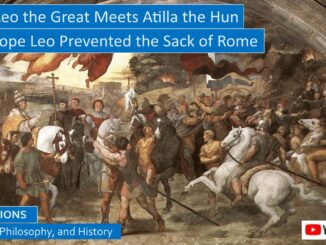
Pope Leo the Great, Confronting Attila the Hun, and His Role in the Fourth Ecumenical Council of Chalcedon

As Pope Benedict XVI writes: “The times in which Pope Leo lived were very difficult: constant barbarian invasions, the gradual weakening of imperial authority in the West, and the long, drawn-out social crisis forced the Bishop of Rome” “to play an important role in both civil and political events.”
“In a period of profound crisis, Leo the Great knew how to make himself close to the people and the faithful with his pastoral action and his preaching. He enlivened charity in a Rome tried by famines, an influx of refugees, injustice, and poverty. He opposed pagan superstitions and actions of Manichaean groups. He associated the liturgy with the daily life of Christians.” […]

Seneca on Aging Death and Suicide
Aging

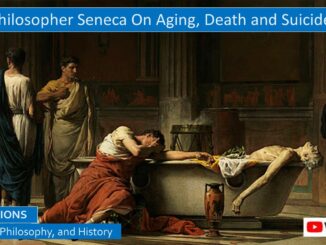
Roman Stoic Philosopher Seneca on Aging, Death, and Suicide

Seneca reminds us: “There is indeed a limit fixed to us,” “but none of us knows how near he is to this limit. Therefore, let us so order our minds as if we had come to the very end. Let us postpone nothing. Let us balance life’s account every day.” “Let us begin at once to live and count each separate day as a separate life.” What is important is “not how long you live, but how nobly you live. And often living nobly means that you cannot live long.” […]

Did Rome Fall, or Evolve to Barbarian Kingdoms? Sack of Rome, and Attila the Hun’s Invasions
Greek and Roman History

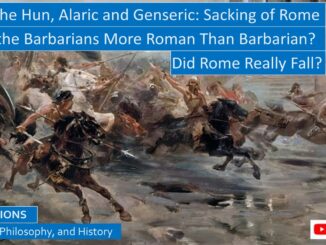
Did Rome Fall, or Evolve Into the Barbarian Kingdoms? Sacks of Rome, and Attila the Hun’s Invasions

Peter Brown contends: “The Roman Empire was not violently breached by barbarian “invasions.” Rather, between AD 200 and 400, the frontier itself changed. From being a defensive region, which kept Romans and barbarians apart, it had become, instead, an extensive middle ground, in which roman and barbarian societies were drawn together. And after AD 400, it was the barbarians and no longer the Romans who became the dominant partners in the middle ground.” Indeed, after AD 400 barbarian tribes served in the army of the Huns, and barbarians from most of the tribes, including the Huns, served in the Roman armies. […]

Classical Christian Psychologist Paul Tournier on Old Age, Death, and Faith
Aging

Classical Christian Psychologist Paul Tournier on Old Age, Death, and Faith

Tournier reminds us that we may experience many successes, but as we grow older, “success retreats, and escapes us, it is limited, unfulfilled.” “When one comes to the end, a man’s life is nothing much.” “Professional life is over, and it finishes unfinished. This is a prefiguration of death, in which the whole of life will finish it, too, being unfinished. That is the dramatic contradiction of death.” Quoting Robert Mehl: “An end, but not a fulfilment, that is the face of death.” […]

St Augustine’s On Christian Teaching and JD Vance, Order of Love
Politics

St Augustine’s On Christian Teaching and JD Vance, Order of Love

St Augustine clearly teaches us: “All people should be loved equally. But you cannot do good to all people equally, so you should take particular thought for those who, as if by lot, happen to be particularly close to you in terms of place, time, or any other circumstances.”
St Augustine explains further: “Suppose you have plenty of something which had to be given to someone in need but could not be given to two people, and you met two people,” you could flip a coin for who would receive it. But if one of them was a relative, Jesus would not object if you benefited him. In other words, if your children are starving, you need not share what little food you have with strangers.
Should we love everyone, even our enemies? Definitely, Christians are exhorted to love their enemies. As St Augustine teaches us: “We do not fear our enemies, for they do not take away from us what we love, but we pity them, for they hate us all the more because they are separated from the one we love,” since they are separated from God. […]

St John Chrysostom, Voltaire, and Leibniz Ask: Why Would a Loving God Permit Earthquakes?
Early Church Writing

St John Chrysostom, Voltaire, and Leibniz Ask: Why Would a Loving God Permit Earthquakes?

Theodicy is the term that Gottfried Leibniz coined in 1710 to describe this so-called problem of how an Almighty God permits suffering in the world.[1] The famed textual critic Bart Ehrman describes how he lost his faith over his concern about Theodicy in his book, On God’s Problem: Why We Suffer. As he points out, different books of the Bible answer this question differently. Many of the prophets, like St John Chrysostom, proclaim that natural disasters are often punishment meted out because we do not take care of the widows, orphans, and the poor.
On the other hand, in the Book of Job God does not give a reason for Job’s suffering, instead asking if Job can fathom the purposes of any of God’s inscrutable actions. why God permits the actions of God.  Although I often do not agree with Bart Ehrman’s conclusions, I rarely disagree with the evidence he cites in his works. Another recent best seller is by Rabbi Harold Kushner: When Bad Things Happen to Good People. We plan to reflect on both these works sometime in 2025. […]

Parable of Lazarus and the Rich Man: Church Fathers, Reformers, and Commentators
Bible Stories and Parables

Parable of Lazarus and the Rich Man: Church Fathers, Reformers, and Commentators

James Boice teaches us: “It is true that the rich man’s riches worked to his hurt, for he lived for those and nothing else. It is hard for the rich to enter heaven, as Jesus said elsewhere in Luke. It is also true that Lazarus’ poverty worked to his spiritual good, for lacking earthly joys and comfort he turned his eyes to heaven and sought divine consolation.”
James Boice remarks on the contrasts in the parable. Spiritually, “the rich man was actually poor, and the poor man was actually rich. This contrast continues after their death: the poor rich man grew poorer, and the rich poor man grew richer.” “The final contrast is between the hopelessness of the rich man’s condition after death and the hopefulness of his condition before. After death there is no possibility of change, but in this life there is.” […]

St John Chrysostom On Reading Scriptures, Preaching, and Chariot Races
Eastern Church Fathers

St John Chrysostom On Reading Scriptures, Preaching, and Chariot Races

“What are you saying, man? That attending to the Scriptures is not for you, since you are surrounded by a multitude of cares? Rather it is for you more than them. Monks do not need the help of the divine Scriptures as much as those who are involved in many occupations. The monks, who are released from the clamor of the marketplace and have fixed their huts in the wilderness, who own nothing in common with anyone, but practice wisdom in the calm of that quiet life, as if resting in a harbor, enjoy great security; but we, as if tossing in the midst of the sea, driven by a multitude of sins the continuous aid of the Scriptures.” […]

St John Climacus on Love, Lust, and Marriage: Ladder of Divine Ascent, Step 15, on Purity & Chastity
Ladder of Divine Ascent

St John Climacus on Love, Lust, and Marriage: Ladder of Divine Ascent, Step 15, on Purity and Chastity

Laymen often wonder: How can those who are married be chaste? In his commentary on the Ladder of Divine Ascent, Father Vassilios Papavassiliou teaches us that “people tend to think of chastity in purely sexual terms as the virtue opposed to sexual depravity.” But just as the word concupiscence has a deeper meaning for Catholics, chastity has a deeper meaning for Orthodox Christians. “In the Orthodox marriage service, we pray that the newlyweds may live in chastity. But yet in the same service, we pray numerous times that they may have honorable children. How can a couple live in” “sexual purity, and yet have children?”
The simple answer is that chastity and sexual purity are not exactly the same. He points out that “a fuller, more accurate translation of the Greek term sphrosini is whole-mindedness, or harmony between the flesh and the spirit.” Father Vassilios teaches us that in the Church “the intimate union between husband and wife is a living symbol of the union between Christ, the Bridegroom, and the Church, His Bride,” which is why intimacy should be experienced by a man and his wife. […]

Book of Ruth: Historical-Critical Commentaries. Was Ruth an Old Testament Illegal Alien?
Bible Stories and Parables

Book of Ruth: Historical-Critical, Patristic, and Rabbinical Commentaries. Was Ruth an Old Testament Illegal Alien?

Was Ruth an Old Testament version of an illegal alien? Marriages between Jews and Moabites were definitely illegal under Jewish law, and Ruth was seen as a sojourner, which is the Biblical term for immigrant, or alien. Ancient Jews were just as suspicious of Moabites just as many Americans are suspicious of Mexicans. Ruth emigrates to Judah because of economic hardship, just as hardship drives many Mexicans to seek to enter the United States.
Is the term illegal alien a misnomer? Are illegal aliens criminals because they are doing illegal things? We can all agree that someone who robs a bank or steals a car or shoots or beats his neighbor is a criminal, but is someone who is fleeing gangs who threaten their lives a criminal? Is someone who flees grinding poverty to take his chances swimming the Rio Grande truly a criminal? […]