
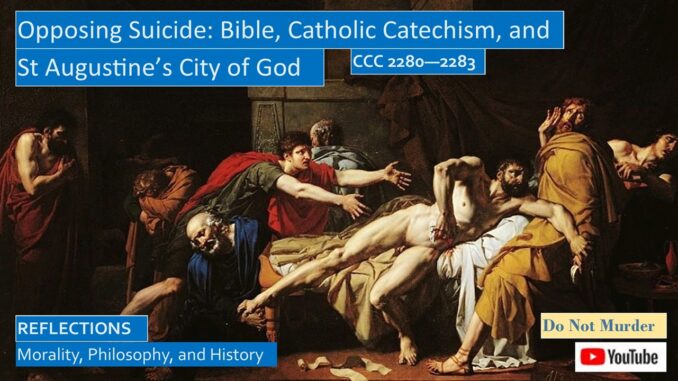
What should clergy say to those who are contemplating suicide? What should clergy say to the family whose loved one has committed suicide?
What can we learn from the stories involving suicide in the Bible, including Samson’s suicide, King Saul’s suicide, and Judas’ suicide?
What was St Augustine’s critique of the accounts of the suicides of Cato the Younger and Lucretia?
YouTube video for this blog: https://youtu.be/G0e0uVCDIwg
CHURCH TEACHING ON SUICIDE
My priest and I once discussed how the Book of Judges celebrated how the blind Samson committed suicide by toppling the main column of the Philistine temple where he was being tormented during a pagan festival. Judges approvingly declares that Samson killed many more thousands of Philistines in his death than he did when he was alive.
My priest, who was also a VA Chaplain, was horrified. He said that whenever anybody ever mentions suicide to him, he adamantly proclaims that anyone who commits suicide does not pass GO, does not collect $200, that he instead GOES STRAIGHT TO HELL, with no possibility of salvation. He said that suicide is so incredibly devastating to the loved ones left behind that he needs to discourage even the thought of suicide in no uncertain terms.
I second his opinion. The teenage son of my acquaintance at work committed suicide, and I have never seen anyone suffer so much wailing emotional anguish. Suicide is incredibly devastating to those left behind. Suicide stains all their good memories of their lifetime, condemning the living to a sort of hell of second-guessing of what they could have done.
But then I asked my priest: What do you tell the family who are left behind? Do you tell them that salvation is beyond reach for those who commit suicide?
My priest said he would never torment the survivors of suicide with such a horrible thought. God is always merciful and is forgiving towards anyone who takes their life because of mental and spiritual torments that are often beyond their control. What good could come from telling those who mourn the death of their loved one anything else? Why torture them with anguish? Why not comfort them instead?
CATHOLIC CATECHISM ON SUICIDE
The Catholic Catechism confirms this approach. Even if you are not Catholic, this provides welcome guidance to all Christians. In times past, many clergy refused to provide a Christian burial for those who committed suicide, but that has changed in the past few decades as our society has become more sensitive towards mental health concerns.
First, the Catechism seeks to discourage suicide:
CCC 2280. “Everyone is responsible for his life before God who has given it to him. It is God who remains the sovereign Master of life. We are obliged to accept life gratefully and preserve it for his honor and the salvation of our souls. We are stewards, not owners, of the life God has entrusted to us. It is not ours to dispose of.”
We do not live our lives for ourselves: this is a central tenet of Christianity. Suicide is the one sin for which you cannot repent before you die.
CCC 2281. “Suicide contradicts the natural inclination of the human being to preserve and perpetuate his life. It is gravely contrary to the just love of self. It likewise offends love of neighbor because it unjustly breaks the ties of solidarity with family, nation, and other human societies to which we continue to have obligations. Suicide is contrary to love for the living God.”
Our life is not our own; it is a gift from God. Unlike other gifts, we do not quite own it, since we are bound to live our lives for others, in love for our neighbors.
Suicide ignores the love and feelings of our loved ones who are left behind. Suicide deprecates the love for our neighbor, and our close family, which is the core of Christian belief.
CCC 2282. “If suicide is committed with the intention of setting an example, especially to the young, it also takes on the gravity of scandal. Voluntary co-operation in suicide is contrary to the moral law.”
“Grave psychological disturbances, anguish, or grave fear of hardship, suffering, or torture can diminish the responsibility of the one committing suicide.”
Finally, the Catechism reassures those loved ones left behind that salvation is possible even for those who commit suicide.
CCC 2283. “We should not despair of the eternal salvation of persons who have taken their own lives. By ways known to him alone, God can provide the opportunity for salutary repentance. The Church prays for persons who have taken their own lives.”[1]
The suicide paragraphs in the Catholic Catechism have no footnotes, which suggests this is pastoral advice from experience dealing with suicide. Perhaps one reason is that Cardinal Ratzinger, the future Pope Benedict, who oversaw the drafting of the Catechism, did not want to muddy the waters by discussing Biblical references and theology that always includes subtleties, no matter what the topic.
This is how the Orthodox St Theophan the Recluse threads this needle: “The Church does not command us to pray for suicides. How then dare its sons and daughters to pray for them? What is evident here is an attempt to show that we are more merciful than the Church, than God Himself. It is better to limit ourselves to feeling pity for them, entrusting them to the immortal compassion of God, and praying for them in our private prayers, that He deal with them according to His loving-kindness and according to your faith in that loving-kindness.”[2]
BIBLICAL REFERENCES ON SUICIDE
Why does the Book of Judges celebrate the suicide of Samson? To properly interpret any of the stories in the Book of Judges, you must first focus on the twice-stated theme of the entire book: “In those days there was no king in Israel; every man did what was right in his own eyes.”[3]
Many of the characters in the Book of Judges do not follow God’s law: they either follow their own law, or their own personal version of God’s law, doing what they see as right in their own eyes. Samson was a judge of Israel chosen by God, and as an instrument of God, he helped defend the Jewish nation from their enemies, the Philistines. But Samson did not come to a good end, and he would have come to a better end had he been faithful to God. Who knows? Maybe Samson is damned to perch on the edge of the chasm of Lazarus in the world to come, yearning for the naked, enticing trollops who dance and torment him on the other side.
Most of the Old Testament references to suicide are related to war, armed conflict, or palace coups, which help explain their ambivalence. For example, the Church Fathers who comment on Samson’s death rarely explore whether suicide is ever justified but rather tend to see him as a Christ-like figure who gives his life for the faith.
Another example is Saul’s suicide. Before his last battle, King Saul, feeling abandoned by God, requests the witch of Endor call the spirit of the prophet Samuel from the grave to offer him advice. Samuel, upset that he was awoken, tells Saul that he and his sons will die in battle with the Philistines the next day. Nobly, he rides into battle to face his fate. When the Philistine soldiers approach him, he asks his bodyguard to slay him. When he refuses, Saul falls on his own sword.
The New Testament has one notable reference to suicide. In Matthew 26, after Judas repents of betraying Jesus for thirty pieces of silver, he throws them at the feet of the Jewish Chief Priests when they refuse to take them back. Judas then hangs himself.
St John Chrysostom comments that when “Judas hung himself, this was unpardonable and a work of an evil spirit. For the devil led him out of his repentance too soon, so that he should reap no fruit from it, and carried him off by a most disgraceful death,” “having persuaded him to destroy himself.”[4]
Some students of the Bible are disturbed that Judas does not kill himself in the opening chapters of Acts. Instead, he falls headlong, his bowels burst, and he perishes in the Field of Blood he purchased with the thirty pieces of silver. This inconsistency did not trouble ancient Christians, as it was common in an oral society to have differing accounts of events in the life and death of historical figures. For example, Herodotus in his Histories of ancient Greece often recorded competing versions of events, informing us which version he preferred. Herodotus records that King Cyrus the Great died ignominiously in battle, while Xenophon’s King Cyrus died in his old age.
Histories of Herodotus, The Greeks Defeat the Mighty Persians in the Greco-Persian Wars
http://www.seekingvirtueandwisdom.com/histories-of-herodotus-the-greco-persian-wars/
https://youtu.be/JjNcyLo54ko
The Greeks Triumph in the Battle of Salamis, Aeschylus and Herodotus: The Greco-Persian Wars
http://www.seekingvirtueandwisdom.com/aeschylus-and-herodotus-the-battle-of-salamis-greco-persian-wars/
https://youtu.be/cabAkQwHnlk
Xenophon’s Cyropaedia, Biography of Cyrus the Great, King of Persia
https://seekingvirtueandwisdom.com/xenophons-cyropaedia-biography-of-cyrus-the-great-king-of-persia/
https://youtu.be/E4BFSIpHHGk
Xenophon’s Cyropaedia, Moral Sayings of Cyrus the Great, King of Persia
https://seekingvirtueandwisdom.com/xenophons-cyropaedia-moral-sayings-of-cyrus-the-great-king-of-persia/
https://youtu.be/Y3ULbvPEmik
STOIC PHILOSOPHERS S ON SUICIDE, SUICIDE AMONG THE ELDERLY
Several Roman Stoic philosophers, including Seneca but not Epictetus, admired how Cato the Younger chose suicide over living under the tyrannical reign of Caesar. Cato held many offices, including tribune, under the corrupt Roman Republic, opposing Julius Caesar’s efforts to become supreme dictator. During the Civil War, he supported Pompey in opposing Caesar. After Pompey’s death, Caesar offered to pardon Cato.[5]
Many of the Stoic philosophers discussed aging and suicide, although their attitudes reflected their life circumstances. Seneca, since he lived the last few years of his life waiting for Nero’s soldiers to arrive at his villa demanding his suicide, obsessed over this topic.
On the other hand, Epictetus strongly discouraged his students from considering suicide. However, in some passages he seems to tolerate suicide. We can only speculate on his reasons; he may be tolerating the injured or sick who seek to prematurely end their lives of physical pain, pain that we in the modern world can often control with medications and drugs.
Roman Stoic Philosopher Seneca on Old Age and Retirement
https://seekingvirtueandwisdom.com/roman-stoic-philosopher-seneca-on-old-age-retirement/
https://youtu.be/hmJoI9-s1q8
Roman Stoic Philosopher Seneca on Aging, Death, and Suicide
https://seekingvirtueandwisdom.com/roman-stoic-philosopher-seneca-on-aging-death-and-suicide/
https://youtu.be/c9JXjqRKgBE
Roman Stoic Philosopher and Politician Cicero on Aging and Death
https://seekingvirtueandwisdom.com/roman-stoic-philosophers-cicero-on-aging-and-death/
https://youtu.be/ne9T2N2mvZY
Epictetus, Eminent Stoic Philosopher, on Living Well, Dying Well, and Opposing Suicide
https://seekingvirtueandwisdom.com/epictetus-eminent-stoic-philosopher-on-living-well-dying-well-and-opposing-suicide/
https://youtu.be/MDRCc8Gu4y8
Although we can only guess how prevalent suicide was in the ancient world, in the modern world, we have far better statistics. Although the greatest number of suicides today is in the fifteen to twenty-nine-year-old age group, the demographic that has the greatest percentage of suicides is the elderly seventy years of age and older, over a quarter of these elderly commit suicide.
In addition, the United States leads the world in number and percentage of gun suicides. Although the United States has only four percent of the world’s population, it has forty-four percent of the global gun suicides in 2019.[6]
ST AUGUSTINE DISCOURAGES SUICIDE IN THE CITY OF GOD
In his City of God, St Augustine discourages Christians from seeing Cato’s suicide as a noble example to follow, as Christians should never consider suicide.
St. Augustine had another interesting teaching late in his life. During the barbarian Vandal invasions, there was a lot of pillaging, murder, and rape, and often the inhabitants of the cities were helpless. In the Roman Empire, it was common for raped women to commit suicide out of shame. He wanted to comfort these women; there is no need to feel shame when you are raped, particularly during a barbarian raid, and even in these circumstances, suicide is not an option, for the woman is still innocent and pure in her heart.
St. Augustine offers this comforting teaching, “Let us fear that the sheep of Christ, when they die, will be slain in the heart by the sword of spiritual wickedness rather than in the body by a sword of iron. Let us rather fear that the inner sense may be corrupted and the purity of faith perish than that women be forcibly defiled in body. For chastity is not destroyed in the body when the will of the sufferer does not shamefully take part in the deeds of the flesh, but without consenting endures another’s violence.”[7]
In the opening chapters of his City of God, St Augustine comforts his fellow Romans: “If our enemies violate our wives and daughters, we should take heart, for without their consent our enemies cannot violate their chastity.”[8]
St Augustine consoles the “women of holy and devout chastity who have felt the pangs of shame at their treatment by the enemy, although they have not lost their resolute purity. I have urged them not to be ashamed of being alive, since they have no possible reason for being ashamed of having sinned.”[9]
St Augustine corrected the ancient Roman beliefs and attitudes when they conflicted with Christian teachings. The Roman belief that it was noble for a Roman woman to commit suicide after her honor was robbed by rape was inspired by the story of the Roman noblewoman Lucretia early in the history of the Republic.[10]
St Augustine recounts: “When King Tarrapin’s son had lustfully gained possession of Lucretia’s body and had ravished her with violence, she revealed the villain’s crime to her husband Collatinus and her kinsman Brutus and encouraged them to take revenge. Then she destroyed herself, unable to endure the horror of the foul indignity.”[11]
King Tarrapin was the last king of Rome; the reactions of his citizens led to his overthrow. Each ancient Roman historian has a different version of this myth.
St Augustine continues: “Lucretia killed herself because, although not adulterous, she had suffered an adulterer’s embraces. Her suicide was due to the weakness of shame, not to the high value she set on chastity.”
“Such is not how Christian women behave. When treated like this, they would not take vengeance on themselves for another’s crime. They would not add crime to crime by committing murder on themselves because the enemy had committed rape on them in lust.”[12]
Likewise, St Augustine did not believe that the celebrated suicide of Cato should serve as an example for Christians. St Augustine notes: “Cato’s friends, who were educated men, wisely endeavored to dissuade him and considered suicide to be a mark of weakness rather than strength of mind, evidence of not so much a sense of honor seeking to avoid disgrace as of weakness unable to overcome adversity.”
“In fact, Cato” “advised his beloved son to ‘place all his hopes in Caesar’s kindness.’ Why did he counsel such a shameful course, if it was ‘shameful to live under the shadow of Caesar’s victory?’ Why did he not compel his son to die with him?”
St Augustine continues: “It follows that Cato judged it not at all shameful to live under the victorious Caesar; otherwise, he would have released his son from this shame with a father’s sword. The truth was that he loved his son, for whom he hoped and wished for Caesar’s pardon, as much as he grudged the praise that Caesar would win by sparing his own life.” “Cato would have been embarrassed at receiving Caesar’s pardon.”[13]
In conclusion, St Augustine teaches us: “We should pray to God for strength to survive whatever suffering life throws our way, for a Christian suicide is never an option, for the sun always follows the night.”[14] In other words, no matter how bad life is, it ain’t all that bad.
DISCUSSING THE SOURCES
We are planning a future series of reflections on St Augustine’s City of God, but first, we want to reflect on Plato’s Republic. We enjoy reading all of St Augustine’s writings, and this is a classic work. Wikipedia has a useful summary to help determine what sections you can skip, such as his review of the history of Rome by Varro in Book VI.[15]
We also have a reflection on the Catholic and Lutheran Catechisms.
The Decalogue, Vatican II, and the Catholic and Lutheran Catechisms
http://www.seekingvirtueandwisdom.com/who-should-study-the-catholic-catechism/
https://youtu.be/i8WXS7l4OzE
During our research, we found another enlightening and profitable blog on Suicide and the Scriptures.
https://adventistreview.org/magazine-article/self-killing-in-scripture/
[1] https://www.vatican.va/archive/ENG0015/__P7Z.HTM
[2] https://preachersinstitute.com/2019/03/12/suicide-why-the-church-does-what-it-does/
[3] https://www.biblegateway.com/passage/?search=judges%2017%3A6&version=NRSVCE and https://www.biblegateway.com/passage/?search=judges%2021%3A25&version=NRSVCE
[4] Ancient Christian Commentary on Scripture, New Testament, Volume 1b, Matthew 14-28 (Downers Grove, Illinois: Intervarsity Press, 2002), quoting St John Chrysostom, Gospel of Matthew, Homily 85.2, p. 272.
[5] https://en.wikipedia.org/wiki/Cato_the_Younger
[6] https://en.wikipedia.org/wiki/Suicide
[7] Possidius, Bishop of Calama, The Life of St Augustine, translated by Herbert Weiskotten, Christian Roman Empire Series Volume 6 (Evolution Publishing, New Jersey, 2008, first published 1919), Book XXX, 49-50
[8] St Augustine, City of God, translated by Henry Bettenson (New York: Penguin Classics, 2003, 1972, originally early 400s), Book 1, Chapter 12, p. 21.
[9] St Augustine, City of God, Book 1, Chapter 16, p. 26.
[10] https://en.wikipedia.org/wiki/Lucretia
[11] St Augustine, City of God, Book 1, Chapter 19, p. 29.
[12] St Augustine, City of God, Book 1, Chapter 19, pp. 29-30.
[13] St Augustine, City of God, Book 1, Chapter 23, p. 34.
[14] St Augustine, City of God, Book 2, Chapter 2, p. 49.


1 Trackback / Pingback