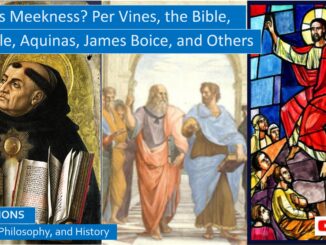
What Is Meekness? Per Vines, the Bible, Aristotle, Aquinas, James Boice, and Others Reflect
Biblical Interpretation

What Is Meekness? Vines, the Bible, Aristotle, Aquinas, James Boice, and Others Reflect

Vine quotes from the Synonyms of the New Testament by the nineteenth-century Anglican Archbishop Richard Chenevix Trench.[7] “The meekness manifested by the Lord and commended to the believer is the fruit of power. The common assumption is that a man is meek when he cannot help himself; but the Lord was meek because he had the infinite resources of God at His command. Meekness is the opposite of self-assertiveness and self-interest. Meekness is equanimity of spirit that is neither elated nor cast down, simply because it is not occupied with self at all.” Vine continues: Meekness is not manifest in a person’s “outward behavior only.” “Rather, it is a grace of the soul” towards God, accepting “without disputing or resisting.”[8]
Luke Timothy Johnson asks, “What is the opposite of meekness? It is the teaching of this world’s kingdom that the earth belongs to those who seize it, that power is meant for domination, oppression and exploitation, that the only limits to my freedom are the limits imposed by my appetites, that arrogance and lack of care are signs of strength.” […]
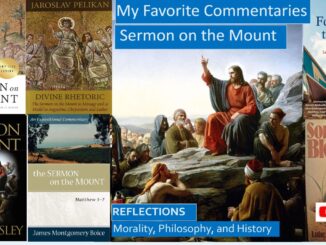
My Favorite Commentaries on the Sermon on the Mount
Biblical Interpretation

My Favorite Commentaries on the Beatitudes and the Sermon on the Mount

We will consult these commentaries when we reflect on the Beatitudes and the Sermon on the Mount. These comment on the Beatitudes in Matthew; while the version in Luke differs, it is known as the Sermon on the Plain. The Beatitudes differ. While in Matthew the first Beatitude is Blessed are the Poor in Spirit; in Luke the first Beatitude is Blessed are the Poor. Also, Luke’s Beatitudes have contrasting woes, such as Woe to You Who are Rich.
The Presbyterian James Boice is my favorite modern commentator, next to CS Lewis. James Boice writes commentaries that are both devotional and scholarly. For example, he points out that Aristotle defined meekness as the mean between apathy and anger. […]

Opposing Suicide: According to the Bible, Catholic Catechism, and St Augustine’s City of God
Command 6 Do Not Murder

Opposing Suicide: Biblical Exhortations, Catholic Catechism, and St Augustine’s City of God

CCC 2281. “Suicide contradicts the natural inclination of the human being to preserve and perpetuate his life. It is gravely contrary to the just love of self. It likewise offends love of neighbor because it unjustly breaks the ties of solidarity with family, nation, and other human societies to which we continue to have obligations. Suicide is contrary to love for the living God.” […]

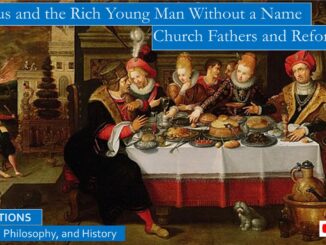
Parable of Lazarus and the Rich Man: Church Fathers, Reformers, and Commentators
Bible Stories and Parables

Parable of Lazarus and the Rich Man: Church Fathers, Reformers, and Commentators

James Boice teaches us: “It is true that the rich man’s riches worked to his hurt, for he lived for those and nothing else. It is hard for the rich to enter heaven, as Jesus said elsewhere in Luke. It is also true that Lazarus’ poverty worked to his spiritual good, for lacking earthly joys and comfort he turned his eyes to heaven and sought divine consolation.”
James Boice remarks on the contrasts in the parable. Spiritually, “the rich man was actually poor, and the poor man was actually rich. This contrast continues after their death: the poor rich man grew poorer, and the rich poor man grew richer.” “The final contrast is between the hopelessness of the rich man’s condition after death and the hopefulness of his condition before. After death there is no possibility of change, but in this life there is.” […]

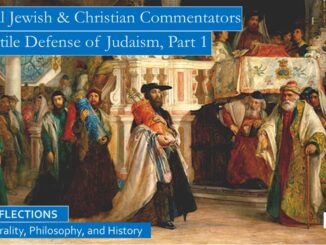
Medieval Jewish and Christian Commentators, My Gentile Defense of Judaism, Part 1
Judaism

Medieval Jewish and Christian Commentators, My Gentile Defense of Judaism, Part 1

At roughly the time of Jesus, an inquirer requested of both Rabbi Shammai and Rabbi Hillel, “Convert me to Judaism on condition that you will teach me the entire Torah while I stand on one foot.” Shammai pushed the man away with the building rod he was holding. Undeterred, the man then came before Hillel with the same request. Hillel responded, “That which is hateful unto you, do not do unto your neighbor. This is the whole Torah; all the rest is commentary. Now, go and study.” […]