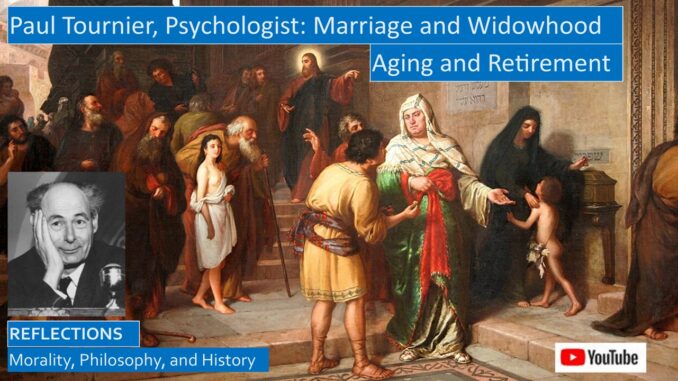
How do retirement and aging affect those who are married?
How can those who live alone, who are widows, widowers, or divorced, face retirement and the challenges of aging?
How can you find purpose in your life when alone in retirement, when your years are growing longer, like long shadows late in the afternoon?
YouTube video for this blog: https://youtu.be/5zqGYiX4LKg
PAUL TOURNIER ON MARRIAGE AND WIDOWHOOD IN RETIREMENT
The classical psychologist Paul Tournier was also a serious Christian; our prior reflection is on his first five chapters of Learn To Grow Old. He believed that the physician not only had to treat the patient’s physical ailments, but also improve his psychological and spiritual well-being. Born in 1898, he was among the first generation of psychologists, and he quotes from Freud, Jung, Viktor Frankl, and many other contemporary psychologists. Our first reflection included his observations and advice for all who retire and who want to find purpose in their life during retirement.
He also offered beneficial advice and observations to married couples, widows, and widowers on how they can better face retirement and old age, which we saved for this shorter reflection.
Classical Christian Psychologist Paul Tournier on Old Age and Retirement
https://seekingvirtueandwisdom.com/classical-psychologist-paul-tournier-on-old-age/
https://youtu.be/HE3LNGB0nUA
How do retirement and aging affect married couples? Paul Tournier observes: “As one grows old, one generally experiences the need for a more restricted but deeper intimacy. This need is fulfilled in the case of a couple who are happy together, in the incomparable blessing of growing old together.”
“The blessing of being able to grow old together is the fruit of a whole married life in which one has been given the courage to face, in a dialogue of truth, a host of problems of mutual adaptation which are never easy.” “No married couple can grow without overcoming conflicts. Through difficult periods and through great mutual frankness, husband and wife can each come gradually to accept the other as he or she is.”
Paul Tournier continues: “Nevertheless, this growth together is not always possible. It can happen that one or another, to safeguard the peace and apparent unity of the couple, has to capitulate to the tyranny of the other, to avoid subjects that give rise to conflict, and hide a portion of his life. And so a trench is gradually dug between them. They became strangers. Married though they are, they regress to becoming a bachelor and a spinster.”
Sad are those couples who live alone while married, who share their home but not their souls. This is somewhat tolerable when they are busy working and caring for their children, but it becomes intolerable when they retire. [1]
Paul Tournier notes: “Freud defined psychological health under the double heading of aptitude for love and for work. To resolve the problem of human loneliness, something more is required than this working of the instincts whose power and subtlety Freud has so clearly demonstrated. The superficial relationships of working life and of sexual attraction must” transition to “a deeper personal commitment. And I believe no commitment can be truly personal unless it takes on a transcendent dimension and becomes love, in the biblical meaning of the word.”
Paul Tournier elaborates: “How rarely this happens is shown by the great loneliness of the old, even among those who have been churchgoers. It reveals that it is possible to spend one’s whole life meeting a multitude of people, living for years side by side with people at work or in one’s family, acting out a professional or social role with them, without having much that is durable to show for it. Add to the enforced separation from workmates the death of the marriage partner or the last close friend, and loneliness becomes catastrophic.”[2]
How do wives whose lives revolve around their husbands cope with retirement, when their children have children and lives of their own? Paul Tournier remembers a former patient: “His wife speaks engagingly of him, of his good qualities and his failings, of his tireless activity outside and his untidiness at home. ‘When he is here,’ she says, ‘he monopolizes my attention. He always needs something. He is such a baby.’”
Paul Tournier continues: “Yes! Helping a famous husband, serving him, making good what he lacks, supplying his needs and coddling him like a baby: that is what gives meaning to a woman’s life, and even more when the husband is exacting and when, by her eagerness to serve him, the wife cultivates his independence.”
“She is happy. She continues: ‘He makes us really live. If he went out of my life, everything would collapse.’”
Paul Tourner reflects: “I have seen many such collapses. Widowhood is a kind of retirement, the retirement of the woman from her job as a wife. Many a wife willingly sacrifices her personal life to a husband’s whims. He does not like music, so she gives it up; he does not like her friends, so she drops them. And all at once, on her husband’s death, the widow finds herself in a desert. Her life has lost its meaning. She no longer has any power to react, because she has long since stopped her own development.”
“Widowhood is always a terrible trial. In addition to the emotional shock of separations, there is always considerable disturbance in the social and personal life of the widow.”
Paul Tournier observes that this estrangement can worsen over time. “Good friends whom they used to visit together show her a lot of sympathy, especially in the early years, but they no longer invite her to their houses as they used to and no longer come to see her. A whole stream of life has dried up.” “Her widowhood is indeed a painful retirement for her.”
Paul Tournier continues: “She often tries to satisfy her maternal instinct by continuing to mother her now adult children, especially in the case of an only son.[3] And whether they are widows or not, it is beneficial for everyone for grandmothers to become involved in the lives, and perhaps the care, of her grandchildren.
Behavior that was merely irritating when her husband was working can become intolerable when he retires and they spend more time together.
Paul Tournier remembers: “There is the husband who lives with his wife almost as if she did not exist, except in their brief moments of intimacy. She does not even know whether he is listening when she speaks, and when she insists, he shrugs his shoulders as if she were incapable of saying anything sensible”[4]
What happens when your partner leaves to sing with Elvis? Paul Tournier remembers what patients have told him in the past: “Sometimes husband and wife say to one another: ‘I’ll be the first to go.’ In saying this,” they reveal “their fear of being left alone. The survivor usually prefers independence to going into an old folks’ home, but no one wants to die alone. Those amorous adventures which some embark upon rather late in life are not just midsummer madness, but have as their true motivation a desire to ensure against loneliness, rather than sexual satisfaction.”[5]
Paul Tournier remembers: “I have a very dear friend who is a university professor. One day, he was told that the illness that had struck down his wife was incurable. He left the university, resigned from all his other duties, professional and otherwise, to devote himself entirely to his wife. Not only to tend her and to take over the housework, but to be with her, to live to the full their life together, in fellowship and dialogue, during that last year of their marriage. That was his career that year.” This caretaking career was sandwiched between the two parts of his professional career as a professor. It was both a temporary retirement and a spiritual retreat.[6]
Marriage is important to the retired person. Paul Tournier notes: “Often a retired man who loses his wife soon follows her to the grave. The state of mind, the social standing, the poverty of a life of monotonous routine, the lack of a real goal in life: all these play a decisive role in the crisis of retirement.”
“These views are in accord with those of Professor Viktor Frankl, who denounces the existential void of modern man, and sees in it the cause of many neuroses. He also talks of an unemployment neurosis. He speaks also of the Sunday neurosis, the depression which assails those who realize the emptiness of their lives when, on Sunday, the week’s activities are interrupted and the existential void is revealed to them. Likewise, he views the crisis of retirement as a permanent unemployment neurosis.” “Among men, the one to die” early in retirement “will be the one whose life contains nothing but his job.”
Paul Tournier proclaims: “To man alone is given as a task to be fulfilled. The animal, strictly controlled by its instinct, necessarily fulfils its destiny. Man, enjoying a measure of liberty and the power of thought, conditioned by his upbringing and by the ideals suggested by society, can make a success of his life; or spoil it.”[7]
What Paul Tournier does not explore is how those who divorce late in life face aging and retirement. In some respects, this is more painful than widowhood, especially when they leave you for someone else. The only antidote for loneliness is to become involved in the life of your neighbor, to become more active in church, civic clubs, and other activities.
No matter your past, your life has purpose if you can be kind to someone tomorrow. We explore how you can find purpose in your life: Jimmy Carter has several suggestions on how you can serve the community in your retirement. The evangelical George Sweeting discusses the Joys of Successful Aging. The Stoic Philosophers Cicero and Seneca also discuss aging.
Jimmy Carter on the Virtues of Aging and Retirement
https://seekingvirtueandwisdom.com/jimmy-carter-on-the-virtues-of-aging-and-retirement/
https://youtu.be/JozGKCnUyaI
Joys of Successful Aging, by Evangelical George Sweeting, Moody Bible Institute
https://seekingvirtueandwisdom.com/joys-of-successful-aging-by-evangelical-george-sweeting-moody-bible-institute/
https://youtu.be/ngh_uIZ6r2o
Roman Stoic Philosopher Seneca on Old Age and Retirement
https://seekingvirtueandwisdom.com/roman-stoic-philosopher-seneca-on-old-age-retirement/
https://youtu.be/hmJoI9-s1q8
Roman Stoic Philosopher and Politician Cicero on Aging and Death
https://seekingvirtueandwisdom.com/roman-stoic-philosophers-cicero-on-aging-and-death/
https://youtu.be/ne9T2N2mvZY
What is the ideal, according to Paul Tournier? “Growing old together, husband and wife can come to know a love which is, in a way, a prefiguration of heaven, for it is less tumultuous than the love of youth, being less directed towards selfish pleasure-seeking, and because a slow advance in mutual comprehension permits more authentic communication.”[8]
The final two chapters in Paul Tournier’s book, Learn to Grow Old, discusses how the elderly can accept their fate and make the best of their final days, and the role that faith plays in accepting retirement and old age, and in facing death.
Classical Christian Psychologist Paul Tournier on Old Age, Death, and Faith
https://seekingvirtueandwisdom.com/classical-christian-psychologist-paul-tournier-on-old-age-death-and-faith/
https://youtu.be/gRaY2hTaEGk
The Stoic philosophers, when they discuss aging, also discuss suicide. Many scholars state the Stoics condoned suicide, but it is not that simple. Most of the examples of suicide in both the Stoic writings and the Christian Old Testament were connected to civil war or palace intrigue. For example, Seneca anticipated for several years that the evil Roman Emperor Nero would command his troops to visit his villa to compel him to commit suicide.
St Augustine argued that suicide is never justified for Christians. During the latter part of this life, the Roman Empire was overrun by barbarian invasions, who often raped many Roman noblewomen. He discouraged them from committing suicide out of shame, that their inner chastity could not be taken from them without their consent.
Plato’s Socrates discussed aging in the first book of his dialogue in the Republic.
Epictetus, Eminent Stoic Philosopher, on Living Well, Dying Well, and Opposing Suicide
https://seekingvirtueandwisdom.com/epictetus-eminent-stoic-philosopher-on-living-well-dying-well-and-opposing-suicide/
https://youtu.be/MDRCc8Gu4y8
Roman Stoic Philosopher Seneca on Aging, Death, and Suicide
https://seekingvirtueandwisdom.com/roman-stoic-philosopher-seneca-on-aging-death-and-suicide/
https://youtu.be/c9JXjqRKgBE
Opposing Suicide: According to the Bible, Catholic Catechism, and St Augustine’s City of God
https://seekingvirtueandwisdom.com/opposing-suicide-biblical-exhortations-catholic-catechism-and-church-father-teachings/
https://youtu.be/G0e0uVCDIwg
DISCUSSING OUR SOURCE
Paul Tournier draws from both his extensive clinical experience and the writings of his contemporaries. His books are enjoyable and easy to read; there are many other interesting stories that we do not mention. We have a more detailed review of his book and his biography in our initial reflection on his book, Learn to Grow Old.
Classical Christian Psychologist Paul Tournier on Old Age and Retirement
https://seekingvirtueandwisdom.com/classical-psychologist-paul-tournier-on-old-age/
https://youtu.be/HE3LNGB0nUA
[1] Paul Tournier, Learn to Grow Old, translated by Edwin Hudson (New York: Harper and Row, 1971), pp. 92-94.
[2] Paul Tournier, Learn to Grow Old, p. 101.
[3] Paul Tournier, Learn to Grow Old, pp. 16-17.
[4] Paul Tournier, Learn to Grow Old, p. 56.
[5] Paul Tournier, Learn to Grow Old, p. 92.
[6] Paul Tournier, Learn to Grow Old, pp. 152-153.
[7] Paul Tournier, Learn to Grow Old, pp. 162-163.
[8] Paul Tournier, Learn to Grow Old, p. 94.


Be the first to comment