How did the life experience of Epictetus differ from Seneca, Cicero, and Marcus Aurelius? How did their life experiences affect their philosophy?
Is it wise to complain? How can we age gracefully? Is health good and illness bad? Should we die grieving and trembling with fear?
Why does Epictetus call exile, imprisonment, shackles, death, and disfavor indifferents?
Did all Stoic philosophers condone suicide? How did their life experiences affect their views on death and suicide? How did these Stoic beliefs differ from those of the Church Fathers?
YouTube video for this blog: https://youtu.be/HE3LNGB0nUA
LIFE AND PHILOSOPHY OF EPICTETUS
Epictetus was a former slave of a former slave, his former master, Epaphroditus, allowed him to study under the philosopher Musonius Rufus. Epictetus gained his freedom after the death of Nero in AD 68. Later, when the Emperor Domitian exiled philosophers from Rome, Epictetus moved to Epirus in Greece.[1]
Epictetus lived a simple life in poverty with few possessions. Epictetus never wrote down his philosophy, his teachings were passed down to us as class notes taken by his student Appian, who also penned the Anabasis on the conquests of Alexander the Great.[2] Epictetus credited his teacher, Musonius Rufus, for many of his teachings.
Unlike Seneca and Cicero, Epictetus’ audience was mostly young men. Since those who lived in the ancient world encountered death often, his Stoic teachings emphasize first living well, then dying the good death. Epictetus’ philosophy deeply influenced Marcus Aurelius. The Stoicism of Epictetus viewed death, pain, exile, and disfavor as indifferences that we should bear quietly.
DISCUSSING THE SOURCES
Several years ago, we were somewhat overwhelmed by the richness of Epictetus’ Discourses, the collection of his class notes, so we jotted down our favorites of his many teachings from the inexpensive Stoic Six-Pack collection. We have since become fans of Robin Waterfield’s translations, which are accompanied by his excellent footnotes, which are essential in understanding the context and background of the text. The moral aspect of the ancient Greeks is clearer in Waterfield’s translations. For example, in the Republic, the Greek word commonly translated as justice is translated as morality by Robin Waterfield.
We will record more reflections on Robin Waterfield’s description of the life and philosophy of Epictetus, many of his observations not included in this reflection, plus his reflections of true freedom, freedom from vice, and freedom under tyranny. We will also soon reflect on his Discourses in the study order suggested by Robin Waterfield in his Introduction.
Epictetus, Stoic Philosopher
http://www.seekingvirtueandwisdom.com/epictetus-discourses-blog-1/
http://www.seekingvirtueandwisdom.com/epictetus-discourses-blog-2/
https://youtu.be/Dhd543kov-E
Major Roman Stoic Philosophers, My Favorite Maxims: Epictetus, Rufus, Seneca & Marcus Aurelius
https://seekingvirtueandwisdom.com/major-roman-stoic-philosophers-my-favorite-maxims-epictetus-rufus-seneca-marcus-aurelius/
https://youtu.be/E0qQgqGkoOE
ACCEPTING WHAT LIFE BRINGS TO US, INCLUDING OLD AGE
We need to accept what life brings to us. Epictetus reasons: “Everything obeys and serves the universe: earth, sea, sun, all the other heavenly bodies, and the flora and fauna of the earth. The human body, too, is its servant, in sickness and health, and in youth and old age.” “The universe is powerful and superior to us, and it has done a better job of taking thought for us than we can.” “To act against it is not only to align oneself with the irrational, but only leads to a futile struggle, causing us pain and grief.”[3]
Is it wise to complain? Epictetus observes: “If someone dies young, he blames the gods because he is being taken before his time. If someone lingers on into extreme old age, he too blames the gods.” “Despite this, at the approach of death, he wants to stay alive; he sends for the doctors and begs them to do all that they can.” “It is quite remarkable to see how people want neither to live nor to die.”[4]
“Is health good and illness bad? No, man. What, then? Health managed well is good, but when badly managed, it is bad.”[5]
Epictetus points out: “If you look at yourself in isolation, it is natural for you to live to an old age, to be rich, to be healthy. But if you look at yourself as a human being and as part of some whole, for the sake of that whole, it may be appropriate for you to be ill, or risk your life at sea, or be poor, or die young. Why get angry then?” “What is a human being? A part of a city made up of gods and human beings,” “a small copy of the universal city.”[6]
When reviewing the various essays on aging, everyone is successful, nobody worries about money. Paul Tournier was a physician and a pioneering psychologist, Jimmy Carter was a former President, and Cicero and Seneca were part of the aristocracy. Of course, Cicero and Seneca had more pressing concerns: they were rewarded for their Stoic integrity by tyrants who demanded their lives. Their wealth made them more visible to a jealous tyrant.
Classical Christian Psychologist Paul Tournier on Old Age and Retirement
https://seekingvirtueandwisdom.com/classical-psychologist-paul-tournier-on-old-age/
https://youtu.be/HE3LNGB0nUA
Jimmy Carter on the Virtues of Aging and Retirement
https://seekingvirtueandwisdom.com/jimmy-carter-on-the-virtues-of-aging-and-retirement/
https://youtu.be/JozGKCnUyaI
Roman Stoic Philosopher Seneca on Old Age and Retirement
https://seekingvirtueandwisdom.com/roman-stoic-philosopher-seneca-on-old-age-retirement/
https://youtu.be/hmJoI9-s1q8
Roman Stoic Philosopher and Politician Cicero on Aging and Death
https://seekingvirtueandwisdom.com/roman-stoic-philosophers-cicero-on-aging-and-death/
https://youtu.be/ne9T2N2mvZY
Another exception is Epictetus. Although he had success as a teacher, he was never rich, he never sought riches. Epictetus had no attachment to worldly goods: he tells us of someone who stole his lamp one night, he got the better end of the exchange. For Epictetus only lost his lamp, but he kept his faith. The man who stole his lamp, in exchange for the lamp he consented to become a thief, becoming faithless.[7]
Epictetus, Stoic Philosopher
http://www.seekingvirtueandwisdom.com/epictetus-discourses-blog-1/
http://www.seekingvirtueandwisdom.com/epictetus-discourses-blog-2/
https://youtu.be/Dhd543kov-E
When I worked first as an accountant, and then as a programmer, I was successful, and my talents were rewarded. But when I tried to be a salesman, and an entrepreneur, I was less successful. As a salesman and entrepreneur, if I had been greedier, less honest, and less gullible, would I have been more successful? To be honest, I really tried, but it was just not my nature. The world cares little for the treasures in heaven, it only judges us for earthly treasures. But a virtuous soul is our most precious possession, even if it dispossesses us of all worldly goods.
Do Not Envy: Lessons from Eeyore’s Birthday Party and the Gnostic Acts of Thomas
https://seekingvirtueandwisdom.com/do-not-envy-lessons-from-eeyores-birthday-party-and-the-gnostic-acts-of-thomas/
https://youtu.be/Nq_UwpKe84A
But now that I am retired, I can relax and be myself. Now that I am drawing social security, I am no longer obligated to be a success. Instead, I can be successful in what really matters: I can strive to love my neighbor, and encourage my neighbors to do the same. Epictetus really does not ponder retirement, but others do, especially modern authors, including Paul Tournier, Jimmy Carter, and Seneca, briefly. My only regret in joining Rotary, which is a community service civic club, is that I didn’t join before I retired. Our motto is: Love Your Neighbor, Join Rotary.
Bruce’s reflection on: Why I Joined Rotary, History and Philosophy of Rotary
https://seekingvirtueandwisdom.com/history-and-philosophy-of-rotary-international-and-my-personal-experience/
https://youtu.be/gN6tb3YawI0
We each have different gifts. Epictetus would agree with Homer in the Iliad:
“There are two great jars that stand on the floor of Zeus’s halls,
and hold his gifts, our miseries one, now good times in turn.
When Zeus who loves the lighting mixes gifts for a man,
now he meets with misfortune, now good times in turn.
When Zeus dispenses gifts from the jar of sorrow only,
he makes a man an outcast – brutal, ravenous hunger
drives him down the face of the shining earth,
stalking far and wide, cursed by gods and men.”[8]
Iliad, Blog 1, Why Should a Christian Read the Iliad?
http://www.seekingvirtueandwisdom.com/iliad_blog01/
The Iliad, the Basis of Greek Culture and the Western Philosophical Tradition
https://youtu.be/DpmuhZJUJn0
Iliad Blog 2, Captured Concubines in the Iliad and the Torah
http://www.seekingvirtueandwisdom.com/iliad_blog02/
The Iliad, blog 4, Briseis, Chryseis, Aren’t all Concubines the Same?
http://www.seekingvirtueandwisdom.com/the-iliad-blog-4-briseis-chryseis-arent-all-concubines-the-same/
Concubines in the Iliad, Old Testament and Christian Tradition
https://youtu.be/bGHHD7XTvr0
Iliad, Blog 3, Visiting the Enemy Camp, Greeks vs Indians
http://www.seekingvirtueandwisdom.com/iliad-blog-3-visiting-the-enemy-camp-greeks-vs-indians/
The Warrior Cultures of the Iliad and the American Indian, Bravely Visiting the Enemy Camp
https://youtu.be/ynIx-AVI2f8
The Iliad Blog 5, the Tide of Battle Turns Against the Greeks
http://www.seekingvirtueandwisdom.com/the-iliad-blog-5-the-tide-of-battle-turns-against-the-greeks/
The Iliad Blog 6, Embassy to Achilles, Oration, Failed Meeting
http://www.seekingvirtueandwisdom.com/the-iliad-blog-6-embassy-to-achilles-oration-failed-meeting/
The Iliad Blog 7, the deaths of Patroclus and Hector
http://www.seekingvirtueandwisdom.com/the-iliad-blog-7-the-deaths-of-patroclus-and-hector/
The Iliad of Homer: Glory, Honor, Madness and Futility of War
https://youtu.be/7lI2ZQ50wRc
Summary of Homer’s Iliad: Warrior Culture of Ancient Greece
https://seekingvirtueandwisdom.com/summary-of-homers-iliad-warrior-culture-of-ancient-greece/
https://youtu.be/6C5znDxvpQ8
Odyssey, Blog 1, Waiting Those Very Long Years For Odysseus
http://www.seekingvirtueandwisdom.com/odyssey-blog-1-waiting-those-very-long-years-for-odysseus/
Odyssey, Blog 2, Odysseus Sings His Adventures
http://www.seekingvirtueandwisdom.com/odyssey-blog-2-odysseus-sings-his-adventures/
Odyssey, Blog 3, Odysseus Returns Home to Ithica
http://www.seekingvirtueandwisdom.com/odyssey-blog-3-odysseus-returns-home-to-ithica/
Odyssey, Blog 4, The Slaughter of the Suitors
http://www.seekingvirtueandwisdom.com/odyssey-blog-4-the-slaughter-of-the-suitors/
Odyssey of Homer: Xenia, the Need for Hospitality
https://youtu.be/bUW4ZT9zpt8
How can such a Stoic narrative be comforting? When, in spite of our best efforts and hard work, life does not go well, and calamities occur, certainly we can use this as a learning experience, seeking to improve. But our ultimate fortune is also influenced by seemingly random events, including whether the people we meet mean us well or ill.
Particularly at the end of your life, you should generate a narrative that is kind to yourself, particularly if your motives were pure. Above all, you should never be bitter, and you should strive to make the world a better place in the few years you have left. Even if you were not successful in your career, even if you did not earn treasures on earth; in retirement you can yet be successful, volunteering to make the world a better place, earning treasures in heaven. The Gnostic Acts of Thomas has an enchanting story regarding treasures in heaven.
Do Not Envy: Lessons from Eeyore’s Birthday Party and the Gnostic Acts of Thomas
https://seekingvirtueandwisdom.com/do-not-envy-lessons-from-eeyores-birthday-party-and-the-gnostic-acts-of-thomas/
https://youtu.be/Nq_UwpKe84A
When I was a facilitator in a divorce support group, many people late in life grieved the end of their marriage, often regretting poor past decisions, or unwise indecision. Most divorces, though not all, are due to addiction or fidelity issues by the husband. The next leading reason for divorce is financial issues: either the spouses disagree strongly whether to save more or spend more, or less frequently, the family encounters a financial crisis that is not easily resolved.
Often, the men would be convicted to reach out to their children and apologize for the pain they put their family through. What to do when past misfortunes were not due to either moral failings, or to laziness leading to unemployment? In these rare cases, whether apologies are warranted, and whether they would be beneficial, can be unclear.
The Social Security website says I only have fifteen years remaining, statistically speaking, so I need to get busy. The good news is, if after fifteen years I am not singing with Elvis, I will have an additional seven years remaining, statistically speaking.[9]
SHOULD WE BE MAD AT GOD FOR OUR MORTALITY?
Epictetus challenges us: “So-and-so’s son has died. What actually happened? His son died.” Or maybe some other great catastrophe has befallen them, maybe his ship was lost at sea, maybe he was framed and sent to prison, maybe he instantly lost his job after decades of excellent evaluations. Often, in the long run, these are not bad occurrences, in the long run.[10]
Modern readers find Epictetus fatalistic when he warns us: “If you kiss a child of yours or your wife, tell yourself that you’re kissing a human being, because then you won’t be upset if they die.”[11] “Has your child died? It has been returned. Has your wife died? She has been returned.”[12]
Perhaps Epictetus refers to a newborn child as “it,” because many ancient parents would not immediately name their child, fearing they might quickly pass away. To understand the Stoic viewpoint, we must remember that the infant mortality rate in the ancient world was incredibly high: between a quarter and a third of infants died in their first year of life. Even for wealthy families, infant mortality was high.
Ordinary Life and Justice in Ancient Athens, Rome, and Israel
http://www.seekingvirtueandwisdom.com/ordinary-life-and-justice-in-the-ancient-world/
https://youtu.be/vl8KGL5Yx2w
For example, Marcus Aurelius’ wife bore him fifteen children, but only six survived to adulthood.[13] We previously quoted Marcus Aurelius on how he coped with such losses, which were common in the ancient world. Marcus Aurelius includes in his Meditations some fatalistic thoughts on how ancient parents can cope with this high mortality rate:
- “Pray not for some way to save your child, but for a way to lose your fear of this.
- Your children are like leaves. The wind scatters some of them on the ground; such are the children of men.
- As you kiss your son goodnight, whisper to yourself that he may be dead in the morning.”[14]
Ordinary Life for Romans Under Stoic Emperor Marcus Aurelius
https://seekingvirtueandwisdom.com/ordinary-life-for-romans-under-stoic-emperor-marcus-aurelius/
https://youtu.be/9hgSbcgbCJw
Epictetus reminds us that Socrates was condemned to death by his enemies on the false charge of corrupting the youth of Athens. When learning of his death sentence, Epictetus has Socrates saying: “Well, Crito, if this is pleasing to the gods, so be it,” and do not “pity me in my old age.” Socrates also proclaims that “Anytus and Meletus,” who were his prosecutors pressing for his death sentence, “may be able to kill me, but they cannot harm me.”[15] “I can’t avoid death!” “Am I bound to die grieving and trembling with fear?”[16]
Pondering the Death of Socrates in Xenophon, Plato, and Aristophanes
http://www.seekingvirtueandwisdom.com/pondering-the-death-of-socrates-in-xenophon-plato-and-aristophanes/
https://youtu.be/Mip1vgRKH1E
Epictetus asks: When “I am condemned to death: Do I have to die moaning and groaning as well? If incarcerated: Do I have to complain? If exiled: Is there anyone stopping me from going with a smile, joyful and content?”[17] “Make it a daily practice to picture to yourself death, exile, and everything else that seems terrifying, especially death. Then you will never have a contemptible thought or crave anything too much.”[18]
Musonius Rufus on Exile
http://www.seekingvirtueandwisdom.com/musonius-rufus-on-exile/
Musonius Rufus, Stoic Philosopher, Forgiveness and Obedience
http://www.seekingvirtueandwisdom.com/musonius-rufus-stoic-philosopher-forgiveness-and-obedience/
Stoic Musonius Rufus on Forgiveness, Obedience, Exile, and Living a Philosophical Life
https://youtu.be/2Ft0YOjfbP8
Many of these themes from Epictetus are also explored by the Eastern and monastic Church Fathers, including St John Climacus in the Ladder of Divine Ascent.
John Climacus: First Step of the Ladder of Divine Ascent
http://www.seekingvirtueandwisdom.com/st-john-climacus-first-step-on-the-ladder-of-divine-ascent/
https://youtu.be/Fco0W3bt5GA
St John Climacus, Ladder of Divine Ascent, On Detachment, Exile, and Pilgrimage, Steps 2 and 3
https://seekingvirtueandwisdom.com/st-john-climacus-ladder-of-divine-ascent-on-detachment-exile-and-pilgrimage-steps-2-and-3/
https://youtu.be/qDtrgYmaAQU
St John Climacus: Ladder of Divine Ascent, Step 5, Repentance, and Perseverance of Winston Churchill
http://www.seekingvirtueandwisdom.com/st-john-climacus-ladder-of-divine-ascent-step-5-repentance-and-perseverance-of-winston-churchill/
https://youtu.be/NiuWNsy4x4Q
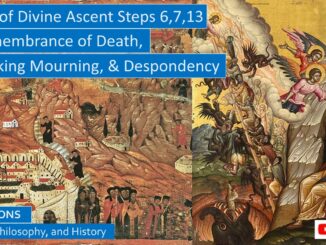
Ladder of Divine Ascent, Remembrance of Death, Joy Making Mourning, and Despondency, Steps 6,7, & 13
https://seekingvirtueandwisdom.com/ladder-of-divine-ascent-remembrance-of-death-joy-making-mourning-and-despondency-steps-67-13/
https://youtu.be/pFwC2nDf1CQ
Epictetus asks: “What do you call exile, imprisonment, shackles, death, and disfavor? They are indifferents,” which “are things that aren’t subject to will. Consequently, they are nothing to me.”[19]
These are the perils Romans faced when living under a totalitarian government, particularly when they served the emperor or the provincial governor, as many of Epictetus’ students will do. This was a risk that Socrates’ students did not need to face in their radical democracy. Epictetus seeks to strengthen their resolve: “Bring on death, pain, prison, disfavor, condemnation in the courts.”[20]
Epictetus scoffs: “We treat death as something to flee from,” something we should not ponder. But “Socrates was right to call death a bogeyman. Masks appear terrifying to young children and frighten them with their weirdness, and we too are affected in much the same way by events” such as death, just as “children are frightened by bogey masks.”
Epictetus asks: “After all, what is a child? A creature of ignorance and incomprehension. If a child knew, it would, in no way, be our inferior. What is death? A bogey-mask. Turn the death mask around and you’ll see it for what it is. Look! Now it can’t bite! Now or later, your body is bound to be separated from your spirit.”[21]
How many times, when a loved one passes, do we seek someone to blame, whether it be a doctor or a relative or their spouse, or God Himself? Epictetus bids us to imagine: “Suppose we are on a voyage. What is it within my power to do? To choose the captain and crew, and the day and time of departure.” The exception is we do not choose our parents and siblings. “Then a storm falls on us. Why should that be any concern of mine? I have done all I can. Coping with the storm is someone else’s business, the captain’s,” or the doctor’s concern, if our loved one is struggling for life in the hospital.
Epictetus asks: “What can I do? All I can do is do what I can. So, I drown,” or my loved one will drown, “without being frightened, without screaming, without cursing God, knowing that everything that is born is bound to die.” “Like an hour” in the day, today “I am present and then I pass.”[22]
“We are liable to illness and death, whatever we do.” “Speaking for myself, I hope to be overtaken by death when my attention is focused on my will: when I am trying to make it undisturbed by passion, unimpeded, unconstrained, and free.”[23]
Epictetus protests: “Can’t you see that the source of all human troubles and debasement and cowardice isn’t death, but rather the fear of death?” “You must train yourself to cope with death,” with “your exercises and your readings. Then you will appreciate this is the only way you can be free.”[24]
IS DEATH AS AN ORDINARY EVENT AT THE END OF OUR LIFE?
Never in my life have I cried. Never. The closest I have come is a slight tearing in a few tear-jerking movies. However, I find it difficult to view movies or television series, like Seinfeld and The Big Bang Theory, when they callously talk about treating women like beers, for pleasure. But as far as breaking down with sobs, never.
For many years, I facilitated divorce support groups, where there were ubiquitous tissue boxes. Sometimes women, and sometimes men, would weep profusely, and I was vicariously sympathetic, but not from personal experience. When I tell people this, they say I should not keep my tears bottled up, I should let my emotions go. But there is nothing to let go. Rather, I have lived my life vicariously as a compassionate observer.
Consequently, I wondered, if someone facing death looked to me for comfort: Would I be able to comfort them? Would what I would say be appropriate?
This has only happened once, when I had a casual conversation at church with a successful engineer facing death, who was wheelchair bound, accompanied by a black nurse aide. It was not my intention, but his son later told me that whatever I said to him, that it greatly eased his father’s anxiety about his passing.
Somehow the conversation wandered to my mother’s last moments. “Burt, my mother was suffering from Lou Gehrig’s disease, which is a kind disease: She was not in pain, nor did she lose her mind, she just lost the ability to walk, and later she lost the use of her arms. I was working and could no longer find aides to help with her daily life activities, so I was compelled to find a place in a rehabilitation hospital for her to stay.”
“It was a typically chilly February day in Jacksonville. My mother caught pneumonia, so she was transported to the hospital next door. She stayed for a week, and all our family visited her. Although she was stable, she was not really improving, but she told the night shift nurse that she really wanted to go home.”
“My mother now regarded as her home her humble bed in her shared rehab hospital room next door. So, the next day the hospital contacted me so I could accompany her on the one-block ambulance trip.”
“When I arrived at the hospital, she was sleeping, she was tired. I don’t remember us conversing. I rode in the ambulance, and the attendant pushed her home in a gurney. We were met in the rehab lobby by the head nurse. In the lobby, my mother passed on to her final home, which nobody noticed until we walked into her room.”
Horrified and panicked, the attendant looked at us both, insistently: “She died, she died! We have got to revive her! We must revive her!”
The nurse matched his insistence. “We can’t revive her! We cannot! She signed a DNR, she doesn’t want to be resuscitated!”
The attendant was unconvinced. “But you don’t understand! We must revive her! We MUST!!!!”
The head nurse pushed back: “She signed a DNR! We are not going to revive her!”
The attendant was panicking: “You do not understand! She is the third patient who has died in my ambulance this month! My boss told me if another patient dies on my shift, I am going to lose my job! And I can’t lose my job!”
The head nurse finally calmed him down: “Look, she signed a DNR, her health was fragile. I promise you, I will call your boss and explain everything, this was not your fault.”
This was not the story that Burt was expecting. The ice broke, and both he and his black nurse started laughing. Death is just part of life. What happens next?
This is a true story. How can we tell? In the real world, life goes on. For example, in the story of the seductress in The Graduate: What were holiday dinners like, when Dustin Hoffman and his newlywed bride shared turkey dinners with his cougar mother-in-law seductress and her father?
And so, the story continues. At nursing homes, the residents are unsettled by the too frequent sight of the exceedingly polite, clean-cut men of slight build, wearing white shirts, black suits, and shiny black shoes, quietly pushing their body carts. He came by where my mother was, parked his cart there, but was nonplussed as he puzzled over his task.
My mother was not obese, but we are pure blood Scandinavians, and she was as slim as a Brunhilda could be. He looks at me with imploring eyes, and quietly asks: “Could you please help me lift her? She is just dead weight.”
I have puzzled over this for many years, but finally found a possible explanation when reading Epictetus: “I show myself to you as a trustworthy, self-respecting, honorable, and serene person. Do I mean that I shall show myself to be immortal, unaging, and immune to illness? No, but as one who is capable of dying and being ill with godlike dignity. That is within my power and capacity, but those other qualities aren’t.”[25]
Epictetus advises us: “When the doctor pays you a visit, don’t be afraid of what he might say, and don’t be overjoyed if he says, ‘You are doing splendidly!’” Keep in mind that ancient doctors were not nearly as effective as doctors are today, who study and are supervised for over a decade before practicing medicine.
Epictetus continues: “Don’t be depressed if your doctor says, ‘You are doing badly.’” What does that mean? “It means that you are close to the separation of the soul from the body. What is there to fear in that? If you are not close now, you are going to be close later, aren’t you? Is the world going to come to an end when you die?”[26]
His students asked their teacher: “What if friends of mine in Rome die?” Epictetus answered, “Well, that is just the death of some mortal beings. Do you really expect to reach old age without seeing the death of any of those you love along the way?”[27]
THE ROMAN STOIC EPICTETUS OPPOSES SUICIDE
Unlike Seneca and Cato, Epictetus did not face certain death. His master Epaphroditus was a former secretary of Nero, and even assisted the evil emperor in his suicide.
Epictetus is clearly opposed to suicide under most circumstances, though he probably would have felt compassion for Seneca committing suicide when Roman soldiers were in the next room, swords in hand. Seneca, in his Letters, obsessed over suicide, he lived for several years waiting for Nero’s soldiers to come knocking on the door of his villa. Unlike Seneca and Cicero, Epictetus taught younger men starting their careers, he did not obsess about suicide as Seneca did.
Roman Stoic Philosopher Seneca on Aging, Death, and Suicide
https://seekingvirtueandwisdom.com/roman-stoic-philosopher-seneca-on-aging-death-and-suicide/
https://youtu.be/c9JXjqRKgBE
What was his response when his students questioned him: “Epictetus, we can no longer stand being bound to this body, feeding and watering it, resting it and cleaning it, and moreover being compelled by its needs to associate with this person and that.” Does this have meaning?
His students continued: “Allow us to go back to where we came from. Allow us to be released at last from these burdensome bonds with which we are chained. Here on earth, robbers and thieves, law courts, and those we call tyrants, plainly have power over us because of this poor body of ours and its possessions.” These tyrants are like the emperors who have driven so many to suicide because of their threats.
In response, Epictetus would say, “My friends, wait for God. You are free to return to him only when he gives the signal and releases you from your service here on earth. For the time being, resign yourselves to residing here, at the post to which he has assigned you. The time of your stay is short, and easy to endure for people with your convictions. What tyrant or thief or law court can strike fear in those who regard the body and its possessions as of no importance? Don’t leave for no good reason.”[28]
Did Epictetus ever think suicide was justified? His Stoic response: “What is pain? A bogey mask. Turn it around and you’ll see it for what it is.” Your body has rough days and better days. “If you don’t find your current existence in your best interests, the door is open.” This is the metaphor Epictetus uses for suicide: passing through the open door. “If you do, put up with it,” suffer the consequences. “Come what may, the door is bound to be open, and we can remain untroubled.”[29]
The Vatican’s 1980 pastoral letter on Euthanasia notes that in the ancient world, euthanasia meant an “easy death without severe suffering,” although it notes that this word has a different meaning today, and that the Catholic Church opposes euthanasia in all circumstances.
YT
We can understand Epictetus’ reluctant approval for those ancients who committed suicide to relieve their unending pain, given the primitiveness of medical treatments in the ancient world. But that is no longer true, we no longer have this excuse, today we have hospice, which can dull the pain with morphine and other drugs. Modern hospice care permits us, in most cases, to die with dignity. Modern hospice care permits us, in most cases, to die with dignity. One YouTube presenter is Hospice Nurse Julie, she has comforted many with her reassuring messages.[30]
On the other hand, St Augustine and the Church Fathers steadfastly oppose suicide under any circumstances. In particular, St Augustine rejects the example of Cato’s suicide. We will also reflect on how the modern church’s teaching on suicide is affected by psychology and modern medicine. If we commit suicide, will we be judged, bound to eternal torment for the psychic harm we inflict on our loved ones, or will God have mercy, instead recognizing the pain that led us to the horrible decision to step through that door? The truth is that the only way to find out is to step through that door. Why take that eternal risk?
YOUTUBE
Epictetus continues: “How did Rufus,” his teacher, “respond?” “If you’re choosing death as the harsher of two options, what an idiotic choice! And if you’re choosing it as the less harsh alternative, who was it that gave you the choice? Shouldn’t you practice being satisfied with what has been given to you?”
Epictetus imagines what it would be like to be condemned to death. Assume “I am condemned to death. If it happens straightaway, I die. If, after a short delay, I eat first, since the time has come for it, and then I will die later. How? As is proper for someone who’s giving back what was not their own.”[31]
As Job said after barbarians looted his property and a storm killed his children: “Naked I came from my mother’s womb, and naked shall I return there; the Lord gave, and the Lord has taken away; blessed be the name of the Lord.”[32]
Critics say the God in Job is cold-hearted, distressed at how blithely he granted Job additional children, and reestablished his prosperity. Should he not have done this? This is just a moral story, the lesson for us is, no matter how disastrous our life has been, we can always restart it anew, with purposeful naivety. Most of the Jews surviving Auschwitz and the other Nazi work camps discovered they were the only members of their families who survived, yet most of them remarried and rebuilt their lives as best as they could.
In Auschwitz, Viktor Frankl noticed that those prisoners with a rich inner spiritual life were more likely to survive. He tells us, “The salvation of man is through love and in love.” “The experiences of camp life show that man does have a choice of action. Apathy can be overcome; irritability can be suppressed. Man can preserve a vestige of spiritual freedom, of independence of mind, even in terrible conditions of psychic and physical stress.” No matter how dire your circumstances, you can always be kind to those around you.[33] Viktor Frankl was strengthened by his study of Stoicism.
Viktor Frankl, Man’s Search For Meaning, His Life in a Nazi Concentration Camp in WWII
http://www.seekingvirtueandwisdom.com/viktor-frankl-mans-search-for-meaning-his-life-in-a-nazi-concentration-camp-in-wwii/
https://youtu.be/O-YtC9qGWPI
Viktor Frankl’s Logo-therapy, Man’s Search For Meaning in Life, Love, and Suffering
https://seekingvirtueandwisdom.com/viktor-frankls-logo-therapy-mans-search-for-meaning/
https://youtu.be/1nTYlhDUJh8
Epictetus asks us: “When someone is at liberty to leave the party,” which is likely another euphemism for suicide, “whenever he chooses to stop playing the game, why would it upset him to stay? He will behave as one does in a game, and stay as long as he is being entertained, won’t he?” Why would anyone want to leave this life, when his neighbors do what is so unexpected, both good and bad? Life is endless compassionate entertainment as we live vicariously through our neighbors.
Epictetus proclaims: “Anyone with this attitude would easily be able to endure lifelong exile, or death if he was sentenced to death.”[34] We can hope for a last-minute reprieve in any death sentence. Or if we are facing a financial cliff, God may send that job offer our way, if we don’t lose heart and quit submitting the resumes. We all know that God will never submit resumes on our behalf.
When many people get mad at God for their suffering, they complain bitterly: “It is not right for Zeus to do these things.” Epictetus responds: “Why isn’t it? Zeus has made you capable of enduring hardship and given you greatness of soul; he has removed the label of ‘bad’ from these things; he has made it possible for you to be happy even under these circumstances; he has opened the door to you, when you have reached your limit. Take that way out, man, and don’t complain.”[35]
Is Epictetus here refusing to judge those who choose suicide? This passage does seem inconsistent with other passages. Perhaps his student Appian, who is transcribing his lectures in the Discourses, misquoted or misunderstood him. What is clear is that Epictetus far more often condemned suicide than Seneca and Cicero did. Unlike Seneca, Epictetus does not mention the historical example of Cato’s suicide. Epictetus prefers closing the door to darkness.
CONCLUSION
Epictetus compares death to “traveling abroad: It’s a change, though just a small one. The same goes for death: It’s a change, a greater one, from what is now,” a perfectly natural process. “You will no longer exist, but something else will, which the universe needs at that moment. After all, you too were born not at a time of your choosing, but when the universe needed you.”
How can we reconcile ourselves with the thought that one day we will pass away? Epictetus urges us: “A truly good person remembers who he is, where he has come from, and focuses on one thing alone: How he can occupy his station in life in a disciplined manner and in obedience to God.”[36]
[1] https://en.wikipedia.org/wiki/Epictetus
[2] https://en.wikipedia.org/wiki/Arrian
[3] Epictetus, Fragments, included in Epictetus, The Complete Works, translated by Robin Waterfield (University of Chicago Press, 2022, originally AD 100+), Fragment 3, p. 336.
[4] Epictetus, Fragments, included in Epictetus, The Complete Works, Fragment 24, p. 365.
[5] Epictetus, Discourses, included in Epictetus, The Complete Works, Discourse 3.29.4, p. 248.
[6] Epictetus, Discourses, included in Epictetus, The Complete Works, Discourse 2.6.24, p. 150.
[7] The Golden Sayings of Epictetus, Saying XII, p. 83.
[8] Homer, “The Iliad,” translated by Robert Fagles (New York: Penguin Books, 1990), Book 24, p. 605.
[9] https://www.ssa.gov/oact/STATS/table4c6.html
[10] Epictetus, Discourses, included in Epictetus, The Complete Works, Discourse 3.8.5-6, p. 230.
[11] Epictetus, Handbook, included in Epictetus, The Complete Works, Chapter 3, p. 46.
[12] Epictetus, Handbook, included in Epictetus, The Complete Works, Chapter 11, p. 48.
[13] Frank McLynn, Marcus Aurelius, A Life (Philadelphia, PA, Da Capo Press, 2009), p. 86, XX.
[14] Frank McLynn, Marcus Aurelius, A Life, p. 93, his footnotes include references to the Meditations.
[15] Epictetus, Handbook, included in Epictetus, The Complete Works, Chapter 53.3-4, p. 66 and Discourses, 1.4.24, pp. 79-80.
[16] Epictetus, Discourses, included in Epictetus, The Complete Works, Discourse 1.27.10, p. 127.
[17] Epictetus, Discourses, included in Epictetus, The Complete Works, Discourse 1.1.22, pp. 72-73.
[18] Epictetus, Handbook, included in Epictetus, The Complete Works, Chapter 21, p. 52.
[19] Epictetus, Discourses, included in Epictetus, The Complete Works, Discourse 1.30,2-3, pp. 137-138.
[20] Epictetus, Discourses, included in Epictetus, The Complete Works, Discourse 2.1.34, p. 142.
[21] Epictetus, Discourses, included in Epictetus, The Complete Works, Discourse 2.1.14-17, pp. 140-141.
[22] Epictetus, Discourses, included in Epictetus, The Complete Works, Discourse 2.5.10-13, p. 148.
[23] Epictetus, Discourses, included in Epictetus, The Complete Works, Discourse 3.5.7, p. 224.
[24] Epictetus, Discourses, included in Epictetus, The Complete Works, Discourse 3.26.38, p. 287.
[25] Epictetus, Discourses, included in Epictetus, The Complete Works, Discourse 2.8.26-28, pp. 157-158.
[26] Epictetus, Discourses, included in Epictetus, The Complete Works, Discourse 3.10.13-14, pp. 234-235.
[27] Epictetus, Discourses, included in Epictetus, The Complete Works, Discourse 3.24.27, p. 271.
[28] Epictetus, Discourses, included in Epictetus, The Complete Works, Discourse 1.9.12-17, pp. 91-92.
[29] Epictetus, Discourses, included in Epictetus, The Complete Works, Discourse 2.1.19-20, p. 141.
[30] https://www.youtube.com/@hospicenursejulie
[31] Epictetus, Discourses, included in Epictetus, The Complete Works, Discourse 1.1.26-32, p. 73 and https://en.wikipedia.org/wiki/Publius_Clodius_Thrasea_Paetus .
[32] https://www.biblegateway.com/passage/?search=job%201%3A21&version=NRSVCE
[33] Viktor Frankl, Man’s Search for Meaning (Boston: Beacon Press, 2006, 1959), Chapter 1, Experiences in Concentration Camp, pp. 36-37, 66.
[34] Epictetus, Discourses, included in Epictetus, The Complete Works, Discourse 2.16.37-38, p. 179.
[35] Epictetus, Discourses, included in Epictetus, The Complete Works, Discourse 3.8.5-6, p. 230.
[36] Epictetus, Discourses, included in Epictetus, The Complete Works, Discourse 3.24.93-95, p. 279.

Thanks Bruce! A good read. It brings to mind the Epicurus quote “The art of living well and dying well are one.” Socrates did not need to resolve upon gracious calm when he learned his death was approaching. Instead, he resolved to live and behave as he had live and behaved until the moment of death. That’s quite a difference! There has been a thought turning over in my own head for some time on this topic as well, which is that beliefs and actions are one. It would be foolish to admire these great men for their actions, and discard their beliefs as childish superstition. Those of us who hold to the Apostolic faith should have no fear of death as the consequence of our actions. Beliefs and actions are one.
Actually, the three-fold progression in the Decalogue, and in the Stoics, are thoughts, words, and deeds: thoughts influence words, and thoughts and words influence deeds.
I get very few comments on my blogs, nearly all of the comment activity are on my sister YouTube videos. These blogs are usually the YouTube scripts.