
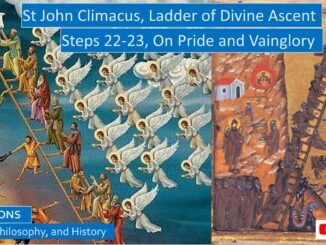
St John Climacus on Mad Pride and Vainglory : Ladder of Divine Ascent, Steps 22-23
Ladder of Divine Ascent

St John Climacus on Mad Pride and Vainglory: Ladder of Divine Ascent, Steps 22-23

What is the difference between vainglory and pride? Today, vainglory is an archaic word that has not been replaced in common usage, so we usually consider them to be synonymous. Although St John Climacus concedes they are similar, except vainglory progresses to mad pride. He examines vainglory in Step 22, and mad pride in Step 23.
Let us compare the definitions:
Step 22.1. “Some like to distinguish vainglory from pride, and to give it a special place and chapter.” “The only difference between them” is like the difference “between a child and a man, between wheat and bread: for the one is the beginning and the other the end.”
Step 22.2. “With regard to its form, vainglory is a change of nature, a perversion of character, a note of blame. With regard to its quality, it is a dissipation of labors, a waste of sweat, a betrayal of treasure, a child of unbelief, the precursor of pride, shipwreck in harbor, an ant on the threshing floor which, though small, has designs upon all one’s labor and fruit. The ant waits for the gathering of the wheat, and vainglory for the gathering of the riches of virtue: for the one loves to steal and the other to squander.” […]
Prayer of St Franics and Brother Giles SMALL
Lives of Saints

Who Was the Author of the Prayer of St Francis? Sayings of Brother Giles

We can say definitely that the Prayer of St Francis was not actually written by St Francis, it first appeared in the December 1912 issue of the French Catholic publication, La Clochette. Quite likely it was penned by the founding editor, Father Esther Bouquerel. Around 1918, it was printed without attribution on the back side of a holy card with a painting of St Francis. Someone then reprinted it in an English translation in 1927, innocently misattributing it to St Francis. Archbishop Francis Spellman printed millions of copies of the prayer during World War II, and it was read into the Congressional Record. […]

Ladder of Divine Ascent

St John Climacus: Ladder of Divine Ascent, Step 5, Repentance, and Perseverance of Winston Churchill

Repentance is not merely a quick apology to St John Climacus. Repentance is not quick in the Ladder of Divine Ascent. The first four rungs, where we renounce the world, detach ourselves from worldly things, become an exile and pilgrim from the affairs of the world, and with daily discipline internalize God’s will in holy obedience, these first four rungs prepare us for the rung of repentance. Repentance is more an attitude and a process than an event. An attitude of humility and repentance will prepare us for the slow ascent up the remaining twenty-five steps of the Ladder of Divine Ascent. Without daily heartfelt repentance we cannot continue the climb to a godly life. […]