Abortion

Regarding Abortion, Should Christians Be Pro-Compassion? Answering Questions, Further Reflections

How should we, as Christians, approach moral problems? This is similar to a related question; How should we interpret the Scriptures and Church teaching to guide us to live a godly life? St Augustine, in his seminal work, On Christian Teaching, or On Christian Doctrine, teaches us that “whoever thinks he understands the Holy Scriptures,” “but interprets them in a way that does not build up this two-fold Love of God and love of neighbor, does not truly understand the Scriptures.” […]

AntiSemitism

Viktor Frankl’s Logo-therapy, Man’s Search For Meaning in Life, Love, and Suffering

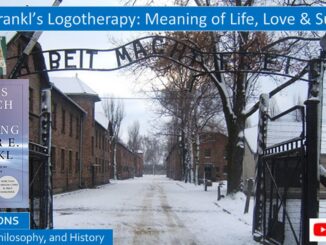
Viktor Frankl’s book, Man’s Search for Meaning, is a life-changing book and one of my favorites, it touched me deeply when I first read it many years ago. The main theme of the book is no matter what challenges you face in your life, or how busy you are, you always have time to be kind to all those whom you encounter, to be a positive influence on the lives whom you touch. Although he does not directly mention stoicism, his account of how he survived Auschwitz is a living example how a stoic mindset can help you survive and thrive through any challenge life may throw at you. […]

Abortion

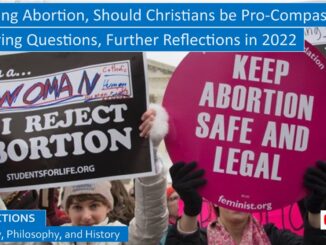
Supreme Court Dobbs Case Overruling Roe v Wade: Should Christians be Pro-Compassion? Pro-Doctors?

There are some really heart-breaking situations involving abortion. Should abortion be allowed if the mother’s and/or the baby’s life is in danger? Should abortion be allowed in case of rape or incest? Should abortion be permitted if it is likely the mother would otherwise commit suicide? Should abortion be permitted to reduce the number of deaths caused by botched abortions by coat hangers or Lysol? […]

Biblical Interpretation

Do Christians Need To Go To Church? Which Type of Church Should You Attend?

St Augustine’s memorable reflection on our question appear in his Confessions, which is really one of the first testimonials. St Augustine tells us the story of Victorinus, a philosopher who studies the Gospels and the Church Fathers but declines to attend services, asking “Do the walls of the Church make you a Christian?” Victorinus was a learned man, an erudite pagan Platonic philosopher, the Word of the Lord spoke directly to him from the page, perhaps he felt intellectually superior to many simple Christians he knew.

In the words of St Augustine, in his studies Victorinus became “resolute, he was seized by the fear that Christ might deny him before the holy angels if he was too faint-hearted to acknowledge Christ before men, and he felt himself guilty of a great crime in being ashamed of the sacraments instituted by the Word of God in his lowly state.” […]

AntiSemitism

Our Reflections on Morality, Philosophy, and History: Ancient and Modern Classics

To a Stoic Philosopher, the question of Theodicy, or why God permits bad things to happen to good people, why God permits suffering, is simply absurd. The fact is, we do suffer, we will face injustices, we will suffer illnesses and death, and the rain falls on both the good man and the bad man. God will not shield us from suffering and injustice, but God will provide us with the strength to endure the challenges of this life. […]

Book Reviews and Miscellaneous

Book Reviews on Apostolic and Early Church Fathers

These quick book reviews include links to our YouTube videos and blogs on the Apostolic and Early Church Fathers, plus related topics. We will also discuss how to read ancient works, and the problems scholars face when translating ancient works, and the 38-volume set of the writings of the Ante-Nicene, ante meaning before, Nicene, and Post-Nicene Church Fathers, translated into English. […]

Catholic Catechism

Do Not Covet, Do Not Envy, Early Church Fathers and Others

St Gregory Palamas teaches us that the command not to covet is not only a negative THOU SHALT NOT command but is more a SHALL positive command, that we shall be generous and show charity and lend to our less fortunate neighbor, and to watch after our neighbor’s interests, returning to him lost items you may find.  “Covetousness, conceived in the soul, produces sin; and sin, when committed, results in death (James 1:5).  Refrain from coveting what belongs to others and avoid filching things out of greediness.  Rather you should give from what you possess to whoever asks of you, and you should, as much as you can, be charitable to whoever is in need of charity, and you should not refuse whoever wants to borrow from you (Matthew 5:42).  Should you find some lost article, you should keep it for its owner, even if the owner is hostile towards you, perhaps your kindness will change him and your kindness will overcome evil, as Christ commands.” […]

Morality

Yves Congar, Meaning of Tradition, Blog 2

By abandoning diatribes, by abandoning the proclaiming of anathemas against those who disagree with Catholic doctrine, the post-Vatican II Catholic Church now explicitly believes that both Catholics and Protestants can both attain Salvation through the grace of God and His Son Jesus Christ.  By opening a dialogue, the Church teaches we can learn from both Catholic and Protestant theologies, and this also infers that this encourages study, effort, and dedication.  In the spirit of Vatican II, we should strive to view these as differences of emphasis rather than as differences that divide. […]

Morality

Yves Congar, Meaning of Tradition, Blog 1

The cleric whose writings most influenced the decrees of Vatican II was Yves Congar, including his work on the Meaning of Tradition. He examined what the Church Fathers taught us about tradition throughout Church History, and as expected, since it was not hotly debated until the Reformation, there was a great many teachings on what tradition meant. […]

AntiSemitism

John Chrysostom, Justin Martyr, and the Church Fathers Preach Against the Judaizers and the Jews

John Chrysostom is the most strident of the early Church writers in his writings opposing the Judaizers where he warned his flock that Christians should not adopt Jewish customs and practices, that Christians needed to celebrate the Church festivals rather than the Jewish festivals, that Christians should not attend services at the synagogue. His work “Against the Judaizers” is so polemic that it is far more anti-Semitic than the writings of Barnabas and St Justin Martyr and many other church fathers, it is painful for us modern readers to read, we who remember the horrific events of the Holocaust. This work is not in the standard collection of the works of the Nicene and Anti-Nicene Fathers, but it was widely read in medieval times and afterward, and unfortunately was used to justify the European and Russian pogroms and persecutions against the Jews.[2]

One scholar who has pondered the problems posed polemic stands against the Judaizers by St John Chrysostom and also St Cyril is Robert Wilken. In this book “John Chrysostom and the Jews,” he explores the history of the early church to better understand the world of the early Church Fathers. We cannot totally excuse the errors in the teachings of the early Church Fathers, but neither can we blindly judge and condemn them for not knowing the lessons of the Holocaust. There is nothing wrong with reading the Church Fathers as they apply to our modern world, but particularly in this case we should also let the Church Fathers in their ancient historical context, we need to do both lest we have a distorted understanding of the history of our faith. […]