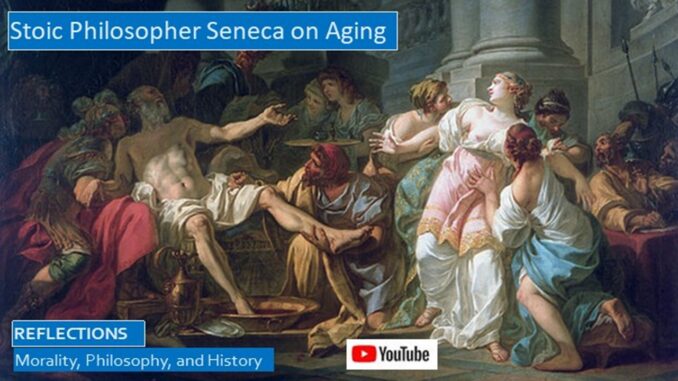
What did Seneca say about accepting old age and retirement? Why didn’t ancient people look forward to retirement?
Why did Seneca obsess over death and suicide? Was he unique in these beliefs among the Stoic philosophers?
Why does Seneca say it is futile to plan ahead for old age? Should we spend our retirement traveling? When should we stop learning how to live?
YouTube video for this blog: https://youtu.be/hmJoI9-s1q8
SHORT BIOGRAPHY OF SENECA
Seneca was born in about the year 4 BC, and due to his wealth and family connections, he was elected to the Roman Senate. The Senate and Emperor Claudius exiled him on what were likely trumped-up charges in AD 41, but he was recalled to Rome in AD 49, and soon after was appointed as tutor of the future Emperor Nero. After Nero became emperor, Seneca was an important advisor from AD 54 to 62. In his early years, Nero followed Seneca’s advice and was a competent emperor. During the last part of his reign, as Nero became cruelly erratic, Seneca spent more time at his distant estates, going into semi-retirement.[1]
SENECA ON ACCEPTING OLD AGE AND DEATH
What should you say when you are old, and someone asks, “How are you doing?” One response is you can look sad, and say dourfully, “Unfortunately, I am on the downhill slope.”
Then they ask quizzically, “Why is that?” And the answer: “When you are twenty, you are on the uphill slope. When you are twice-twenty, you are even-keel. But when you are thrice-twenty, you are on the downhill slope.”
This is not bad news for Seneca: “Life is most delightful when it is on the downhill slope but has not reached the abrupt decline.” “The very fact of our not wanting pleasures has taken the place of the pleasures themselves. How comforting it is to have tired out one’s appetites, and to be done with them!”
Seneca continues: “But, you say, it is a nuisance to be looking death in the face! Death, however, is faced by young and old alike,” and this was far more true in the ancient and medieval worlds, where spoilt food could do you in before the next sunrise. “But nobody is so old that it would be improper for him to hope for another day of existence. Every day is a stage of life’s journey.”[2]
Seneca faces old age and death as only a Stoic could. “Old age is a time of life that is weary rather than crushed.” Nevertheless, I am thankful, “for age has not damaged my mind, though I feel its effects on my constitution. Only my vices” “have reached senility; my mind is strong,” “it is alert,” “it declares that old age is when it blooms.” “My mind bids me to consider how much this peace of mind and moderation of character I owe to wisdom and how much to my time of life; it bids me to distinguish carefully what I cannot do and what I do not want to do.” “There is only one chain that binds us to life, and that is the love of life.”[3]
SENECA ON RETIREMENT
Retirement is a modern construct influenced by old-age pensions and social security. In contrast, in the ancient world only the idle wealthy could “retire,” as so few people lived to their sixties. This was not a worry in the ancient world. Most ancient people worried that their city-state would be defeated by a hostile army that would burn and plunder their city, massacre the military age men, and enslave the women and children.
Ancient Warrior Societies, Blog 1, The Warrior Ethos of Ancient Greece, Rome, and Israel
https://seekingvirtueandwisdom.com/ancient-warrior-societies-blog-1-the-warrior-ethos-of-ancient-greece/
https://youtu.be/7QAZ_s6zw4E
Iliad Blog 2, Captured Concubines in the Iliad and the Torah
Iliad Blog 2, Captured Concubines in the Iliad and the Torah
The Iliad, blog 4, Briseis, Chryseis, Aren’t all Concubines the Same?
http://www.seekingvirtueandwisdom.com/the-iliad-blog-4-briseis-chryseis-arent-all-concubines-the-same/
Concubines in the Iliad, Old Testament and Christian Tradition
https://youtu.be/bGHHD7XTvr0
Slaves in the Ancient World, Blog 1, Were Slaves the Employees of the Ancient World?
http://www.seekingvirtueandwisdom.com/slaves-in-the-ancient-world-blog-1-were-slaves-the-employees-of-the-ancient-world/
Slaves in Ancient Greece and Rome, Blog 2
http://www.seekingvirtueandwisdom.com/slaves-in-ancient-greece-and-rome-blog-2/
https://youtu.be/O67cmVRvBtA
Teachings about Slavery in the Bible, the Stoics, and by the Early Church Fathers
http://www.seekingvirtueandwisdom.com/teachings-about-slavery-in-the-bible-and-by-the-early-church-fathers/
https://youtu.be/poyvJajCXnE
But even in the ancient world, men retired when they were too elderly for the active life, including military service, and when the passions dimmed. In ancient Greece, many elderly men served on the large public juries or were harassed by Socrates in the public markets.
What did Seneca say about retirement? Seneca retired from public life when his former student, Emperor Nero, became more and more sadistically unhinged. Seneca went into voluntary exile on his remote estates, where he composed philosophical reflections. Seneca advises us: “As long as you live, keep learning how to live.” “Even an old man should keep learning.”
Seneca betrays that, unlike most people, he was born into immense wealth, he cannot imagine a world where people are compelled to earn wealth. He states: “Wisdom comes haphazardly to no man. Money will come of its own accord; titles will be given to you; influence and authority will perhaps be thrust upon you; but virtue will not fall upon you by chance.”
Seneca inquires: “What quality is best in man? It is reason; by virtue of reason, he surpasses the animals and is surpassed only by the gods.” “Perfect and well-ordered reason is called virtue.” Virtue is superior to health, riches, and pedigree. “Virtue makes the soul stronger, loftier, and larger.”
“A good man will do what is honorable, even if it involves toil,” “even if it involves harm and peril.” “A good man will not do what is base, even if it brings him money, or pleasure, or power.”
This is like Kant’s categorical imperative, which teaches us that for certain major challenges in our lives, that we must do what is morally right regardless of the consequences, especially when our neighbor is threatened with serious harm. After all, our greatest calling in life is to Love God, love and seek the good, and love our neighbor as ourselves.
Hillel and Jesus, Reflections on Rabbi Telushkin’s Observations
http://www.seekingvirtueandwisdom.com/hillel-and-jesus-reflections/
Comparing Hillel and Shammai to Jesus
http://www.seekingvirtueandwisdom.com/comparing-hillel-and-shammai-to-jesus/
More Stories and Sayings of Hillel and Shammai
http://www.seekingvirtueandwisdom.com/more-stories-and-sayings-of-hillel-and-shammai/
Jesus, Hillel, and Shammai, Loving God and Neighbor
https://youtu.be/ygxn2qqGnOI
Seneca urges us: “A good man must have the highest sense of duty towards the gods. He will endure with an unruffled spirit whatever happens to him; for he will know it has happened because of divine law by which the whole creation moves. For him there is one good, one honorable good, which dictates that we shall obey the gods and not blaze forth in anger at sudden misfortunes or deplore our lot, but rather patiently accept fate and obey its commands.”
This is our error, as Seneca reminds us: “We value no man at what he is, but add to the man the trappings in which he is clothed. But when you wish to inquire into a man’s true worth, and to know what manner of man he is, look at him when he is naked; make him lay aside his inherited estate, his titles, and the other deceptions of fortune; let him even strip off his body. Consider his soul, its quality and its stature, and thus learn when its greatness is borrowed, or its own.”[4]
Seneca warns us: “Prosperity is a turbulent thing; it torments itself.” “It goads men to various aims, some to power, and others to high living. Some it puffs up; others it slackens and wholly enervates.” Some men carry their prosperity as well as they carry their liquor.[5]
It is futile to plan ahead. Seneca warns: “There is indeed a limit fixed for us” by Fate, “but none of us know how near we are to our limit. Therefore, let us order our minds as if we had come to the very end. Let us postpone nothing. Let us balance life’s account each day.” Let us “begin to at once to live and count each separate day as a separate life.” What is important is “not how long you live, but how nobly you live. And often living nobly means that you cannot live long.”[6]
SENECA ON WHETHER TRAVEL IS BENEFICIAL
Seneca asks: “What benefit has travel of itself even given anyone? No restraint upon pleasure, no checking of bad temper, no opportunity to rid the soul of evil. Travelling cannot give us judgment or shake off errors; it merely holds our attention for a moment by a certain novelty, as children pause to wonder at something unfamiliar.” “Hence the spots we had sought most eagerly we quit still more eagerly, like birds that flit and are off as soon as they have alighted.”
Perhaps we ought to instead explore different cultures in different times. Seneca advises us: “We ought rather to spend our time in study, and to cultivate those who are masters of wisdom, learning something which has been investigated, but not settled; by this means the mind can be relieved of a most wretched serfdom, and won over to freedom. Indeed, as long as you are ignorant of what you should avoid or seek, or of what is necessary or superfluous, or of what is right and wrong, you will not be traveling but merely wandering.”
Seneca asks us: “Where lies the truth, then? Can wisdom, the greatest of all the arts, be picked up on a journey?” “That from which you are running is within you. Accordingly, reform your own self, get the burden off your own shoulders, and keep within safe limits the cravings which ought to be removed. Wipe out from your soul all trace of sin.”[7]
Should retirement center on travel? Should those who cannot afford to travel during retirement be shunned? Remember that when you visit popular tourist destinations, the goal of all you meet will be to part from you as much of your money in as short a time as possible.
Seneca lived in a different time, where only the wealthy could travel abroad; there wasn’t a tourist industry like there is today. If Seneca were alive today, he would encourage you to spend time and money to create memories for your children and grandchildren, treating them to Disney and many other kid-friendly destinations. If you want to avoid the tourist crowds and your health is good, you can also hike off the beaten trail and enjoy the wilderness outdoors in our many state and national parks.
SENECA ON THE SHORTNESS OF LIFE
Seneca rues: “Death is on my trail, and life is fleeting away; teach me something with which to face these troubles. May I cease trying to escape from death, and that life may cease to escape from me. Give me courage to meet hardships; make me calm in the face of the unavoidable.” “Show me that the good in life does not depend upon life’s length, but upon the use we make of it.”[8]
Seneca urges: “We should strive, not to live long, but to live rightly; for to achieve long life you have need of Fate only, but for right living you need the soul. A life is really long if it is a full life; but fullness is not attained until the soul has rendered to itself its proper Good, that is, until it has assumed control over itself. What benefit does an eighty-year-old man derive from a life spent in idleness? A person like him has not lived; he has merely tarried while in life. Nor will he die late in life; he has simply been a long time dying.”
Compare this to a young man who “departed in the bloom of his manhood. He had fulfilled all the duties of a good citizen, a good friend, a good son; in no respect had he fallen short. His age may have been incomplete, but his life was complete.”[9]
Seneca was forcibly retired by Nero, and he knew one day Roman soldiers would come knocking, suggesting he commit suicide rather than be slain by the sword, so he counsels that when you retire, you should be inconspicuous. Seneca states, “Certain animals hide themselves from discovery by confusing the marks of their footprints about their lairs. You should do the same.”[10]
Seneca withdrew from Nero’s court in AD 62; he completed his voluminous letters on Moral Discourses that are our main source in about AD 64. Since he knew his death was imminent, he obsessed over how we should accept death, sometimes mentioning suicide. We will also reflect on the Roman historian Livy’s account of Seneca’s suicide.
Roman Stoic Philosopher Seneca on Aging, Death, and Suicide
https://seekingvirtueandwisdom.com/roman-stoic-philosopher-seneca-on-aging-death-and-suicide/
Scholars have this mistaken view that all Stoic philosophers condoned suicide, but this is simply not true. Actually, the views of the Stoic philosophers varied according to their life situations. Seneca was compelled to commit suicide by Roman soldiers knocking on his door. Since both Cicero and Seneca held up as a noble death Cato’s suicide after Julius Caesar overthrew the rotting Roman Republic, we will reflect on the Roman Biographer Plutarch’s life of Cato.
Neither Christians nor the Stoic Epictetus would have approved of Cato’s suicide. Plutarch also wrote a biopic on Cicero, who was murdered by troops loyal to Mark Antony. On the other hand, the Roman Stoic Epictetus was a commoner who only faced the philosopher’s exile, and he stridently opposed suicide.
YT suicide and martyrdom
FUTURE YOUTUBE VIDEOS
We have reflected on the classical Christian psychologist Paul Tournier’s reflections on Acceptance of Old Age, Retirement, and Death, and plan another short reflection for widows and housewives. Jimmy Carter also reflected on Aging and Retirement in his Virtues of Aging.
Classical Christian Psychologist Paul Tournier on Old Age and Retirement
https://seekingvirtueandwisdom.com/classical-psychologist-paul-tournier-on-old-age/
https://youtu.be/HE3LNGB0nUA
Classical Christian Psychologist Paul Tournier on Old Age, Death, and Faith
https://seekingvirtueandwisdom.com/classical-christian-psychologist-paul-tournier-on-old-age-death-and-faith/
https://youtu.be/gRaY2hTaEGk
We have previously reflected on our favorite quotes from Seneca, we plan more reflections in the future. The summaries repeat my favorite quotes of many Stoic philosophers. Plus, the first book of Plato’s Republic includes reflections on aging.
Seneca, Moral Epistles, Blog 1, Living Well, Dying Well
http://www.seekingvirtueandwisdom.com/seneca-moral-epistles-blog-1-living-well-dying-well/
Seneca, Moral Epistles, Blog 2, Stoicism and Living a Godly Life
http://www.seekingvirtueandwisdom.com/seneca-moral-epistles-blog-2-stoicism-and-living-a-godly-life/
Seneca, Moral Epistles, Blog 3, Loving Philosophy, Loving God, Loving our Neighbor
http://www.seekingvirtueandwisdom.com/seneca-moral-epistles-blog-3-loving-philosophy-loving-god-loving-our-neighbor/
Seneca, Moral Epistles, Blog 4, Stoic Concepts of Virtue and the Good
http://www.seekingvirtueandwisdom.com/seneca-moral-epistles-blog-4-stoic-concepts-of-virtue-and-the-good/
Seneca, Moral Epistles, Blog 5, On the Benefits of Friends and Keeping Score
http://www.seekingvirtueandwisdom.com/seneca-moral-epistles-blog-5-on-the-benefits-of-friends-and-keeping-score/
Seneca, Moral Epistles, Blog 6, Stoicism and the Golden Rule
http://www.seekingvirtueandwisdom.com/seneca-moral-epistles-blog-6-stoicism-and-the-golden-rule/
Seneca, Moral Epistles, Blog 7, Precious Stoic Nuggets of Wisdom
http://www.seekingvirtueandwisdom.com/seneca-moral-epistles-blog-7-precious-stoic-nuggets-of-wisdom/
Seneca the Younger, Roman Stoic Philosopher, Short Biography and Sayings
https://youtu.be/wgD8skYi3I0
Seneca: Stoic Sayings on Virtue, Friendship, Pleasure, Joy, and Philosophy
https://youtu.be/m4mcP2F9c4w
Major Roman Stoic Philosophers, My Favorite Maxims: Epictetus, Rufus, Seneca & Marcus Aurelius
https://seekingvirtueandwisdom.com/major-roman-stoic-philosophers-my-favorite-maxims-epictetus-rufus-seneca-marcus-aurelius/
https://youtu.be/E0qQgqGkoOE
Greek Stoic and Cynic Philosophers: My Favorite Maxims: Heraclitus, Antisthenes, Diogenes, and Zeno
https://seekingvirtueandwisdom.com/greek-stoic-and-cynic-philosophers-my-favorite-sayings/
https://youtu.be/rq3oRftjM4c
DISCUSSING THE SOURCE
Seneca was admired by many early Christians, Tertullian referred to him as “our Seneca.” This admiration led to a fourth century compilation of purported letters between Seneca and his compatriot St Paul, though scholars label them as both spurious and uninteresting. His Moral Discourses, which is our source for his thoughts on aging and retirement, were written in his enforced retirement from Nero’s court, and are mostly easy to read, though the translation often is too wordy.
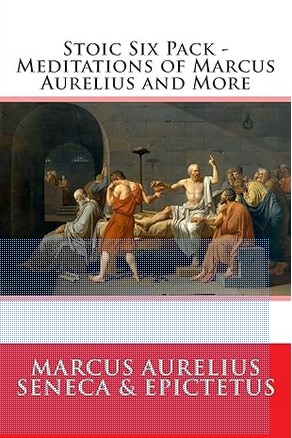
We recommend the Stoic Six-Pack of writings of the leading Stoic philosophers. Ordinarily the lack of footnotes and an index detract from this translation, but these are found in the Wikipedia public domain links in their article on Seneca.[11]
[1] https://en.wikipedia.org/wiki/Seneca_the_Younger
[2] Seneca, Moral Discourses,” in Stoic Six-Park – Meditations of Marcus Aurelius and More, translated by Richard Gummere, (Enhanced Media, 2014, first published 1925, originally 65 AD), Letter XII, On Old Age, p. 235.
[3] Seneca, Moral Discourses, Letter XXVI, On Old Age and Death, p. 235.
[4] Seneca, Moral Discourses, Letter LXXVI, On Learning Wisdom in Old Age, pp. 368-373.
[5] Seneca, Moral Discourses, Letter XXXVI, On the Value of Retirement, p. 279.
[6] Seneca, Moral Discourses, Letter CI, On the Futility of Planning Ahead, pp. 487-489.
[7] Seneca, Moral Discourses, Letter CIV, On Care of Health and Peace of Mind, pp. 496-497.
[8] Seneca, Moral Discourses, Letter XLIX, On the Shortness of Life, p. 300.
[9] Seneca, Moral Discourses, Letter XCIII, On the Quality, as Contrasted with the Length, of Life, p. 449.
[10] Seneca, Moral Discourses, Letter LXVIII, On Wisdom and Retirement, p. 343.
[11] https://en.wikisource.org/wiki/Moral_letters_to_Lucilius/Subject_index and https://en.wikipedia.org/wiki/Seneca_the_Younger

4 Trackbacks / Pingbacks