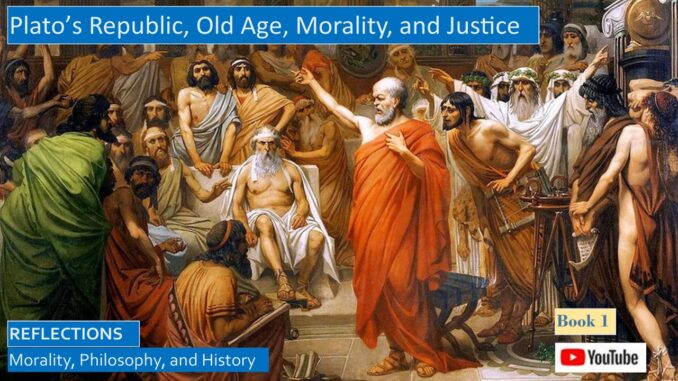
How were the traumas of the Peloponnesian Wars, which Athens recently lost, and in which a sizable portion of the population perished, and the ruinous rule of the Thirty Tyrants put in place by the victorious Spartans, reflected in the first book of Plato’s Republic?
How did Cephalus reconcile himself with his advanced age and mortality?
Can wealth pacify the gods? Does might make right? Is morality always preferable, or is it championed by fools? Does success imply virtue?
Does Plato’s Republic seek justice? Does it seek morality?
YouTube video for this blog: https://youtu.be/JY1ILO3weZI
PLATONIC DIALOGUES AND PELOPONNESIAN WARS
How did the ancient Greeks approach the Platonic dialogues, the Republic in particular? The Peloponnesian Wars, which the Athenian Delian League lost to Sparta and her allies, were recent traumatic events that took the lives of a large portion of the ancient Greek population.
These were the world wars of the ancient world: the peace after the first series of battles was interrupted by the Athenian defeat at Syracuse. Like the two modern World Wars, the two phases of the Peloponnesian wars spanned two generations. These wars were long and complex, with many battles that spanned two generations and a dozen reflections.
Plutarch: Lives of Aristides and Cimon, Formation of the Delian League After the Greco-Persian Wars
http://www.seekingvirtueandwisdom.com/plutarch-lives-of-aristides-and-cimon-formation-of-the-delian-league-after-the-greco-persian-wars/
https://youtu.be/QabwtFANCDc
Thucydides and Plutarch: Pericles and the Radical Democracy Before the Peloponnesian Wars
http://www.seekingvirtueandwisdom.com/thucydides-and-plutarch-pericles-and-the-radical-democracy-before-the-peloponnesian-wars/
https://youtu.be/uhtGzfxVdzk
Thucydides and Plutarch: Pericles and the Beginning of the Peloponnesian War Between Athens and Sparta
http://www.seekingvirtueandwisdom.com/thucydides-and-plutarch-pericles-and-the-beginning-of-the-peloponnesian-war-between-athens-and-sparta/
https://youtu.be/1ra58mg33nM
Pericles Funeral Oration & Plague, Lincoln Gettysburg Address, Churchill Battle of Britain Speech
https://seekingvirtueandwisdom.com/pericles-funeral-oration-plague-lincoln-gettysburg-address-churchill-battle-of-britain-speech/
https://youtu.be/wyjWBAG6xrc
From the Death of Pericles to the Peace of Nicias, Peloponnesian War, Thucydides and Plutarch
https://seekingvirtueandwisdom.com/from-the-death-of-pericles-to-the-peace-of-nicias-peloponnesian-war-thucydides-and-plutarch/
https://youtu.be/szi7-9QQWI0
Aristophanes’ Comedy on the Peace of Nicias, Peloponnesian Wars
https://seekingvirtueandwisdom.com/aristophanes-comedy-on-the-peace-of-nicias-peloponnesian-wars/
https://youtu.be/UHRzKH-asoo
Thucydides, Moral Lessons Drawn from Histories of the Peloponnesian War
https://seekingvirtueandwisdom.com/thucydides-moral-lessons-drawn-from-histories-of-the-peloponnesian-war/
https://youtu.be/yECl8cKCzao
Athens’ Disastrous Defeat at Syracuse in the Sicilian Expedition, the Peloponnesian Wars
https://seekingvirtueandwisdom.com/athens-disastrous-defeat-at-syracuse-in-the-sicilian-expedition-the-peloponnesian-wars/
https://youtu.be/SaIqQ35ysl4
Comeback of Alcibiades in Peloponnesian War, according to Plutarch, Thucydides, and Xenophon
https://seekingvirtueandwisdom.com/comeback-of-alcibiades-in-peloponnesian-war-according-to-plutarch-thucydides-and-xenophon/
https://youtu.be/b7QLp1HrOMs
Spartan Lysander Shows Mercy on Athens, Ending the Peloponnesian Wars
https://seekingvirtueandwisdom.com/spartan-lysander-shows-mercy-on-athens-ending-the-peloponnesian-wars/
https://youtu.be/giNzqNoOH3Y
The eventual defeat of Athens was followed by the rule of the Thirty Tyrants, forced upon the Athenians by the victorious Spartans. This descended into a vicious civil war, where many aristocrats lost both their lives and their property.
Before you read any Platonic dialogue, you should first investigate what role the various speakers and participants played in the Peloponnesian Wars,[1] including the bloodbath initiated by the Thirty Tyrants. Many ancient Athenians knew these speakers or their relatives personally. Plus, you should not take Plato too seriously, often he has Socrates proposing absurd arguments to challenge the listener.
Thirty Tyrants Ruling Athens After Spartan Victory in the Peloponnesian Wars
https://seekingvirtueandwisdom.com/thirty-tyrants-ruling-athens-after-spartan-victory-in-the-peloponnesian-wars/
https://youtu.be/rrcwdHyvIEg
To understand both the Platonic dialogues and the Peloponnesian Wars, it is essential to study the Greek classics, including the Iliad and the Odyssey, as well as the histories of Herodotus, who recorded the history of the Persian Wars that led to the Peloponnesian Wars. The Delian League, organized by Athens, was the NATO of the ancient world. It was formed to protect the Greek city-states from further Persian aggression.
Iliad, Blog 1, Why Should a Christian Read the Iliad?
http://www.seekingvirtueandwisdom.com/iliad_blog01/
The Iliad, the Basis of Greek Culture and the Western Philosophical Tradition
https://youtu.be/DpmuhZJUJn0
Iliad Blog 2, Captured Concubines in the Iliad and the Torah
http://www.seekingvirtueandwisdom.com/iliad_blog02/
The Iliad, blog 4, Briseis, Chryseis, Aren’t all Concubines the Same?
http://www.seekingvirtueandwisdom.com/the-iliad-blog-4-briseis-chryseis-arent-all-concubines-the-same/
Concubines in the Iliad, Old Testament and Christian Tradition
https://youtu.be/bGHHD7XTvr0
Iliad, Blog 3, Visiting the Enemy Camp, Greeks vs Indians
http://www.seekingvirtueandwisdom.com/iliad-blog-3-visiting-the-enemy-camp-greeks-vs-indians/
The Warrior Cultures of the Iliad and the American Indian, Bravely Visiting the Enemy Camp
https://youtu.be/ynIx-AVI2f8
The Iliad Blog 5, the Tide of Battle Turns Against the Greeks
http://www.seekingvirtueandwisdom.com/the-iliad-blog-5-the-tide-of-battle-turns-against-the-greeks/
The Iliad Blog 6, Embassy to Achilles, Oration, Failed Meeting
http://www.seekingvirtueandwisdom.com/the-iliad-blog-6-embassy-to-achilles-oration-failed-meeting/
The Iliad Blog 7, the deaths of Patroclus and Hector
http://www.seekingvirtueandwisdom.com/the-iliad-blog-7-the-deaths-of-patroclus-and-hector/
The Iliad of Homer: Glory, Honor, Madness and Futility of War
https://youtu.be/7lI2ZQ50wRc
Herodotus, Histories of Persia, Egypt and Scythia Before the Greco-Persian Wars
http://www.seekingvirtueandwisdom.com/herodotus-histories-of-persia-egypt-and-scythia-before-the-greco-persian-wars/
https://youtu.be/YwUojwMIQEw
Histories of Herodotus, The Greeks Defeat the Mighty Persians in the Greco-Persian Wars
http://www.seekingvirtueandwisdom.com/histories-of-herodotus-the-greco-persian-wars/
https://youtu.be/JjNcyLo54ko
The Greeks Triumph in the Battle of Salamis, Aeschylus and Herodotus: The Greco-Persian Wars
Aeschylus and Herodotus, the Battle of Salamis, Greco-Persian Wars
Summary of Greco-Persian Wars, Herodotus, Plutarch and Aeschylus Celebrate Greek Victory
https://seekingvirtueandwisdom.com/summary-of-greco-persian-wars-ancient-historians-herodotus-plutarch-and-aeschylus-celebrate-greek-victory/
https://youtu.be/frBzSQVala4
FATE OF SPEAKERS IN PELOPONNESIAN WARS
Plato may have originally written Book 1, which opens with a dialogue with the elderly Cephalus on aging, as a stand-alone dialogue. Socrates asks: How do you define morality? Cephalus offers a weak definition, but then he leaves to make a sacrifice so his sons can continue the dialogue with Socrates. The Sophist Thrasymachus barges into the dialogue, and he and Socrates debate the nature of morality and justice.
Socrates himself fought on the side of Athens in the Battle of Potidaea early in the war, saving the irrepressible Alcibiades when he fell in the battle.[2] Socrates lost his life when he was falsely accused, tried, and executed for corrupting the youth of Athens. Many Athenians blamed him for the troubles Athens suffered in the wars, since the general Alcibiades was his star student, as was Critias, the leader of the Thirty Tyrants.
Pondering the Death of Socrates in Xenophon, Plato, and Aristophanes
http://www.seekingvirtueandwisdom.com/pondering-the-death-of-socrates-in-xenophon-plato-and-aristophanes/
https://youtu.be/Mip1vgRKH1E
Trial of Socrates in Apology and Crito, Blog 1
http://www.seekingvirtueandwisdom.com/trial-of-socrates-in-apology-and-crito-blog-1/
Sentencing and Execution of Socrates in Apology and Crito, Blog 2
http://www.seekingvirtueandwisdom.com/sentencing-and-execution-of-socrates-in-apology-and-crito-blog-2/
Plato: Euthyphro, Who Won’t Listen
http://www.seekingvirtueandwisdom.com/plato-euthyphro-who-wont-listen/
https://youtu.be/etK0eIpYPPg
Socrates, Aristophanes and The Clouds, Capitol Riots, Georgia, and the Big Lie
http://www.seekingvirtueandwisdom.com/aristophanes-socrates-georgia-and-the-capital-riots/
https://youtu.be/Pn7wYntimjo
After attending a religious festival in the port city of the Piraeus, Socrates and Plato’s brothers and companions go to Polemarchus’ house. This is significant: Polemarchus would be one of the victims of the Thirty Tyrants, who abused their power by executing many aristocrats to seize their property. Polemarchus was one of these victims; they executed him by compelling him to drink hemlock, the same death awaiting Socrates. During the wars, his family owned a shield manufacturing store that employed over a hundred skilled slaves.[3]
Polemarchus’ father Cephalus likely passed away peacefully before the end of the war, since the dialogue hints that his days were numbered. If not, he would likely have been executed by the Thirty Tyrants as well. Cephalus was a metic, a foreign tradesman, invited to Athens by Pericles.[4]
Polemarchus’ brother Lysias is a bystander in this dialogue. Although he was high on the hit list of the Thirty Tyrants, he narrowly escaped, aided by a large bribe, and assisted the exiles who overthrew the tyrants and reestablished the Athenian direct democracy. The Spartans were too embarrassed by the brutality of the tyrants to oppose this. Since he lost most of his wealth, he supported himself by writing speeches for clients standing before the Athenian law courts, Dr Wikipedia lists his many surviving speeches.[5] Little is known about his other brother the Republic mentions, Euthydemus, other than his appearance in the Phaedrus dialogue.
Glaucon and Adeimantus are Plato’s brothers. Glaucon distinguished himself fighting for Athens in the Battle of Megara during the Peloponnesian Wars. He was also a student of Socrates, and he is mentioned briefly in the Symposium and Parmenides dialogues.[6] Little is known about Adeimantus, he also appears in the Apology and Parmenides dialogues.[7]
Thrasymachus of Chalcedon is a leading sophist who also speaks in Plato’s dialogue, the Phaedrus. Like most sophists, he is a foreigner teaching politically ambitious aristocratic students in Athens the art of rhetoric and persuasion, and did not participate in the wars.[8]
Another bystander, Cleitophon, son of Aristonymus, supported the rule of the aristocratic Four Hundred who briefly ruled near the end of the war to encourage Persian support. He was an ambassador to Lysander. He was likely a moderate oligarch not affiliated with the Thirty Tyrants. Plato depicts him as a close associate of Lysias and Thrasymachus.[9]
Niceratus, son of Nicias, is another bystander in this dialogue. His father, Nicias, lost his life leading the disastrous Sicilian Expedition. Due to his indecisiveness, Nicias not only lost his life and the lives of most of his sailors and soldiers, he also lost all the ships in his massive trireme fleet, which nearly lost the war to Sparta. Xenophon tells us that Niceratus was one of the victims of the Thirty Tyrants.[10]
Athens’ Disastrous Defeat at Syracuse in the Sicilian Expedition, the Peloponnesian Wars
https://seekingvirtueandwisdom.com/athens-disastrous-defeat-at-syracuse-in-the-sicilian-expedition-the-peloponnesian-wars/
https://youtu.be/SaIqQ35ysl4
SOCRATES GOES DOWN INTO THE PIRAEUS
Early in the dialogue, Socrates asks playfully, “Can you convince people who won’t listen?”[11] This is the underlying theme of the Platonic dialogues. Socrates longs to have thoughtful philosophical debates on morality with his fellow Athenians, but this rarely happens. Rather, he poses clever questions so he can respond with his moral reasoning. The earlier dialogues often have no conclusion, but in the first book of the Republic, he does conclude with a clear moral teaching.
Plato begins the Republic with Socrates announcing: “Yesterday I went down to the Piraeus with Glaucon the son of Ariston to worship the goddess and also because I wanted to see how they would conduct the festival on this, its first performance.”[12]
Some scholars see this as a metaphorical moral descent into Hades when Socrates goes down to the Piraeus. Is this an overinterpretation? The Piraeus was the port city near Athens, and the Athenians physically did descend down from the hills to the coast. But, the Piraeus also reminded many ancient Athenians of many traumatic events of the Peloponnesian Wars.
Before the wars, Athens extended the city walls to protect the six-mile-long street leading to the Piraeus. When the wars began, Pericles brought the Athenians into the city walls, and while the Spartans ravaged the Athenian crops, the Athenians sailed out and ravaged the lands of Sparta and her allies. These tactics likely lengthened the war and increased the bitterness between the Athenians and the Spartans. Crowding these extra Athenians from the country into the city walls, and especially in the walls leading to the Piraeus, led to an outbreak of a deadly plague which killed many Athenians, including Pericles.
Thucydides and Plutarch: Pericles and the Beginning of the Peloponnesian War Between Athens and Sparta
http://www.seekingvirtueandwisdom.com/thucydides-and-plutarch-pericles-and-the-beginning-of-the-peloponnesian-war-between-athens-and-sparta/
https://youtu.be/1ra58mg33nM
Pericles Funeral Oration & Plague, Lincoln Gettysburg Address, Churchill Battle of Britain Speech
https://seekingvirtueandwisdom.com/pericles-funeral-oration-plague-lincoln-gettysburg-address-churchill-battle-of-britain-speech/
https://youtu.be/wyjWBAG6xrc
When Sparta won the war, many Athenians were dreading the thought that Sparta would raze and plunder their city, enslave the women and children, and slaughter the military-age men, which often happened after bitterly fought battles in the ancient world.
Slaves in the Ancient World, Blog 1, Were Slaves the Employees of the Ancient World?
http://www.seekingvirtueandwisdom.com/slaves-in-the-ancient-world-blog-1-were-slaves-the-employees-of-the-ancient-world/
Slaves in Ancient Greece and Rome, Blog 2
http://www.seekingvirtueandwisdom.com/slaves-in-ancient-greece-and-rome-blog-2/
https://youtu.be/O67cmVRvBtA
Teachings about Slavery in the Bible, the Stoics, and by the Early Church Fathers
http://www.seekingvirtueandwisdom.com/teachings-about-slavery-in-the-bible-and-by-the-early-church-fathers/
https://youtu.be/poyvJajCXnE
Ancient Warrior Societies, Blog 1, The Warrior Ethos of Ancient Greece, Rome, and Israel
https://seekingvirtueandwisdom.com/ancient-warrior-societies-blog-1-the-warrior-ethos-of-ancient-greece/
https://youtu.be/7QAZ_s6zw4E
Iliad Blog 2, Captured Concubines in the Iliad and the Torah
http://www.seekingvirtueandwisdom.com/iliad_blog02/
The Iliad, blog 4, Briseis, Chryseis, Aren’t all Concubines the Same?
http://www.seekingvirtueandwisdom.com/the-iliad-blog-4-briseis-chryseis-arent-all-concubines-the-same/
Concubines in the Iliad, Old Testament and Christian Tradition
https://youtu.be/bGHHD7XTvr0
This did not happen: the Spartan commander Lysander was generous, preserving Athens, remembering the leading role Athens played in expelling the Persians several generations before. But the Spartans crowded the Athenians who ruled over their Delian allies back into starving Athens.
Xenophon writes: “After Lysander sailed into the Piraeus, the Athenian exiles returned, and the walls were pulled down among scenes of great enthusiasm and to the music of flute girls. It was thought that this day was the beginning of freedom for Greece.”[13]
Spartan Lysander Shows Mercy on Athens, Ending the Peloponnesian Wars
https://seekingvirtueandwisdom.com/spartan-lysander-shows-mercy-on-athens-ending-the-peloponnesian-wars/
https://youtu.be/giNzqNoOH3Y
The residents of the Piraeus initially resisted the rule of the Thirty Tyrants.[14] After they were defeated in Athens, the forces loyal to the Tyrants retreated to the Piraeus. When the Athenians attacked their remaining forces, the Spartan forces assisting them narrowly won. However, the Spartan King Pausanias of Sparta negotiated a truce, permitting the reestablishment of the Athenian democracy. The walls were torn down by Lysander in 404 BC, they were rebuilt a decade later in 393 BC by General Conon.[15]
Thirty Tyrants Ruling Athens After Spartan Victory in the Peloponnesian Wars
https://seekingvirtueandwisdom.com/thirty-tyrants-ruling-athens-after-spartan-victory-in-the-peloponnesian-wars/
https://youtu.be/rrcwdHyvIEg
Socrates had likely visited the Piraeus before, because the aging Cephalus greets him as an old friend. Cephalus immediately reveals what is uppermost on his mind: “In my case, declining interest in physical pleasures is exactly matched by increasing desire for and enjoyment of conversation,” welcoming Socrates.
Socrates responds: “I enjoy talking with very old men, because I think we ought to learn from them. They’ve gone ahead of us on a road which we too will probably have to travel, and we ought to find out from them what the road is like: whether it is rough and hard, or easy and smooth.” Since Cephalus has reached the “threshold of old age,” Socrates asks him: “Is this a difficult period of your life?”
Cephalus tells him that so many who are old complain, missing the pleasures of youth, the loving, the drinking, the feasting. Others complain that their families treat them like dirt. Then Cephalus remembered Sophocles’ answer when someone asked him: “How do you feel about sex, Sophocles? Are you still capable of having sex with a woman?”
Sophocles replied: “Be quiet, man! To my great delight, I have broken free of that, like a slave who has got away from a rabid and savage monster.”
Cephalus observes that a man’s character determines how well he will cope with old age. “If someone is self-disciplined and good-tempered, old age isn’t too much of a burden; otherwise, it’s not just a question of old age, Socrates, such a person will find life difficult when he is young as well.”
Socrates counters that most people would say that he is “finding old age easy to bear not because of your character, but because of your great wealth.” In response, Cephalus admits he inherited his wealth, although he does take credit for growing his estate during his lifetime.
Socrates then comments to Cephalus: “I got the impression that you don’t particularly care for money, and this is usually the mark of someone who hasn’t made it himself, whereas people who have made it themselves are twice as attached to it as anyone else.”[16]
Socrates then asks Cephalus: “What is the greatest benefit you have gained from being rich?”
Cephalus answers that when he was young, he scoffed at stories that claimed our evil deeds will be punished in Hades; but now, due to the weakness of old age, these thoughts fill him with anxiety and fear. But his wealth helps him to “avoid the fear of leaving this life still owing some ritual offerings to a god or some money to someone.” But can we buy forgiveness with sacrifices purchased with great wealth? Robin Waterfield’s footnotes remind us that the original listeners of this dialogue would know that the Thirty Tyrants destroyed their family fortune.
ROBIN WATERFIELD EMPHASIZES MORALITY OVER JUSTICE
Where Benjamin Jowett and other translators tend to translate the original Greek as justice, Robin Waterfield tends to translate it as morality. We view justice as removed, something that applies to them; whereas morality is personal, revealing our faults. Robin Waterfield’s Plato emphasizes morality rather than justice.
In Robin Waterfield’s translation, Cephalus declares to Socrates that the poet Pindar “expresses it beautifully when he says that anyone who has spent his life behaving morally and justly has ‘sweet hope as a partner, joyfully fostering his heart, comforting him in old age: hope which steers, more than anything else does, men’s fickle intention.’” This is the closest reference to justice by Waterfield in this section.
Waterfield’s Socrates asks Cephalus the key question of this dialogue: “What about this thing you mentioned, doing right? Shall we say that it is, without any qualification, truthfulness and giving back anything one has borrowed from someone?” Socrates then asks if you borrow a weapon from a friend who then goes insane, would it be right for you to return the weapon?
Waterfield’s Cephalus agrees with this exception, to which Socrates responds: “It follows that this isn’t the definition of morality, to tell the truth and to give back whatever one has borrowed.”[17]
But in Benjamin Jowett’s translation, Cephalus declares to Socrates that the poet Pindar says, “Hope cherishes the soul of him who lives in justice and holiness and is the nurse of his age and companion of his journey; hope which is mightiest to sway the restless soul of man.”
Jowett’s Socrates asks Cephalus the key question of this dialogue: “Concerning justice, what is it? To speak the truth and pay your debts, no more than this?”
Jowett’s Cephalus agrees with this exception, to which Socrates responds: “Speaking the truth and paying your debts is not a correct definition of justice.”[18]
Reading Robin Waterfield’s translation was like breathing fresh alpine air. When I thought that Plato’s Republic was about justice, I reasoned that this was because Socrates sought to train Athenians to be better citizens in a direct democracy, a skill that would not be needed in the later totalitarian Roman Empire of the Roman Stoics. But Robin Waterfield’s rendition of the Republic makes more sense and reinforces Stoic and Christian moral values. So thus, I demur from the conventional scholarly opinion that who the translator is does not matter.
How should we read the works of the Greek and Roman moral philosophers? St Augustine teaches us that when we interpret the Bible, that every word of Scripture, whether historical and literal, or figurative and prophetic, should be interpreted to deepen “our love towards God or our neighbor, or both.”[19]
Although Plato is not Scripture, and does not have the authority of Scripture to Christians, we can choose to interpret it so it deepens our two-fold Love of God and neighbor, as long as this interpretation makes logical sense, which it does in the case of Plato’s Republic.
St Augustine: On Christian Teaching, aka On Christian Doctrine, How To Read Scripture
http://www.seekingvirtueandwisdom.com/st-augustine-on-christian-teaching-how-to-read-scripture/
https://youtu.be/uQCnAJMPoos
Returning to the Republic, Cephalus then takes his leave from the questioning by Socrates, saying he is expected at a religious ceremony, handing over his part of the dialogue to his son, Polemarchus.
SOCRATES: CAN IT EVER BE MORALLY RIGHT TO HARM ANYONE?
Robin Waterfield notes that in this dialogue, as well as in the Crito and Gorgias dialogues, Socrates anticipates Christian ethics by concluding that “it is never right to harm anyone under any circumstances.”[20]
Polemarchus agrees with his father that you should return what you owe. Socrates asks him if that includes his enemies, and he says yes, responding that “what an enemy owes an enemy is something bad,” something that harms them.
Socrates asks: Does this mean a moral person does good to his friends and harms his enemies? During the dialogue, he then asks: How do you know for sure who is your friend and who is your enemy?
Furthermore, “Is it right to harm wrongdoers and to harm those who do right?” When you harm someone, can this cause them to be less moral?
What Socrates is suggesting is that if you give people the benefit of the doubt and are gracious toward them, this brings out the best in them and boosts their confidence. If you think the worst of them, you risk bringing out the worst in them, possibly damaging their sense of self-worth. In other words, the virtuous live a life of purposeful naivety.
Socrates asks: “Can moral people use morality to make people immoral? Or in general, can good people use their goodness to make people bad?”
Polemarchus denies this as absurd, but does this recasting of the question ring true? Can hypocritical people use their supposed morality to make people immoral? Or in general, can hypocritical people use their supposed goodness to make people bad? Are these questions true for wolves dressed in sheep’s clothing?
The eastern monastic Church Father St John Climacus, in the first rung of the Ladder of the Divine Ascent, comments on this dilemma. His advice to monastic novices applies to laymen when they decide which church they wish to attend, or when a new priest or pastor leads their local church:
“If we are prudent, we should test our helmsman (i.e., priest or pastor), so as not to mistake the sailor for the pilot, a sick man for a doctor, a passionate man for a dispassionate man, the sea for a harbor, and so bring about the speedy shipwreck for our soul. But when once we have entered the arenas of piety and obedience, we must no longer judge our good manager in any way at all, even though we may perhaps see in him some slight failings, since he is only human. Otherwise, by sitting in judgment we shall not profit from our obedience.”[21]
As a practical matter, this advice applies more readily to an abbot of a monastery, who knows the daily habits of his monks, that our local pastor or priest, who only sees his flock once a week, often only for an hour or two.
John Climacus: First Step of the Ladder of Divine Ascent
http://www.seekingvirtueandwisdom.com/st-john-climacus-first-step-on-the-ladder-of-divine-ascent/
https://youtu.be/Fco0W3bt5GA
Socrates concludes: “It is not the job of a moral person to harm a friend or anyone else; it is the job of his opposite, an immoral person.” “We have found that it is never right to harm anyone.”[22]
THE SOPHIST THRASYMACHUS: DOES MIGHT MAKE RIGHT?
The sophist Thrasymachus barges in and challenges Socrates to tell him his definition of morality. Socrates responds, with false meekness, that he and Polemarchus are doing the best they can. Our sophist retorts: “There goes Socrates again, pretending to be an ignoramus!”
Thrasymachus proclaims: “My claim is that morality is nothing more than the advantage of the stronger party. Why aren’t you applauding?”
Here Plato suggests that Sophists perform for applause, rather than searching for truths that may be unpopular. Always tell people what they want to hear! Most consultants today are Sophists.
In the case of a government, Thrasymachus agrees that they are not infallible. Socrates asks: “Are you saying that the governments’ subjects must act in accordance with any law that is passed,” even if it is only to the ruler’s advantage, “and that this constitutes doing right?” What about laws that harm some citizens? If you follow these laws, are you morally right?[23]
If the government enacts a directive where the aim is needless cruelty to a minority, are you morally obligated to obey? Or are you morally obligated to ignore the law?
We have several examples, one is the current Trump ICE raids, where masked men are grabbing men and women who look like they might be immigrants on the streets and deporting them, without bothering with due process, often grabbing law abiding citizens, and sometimes US citizens.
Helene O’Brien, Service Union Leader, Effect of ICE Raids on Working People, 2025 Speaker
https://youtu.be/uRnSi4IyZ84
A more extreme example is Nazi Germany: the government coopted a third of the Protestant German Churches, who denied that Jesus was a Jew. A third of the Protestant Churches were confessing churches that opposed the Nazi regime, while the remainder were totally passive. But even the Confessing Churches objected far more strenuously to Christian persecution. Only a few protested the growing persecution of the Jews, which would have been seen as breaking the law.
How the Catholic Church and the Confessing Church Survived Under Hitler’s Pagan Nazi Regime
http://www.seekingvirtueandwisdom.com/christians-under-hitlers-german-nazi-regime/
https://youtu.be/QP9UR8fqfvs
The French police in the Vichy Regime that collaborated with the Nazis cooperated with the legal German authorities by assisting them in deporting the Jews to the concentration camps, where millions of Jews were gassed. To object would be breaking the law, and many Frenchmen died sheltering Jews from persecution.
Vichy France Regime, Blog 1, Pro-Life, Pro-Catholic, and Fascist
http://www.seekingvirtueandwisdom.com/vichy-france-regime-blog-1-pro-life-pro-catholic-and-fascist/
Vichy France, Blog 2, Collaborating with the Germans in the Early Years, 1940-1942
http://www.seekingvirtueandwisdom.com/vichy-france-blog-2-collaborating-with-the-germans-in-the-early-years-1940-1942/
Vichy France, Blog 3, The Tide Turns, Resistance and Collaboration
http://www.seekingvirtueandwisdom.com/vichy-france-blog-3-the-tide-turns-resistance-and-collaboration/
Vichy France, Blog 4, Christianity in Vichy France
http://www.seekingvirtueandwisdom.com/vichy-france-blog-4-christianity-in-vichy-france/
Vichy France in WWII: Pro-Fascist, Pro-Catholic, Pro-Life, Anti-Semitic
https://youtu.be/yYpNrhpmsYw
THE SOPHIST THRASYMACHUS: IS MORALITY A BAD THING?
Here Robin Waterfield notes that “Socrates has tried to reduce Thrasymachus’ position to the relatively trivial claims that rulers rule in their own interest, and that morality is obeying rulers.” Thrasymachus thus changes his position, instead arguing that “morality is a bad thing, and weak, and unprofitable to its possessor.”
Thrasymachus tells Socrates: “You are so far off understanding right and wrong, and morality and immorality, that you don’t even realize that morality and right are actually good for someone else: they are for the advantage of the stronger party, the ruler, and bad for the underling at the receiving end of the orders.”
“Nor do you realize that the opposite is true for immorality: the wrongdoer lords it over those moral simpletons, while his subjects do what is to his advantage, since he is stronger, and make him happy by doing his bidding, but don’t further their own happiness in the slightest.” “In any and every situation, a moral person is worse off than an immoral one.”
Thrasymachus continues: “Immorality enhances a wrongdoer’s life beyond measure, while it ruins the lives of its victims, who haven’t the same stomach for crime.” “So you see, Socrates, immorality, if practiced on a large enough scale, has more power, license, and authority than morality.
But Socrates counters: “I do not think that immorality is more profitable than morality, not even if it is given free rein and never prevented from getting its own way; and even if I grant you your immoral person with the power to do wrong either by stealth or by brute force, for my part, I am still not convinced that it is more profitable than morality.”
In the Gospels, Jesus is referred to as the Good Shepherd. Plato’s Socrates likewise refers to the just ruler as a shepherd for his citizens, who do what is best for the sheep. Socrates further proclaims that those in authority should work for the advantage of their subjects, or their citizens, rather than for themselves. This is true even though the subject is the weaker party.[24]
Robin Waterfield summarizes the argument: “Thrasymachus has claimed that immorality is more rewarding than morality. Socrates now attacks this claim, which is also the target of much of the rest of the Republic.” “Socrates argues that an immoral person’s behavior resembles that of bad, stupid people in other areas of expertise, rather than that of good, intelligent people.” How can you say that immoral people succeed when moral people fail, when they both have different goals?
The Stoic philosopher Epictetus gives us an example of differing goals. He tells us of someone who stole his lamp one night, he got the better end of the exchange. For Epictetus only lost his lamp, but he kept his faith. The man who stole his lamp, in exchange for the lamp, consented to become a thief, becoming faithless.[25]
Epictetus, Stoic Philosopher
http://www.seekingvirtueandwisdom.com/epictetus-discourses-blog-1/
http://www.seekingvirtueandwisdom.com/epictetus-discourses-blog-2/
https://youtu.be/Dhd543kov-E
Here is a haunting series of questions today, in Donald Trump’s second term:
Socrates: “Is morality bad?”
Thrasymachus: “No, it is sheer simplicity.”
Socrates: “Is immorality duplicity?”
Thrasymachus: “No, it is sound judgment.”
Socrates: “Do you really think that criminals are clever, good people?”
Thrasymachus: “Yes, if their criminality is able to manifest in a perfect form and they are capable of dominating countries and nations.”
In most dialogues, both parties agree from the beginning that right is right and wrong is wrong. However, in the Republic, Socrates has to argue to convince Thrasymachus that a “moral person is good and clever, whereas an immoral person is ignorant and bad.”
Socrates then attacks the effectiveness of immoral behavior, he posits that “immorality makes for mutual conflict, hatred, and antagonism; wile moral behavior makes for concord and friendship.” Furthermore, “since immorality generates hatred,” “won’t it make people hate and clash with one another?” Won’t the hostility that immorality generates make cooperation impossible?
Socrates then broaches the most important questions: “Do moral people live better and more fulfilled lives than immoral people?” How should we live our lives?
Socrates then questions the role the various parts of the body play in a person’s life, until he gets to the function of the mind, which in Greek means also your psyche, your innermost being. “What about your way of life? Is that a function of the mind?”
“Won’t management and authority be handled badly by a bad mind,” and well by a good mind?
“Won’t a moral mind and a moral person live a good life, while an immoral person will live a bad life?”
Socrates concludes: “Therefore, a moral person is happy, whereas an immoral person is unhappy.” “Immorality is never more rewarding than morality.”[26]
Plato’s Allegory of the Cave later in the Republic celebrates how education can redeem you from the cave of ignorance, while observing that many prefer being chained to the wall of ignorance to climbing out of the cave to the light. St Gregory of Nyssa proclaims that once Christians climb up to the light, they can continue their climb up the mountain leading to perfection. CS Lewis, in his Great Divorce, describes heaven as continuing this virtuous climb in perpetuity.
We are planning future reflections on Plato’s Republic.
St Gregory of Nyssa, Beatitudes, Blog 1, The Allegory of the Cave
http://www.seekingvirtueandwisdom.com/st-gregory-of-nyssa-beatitudes-blog-1-the-allegory-of-the-cave/
CS Lewis’ Great Divorce, An Allegory of Hell and Plato’s Cave
http://www.seekingvirtueandwisdom.com/cs-lewis-great-divorce-an-allegory-of-hell-and-platos-cave/
St Gregory Of Nyssa on Beatitudes, Plato’s Allegory of the Cave, and CS Lewis and the Great Divorce
https://youtu.be/wuqwy3GyO_4
DISCUSSING THE SOURCES
We value not only Robin Waterfield’s crisply moral translations of the Platonic Dialogues, but especially his footnotes and summaries. It is impossible for the modern reader, no matter how well educated, to recognize all the allusions that were plain to the ancient Greeks living at the time.
In the first part of the dialogue with Cephalus and Polemarchus, Socrates quotes Simonides of Ceos multiple times. He was renowned in ancient Greece as one of the nine great lyric poets, but most of his works have been lost in the sands of history. Wikipedia has links to many surviving fragments of his works, this is an interesting sample celebrating the three hundred Spartan warriors who held back the massive Persian army:
ON THOSE WHO DIED AT THERMOPYLAE
Translated by John Sterling
Of those who at Thermopylae were slain,
Glorious the doom, and beautiful the lot;
Their tomb an altar: men from tears refrain
To honor them, and praise, but mourn them not.
Such sepulcher, nor drear decay
Nor all-destroying time shall waste; this right have they.
Within their grave the home-bred glory
Of Greece was laid: this witness gives
Leonidas the Spartan, in whose story
A wreath of famous virtue ever lives. [27]
Pindar was the most admired ancient poet, but his archaic style is hard to understand. Many poems he wrote have survived.[28]
There are a few trivial fragments surviving of the Sophist Thrasymachus’ works. He doesn’t seem quite like the villain that Plato paints.[29]
Robin Waterfield reminds us that when reflecting on the Republic, that “philosophy for Plato was not, or not just, confined to lectures and books: it was a way of life. The modern distinction between rational philosophy and emotional religion and mysticism would have struck Plato as outlandish. His purpose was to persuade his readers and listeners to change their lives, to undertake the assimilation to God.”[30]
We also have a Book Review of Greek History and Philosophy.
Book and Lecture Reviews of Ancient Greek History and Philosophy
http://www.seekingvirtueandwisdom.com/book-and-lecture-reviews-of-ancient-greek-history-and-philosophy/
https://youtu.be/472aVKkPsk8
[1] https://en.wikipedia.org/wiki/List_of_speakers_in_Plato%27s_dialogues
[2] https://en.wikipedia.org/wiki/Socrates#Biography
[3] https://en.wikipedia.org/wiki/Polemarchus
[4] DJ Sheppard, Plato’s Republic (Edinburgh University Press, 2009), p. 21 and http://faculty.smcm.edu/jwschroeder/GlobalJustice2014/Links_files/D_J_Sheppard_Platos_Republic_Guide%20Book.pdf
[5] https://en.wikipedia.org/wiki/Lysias
[6] https://en.wikipedia.org/wiki/Glaucon
[7] https://en.wikipedia.org/wiki/Adeimantus_of_Collytus
[8] https://en.wikipedia.org/wiki/Thrasymachus
[9] https://en.wikipedia.org/wiki/Clitophon_(Athenian)
[10] Xenophon, A History of My Times, or Hellenica, translated by Rex Warner (New York: Penguin Books, 1979, 1966, originally 356 BC), Book 2 Chapter 3.39, p. 118.
[11] Plato, The Republic, translated by Robin Waterfield (Oxford University Press, 1998, 1993, originally 375 BC), Book 1, 327a, p. 3.
[12] Plato, The Republic, translated by Robin Waterfield, Book 1, 327a, p. 3.
[13] Xenophon, A History of My Times, or Hellenica, Book 2 Chapter 2.23, p. 108.
[14] DJ Sheppard, Plato’s Republic, p. 22.
[15] https://en.wikipedia.org/wiki/Piraeus and https://en.wikipedia.org/wiki/Battle_of_Piraeus , which quotes from Xenophon’s Hellenica.
[16] Plato, The Republic, translated by Robin Waterfield, Book 1, 328d-330c, pp. 5-7.
[17] Plato, The Republic, translated by Robin Waterfield, Book 1, 330d-331d, pp. 7-8.
[18] Plato, The Republic, translated by Benjamin Jowett (New York: Dolphin Books, Doubleday, 1960, 1800s, originally 375 BC), Book 1, p. 13.
[19] St Augustine, “On Christian Doctrine,” in the Nicene and Post-Nicene Fathers, First Series, Volume 2, translated by Rev JF Shaw (Boston: Hendrickson Publishers, 1994, first published 1887), Book 3, Chapters 10-14, pp. 561-563.
[20] Plato, The Republic, translated by Robin Waterfield, Book 1, p. 8.
[21] St John Climacus, Ladder of Divine Ascent, Holy Transfiguration Monastery, p. 22, Step 4, Paragraph 6. I did not want to say “if you are clever and prudent,” because I wonder if the meaning of “clever” has changed and is still valid.
[22] Plato, The Republic, translated by Robin Waterfield, Book 1, 331e-335e, pp. 9-15.
[23] Plato, The Republic, translated by Robin Waterfield, Book 1, 336b-339c, pp. 16-20.
[24] Plato, The Republic, translated by Robin Waterfield, Book 1, 343a-346e, pp. 25-30.
[25] The Golden Sayings of Epictetus, Saying XII, p. 83.
[26] Plato, The Republic, translated by Robin Waterfield, Book 1, 347e-354b, pp. 31-42.
[27] https://en.wikipedia.org/wiki/Simonides_of_Ceos and https://en.wikisource.org/wiki/Author:Simonides_of_Keos
[28] https://en.wikipedia.org/wiki/Pindar
[29] https://www.sacred-texts.com/cla/app/app80.htm and https://en.wikipedia.org/wiki/Thrasymachus
[30] Robin Waterfield, Introduction to Plato’s Republic, p. xxi

Be the first to comment