Does the Bible provide us any advice on how to age well?
Why did Adam and the generations following often live for over nine hundred years? Why are we now limited to living only one hundred and twenty years?
How should we face old age and death? What are the sins of our youth, our middle years, and our old age?
How was St Francis of Assisi able to face death with joy?
YouTube video for this blog: https://youtu.be/ngh_uIZ6r2o
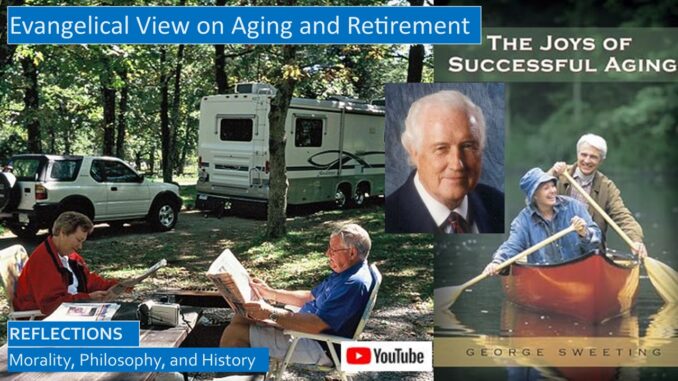
GEORGE SWEETS’ ADVICE ON FACING OLD AGE
Although the Stoic philosophers pondered on living well, aging well, and dying well, there are precious few Bible verses that directly discuss aging. The Torah, or the first five books of the Old Testament, explores what we should and should not do to live a godly life. Many family stories of the Patriarchs explore the consequences of deceitfulness and provide examples of how we should and should not live our lives.
Roman Stoic Philosopher Seneca on Old Age and Retirement
https://seekingvirtueandwisdom.com/roman-stoic-philosopher-seneca-on-old-age-retirement/
https://youtu.be/hmJoI9-s1q8
Roman Stoic Philosopher Seneca on Aging, Death, and Suicide
https://seekingvirtueandwisdom.com/roman-stoic-philosopher-seneca-on-aging-death-and-suicide/
https://youtu.be/c9JXjqRKgBE
Roman Stoic Philosopher and Politician Cicero on Aging and Death
https://seekingvirtueandwisdom.com/roman-stoic-philosophers-cicero-on-aging-and-death/
https://youtu.be/ne9T2N2mvZY
But Genesis, before Noah’s Ark and the Flood, has many stories of patriarchs who live very long lives. Adam lived until 930, many of his children lived longer, and his ancestor Methusaleh lived the longest, at 969 years old, dying just before the flood. Noah was the last patriarch to live past 900, his immediate ancestors lived around three hundred years less, decreasing until Moses, who lived to 120 years.
Moses lived a long life. You can split his life into three periods of forty years. He lived forty years in Pharaoh’s palace. After he fled Egypt, he lived forty years in the desert tending the flocks of Jethro. He accomplished little in the first eighty years of his life, which is an encouragement to those like me who want to make a difference in their retirement. In the last forty years of his life Moses led the Jews out of Egypt, crossing the Red Sea and finally the desert, to the borders of the Promised Land.[1]
Shortly before the Flood, God explained that because of the sinfulness of man and possibly fallen angels, he would limit man’s years to one hundred and twenty:
“When people began to multiply on the face of the ground, and daughters were born to them, the sons of God saw that they were fair; and they took wives for themselves of all that they chose. Then the Lord said, ‘My spirit shall not abide in mortals forever, for they are flesh; their days shall be one hundred twenty years.’ The Nephilim were on the earth in those days, and also afterward, when the sons of God went in to the daughters of humans, who bore children to them. These were the heroes that were of old, warriors of renown.”[2]
Commentators speculate that these verses are among the oldest in Genesis. Who are these Nephilim? Who are these heroes of old, warriors of renown? Commentators speculate on the meaning of these verses.[3] The Book of Enoch also mentions these giants. Ten of the twelve Israelites who spied out the Promised Land report that they saw Nephilim, or giants, blocking their way in Exodus.[4]
The few Old Testament verses and other early Jewish and Christian sources that refer to Nephilim likely draw on myths long lost and buried in the sands of history.[5] What these stories reveal is that in the ancient world, how long you lived was a gift from God, as men knew little about how to lengthen their days.
Our author, George Sweeting, points to Caleb as a Christian role model. When the Jews reached the borders of the Promised Land, they sent twelve men to spy out the new land. While ten spies were discouraged by the giants that inhabited the settlement, Caleb and Joshua were encouraged by their faith in the Lord,[6] as is recorded in the Book of Joshua, Caleb said:
“I was forty when Moses sent me” to “spy out the land; and I brought him an honest report. But my companions who went up with me made the heart of the people melt; yet I wholeheartedly followed the Lord my God.”[7]
“Here I am today, eighty-five years old. I am still as strong today as I was on the day that Moses sent me; my strength now is as my strength was then, for war, and for going and coming. So now give me this hill country of which the Lord spoke on that day.”[8] Caleb was truly a man who was strong in his old age.
There is a psalm for seniors: Psalm 71. Quoting George Sweeting: “The psalmist voices some of the feelings that accompany aging but also states his strong desire to be a light in the darkness.” Quoting from this psalm:
“O God, from my youth you have taught me,
and I still proclaim your wondrous deeds.
So even to old age and gray hairs,
O God, do not forsake me,
until I proclaim your might
to all the generations to come.”[9]
YT
George Sweeting writes: “Age adds maturity and richness to life. Age smooths the rough edges of life, adding gentleness and compassion. They say: ‘The older the violin, the sweeter the music.’ Some speak of seniors as ancient, faded, frail, shriveled, senile, withered, wrinkled, and worthless!” I prefer to say seniors are “experienced, dependable, mature, patient, seasoned, steady, wise, tested, survivor, and veteran!”[10]
George Sweeting reminds us that each age has its own sin:
- Sin of youth: “The lust of the flesh.
- Sin of our middle years: “Pride of life. You can do it! Take care of yourself!” “Ego struts its stuff, while also seeking security.”
- Sin of old age: “Greed. The accumulation of things. The quest for more. The push for security. Old age confuses having with being. However, what you are beats what you have, any day.”
“Another word for greed is covetousness, an excessive desire for things.” Covetousness leads to all other sins.
Martin Luther’s Catechisms on Do Not Envy, and Confronting Luther’s Anti-Semitism
http://www.seekingvirtueandwisdom.com/martin-luther-large-catechism-on-decalogue-do-not-envy-and-anti-semitism/
https://youtu.be/FQmBggJAhKg
Do Not Envy: Dr Laura and Her Rabbi Stewart Vogel on Ten Commandments
http://www.seekingvirtueandwisdom.com/dr-laura-and-her-rabbi-stewart-vogel-on-ten-commandments-do-not-envy/
https://youtu.be/4G-k8NfvZJ8
Catholic Catechism, Thou Shalt Not Covet thy Neighbors Possessions, CCC 2534-2540
https://www.seekingvirtueandwisdom.com/catholic-catechism-thou-shalt-not-covet-thy-neighbors-possessions-blog-4/
Catholic Catechism, Thou Shalt Not Covet thy Neighbors Possessions, CCC 2541-2557
https://www.seekingvirtueandwisdom.com/catholic-catechism-thou-shalt-not-covet-thy-neighbors-possessions-blog-5/
Catholic Catechism CCC 2534-2555: Do Not Covet Your Neighbor’s Prized Possessions
https://youtu.be/8QHrtKGDzKM
Do Not ENVY: Teachings from the Medieval Rabbis: Rashi, Rambam, Ramban, and the Talmud
https://seekingvirtueandwisdom.com/the-decalogue-in-the-torah-blog-4-coveting-the-sin-that-leads-to-many-other-sins/
https://seekingvirtueandwisdom.com/the-decalogue-in-the-torah-blog-5-coveting-tempts-you-to-harm-your-neighbor/
https://youtu.be/TOJr5J7N9Xc
George Sweeting advises us: “Do your giving while you’re living,” so you can “see firsthand the good your giving can do. To see loved ones helped is especially rewarding. To enable struggling people to find hope provides enormous satisfaction.”[11]
George Sweeting reminds us how St Francis of Assisi faced death. “When told by his doctor that his condition was incurable and death would soon arrive, Francis, with great joy, raised his hands to welcome death,”[12] quoting from the Psalms:
“Bring me out of prison,
so that I may give thanks to your name.
The righteous will surround me,
for you will deal bountifully with me.”[13]
In his Canticle to the Sun, St Francis praises Brother Sun, Sister Moon, Brother Wind, Sister Water, Brother Fire, Sister Mother Earth, and finally, in the last stanza:
“Praised be You, my Lord, through our Sister Bodily Death,
from whom no living man can escape.
Woe to those who die in mortal sin.
Blessed are those who will find Your most holy will,
for the second death shall do them no harm.”[14]
Some early rabbinical writings refer to the second death, it is the death of the wicked. In the Christian Book of Revelation, the wicked will, after their first death, die a second death after their first resurrection, where they will suffer eternal torment.[15]
Our family was blessed to spend time with my mother during her last days in the hospital, but although I accompanied her, I was not able to hear her last words the day she departed to sing in Elvis’ choir.
Epictetus, Eminent Stoic Philosopher, on Living Well, Dying Well, and Opposing Suicide
https://seekingvirtueandwisdom.com/epictetus-eminent-stoic-philosopher-on-living-well-dying-well-and-opposing-suicide/
https://youtu.be/MDRCc8Gu4y8
Unfortunately, we could not spend any time or talk to my father in the weeks before he passed. He had a phone installed since his landlord was in poor health, but he discovered a painful truth: that if you own a telephone, sometimes people call you. So, he requested that the phone company take their phone back.
My father was a hermit. Over the course of his life, he did drink too much. Like many ex-military men, drinking was his social life, he often hung out at an American Legion bar or a topless bar. He was never comfortable around children. Before our divorce, he only saw his grandchildren at Christmas, wrapping his presents in crumpled paper. After our divorce, he never visited or called his grandchildren.
Beer hastened his demise. His new landlord saw the dreaded overly plump flies in the windowsills. My father opened the refrigerator to get a beer, and keeled over backwards. The mortician said he was not viewable.
Since my dad was a Korean War veteran, his final posting was in the Barracks Eternal in the pine tree forests of Bunnell, Florida. His funeral was several hours’ drive from Jacksonville. I was accompanied only by my favorite youngest daughter and a then close friend, whose friendship Trump later ruined.
Every veteran, no matter his rank, no matter how successful he was, even if he was homeless, is sent away with a twenty-one-gun salute by an honor guard in uniform. Afterwards, we were permitted to watch the small cemetery backhoe dig his last resting place in the next available everlasting bunk.
My father accomplished so little, dying divorced and nearly broke, estranged from his grandchildren. Was my father’s life a waste? Most importantly, my father was a kind man, he did not seek to hurt anyone close to him. At the lowest time in my life, he was there, sharing his humble hovel, and loaning me a thousand dollars out of his meager savings so I could restart my professional career in South Florida.
My father lived a better life than those who destroy thousands of lives to live in mansions and float in luxurious yachts, whose funerals are often attended by a multitude. Certainly, my father was not disappointed at how few people attended his funeral, since he did not complain. So, whatever happens at my funeral, I suppose I won’t complain either.
FAVORITE QUOTATIONS ON AGING AND DYING
These are my favorite quotations from George Sweeting’s compilation:
“For age is opportunity no less
Than Youth itself, though in another dress;
and as evening twilight fades away
The sky is filled with stars invisible by day.”
Henry Wadsworth Longfellow
“Old age has its pleasures, which though different,
are no less than the pleasures of youth.”
W Somerset Maugham
“Enjoy the little things,” “for one day you may look back and realize,” “they were the big things.”
Robert Brault[16]
“It’s nice to be here. When you’re ninety-nine years old, it’s nice to be anywhere.”
George Burns
“Whatever poet, orator, or sage may say, old age is still old age.”
Sinclair Lewis
“One benefit of drawing social security is that you are no longer obligated to be a success.”
Anonymous
“A joyous occasion is never quite as wonderful as when it becomes a memory.” Jimmy Carter
Jimmy Carter on the Virtues of Aging and Retirement
https://seekingvirtueandwisdom.com/jimmy-carter-on-the-virtues-of-aging-and-retirement/
https://youtu.be/JozGKCnUyaI
“My grandfather would look through the obituaries and say to me:
‘Strange, isn’t it, how everybody seems to die in alphabetical order.”
Jackie Vernon
When in a presidential debate, Walter Mondale asked his opponent about his age, questioning whether he would be fit to serve, Ronald Reagan responded:
“I will not make age an issue,” “I am not going to exploit for political purposes my opponent’s youth and inexperience.”
“Old soldiers never die; they just fade away.”
General MacArthur
“Every man must do two things alone; he must do his own believing and his own dying.”
Martin Luther
“As a well-spent day brings happy sleep,
so a life well-lived brings happy death.”
Leonardo Da Vinci
“Preparation for old age should begin not later than one’s teens. A life which is empty of purpose until sixty-five will not suddenly become filled on retirement.”
Arthur Morgan
When you are facing death, “you needn’t worry about not feeling brave. Our Lord didn’t.” Remember how Jesus sweated blood when he prayed in the Garden of Gethsemane. “How thankful I am that when God became man, he did not choose to become a man of iron nerves. That would not have helped weaklings like you and me nearly so much.”
CS Lewis
Summary of CS Lewis’ Mere Christianity, WWII Ecumenical Broadcast: Morality Not Polemics
https://seekingvirtueandwisdom.com/summary-of-cs-lewis-mere-christianity-wwii-ecumenical-broadcast-morality-not-polemics/
https://youtu.be/6-Hc4X0NN8k
We have three quotes from Paul Tournier, a classical Christian psychologist:
“One must prepare for retirement.” “Your manner of life now is already determining your life during those years of age and retirement, without your realizing it.”
“People are reluctant to talk about old age and death because they are afraid of emotion, and they willingly avoid the things they feel most emotional about, though these are the very things they most need to talk about.
“Christian faith” “doesn’t repress one’s anxiety in order to appear strong. On the contrary, it means recognizing one’s weakness, accepting the inward truth about oneself, confessing one’s anxiety,” “and still believe. The Christian puts his trust not in his own strength, but in the grace of God.”
Classical Christian Psychologist Paul Tournier on Old Age and Retirement
https://seekingvirtueandwisdom.com/classical-psychologist-paul-tournier-on-old-age/
https://youtu.be/HE3LNGB0nUA
Classical Christian Psychologist Paul Tournier on Old Age, Death, and Faith
https://seekingvirtueandwisdom.com/classical-christian-psychologist-paul-tournier-on-old-age-death-and-faith/
https://youtu.be/gRaY2hTaEGk
His best quote: advice from Dr E Stanley Jones for continuing growth in old age:
- “Don’t retire. Change your occupation. Do something you have always wanted to do.
- Learn something new every day.
- Be gracious and kind to someone every day.
- Don’t let yourself grow negative; be positive.
- Be grateful for something every day. Make gratitude a habit.
- Now that your body is slowing down, increase your spiritual activities and prayer life.
- Each year, increase the ‘good store’ of which Jesus spoke: the depository of every thought, motive, action, attitude which we drop into our subconscious mind. This is the deep subsoil into which we can strike our roots in old age which will blossom at the end.”[17]
Let us conclude with a prayer for aging in the Anglican Book of Common Prayer:
“Look with mercy, Lord, on all whose increasing years bring them weakness, distress, or isolation. Provide for them homes of dignity and peace; give them understanding helpers, and the willingness to accept help; and as their strength diminishes, increase their faith and their assurance of your love.”[18]
DISCUSSING THE SOURCE
George Sweeting, an evangelical pastor who was affiliated with the Moody Bible Institute, wrote a delightfully humorous book on aging with much practical advice. I like how he drew from many religious traditions for his many examples and sayings.
[1] https://en.wikipedia.org/wiki/Patriarchs_(Bible)
[2] https://www.biblegateway.com/passage/?search=genesis%206%3A1-5&version=NRSVCE
[3] Gerhard Von Rad, Genesis, A Commentary, translated by John Marks (Philadelphia: West Minister Press, 1972. Originally early 1900’s), pp. 113-115.
[4] https://www.biblegateway.com/passage/?search=numbers%2013%3A33&version=NRSVCE
[5] https://en.wikipedia.org/wiki/Nephilim
[6] George Sweeting, The Joys of Successful Aging (Chicago: Moody Publishers, 2002, 2008), Chapter 1, Lighten Up, pp. 15-18.
[7] https://www.biblegateway.com/passage/?search=joshua%2014%3A7-8&version=NRSVCE
[8] https://www.biblegateway.com/passage/?search=Joshua%2014%3A10-12&version=NRSVCE
[9] https://www.biblegateway.com/passage/?search=psalm%2071%3A17-18&version=NRSVCE
[10] George Sweeting, The Joys of Successful Aging, Chapter 5, Aging With Joy, p. 53.
[11] George Sweeting, The Joys of Successful Aging, Chapter 11, Do Your Giving While You’re Living, pp. 107-1088.
[12] George Sweeting, The Joys of Successful Aging, Chapter 12, Finishing With Grace, p. 120.
[13] https://www.biblegateway.com/passage/?search=psalm%20142%3A7&version=NRSVCE
[14] https://en.wikipedia.org/wiki/Canticle_of_the_Sun
[15] https://en.wikipedia.org/wiki/Second_death
[16] George Sweeting, The Joys of Successful Aging, p. 49.
[17] George Sweeting, The Joys of Successful Aging, Chapter 14, Great Quotations On Aging and Dying, pp. 136-145
[18] https://bcp2019.anglicanchurch.net/wp-content/uploads/2019/08/56-Occasional-Prayers.pdf


1 Trackback / Pingback