History

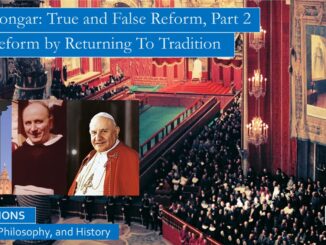
Yves Congar, True and False Reform, Part 2, True Reform by Returning to Tradition

Yves Congar reflects: Who were the successful reformers? Who were the divisive reformers? Successful reformers are those reformers who respect the tradition of the church, whose reforms seek to return the church to its ancient traditions recently forgotten, to return to the ancient sources of the faith. These successful reformers include St Francis of Assisi, and St Thomas Aquinas, and he contrasts them with reformers who broke with the church, including Peter Waldo and Luther, while being careful to acknowledge when these divisive reformers did provide valuable spiritual and practical insights. […]

History

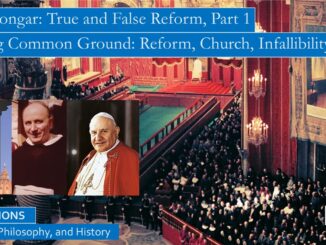
Yves Congar, True and False Reform, Part 1, Finding Common Ground

When Archbishop Angelo Roncalli, the future Pope John XXIII, reflected on this book, he asked, “A reform of the church? Is such a thing really possible?” Yves Congar reflects, What is the role of the church? Is the church the hierarchy in the Curia; or is the church the parishioners in the pews? What are the sacraments? What is the church’s definition of commonly misunderstood concepts, such as infallibility?
This book, along with help by the Holy Spirit, encouraged the pope to call for a church council, and helped set the tone for Vatican II. As Yves Congar teaches us, spiritual reform cannot be a revolution, false reform divides rather than unites. […]

AntiSemitism

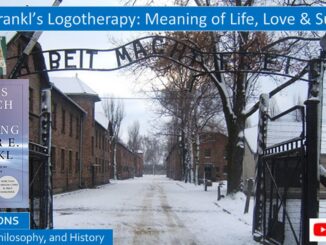
Viktor Frankl’s Logo-therapy, Man’s Search For Meaning in Life, Love, and Suffering

Viktor Frankl’s book, Man’s Search for Meaning, is a life-changing book and one of my favorites, it touched me deeply when I first read it many years ago. The main theme of the book is no matter what challenges you face in your life, or how busy you are, you always have time to be kind to all those whom you encounter, to be a positive influence on the lives whom you touch. Although he does not directly mention stoicism, his account of how he survived Auschwitz is a living example how a stoic mindset can help you survive and thrive through any challenge life may throw at you. […]

Biblical Interpretation

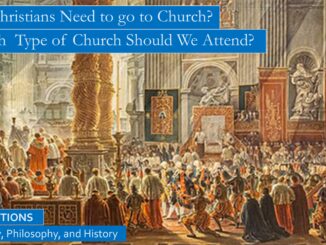
Do Christians Need To Go To Church? Which Type of Church Should You Attend?

St Augustine’s memorable reflection on our question appear in his Confessions, which is really one of the first testimonials. St Augustine tells us the story of Victorinus, a philosopher who studies the Gospels and the Church Fathers but declines to attend services, asking “Do the walls of the Church make you a Christian?” Victorinus was a learned man, an erudite pagan Platonic philosopher, the Word of the Lord spoke directly to him from the page, perhaps he felt intellectually superior to many simple Christians he knew.

In the words of St Augustine, in his studies Victorinus became “resolute, he was seized by the fear that Christ might deny him before the holy angels if he was too faint-hearted to acknowledge Christ before men, and he felt himself guilty of a great crime in being ashamed of the sacraments instituted by the Word of God in his lowly state.” […]

Philosophy

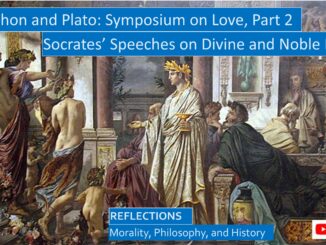
Xenophon and Plato, Socratic Dialogue, Symposium, Divine and Noble Love, Part 2

Both of these commandments are the Divine Love that Plato describes in the Symposium. Like the country song suggests, If you don’t love your neighbor, you don’t Love God. As we learned from St John of the Cross, if our love for our neighbor or our love does not increase in us our Love of God, then it is not love at all. Which means that you cannot talk about two types of love, one mortal, one divine, as do the speakers like Agathon in the Symposium, though you could talk about love and lust, love being unselfish, and lust being selfish, caring only about yourself, not caring about the well-being of your partner or friend. […]

Civil Rights

Comparing Martin Luther King’s Letter From the Birmingham Jail with Hannah Arendt’s The Banality of Evil

Many Americans are either unaware or do not want to make the connection between the Jim Crow system of racial segregation and the Nazi ideology of the master race. In fact, the Jim Crow statutes enforcing segregation was used as precedents by the Nazi lawyers drafting the Nuremberg Jewish Race Laws soon after the Adolph Hitler came to power in Germany in 1933. […]

Command 9&10 Do Not Envy

St Augustine on Catechizing the Uninstructed, Blog 2

If you seek to become a Christian for social or temporal reasons you may backslide from the faith when you see “wicked and impious men” who are more prosperous than you are.  You may ask yourself, How is this faith helping me?  This is the wrong question, for the true Christian seeks “everlasting blessedness and the perpetual rest of the saints so he may not pass into eternal fire with the devil but rather enter into the Eternal Kingdom together with Christ.  He will be on his guard in every temptation, so we will neither be corrupted by prosperity nor be utterly broken in spirit by adversity, but remain modest and temperate during good times, and be brave and patient during times of tribulation.”  Then this Christian will “Love God more than he fears hell,” and he will recoil from evil thoughts and temptations. […]

Command 9&10 Do Not Envy

St Augustine on Catechizing the Uninstructed, Blog 1

In all his writings St Augustine reminds us that the core of our faith is the commands to Love God with all of our heart and with all of our soul and with all of our mind and with all of our strength, and to love our neighbor as ourselves.  In this work on catechesis St Augustine teaches that the vice that ruins love, the vice that is the enemy of love is envy, and that the mother of envy is pride.  This section is referenced in the Catholic Catechism teaching on the Commandment, Do Not Covet. […]