AntiSemitism

John Chrysostom, Justin Martyr, and the Church Fathers Preach Against the Judaizers and the Jews

John Chrysostom is the most strident of the early Church writers in his writings opposing the Judaizers where he warned his flock that Christians should not adopt Jewish customs and practices, that Christians needed to celebrate the Church festivals rather than the Jewish festivals, that Christians should not attend services at the synagogue. His work “Against the Judaizers” is so polemic that it is far more anti-Semitic than the writings of Barnabas and St Justin Martyr and many other church fathers, it is painful for us modern readers to read, we who remember the horrific events of the Holocaust. This work is not in the standard collection of the works of the Nicene and Anti-Nicene Fathers, but it was widely read in medieval times and afterward, and unfortunately was used to justify the European and Russian pogroms and persecutions against the Jews.[2]

One scholar who has pondered the problems posed polemic stands against the Judaizers by St John Chrysostom and also St Cyril is Robert Wilken. In this book “John Chrysostom and the Jews,” he explores the history of the early church to better understand the world of the early Church Fathers. We cannot totally excuse the errors in the teachings of the early Church Fathers, but neither can we blindly judge and condemn them for not knowing the lessons of the Holocaust. There is nothing wrong with reading the Church Fathers as they apply to our modern world, but particularly in this case we should also let the Church Fathers in their ancient historical context, we need to do both lest we have a distorted understanding of the history of our faith. […]
Early Church Writing

St Irenaeus Blog 3 Allegorical Interpretations of Scripture

After Adam and Eve had eaten of the apple they were ashamed and hid, weaving coverings of fig leaves, a rather itchy leaf. St Irenaeus tells us, “Adam adopted a dress suited for his disobedience, awed by the fear of God,” which is the beginning of wisdom, “waiting for God’s coming.” By his dress he admits to himself, “I by disobedience lost that robe of sanctity which I had from the Spirit, I do now acknowledge that I am deserving” of such uncomfortable dress, which tortures the body. God, who is merciful, clothes them instead in a more comfortable tunics of skins of fur. They were then driven out of Paradise and the Tree of Life because “God pitied them and did not desire that he should continue a sinner forever, nor that his sins become immortal.” God set a limit to his sin by imposing death, “so that man, ceasing at length to live to sin, and dying to it, might begin to live in God.” There would be life in Christ, as St Paul exhorts, “O death, where is thy victory? O death, where is thy sting?” […]

Early Church Writing

St Irenaeus Blog 2 On Heresies

St Irenaeus elegantly summarizes his refutation of Gnosticism, “If Christ was not born, neither did He die. If Christ did not die, neither did He rise from the dead. If He did not rise from the dead, He did not conquer death and abolish its reign. If Christ did not conquer death, how are we to ascend to the light, we who from the beginning have been subject to death? Those who rob man of redemption do not believe that God will raise man from the dead.” […]

Early Church Writing

St Irenaeus Blog 1 On Heresies, Introduction

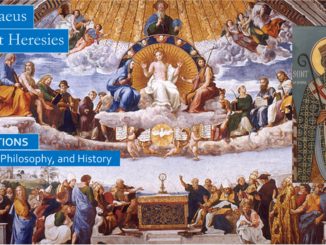
St Irenaeus teaches us, “The redemption depends on the real Incarnation, the real suffering on the Cross, and the real resurrection of the flesh. All three of these are a scandal for Gnosticism. On their view, Mary is not really Mother of God, and Christ did not really suffer, NO, the heavenly Christ escaped before the man Jesus suffered, and there can be no question at all of an actual resurrection of the flesh. Underlying this refusal of the flesh and its saving role in the Incarnation is a confusion between the human spirit (nous) and the divine Holy Spirit.” The Gnostics want to replace the Holy spirit with the human spirit. Irenaeus preaches “the salvific character of the Incarnation of God’s Son and Word.” […]

Early Church Writing

Shepherd of Hermas on Envy, Dangers of Luxury, and Salvation

The Shepherd of Hermas, also known as the Pastor of Hermas, was regarded by some early Christians as Scripture. A consensus was reached that only books that were apostolic would be included in the canon, and the Shepherd was written in the generations after the apostles. But it was recommended by many for profitable spiritual reading, and reading this work is profitable still, for the message of Hermas runs counter to the prosperity gospel, condemning luxurious living. He has a vision in Similitude 6 of a false shepherd, “an angel of luxury and deceit,” whose sheep “were feeding luxuriously and riotously, merrily skipping about,” “deceived by wicked desires, forgetting the commandments of the Living God.” Those who are lost in luxurious living, spending their time eating “the richest delicacies and in drunken revels,” cannot “return to life through repentance, because they are adding to their sins, and blaspheming the name of the Lord.” […]

Early Church Writing

Epistles of St Ignatius to the Romans and Polycarp

Repeatedly St Ignatius begs the Romans not to seek a pardon to prevent his martyrdom. He writes his rhapsody, “in the fullness of life I am yearning for death with all the passion of a lover. Earthly longings have been crucified; in me there is left no spark of desire for mundane things, but only a murmur of living water that whispers within me, ‘Come to the Father’. There is no pleasure for me in any meats that perish, or in the delights of this life; I am fain for the bread of God, even the flesh of Jesus Christ, who is the seed of David; and for my drink I crave that Blood of His which is Love imperishable.” “I am His wheat, ground fine by the lion’s teeth to be made purest bread for Christ.” […]

Early Church Writing

St Ignatius Epistles to the Ephesians, Magnesians, and Smyrnaeans

The early writings of St Ignatius of Antioch gave the early church a shining example of martyrdom. He was arrested by the authorities for his faith, like St Paul, and was being escorted to Rome to be fed to the wild animals in the arena. During the stops in his journey he received delegations from the various churches who received epistles from him to be read to their flocks. In his epistles to the churches St Ignatius insists that there be unity in the churches, that the members respect the bishops. He also tells them that a liturgy or sacrament that is not blessed by the bishop is not valid, that the faithful should be loyal and obedient to their bishop. These epistles were revered by the early church and were quoted often by the church fathers. […]

Early Church Writing

Didache: Early Church Writing

What is the Way of Life? You shall Love God with all of your heart and with all of your soul and all of your mind and with all of your strength, and you should love your neighbor as yourself, and you should never do to others what you do not want done to yourself. Thus opens the first paragraph of the Didache, which may be among the most ancient patristic works surviving. […]

AntiSemitism

Epistle of Barnabas, Beginnings of Anti-Semitism?

The Epistle of Barnabas is a curious epistle that surprisingly has some messages that ring true with modern Christians. This epistle was likely written just after most of the books of the Bible, and was considered by some Christian communities as inspirational. Eusebius in his early History of the Church says the Epistle of Barnabas was “not canonical but disputed, yet familiar to most churchmen,” […]