Preparing the Way for Vatican II: CS Lewis' Mere Christianity
CS Lewis

Preparing the Way for Vatican II: CS Lewis’ Mere Christianity

CS Lewis did not wave the flag of ecumenicism, attending this conference or that on interfaith dialogues, but instead prepares the way, saying that what denominational creed you profess is less important than whether you truly believe the core Christian teaching of the two-fold Love of God and neighbor. This was the key change wrought by Vatican II, no longer did the Catholic Church believe you needed to be Catholic to be saved. Likewise, CS Lewis is against the notion that Catholics cannot be saved. […]

Facing the Nazi Menace: CS Lewis' Mere Christianity and Viktor Frankl's Man's Search for Meaning
CS Lewis

Facing the Nazi Menace: CS Lewis’ Mere Christianity and Viktor Frankl’s Man’s Search for Meaning

Mere Christianity was compiled from a series of radio addresses by CS Lewis explaining the tenets of Christianity which were broadcast during the dark days of World War II, when Londoners fled to the safety of the underground subway tunnels while Nazi bombers destroyed their homes above. We will reflect on the many instances where CS Lewis referred often to this monumental struggle, one of the rare political struggles that actually pitted the forces of good and evil against each other, in Mere Christianity. […]

Book Reviews and Miscellaneous

Book Reviews on Apostolic and Early Church Fathers

These quick book reviews include links to our YouTube videos and blogs on the Apostolic and Early Church Fathers, plus related topics. We will also discuss how to read ancient works, and the problems scholars face when translating ancient works, and the 38-volume set of the writings of the Ante-Nicene, ante meaning before, Nicene, and Post-Nicene Church Fathers, translated into English. […]

Early Church Writing

St Irenaeus On Heresies, Eusebius and Modern Scholars, and Catholic Catechism

Eusebius explains, “Irenaeus, whose name means ‘peaceable’ and who by temperament was a peacemaker, pleased and negotiated for the peace of the churches.” There was a dispute between Bishop Viktor of Rome and the Asian dioceses over the length of a church fast, he was threatening excommunication over this dispute. Irenaeus interceded, arguing that “the dispute is not only about the day, but also about the actual character of the fast.” He pointed out the variations were differences in practice extending back to their forefathers. Although they had their differences, “they all lived in peace with one another, and so do we: the divergences in the fast emphasizes the unanimity of the faith.” […]

Command 9&10 Do Not Envy

St Cyprian on Envy and Jealousy

St Cyprian warns us of the pernicious evils of envy. “What a gnawing worm of the soul envy is, what a plague-spot of our thoughts, what a rust of the heart, to be jealous of another.” How envy gnaws at our soul when we hate our neighbor for their prosperity, their good luck, their inheritance, when we make other people’s glory our penalty, when we allow envy to be the executioner of our soul. When we are consumed by envy, “no food is joyous, no drink is cheerful. The envious are every sighing and groaning and grieving,” our envy torments us day and night. […]

Cappodocian Church Fathers

St Gregory of Nyssa, Beatitudes, Blog 5, Blessed are the Peacemakers and the Persecuted

We must be one of the peacemakers. What is peace? Peace is a “loving disposition towards our neighbor.” What is the opposite of this love? The enemy of peace is “hate and wrath, anger and envy, harboring resentment as well as hypocrisy and the calamity of war.”
We are reminded that the Beatitudes in the Sermon on the Plain directly reminds us that not only are the poor in spirit blessed, but also the poor and down and out, and in case we do not comprehend, Jesus in Luke warns us, “woe to you who are rich, for you have received your consolation.” So what is common between to these two Beatitudes and the words of Jesus on the Day of Judgement? St Gregory of Nyssa teaches us, “they all converge on the same goal,” they all show how the Love of God shines in our lives and in how we live our lives, and the love we show to our neighbor. […]

Cappodocian Church Fathers

St Gregory of Nyssa, Beatitudes, Blog 4, Blessed are the clean of heart and the merciful

These sermons by St Gregory of Nyssa are cited twice in the Catholic Catechism in its discussion of the Commandment, DO NOT COVET, DO NOT ENVY.  St Gregory of Nyssa mentions envy in this Beatitude: “Some people covet glory, or wealth, or prominence.  Others lap up envy like some noxious food, and there are others (more holy) who desire things whose nature is good.”  He continues, “the Word calls blessed those who hunger not without qualification, but those whose desire is directed toward true justice.”

Those who hunger and thirst for justice need never be filled, the possession of virtue “always offers its disciples the fulness of its delights.  Therefore, God the Word promises to those who hunger for these things that they shall be filled, and in being filled their desire for virtue will not be dulled but rather kindled anew.” […]

Cappodocian Church Fathers

St Gregory of Nyssa, Beatitudes, Blog 3, Blessed are the Meek and Those Who Mourn

St Gregory of Nyssa teaches, “Blessed are those who are not easily turned towards the passionate movements of the soul, but who are steadied by reason.”  “To boast of riches or to be proud of one’s family, to have regard to fame and to think oneself above one’s neighbor, all these human honors destroy and shame the honor of the soul.  No righteous man would thus defile the purity of his soul.  When humility is well established, wrath will find no entrance into the soul.  If there is no wrath, our life will be in a settled state of peace.  This is true meekness.” […]

Cappodocian Church Fathers

St Gregory of Nyssa, Beatitudes, Blog 2, Blessed are the Poor in Spirit

St Gregory of Nyssa’s collection of sermons on the Beatitudes is quoted twice in the Catholic Catechism’s discussion on the commandment, DO NOT ENVY.  At first blush that seems odd, the Beatitudes do not directly mention envy, but when you think of the Beatitudes as positive commands, as encouragements to Love God and our neighbor more deeply, promising blessings to those whose hearts are humble, we realize that the connection between the Beatitudes is quite natural and not odd at all, for the commandment DO NOT envy is also a positive command to see our neighbor in the best light possible, to see our neighbor’s good fortune as our good fortune, to truly love our neighbor as ourselves. […]

Cappodocian Church Fathers

St Gregory of Nyssa, Beatitudes, Blog 1, The Allegory of the Cave

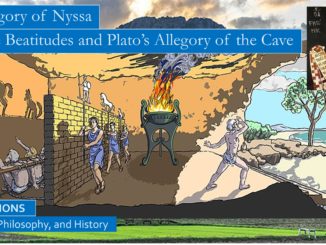
The Beatitudes and St Nyssa’s sermons on the Beatitudes are both poetry of the soul.  St Nyssa asks us, “Who among us is a disciple of the Word, seeking to ascend with our Lord from the low ground, from superficial and ignoble thoughts to the spiritual mountain of sublime concentration?  This mountain leaves behind all shadows cast by the rising hills of wickedness, this mountain is lit up on all sides by the rays of true light, from the summit of this mountain everything that is invisible to those imprisoned in the CAVE may be seen the pure air of truth.” […]