Philosophy

Xenophon and Plato, Socratic Dialogue, Symposium, Divine and Noble Love, Part 2

Both of these commandments are the Divine Love that Plato describes in the Symposium. Like the country song suggests, If you don’t love your neighbor, you don’t Love God. As we learned from St John of the Cross, if our love for our neighbor or our love does not increase in us our Love of God, then it is not love at all. Which means that you cannot talk about two types of love, one mortal, one divine, as do the speakers like Agathon in the Symposium, though you could talk about love and lust, love being unselfish, and lust being selfish, caring only about yourself, not caring about the well-being of your partner or friend. […]

AntiSemitism

Our Reflections on Morality, Philosophy, and History: Ancient and Modern Classics

To a Stoic Philosopher, the question of Theodicy, or why God permits bad things to happen to good people, why God permits suffering, is simply absurd. The fact is, we do suffer, we will face injustices, we will suffer illnesses and death, and the rain falls on both the good man and the bad man. God will not shield us from suffering and injustice, but God will provide us with the strength to endure the challenges of this life. […]

Civil Rights

Comparing Martin Luther King’s Letter From the Birmingham Jail with Hannah Arendt’s The Banality of Evil

Many Americans are either unaware or do not want to make the connection between the Jim Crow system of racial segregation and the Nazi ideology of the master race. In fact, the Jim Crow statutes enforcing segregation was used as precedents by the Nazi lawyers drafting the Nuremberg Jewish Race Laws soon after the Adolph Hitler came to power in Germany in 1933. […]

Biblical Interpretation

St Augustine: On Christian Teaching, How To Read Scripture

St Augustine teaches, “Whoever thinks he understands the Holy Scriptures, or any part of them, but interprets them in a way that does not build up this two-fold Love of God and love of neighbor, does not truly understand the Scriptures. If, on the other hand, a man draws a meaning from Scriptures that builds up the two-fold Love of God and love of his neighbor, although he does not precisely understand the exact meaning of the author, his error is not pernicious, and he is wholly clear from the charge of deception.” […]

Command 9&10 Do Not Envy

St Augustine’s Treatise on the Faith and the Creed

This discourse on the Apostle’s Creed was delivered by St Augustine to a local church council in North Africa.  In this treatise he repeats his classical explanation of the Trinity:
The Father is truly God, the Son is truly God, and the Holy Spirit is truly God.
The Father is not sometimes the Son, and the Father is not sometimes the Holy Spirit, and God is One.  We have God the Father, God the Son, and God the Holy Spirit, but “there are not three Gods in that Trinity, but One God and one substance.” […]

Morality

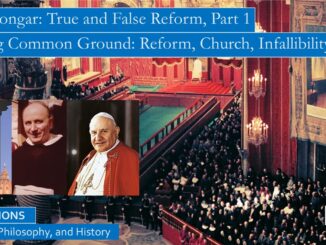
Yves Congar, Meaning of Tradition, Blog 2

By abandoning diatribes, by abandoning the proclaiming of anathemas against those who disagree with Catholic doctrine, the post-Vatican II Catholic Church now explicitly believes that both Catholics and Protestants can both attain Salvation through the grace of God and His Son Jesus Christ.  By opening a dialogue, the Church teaches we can learn from both Catholic and Protestant theologies, and this also infers that this encourages study, effort, and dedication.  In the spirit of Vatican II, we should strive to view these as differences of emphasis rather than as differences that divide. […]

Morality

Yves Congar, Meaning of Tradition, Blog 1

The cleric whose writings most influenced the decrees of Vatican II was Yves Congar, including his work on the Meaning of Tradition. He examined what the Church Fathers taught us about tradition throughout Church History, and as expected, since it was not hotly debated until the Reformation, there was a great many teachings on what tradition meant. […]

Command 5 Do Not Adulter

St Augustine on Concupiscence, Blog 3, Final Reflections

The church teaches that what gives marriage purpose is the bearing of children, so we do not live our lives for ourselves. Salvation is the purpose of marriage, the salvation of our children, the salvation of our spouse, and the working out of our salvation. How does the command to love our neighbor as ourselves work its way out in marriage? We should consider first the good of our children in the living of our lives, then we should work for the good of our spouse, and we should take care of ourselves, but we are last. But last of all in a marriage should be concupiscence, but we should not neglect loving kindness and tenderness, that should pervade all the relationships with our children and with our husband or wife. […]