How can we successfully progress from working every workday to a successful retirement?
What type of person is best suited for retirement? How can retirees combat boredom? How can they be happy in their retirement?
Should retirees start a second career, or continue their first career?
What plan does God have for our retirement?
PAUL TOURNIER ON AGING AND RETIREMENT
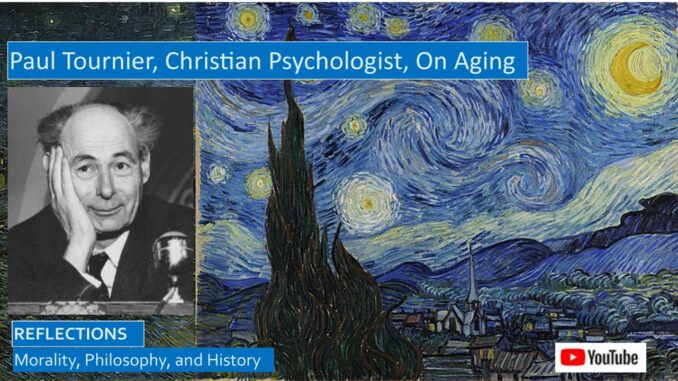
Born in 1898, Paul Tournier was a well-read pastoral counselor when Freud, Jung, and the other founders of the new science of psychiatry were practicing. He received an MD degree in 1923, and in the next year opened a private practice in Geneva, Switzerland as a general practitioner. He became a Reformed Christian at twelve, but later in life had a profound personal religious experience, which led him to believe that the physician not only had to treat the physical ailments of the patient, but also the psychological and spiritual elements. He decided to combine medicine and counseling in his practice in 1937.[1]
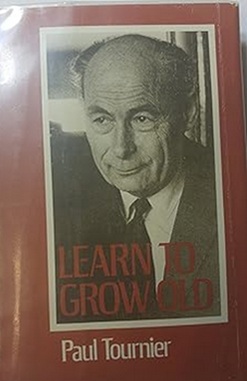
In his book Learning to Grow Old, Paul Tournier presents themes shared by many of his works. “Throughout all my books, I have maintained this idea of a civilization of the person, that all those people who have in the past been treated as things should be recognized as persons: the weak, the sick, the infirm, workers, children, adolescents, and now the old.”[2]
Paul Tournier often distinguishes “between the world of persons and the world of things, because human beings need to feel that they are loved personally, loved for themselves as persons, because too often in our modern world people feel like they are treated as things,” as merely human resources, “as tools of production. But the person is not pure spirit: the person acts and feels; and the person is one with his work; he reveals himself quite as much by his acts as by his ideas and emotions; and his ideas and emotions are but the inner echo of his encounter with the world through actions.”[3]
Tournier’s observations are from many decades of counseling hundreds of patients baring their souls, sharing their struggles and their triumphs.
CHAPTER 1: WORK AND LEISURE
Paul Tournier advises us that “to make a success of old age, one must begin it earlier and not try to postpone it as long as possible.”
There are “two great turning-points in life: the passage from childhood to adulthood and from adulthood to old age.” Jung says we should always move forward, and that those “who refuse to grow old are as foolish as those who refuse to leave behind their childhood.” If we wish to be fulfilled in our old age, we should “reawaken everything that we had to sacrifice for our career.” When we are young, we are more productive; when we are old, we are more meditative.
De Rougemont observes: “Liberated from physical labor, the Westerner turns at once to travel, sport, gambling, and eroticism.” But what happens when leisure time increases? Many of us succumb to “regression, boredom, and even anxiety-neurosis.”[4]
One trap Paul Tournier has witnessed is the fear of liberty, when someone has no interests other than work. When he retires, he often does not take up another interest to replace this activity in his life.[5]
Tournier observes that our society has taught us “to look upon work as a duty, unlike the pleasurable activities of leisure. Work, as a duty, is full of dignity, even if it is tedious or inhuman,” which makes it more meritorious.” “If your work is interesting, you are lucky, but its only true value lies in its being a duty, not in its being a pleasure.”[6] “It is particularly difficult for men who are so devoted to their work that they have hardly dared to indulge in any leisure activities during their working lives.”[7]
CHAPTER 2: TOWARDS A MORE HUMANE SOCIETY
In the ancient world, the elderly were respected, but in the modern world, the question is:
Will you still need me, will you still feed me
When I’m sixty-four?
Like the Beatles sing:
When I get older losing my hair
Many years from now
Will you still be sending me a Valentine
Birthday greetings, bottle of wine?
If I’d been out ’til quarter to three
Would you lock the door?
Will you still need me, will you still feed me
When I’m sixty-four?[8]
Paul Tournier reminds us: “The problem of old age does not concern only the old. It calls into question the whole of our society and exposes its faults.” When we are young, “we are too weak to defend ourselves.” As an adult, we can fight and strive, “but when old age comes, we find ourselves powerless once again, and feel once more the pain of the faults in our civilization.”[9]
Paul Tournier observes: “Contempt for old people” “contributes greatly to their becoming a heavy burden on society. What is the origin of this contempt?” Perhaps it results from the rising number of the elderly. In contrast, “the old were highly respected in ancient society because they were a rarity.”[10]
But he reminds us: “The old have a terribly important job: to restore to our impersonal society of the human warmth, the soul that it lacks.” “When we are old, and when we are retired, either partially or completely, our job no longer absorbs all our energies, and our experience and our understanding of life has been enriched, and so we have the time and the qualifications necessary to a true ministry of personal relationships.”[11]
Paul Tournier observes: “Prosperity, like liberty, can make people afraid. What are we to do with our liberty, what are we to do with the prosperity acquired through work, when we have spent our whole lives thinking only about work, valuing people only in terms of their labor, and condemning idleness as a vice?”
“Retired people hide themselves away and make themselves as inconspicuous as possible. They feel themselves to be a dead branch of society, like the remnant at the end of a roll of cloth, sold off cheaply after all the best of the material has gone at a good price.”[12]
Psychiatrists once thought, and many still do, that there is a strict barrier between the mentally healthy and the mentally ill. But Paul Tournier quotes a colleague who agrees that “the idea of this barrier is a mere prejudice, and that the psychiatrist’s own mental and emotional reactions are not so very different from those of their patients.”
Tournier says Freud was an example: he listened to patients whose previous complaints were ignored. “He tried to understand their strange dreams, the experiences they had undergone, the ideas they expressed, which until then had been simply dismissed either as perverse and wicked thoughts, or else as silly fantasies.” His patients “felt they were taken seriously,” which “helped them to grow and liberate themselves.”[13]
Effective medical care should not be merely tests and observations; there should be meaningful contact between the patient and the doctor. Paul Tournier counsels: “Personal contact, personal love, consists in the looks and words exchanged, the hands clasped. It means giving the patient the chance to express his secret emotions and explaining carefully to him what is being done for his welfare, because he is not a thing, but a person.”
Paul Tournier urges: “To love is to listen. It was not so long ago that children were forbidden to speak at the table. The adults’ conversation flowed around them, and they were unable to take part in it. The same thing still happens with old people. There are families in which both children and adults give noisy expression to their views, arguing by answering back over the heads of the old, who are given no opportunity to speak, because nobody bothers to think that they might have anything to say. They feel that they are looked upon as worn-out and of no further importance.”
“Love is peculiar in that the more one gives, the more one has to give. The young won’t be less loved when the old are loved more, quite the contrary.”[14]
Paul Tournier tells the tale of a pastor who had a reclusive elderly man in his parish who refused all visitors, but who was charmed when three young parish girls knocked on his door. “What a surprise! What have I done to deserve such a charming visit?” exclaimed the old man. He had lived a momentous life, he had known Napoleon III, nephew of the Emperor Napoleon and deposed ruler of France, and shared with them many interesting unknown historical events. Paul Tournier urges the young people: “Go talk to the old! You know so little about them now! So, go and discover them.”[15]
Paul Tournier observes: “One of the dimensions of your consciousness as a living being is missing if you do not enter into relationship with all age-groups, and more particularly with those who are nearing the end of their lives. If, as young people, you despise the old, you are preparing yourselves to be despised when you are old.”
We will all suffer, grow old, and die, a fact that Prince Siddhartha’s father, the king, tried to hide from him. Paul Tournier quotes from a book by Simone de Beauvoir:
“When the Buddha was still Price Siddhartha, shut up by his father inside a magnificent palace, he slipped out on several occasions, and rode about the countryside in a carriage. On the first occasion he met a man who was infirm, toothless, wrinkled, white-haired, and bent, leaning on a stick, muttering and shaking. He was astonished, and the coachman explained to him what an old man was. ‘How said it is,’ exclaimed the prince, ‘that the weak and ignorant beings, drunk with the pride of youth, do not see old age! Let us go quickly back home. What good is there in games and pleasure since I am the future abode of old age!’”[16]
CHAPTER 3: CONDITION OF THE OLD
Paul Tournier notes: “Freud defined psychological health under the double heading of aptitude for love and for work.” But Paul Tournier cautions that “the superficial relationships of working life and of sexual attraction must lead to a deeper personal commitment. And I believe that no commitment can be truly personal unless it takes on a transcendent dimension and become love, in the biblical meaning of the word.”[17]
Paul Tournier is grateful: “As an intellectual, I am specially privileged. It is true that the better educated people are, the more chance they have to enjoy their retirement. First, intellectual work” is not physically taxing. “Second, the capacity for intellectual work is retained longer than physical ability. It can even increase in old age as long as disease does not affect the mental faculties. But most of all, the more one exercises one’s mind, the more pleasure it gives to exercise it. The more one learns, the more one wants to learn, and the easier study becomes.”
During the years before I retired, I bought books that I could study during retirement, books that would improve my soul, books that would increase my compassion for my neighbor. I don’t buy books merely for entertainment, though I do occasionally read books for pleasure. Quite often, when I pick these books off the shelf, I find myself buying other books they recommend or footnote to provide background. We include books on history because you cannot truly comprehend philosophy and theology unless you have a basic understanding of the historical times in which they developed and evolved over the centuries.
Our Reflections on Morality, Philosophy, and History: Ancient and Modern Classics
http://www.seekingvirtueandwisdom.com/our-philosophy-for-this-blog-reflections-on-ancient-and-modern-classics/
https://youtu.be/Si0TsO5bNr0
Paul Tournier warns: “The problem of boredom merits our full attention, such is the suffering it brings to the hearts of many of the old.”
“Retired people are divided into two quite distinct categories.” “The one consists of people who enjoy their retirement wonderfully, spontaneously find useful and interesting things to do, and are never bored. The others are like a car that has broken down. Without that motive power in their lives provided by work, they are depressed, resigned, or in revolt.” “The first group do not need us and our advice.” “But how difficult it is to advise and help the other group!”
Paul Tournier observed from his counseling practice: “The kindly person becomes kinder as he advances in age. The critical person never stops grumbling.” “Grumbling when old is weakness and causes enfeeblement. Complaints, regrets and worry, when they go along with a feeling of impotence, become obsessive.”
“Therefore, if one’s old age is to be happy, there must be a change of attitude. This inner reformation should take place early. The task of the doctor is not merely to cure the disease, but to help the patient become aware of his problems and resolve them while there is still time.”
Paul Tournier speaks from his experience as a counselor: “Reforming lives, however, is no small matter! The vicious circles are powerful. To break them requires more than advice and good intentions. It requires an inner revolution, a decisive turn-around, as sort of conversion.”[18]
CHAPTER 4: STARTING A SECOND CAREER
Paul Tournier observes: “There are old people who struggle to continue their professional career, which they will certainly have to give up one day.” Not certainly, my doctor is over seventy and has no plans to retire, and since he owns the practice, nobody will ever fire him. He keeps up with his profession, and he has many interns that refresh his knowledge constantly.”
Unfortunately, “there are others who turn in upon themselves in idleness and boredom, in a sort of resignation from real life and from society. There are yet others who fill the void left by their retirement with so-called leisure activities which do not always suffice to give meaning to their lives, so long as they remain mere distractions.”[19]
But sometimes those who were leaders when retired still want to lead, still want to give orders, but their time has past. Will this frustration poison their old age? Will they become difficult old men? Should we force people into retirement?[20]
When those whose lives are bound in routine, what will become of them when they retire? Paul Tournier observes: “We can see a vicious circle here, as in all domains of life: routine causes aging, and this premature aging buries the individual all the deeper in routine. On the other hand, to stay open throughout our lives to a multiplicity of interests is to prepare ourselves for a lasting youth and a retirement free from boredom.” “For man alone, life is given as a task to be fulfilled.” “If man does not fulfill this task, then death supervenes.”[21]
Paul Tournier continues: “The most difficult and unhappiest old people are those who cannot accept the world and life as they are, with sickness, old age, and death; those who cannot learn abandonment, who cannot bear to be contradicted, who are nothing but complaints and criticisms, who cannot accept themselves, their infirmity, and their dependence.”[22]
Paul Tournier wrote this book on aging over a decade after the standard retirement age, and by then he had counseled many patients facing the anxieties and fears they faced near the end of their lives. Not only was he able to continue his medical and counseling practice, he also wrote many best-selling books. We plan to reflect on his most famous book, On the Meaning of Persons. The theme is shared by his many works: that all of us hide behind a mask of whom we want to be and how we want to appear. It is challenging to peer behind these masks, masks that we, our loved ones, our neighbors, and our acquaintances hide behind.
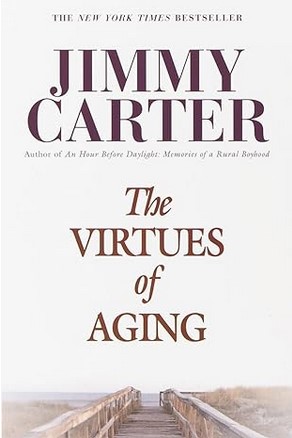
Like Paul Tournier, Jimmy Carter also reflected on the Virtues of Aging when he was in his nineties. Jimmy Carter’s humorous subhead for the first chapter quips: “Experience is what you’ve got plenty of when you’re no longer able to hold the job.”
Jimmy Carter opens his book on the Virtues of Aging recalling: “I was just fifty-six years old when I was involuntarily retired from my position in the White House. What made losing the job even worse was that it was a highly publicized event, with maybe half the people in the world knowing about my embarrassing defeat!”
Jimmy Carter realized that, as ex-President, he still had considerable prestige that could be wielded for good. He had always been active in Habitat for Humanity, which builds houses for the poor, and as President he and Rosalyn had initiated many health, education, peace, and anti-poverty initiatives to better the lives of ordinary people, so why not continue these efforts? So, attached to his Presidential Library in Atlanta are the offices of his non-profit Carter Center, initiating and continuing these many initiatives.
Jimmy Carter did more to advance these peaceful initiatives during his decades as a former President than he did in his term as President. He suggests how those who retire can volunteer to help their communities and find meaning during retirement. We need more than entertainment and leisure to find purpose in our lives.
Jimmy Carter on the Virtues of Aging and Retirement
https://seekingvirtueandwisdom.com/jimmy-carter-on-the-virtues-of-aging-and-retirement/
https://youtu.be/JozGKCnUyaI
Another former one-term President, Lyndon Baines Johnson, did not handle retirement nearly as well. Although his health after he left the Presidency was not as robust as Carter’s, he did not take well to his sudden withdrawal from the limelight to the remoteness of his Texas ranch. He had heart problems, he lived for only four years after retirement. Plans for his Presidential Library didn’t hold his attention: what kept him going were those times when his biographer and former Harvard-intern staffer, Doris Kearns, lived part-time on his ranch, bouncing around in his truck as she took copious notes on his memories of his life and presidency.
Lady Bird Johnson was grateful: Doris’ constant attention to LBJ’s storytelling gave purpose to his life. LBJ in turn gave greater purpose to Doris Kearns’ life, as he encouraged her to concentrate on her literary career rather than her safer academic career.
Lyndon Baines Johnson, Youth, Schooling, and Rise to Power
https://seekingvirtueandwisdom.com/lyndon-baines-johnson-youth-schooling-and-rise-to-power/
https://youtu.be/hBYD1yDo9eE
Presidency of Lyndon Baines Johnson, Civil Rights, Great Society, and Vietnam War
https://seekingvirtueandwisdom.com/presidency-of-lyndon-baines-johnson-civil-rights-great-society-and-vietnam-war/
https://youtu.be/lydW8mfpJGQ
Lyndon Johnson, Enacting the Great Society and Vietnam, Review of an Unfinished Love Story
https://seekingvirtueandwisdom.com/lyndon-johnson-enacting-the-great-society-and-vietnam-review-of-an-unfinished-love-story/
https://youtu.be/MgVEipHdvfM
Martin Luther King & LBJ: Great Society, Vietnam, Chicago & Memphis, Lewis Biography Chapters 10-12
https://seekingvirtueandwisdom.com/martin-luther-king-lbj-great-society-and-vietnam-northern-civil-rights-biography-chapters-10-12/
https://youtu.be/IeKssG8mrlk
When we retire, especially if we live alone, how can we replace that daily interaction with our business associates? His many patients have taught Paul Tornier that social interaction is as important in promoting psychological health as is physical health.[23]
After I retired, since I have accounting and auditing experience, I was asked to volunteer to be Treasurer for my over-55 condominium association. To my horror, when we were contemplating foreclosing on one of our more cantankerous owners who had been in and out of collections for unpaid maintenance fees for a decade, one of his neighbors cautioned us that he seemed demented and irrational. He had been such a headache for the community that my fellow board members lost patience. His demented behavior turned many in the community against him.
When I went to talk with this owner with a mental health professional, we discovered that his mind was totally gone. We hurriedly asked the attorney to halt the foreclosure until the court could appoint him a guardian, who would sell his unit and settle his debts in due course. Halting the foreclosure was quite controversial.
What was curious was the total lack of support for this cause from my fellow officers. But like many issues, what matters the most is not the issue itself, but the meta-issue. Our association was not unique: this foreclosure could have happened at any over-55 Condominium! They gifted me a great story to share to make the world a better place! Since then, I was invited to return and serve as Treasurer, and our community is supportive of this endeavor.
How I Halted a Foreclosure on a Destitute Owner with Advanced Dementia! We Discuss Dementia
https://seekingvirtueandwisdom.com/how-i-halted-foreclosure-on-owner-with-advanced-dementia-reflecting-on-dementia/
https://youtu.be/_uAJPCCRNQ8
Glen Campbell Suffering from Alzheimer’s, Early Signs and Symptoms
https://seekingvirtueandwisdom.com/glen-campbell-suffering-from-alzheimers-early-signs-and-symptoms/
https://youtu.be/F9NmDiiPowI
Wellness Checks for Dementia: Police and Mental Illness
https://seekingvirtueandwisdom.com/wellness-checks-for-dementia-police-and-mental-illness/
https://youtu.be/z_SlPLARCxU
Neurological Case Studies Including the Man Who Mistook His Wife for a Hat, and the Curious Story of Phineas Gage
https://seekingvirtueandwisdom.com/case-studies-including-the-man-who-mistook-his-wife-for-a-hat-and-the-curious-story-of-phineas-gage/
https://youtu.be/tBZIs0YZ05A
Maybe I will be less than successful in attracting media attention for this issue. Soon after this, I joined a small Rotary Chapter, and now we sponsor Health and Wellness seminars to educate the public on this issue, and to facilitate community discussions on this issue.
Bruce’s reflection on: Why I Joined Rotary, History and Philosophy of Rotary
https://seekingvirtueandwisdom.com/history-and-philosophy-of-rotary-international-and-my-personal-experience/
https://youtu.be/gN6tb3YawI0
Paul Tournier is appreciative that he also has a career as an author, as authors are never asked to retire. He is grateful that his critics cannot halt this career: “Theologians have often criticized me for interfering in what does not concern me in practicing the cure of souls without having studied at a theological college. I am fortunate in that the career of an author is not yet controlled by a committee of grammarians, for I should certainly not have found grace in the eyes of such an academy of experts.”
Paul Tournier states: “People talk of an age when we are exempt from passion. But the absence of passion really means anticipated death. If the frown of anger is no more, then the smile of pleasure will have gone as well; if there is no more indignation, neither will there be forgiveness; if there is no more anxiety, then there will be more hope either.” “For the able-bodied retired person, the real question is how to make a success of his retirement. His strength is diminishing, infirmities may supervene, but he how kept his heart, his capacity for love, his need to give meaning to his life. Is he going to fill it with endless hobbies? Spend it in sulking resignation?”
But retirement is also a liberation, a time of liberty. When we retire, we also seek “imagination and spontaneity: the need to be able to do, or not to do, what one likes, when one likes; the need to escape from the net of obligations and prohibitions imposed by economic and social life.”[24]
Paul Tournier declares: “I believe that God has a plan for every man at every moment.” What could that plan be? How detailed is God’s plan for us?
Perhaps the general plan is simple: Love your neighbor! Be kind to your neighbor! It is up to us to provide the details. But we know what is not in God’s plan: Death caused by retirement. Paul Tournier relates that, in his day, many men who retire after working on the railroad all their lives often lived only a few years after their retirement.[25]
Hillel and Jesus, Reflections on Rabbi Telushkin’s Observations
http://www.seekingvirtueandwisdom.com/hillel-and-jesus-reflections/
Comparing Hillel and Shammai to Jesus
http://www.seekingvirtueandwisdom.com/comparing-hillel-and-shammai-to-jesus/
More Stories and Sayings of Hillel and Shammai
http://www.seekingvirtueandwisdom.com/more-stories-and-sayings-of-hillel-and-shammai/
Jesus, Hillel, and Shammai, Loving God and Neighbor
https://youtu.be/ygxn2qqGnOI
This was a reflection on the first four chapters of Paul Tournier’s book, Learn to Grow Old. The final two chapters cover:
- Acceptance of Old Age and Death, and
- On Faith, How Old Age Foreshadows Death,
Which includes religious and psychological inspirations. We plan a shorter reflection on the advice Paul Tournier offers to wives and widows on aging.
We are also planning reflections on essays by the Roman Stoic philosophers Cicero and Seneca on aging and acceptance of death.
DISCUSSING THE SOURCES
Although he is somewhat forgotten today, Paul Tournier published many best-selling books in his career, and lectured in Europe and America. His books have a conversational tone, although some of the discussion is dated since this book was published about fifty years ago. We plan to reflect on his best known work, the Meaning of Persons, in the near future.
[1] https://en.wikipedia.org/wiki/Paul_Tournier and https://www.paultournier.org/en/mdlp.html
[2] Paul Tournier, Learn to Grow Old, translated by Edwin Hudson (New York: Harper and Row, 1971), p. 73.
[3] Paul Tournier, Learn to Grow Old, p. 113.
[4] Paul Tournier, Learn to Grow Old, pp. 5-13.
[5] Paul Tournier, Learn to Grow Old, pp. 18-21.
[6] Paul Tournier, Learn to Grow Old, p. 24.
[7] Paul Tournier, Learn to Grow Old, p. 32.
[8] https://www.youtube.com/watch?v=HCTunqv1Xt4 and https://en.wikipedia.org/wiki/When_I%27m_Sixty-Four
[9] Paul Tournier, Learn to Grow Old, p. 36.
[10] Paul Tournier, Learn to Grow Old, p. 38.
[11] Paul Tournier, Learn to Grow Old, p. 43.
[12] Paul Tournier, Learn to Grow Old, pp. 51-52.
[13] Paul Tournier, Learn to Grow Old, pp. 57-58.
[14] Paul Tournier, Learn to Grow Old, p. 62-64.
[15] Paul Tournier, Learn to Grow Old, pp. 70-71.
[16] Paul Tournier, Learn to Grow Old, p. 75.
[17] Paul Tournier, Learn to Grow Old, p. 101.
[18] Paul Tournier, Learn to Grow Old, pp. 112-119.
[19] Paul Tournier, Learn to Grow Old, pp. 125-126.
[20] Paul Tournier, Learn to Grow Old, pp. 137-140.
[21] Paul Tournier, Learn to Grow Old, pp. 161-163.
[22] Paul Tournier, Learn to Grow Old, p. 168.
[23] Paul Tournier, Learn to Grow Old, p. 149.
[24] Paul Tournier, Learn to Grow Old, pp. 131-135.
[25] Paul Tournier, Learn to Grow Old, pp. 155-158.


4 Trackbacks / Pingbacks