
Can we die in peace if we feel we have left much unfulfilled, if our life has not been a success? How can we find meaning in life?
Do believers accept old age more readily than unbelievers? Do they accept death more readily than unbelievers, and the prospect of approaching death?
Will true Christians always face death with confidence? Should we fear death? Does faith free us from anxiety?
Why did Jesus sweat blood in the Garden of Gethsemane?
PAUL TOURNIER ON OLD AGE, DEATH, AND FAITH
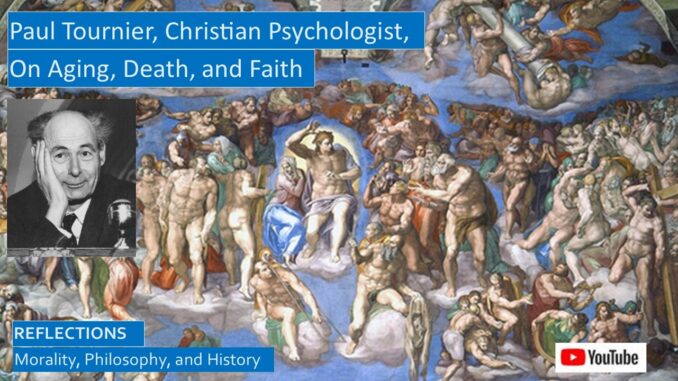
Born in 1898, Paul Tournier was a well-read pastoral counselor when Freud, Jung, and the other founders of the new science of psychiatry were practicing. He became a Reformed Christian at twelve, but later in life had a profound personal religious experience, which led him to believe that the physician not only had to treat the physical ailments of the patient, but also the psychological and spiritual elements.[1]
Our first reflection is on Aging and Retirement. The first four chapters in Paul Tournier’s Learning to Grow Old are:
- Work and Leisure
- Towards a More Humane Society
- Condition of the Old
- Starting a Second Career
Paul Tournier ends the fourth chapter with his proclamation that: “I believe that God has a plan for every man at every moment.”[2] What could that plan be? How detailed is God’s plan for us?
Perhaps the general plan is simple: Love your neighbor! Be kind to your neighbor! It is up to us to provide the details. But we know what is not in God’s plan: Death caused by retirement.[3]
Are our family, friends, and acquaintance slightly better people because we were in their lives? Do we bring out the best, or worst, in those around us? Do we see the best, rather than the worst, in those whom we meet? How can we bring out the best in someone if we think the worst of them? Is a virtuous life one of purposeful naivete?
Hillel and Jesus, Reflections on Rabbi Telushkin’s Observations
http://www.seekingvirtueandwisdom.com/hillel-and-jesus-reflections/
Comparing Hillel and Shammai to Jesus
http://www.seekingvirtueandwisdom.com/comparing-hillel-and-shammai-to-jesus/
More Stories and Sayings of Hillel and Shammai
http://www.seekingvirtueandwisdom.com/more-stories-and-sayings-of-hillel-and-shammai/
Jesus, Hillel, and Shammai, Loving God and Neighbor
https://youtu.be/ygxn2qqGnOI
If you or your loved one is facing imminent death, you may find comfort from the video channel hosted by Hospice Nurse Julie. https://www.youtube.com/@hospicenursejulie.
CHAPTER 5: ACCEPTANCE OF OLD AGE AND DEATH
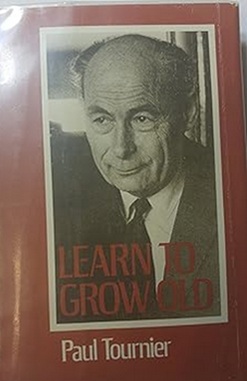
Paul Tournier begins: “To accept old age is to say YES to life in its entirety.” “Life is one way,” “it only moves forward.” “One prepares for old age by taking a positive attitude throughout one’s life, by living each stage fully.”[4]
When you ask someone young, “Are you afraid of old age?”
They may respond: “If I have made a success of my life, I shall not be afraid of growing old.”
Tournier reminds us that we may experience many successes, but as we grow older, “success retreats, and escapes us, it is limited, unfulfilled.” “When one comes to the end, a man’s life is nothing much.” “Professional life is over, and it finishes unfinished. This is a prefiguration of death, in which the whole of life will finish it, too, being unfinished. That is the dramatic contradiction of death.” Quoting Robert Mehl: “An end, but not a fulfilment, that is the face of death.”[5]
We fear the truth. Paul Tournier states: “Man both seeks truth and flees from it. Though man flees from the truth, he does not stop seeking it as well. We flee only from the things that fascinate us. Man needs truth in order to live. The love of truth is the source of all harmony with oneself.”
“To live is to grow old, and that is true at any age.” “There is a tension between one’s real age, the age one looks, and the age one pretends to be.”[6]
Paul Tournier shares: “A relationship of love or friendship is also a creation that has the savor of eternity, but death strikes it brutally with incompleteness. St Augustine expressed this vividly regarding the death of his young friend: ‘I wondered yet more that myself, who was to him a second self, could live, he being dead.’ Each of us dies a little in the death of those we love, and there is a part of our lives which ever afterwards we feel to be incomplete.’”[7]
Professor Cary of the Great Courses Plus says St. Augustine’s description of the grief he suffered when he lost his friend is probably the most poignant description of grief in ancient or modern literature:
“My heart grew somber with grief, and wherever I looked I saw only death. My own country became a torment and my own home a grotesque abode of misery. All that we had done together was now a grim ordeal without him. My eyes searched everywhere for him, but he was not there to be seen. I hated all the places we had known together, because he was not in them and then could no longer whisper to me ‘Here he comes!’ as he would have done had he been alive but absent for a while.”
Young Augustine continues: “I had become a puzzle to myself, asking my soul again and again ‘Why are you downcast? Why do you distress me?’ But my soul had no answer to give. If I said, ‘Wait for God’s help’, she did not obey. And in this she was right because, to her, the well-loved man whom she had lost was better and more real than the shadowy being in whom I would have her trust. Tears alone were sweet to me, for in my heart’s desire they had taken the place of my friend.”
Grief is the agony that comes upon your soul when it is torn in two when you lose your friend. St. Augustine loved his friend as if he would never die, cleaving to his friend as if he were his source of happiness, loving someone he would inevitably lose. Instead, we should love our friends in God, love them for the sake of the happiness that is eternal, sharing this eternal happiness with your friend, so you Love God through your love for your friend. When you have excessive grief, it means your love has gone astray.[8]
St Augustine’s Confessions: Manichaeism, NeoPlatonic Philosophy, and Monica’s Prayers, Books 3, 4, and 5
https://seekingvirtueandwisdom.com/st-augustines-confessions-manichaeism-neoplatonic-philosophy-and-monicas-prayers/
https://youtu.be/ydskqlgZSrE
Paul Tournier concludes: “But the pain of unfulfillment is not felt only in exceptional and dramatic situations. It is a daily occurrence. We die a little every day in all the things we leave uncompleted. All work is a beginning which does not really finish. It is rare for a man to be able to achieve what he has undertaken to do.”
Paul Tournier reflects on how Jesus, “in the tragic dialogue in the Garden of Gethsemane, there is physical anguish in face of approaching death. There is also the painful problem of the slow, dark search to know God’s will, so difficult to make out with certainty.”
“That Jesus could not get his message across to the religious leaders of his people was not the worst of his disappointments. His own disciples, his intimate friends, asleep there, nearby, at this moment!”[9]
To appreciate how deeply disappointed and anguished Jesus was, let us read the account in Luke:
“When Jesus reached Gethsemane, he said to his disciples, ‘Pray that you may not come into the time of trial.’ Then he withdrew from them about a stone’s throw, knelt down, and prayed, ‘Father, if you are willing, remove this cup from me; yet, not my will but yours be done.’ [[Then an angel from heaven appeared to him and gave him strength. In his anguish, he prayed more earnestly, and his sweat became like great drops of blood falling down on the ground.]] When he got up from prayer, he came to the disciples and found them sleeping because of grief, and he said to them, ‘Why are you sleeping? Get up and pray that you may not come into the time of trial.’”[10]
Why are two key verses bracketed? Because they do not appear in some earlier manuscripts. Bruce Metzger, a textual critic who was on the New Revised Standard translation committee, explained that although some earlier manuscripts omitted these two verses, they were included in commentaries by many early Church Fathers, including St Justin the Martyr, St Irenaeus, Eusebius, and others, which means they likely originated from a genuine ancient oral tradition.[11]
When we are young, we “work in order to live, and we live in order to work!” Paul Tournier asks: “Does life have meaning?” Or does life not make sense? The philosopher Camus asks this in his Myth of Sisyphus, where he explores why some find meaning in their lives, and why others end their lives in suicide. Tournier summarizes: “Sisyphus was the mythical hero whom Zeus condemned to pushing an enormous boulder eternally up a steep slope, only to have it roll back to the bottom whenever he got it nearly to the top.”
Paul Tournier continues: “With brutal suddenness retirement comes. Old age creeps on, a new generation takes their place, challenging the validity of their beliefs, bereavements bring loneliness and leave unfulfilled their dearest affections, and on the horizon, death takes shape.”
Paul Tournier finds inspiration in how the Jewish psychologist, Viktor Frankl, found meaning even in his life in the Auschwitz work camp during World War II. He quotes Viktor Frankl: “Man seeks a meaning for his life, and tries to fulfill himself in accordance with that meaning.”[12]
Frankl believed that there can always be meaning in your life if you seek meaning outside yourself. He remembers how many in Auschwitz committed a passive suicide when they lost their will to live. Those prisoners with a rich inner spiritual life were more likely to survive.
Viktor Frankl remembers, “In spite of all the enforced physical and mental primitiveness of life in a concentration camp, it was possible for spiritual life to deepen. Sensitive people who were used to a rich intellectual life may suffer more pain, but the damage to their inner selves was less. They were able to retreat from their terrible surroundings to a life of inner riches and spiritual freedom. Only in this way can one explain the apparent paradox that some prisoners of a less hardy make-up often seemed to survive camp life better than those who were more robust.” [13]
Viktor Frankl tells us, “The experiences of camp life show that man does have a choice of action. Apathy can be overcome; irritability can be suppressed. Man can preserve a vestige of spiritual freedom, of independence of mind, even in terrible conditions of psychic and physical stress.” No matter how dire your circumstances, you can always be kind to those around you.[14]
Viktor Frankl, Man’s Search For Meaning, His Life in a Nazi Concentration Camp in WWII
http://www.seekingvirtueandwisdom.com/viktor-frankl-mans-search-for-meaning-his-life-in-a-nazi-concentration-camp-in-wwii/
https://youtu.be/O-YtC9qGWPI
What helped keep Viktor Frankl alive was the memory of his wife whom he loved dearly. She did not survive the camp, but he would not know that until after the war, although she was less than a mile distant. He also imagined himself teaching a class on the psychology of the camps, what he called Logotherapy, which taught that man must find meaning, have a purpose in life, to be psychologically and spiritually healthy. He must live life for others rather than for himself.
Viktor Frankl’s Logo-therapy, Man’s Search For Meaning in Life, Love, and Suffering
https://seekingvirtueandwisdom.com/viktor-frankls-logo-therapy-mans-search-for-meaning/
https://youtu.be/1nTYlhDUJh8
What embarrasses Paul Tournier is the oft-heard mantra that “the meaning of my old age is to prepare me for death and for meeting God, to detach me from the things of this world in order to attach me to those of heaven.”
Tournier explains, “Death is not a project, and it is not my reality. What concerns me if my life now, and to seek the will of God for me today, for the meaning of life is always the same, to allow oneself to be led by God. Detach myself from the world? That would be to run away from my own reality.”
Paul Tournier quotes General MacArthur, who fought against the Japanese during World War II, and remade Japanese society after the war: “You don’t get old from living a particular number of years. You get old because you have deserted your ideals. Years wrinkle your skin, renouncing your ideals wrinkles your soul. Worry, doubt, fear, and despair are the enemies which slowly bring us down to the ground and turn us to dust before we die.”[15]
CHAPTER 6: ON FAITH, HOW OLD AGE FORESHADOWS DEATH
Paul Tournier asks: “Do believers accept old age more readily than unbelievers? Do they accept death more readily than unbelievers, and the prospect of approaching death?”
Tournier first replies that death “is a psychological problem much more than a religious problem.” “All anxiety is reduced to anxiety about death.” When men are freed from the fear of death, “they are freed from all other fears.” Nevertheless, the sociologists are right: men do not talk about this anxiety concerning the threat of death, because all men attempt to repress it.”
Paul Tournier laments: “Religious controversies” “add their poison to the emotional drama” through a “vicious circle: anguished minds tend to retain from the Bible and the preaching of the church the implacable threats, while untroubled minds only retain the reassuring promises of divine grace.”
“On the one hand, it is true, we must admit that Christianity has done little to lessen the anxiety of the faithful in the face of death, despite its triumphant message about the Resurrection of Jesus. But on the other hand, we must also recognize that great victims of anxiety such as St Francis of Assisi, Pascal, Luther, and Kierkegaard won a victory of a quite different kind, through the faith that was grafted onto their anxiety.”
If we truly believe in Christ, should we fear death? Although if this attitude and fortitude were genuine, Paul Tournier does concede that this demonstrates a courageous faith, but what moves him most “is not this or that declaration of fervent belief, however impressive, but the feeling that a person is living his personal experience of Jesus Christ.”
“Christian faith does not involve repressing one’s anxiety in order to appear strong. On the contrary, it means recognizing one’s weakness, confessing one’s anxiety” “while still believing.” “That is to say that the Christian puts his trust not in his own strength, but in the grace of God.”[16]
Paul Tournier reminds us: “The ideal of indifference in the face of death is not Christian. It was the ideal of the Epicureans,” “and the Stoics, who called it ataraxia,” or “repression of emotion, a stubborn bracing of the mind against the drives of the unconscious. It is the opposite of a surrender” when you have faith.
Was Epicurus Really a Stoic-Lite Philosopher? Were all Epicureans hedonists?
http://www.seekingvirtueandwisdom.com/was-epicurus-really-a-stoic-lite-philosopher-were-all-epicureans-hedonists/
Epicurus, Aristippus, and Lucretius: History of Epicurean Philosophy
http://www.seekingvirtueandwisdom.com/epicurus-aristippus-and-lucretius-history-of-epicurean-philosophy/
Epicurus, Aristippus, and Lucretius: Were the Epicureans Stoic-Lite Philosophers?
https://youtu.be/49Qv3Be86Jw
Paul Tournier continues: “It may have worked in the case of strong-willed personalities like Epictetus, Cicero, or Marcus Aurelius. But it lacks the tenderness which is an inseparable element in the Christian gospel.”
Major Roman Stoic Philosophers, My Favorite Maxims: Epictetus, Rufus, Seneca & Marcus Aurelius
https://seekingvirtueandwisdom.com/major-roman-stoic-philosophers-my-favorite-maxims-epictetus-rufus-seneca-marcus-aurelius/
https://youtu.be/E0qQgqGkoOE
Greek Stoic and Cynic Philosophers: My Favorite Maxims: Heraclitus, Antisthenes, Diogenes, and Zeno
https://seekingvirtueandwisdom.com/greek-stoic-and-cynic-philosophers-my-favorite-sayings/
https://youtu.be/rq3oRftjM4c
Modern Stoic Philosophers: My Favorite Maxims: Viktor Frankl, Nelson Mandela, and Others
https://seekingvirtueandwisdom.com/modern-stoic-philosophers-my-favorite-maxims-viktor-frankl-nelson-mandela-and-others/
https://youtu.be/rq3oRftjM4c
On this point I differ from Paul Tournier, although I agree that because of modern medicine, we do not face death as frequently as did the ancients. Maybe we do not need to follow the Stoic advice not to grieve when a loved one passes away, but we should be inspired by the Stoics to develop good habits so we can control our passions, that it is indeed possible to us to control our passions.
To understand the Stoic viewpoint, we must remember that the infant mortality rate in the ancient world was incredibly high: between a quarter and a third of infants died in their first year of life. If you survived childhood, you had a decent chance of surviving until middle age, though most people died before they were fifty. The diet of many ordinary people in the ancient world was just above a starvation diet. So many women died in childbirth that Roman wives often updated their wills when they learned they were pregnant.[17]
Ordinary Life and Justice in Ancient Athens, Rome, and Israel
http://www.seekingvirtueandwisdom.com/ordinary-life-and-justice-in-the-ancient-world/
https://youtu.be/vl8KGL5Yx2w
Even for wealthy families, infant mortality was high. For example, Marcus Aurelius’ wife bore him fifteen children, of whom only six survived to adulthood.[18]
Marcus Aurelius includes in his Meditations some fatalistic thoughts on how ancient parents can cope with this high mortality rate:
- “Pray not for some way to save your child, but for a way to lose your fear of this.
- Your children are like leaves. The wind scatters some of them on the ground; such are the children of men.
- As you kiss your son goodnight, whisper to yourself that he may be dead in the morning.”[19]
Ordinary Life for Romans Under Stoic Emperor Marcus Aurelius
https://seekingvirtueandwisdom.com/ordinary-life-for-romans-under-stoic-emperor-marcus-aurelius/
https://youtu.be/9hgSbcgbCJw
Paul Tournier confesses: “I believe in the resurrection of the body, but I realize perfectly well that as death approaches, my supreme security lies not so much in which doctrine I believe, as in the close bond which attaches me to the person of Jesus. I am not alone as I face death. I am with Jesus who has faced it too.”[20]
“Eternal life does not begin after death, we start living it now; only it is masked by our daily cares, and it is only on contact with death, perhaps, that we discover it. God is not a God of the dead, but of the living, since for him they are all living. Which, to my astonishment, fills me with joy, despite the sadness.”[21]
How can Paul Tournier see joy in death and sadness? St John Climacus also finds joy in the remembrance of death in his monastic manual, Ladder of Divine Ascent, where he instructs the devout on how they can climb to the heavenly realms. Step 6 is titled On Remembrance of Death, and Step 7 is Joy-Making Mourning. He echoes many of the lessons Viktor Frankl teaches us.
St John Climacus explains:
Step 6.3. “Fear of death” “comes from disobedience, but trembling at death is a sign of unrepented sins.” Those who fear death the most are the disobedient who live only to party, who live for today, who live for themselves, and do not live for others, they are the unrepentant who tremble at death’s gates. Even “Christ fears death, but does not tremble,” so He can show us that he is both God and man.
Step 6.24. Our saint continues: “It is impossible, someone says, impossible to spend the present day devoutly unless we regard it as the last of our whole life.”[22]
St John Climacus’ chapter on joy making mourning starts with great longing:
Step 7.1. “Mourning according to God is sadness of soul and the disposition of a sorrowing heart, which ever madly seeks that for which it thirsts; and when it fails in its quest, it painfully pursues it; and follows in its wake grievously lamenting.”
In the Ladder of Divine Ascent, we mourn out of Love of God, so he will blot out all our sins:
Step 7.45. “My friends, God does not ask or desire that man should mourn from sorrow of heart, but rather that, out of love for Him, he should rejoice with spiritual laughter. Remove the sin, and the tear of sorrow is superfluous for your eyes.” [23]
But St John Climacus not only bids us to remember of our impending death; he also teaches that we should not be despondent, reminding us that:
Step 13.11. “Despondency is one of the eight capital vices, and moreover the gravest.”[24]
Ladder of Divine Ascent, Remembrance of Death, Joy Making Mourning, and Despondency, Steps 6,7, & 13
https://seekingvirtueandwisdom.com/ladder-of-divine-ascent-remembrance-of-death-joy-making-mourning-and-despondency-steps-67-13/
https://youtu.be/pFwC2nDf1CQ
Paul Tournier concludes: “Death remains a fearful and cruel monster. The Bible says that it will be the last enemy to be overcome (1 Cor 15:26). Jesus himself overcame death only by accepting it and accepting its anxiety”[25] when he sweated blood in the Garden of Gethsemane and when hanging on the cross.
Paul Tournier laments: “What kills many retired people” “is not the prospect of approaching death,” which they clearly sense, “but it is a problem in their lives that they are unable to resolve: the crisis of their retirement. The crisis they face is being unable to see any more meaning in their lives, anything more to hope for.”[26]
[1] https://en.wikipedia.org/wiki/Paul_Tournier
[2] Paul Tournier, Learn to Grow Old, translated by Edwin Hudson (New York: Harper and Row, 1971), p. 155.
[3] Paul Tournier, Learn to Grow Old, p. 158.
[4] Paul Tournier, Learn to Grow Old, p. 178.
[5] Paul Tournier, Learn to Grow Old, p. 171.
[6] Paul Tournier, Learn to Grow Old, pp. 182-183.
[7] Paul Tournier, Learn to Grow Old, p. 172.
[8] St Augustine, Confessions, translated by RS Pine-Coffin (New York: Dorset Press, 1986, 1961, originally 400 AD), Book 4, Chapter 4, pp. 75-76 and Phillip Cary, Augustine, Philosopher and Saint, Teaching Company, 1997, Lecture 4, Confessions, Love and Tears.
[9] Paul Tournier, Learn to Grow Old, pp. 173-174.
[10] https://www.biblegateway.com/passage/?search=Luke%2022%3A40-46&version=NRSVCE
[11] Bruce Metzger, A Textual Commentary on the Greek New Testament, Second Edition (Germany: Deutsche Bibelgesellschaft, 2016, First Edition, 1971), p. 151.
[12] Paul Tournier, Learn to Grow Old, pp. 188-199.
[13] Viktor Frankl, Man’s Search for Meaning (Boston: Beacon Press, 2006, 1959), Chapter 1, Experiences in Concentration Camp, p. 36.
[14] Viktor Frankl, Man’s Search for Meaning, Chapter 1, Experiences in Concentration Camp, pp. 3-96.
[15] Paul Tournier, Learn to Grow Old, p. 192.
[16] Paul Tournier, Learn to Grow Old, pp. 215-222.
[17] Gregory S Aldrete, History of the Ancient World: A Global Perspective, The Great Courses/Wondrium lectures, 2011, Lecture 1, Cities, Civilizations, and Sources
[18] Frank McLynn, Marcus Aurelius, A Life (Philadelphia, PA, Da Capo Press, 2009), p. 86, XX.
[19] Frank McLynn, Marcus Aurelius, A Life, p. 93, his footnotes include references to the Meditations.
[20] Paul Tournier, Learn to Grow Old, p. 239.
[21] Paul Tournier, Learn to Grow Old, pp. 230-231.
[22] St John Climacus, Ladder of Divine Ascent, translated by Colm Luibheid and Norman Russell (Boston: Holy Transfiguration Monastery, 1991, originally written 1100’s), Step 6, pp. 66-69.
[23] St John Climacus, Ladder of Divine Ascent, Step 7, p. 358.
[24] St John Climacus, Ladder of Divine Ascent, Step 13, pp. 95-97.
[25] Paul Tournier, Learn to Grow Old, pp. 222-223.
[26] Paul Tournier, Learn to Grow Old, p. 166.


2 Trackbacks / Pingbacks