Popes Between Trent and Vatican I, Including Napoleon, the French Revolution, and Pope Pius VI
History

Catholic Popes from Trent to French Revolution and Napoleon to Vatican I

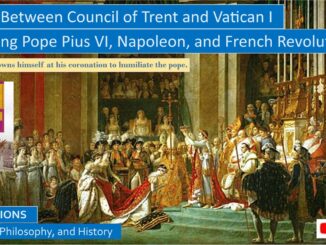
Negotiations for a Concordat between France and the Pope dragged on for thirteen months and over two dozen drafts. O’Malley writes: “Pope Pius VII and” his secretary of state “Consalvi stalled for time, intent on getting out of Napoleon every concession they could. The delay drove Napoleon crazy. He threw tantrums. He threatened to become a Protestant. He threatened to have his troops march on Rome. But finally, on July 15, 1801, the concordat was signed.”
What were the terms of the concordat? Although it acknowledged that most French were Catholics, there was freedom of religion, and Catholicism was not the state religion of France. O’Malley notes: “The buildings and real estate seized from the church during the Revolution were to remain in the hands of the new owners, but cathedrals and churches needed for worship were put at the disposal of clergy as needed. The clergy, who must swear to uphold the government, were paid by the state, which is the first time in history for such a provision.” It reaffirmed that “the state had the right to nominate bishops, subject to the approval of the papacy.” […]
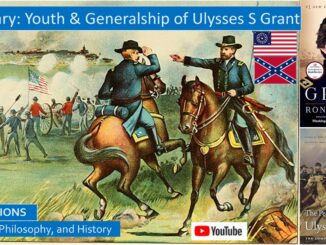
Summary of Youth and Military Career of Ulysses S Grant
Civil War Memories

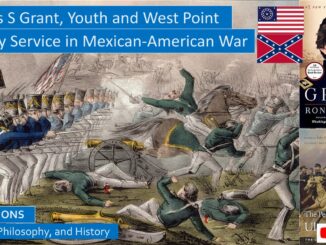
Summary of Youth, West Point, and Generalship of Ulysses S Grant, From Mexican-American War to Civil War

Those who fought the Civil War grew up in the America of Andrew Jackson, when the giants of the second generation of American leaders fought to hold the United States together. These great orators, including Henry Clay and Daniel Webster, would later inspire Union soldiers to fight and die to preserve the Union. These were the years when the slave-owning Southern President Andrew Jackson threatened to deploy federal troops to prevent the secession of South Carolina over tariffs during the Nullification Crisis in the 1830s. […]

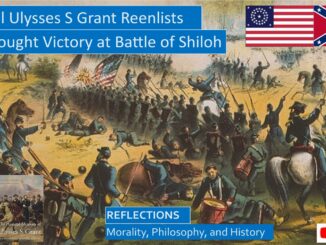
General Ulysses S Grant’s Victory at the Bloody Battle of Shiloh, and His Earlier Civil War Battles
Civil War Memories

General Ulysses S Grant’s Victory at the Bloody Battle of Shiloh, and His Earlier Civil War Battles

Chernow recounts: “Before Shiloh, Grant had nursed hopes for a titanic battle that would triumphantly crush the rebellion. Now, stunned by the combative spirit of his foes, he knew there would be many more bloodbaths in a long, grinding war of attrition. This began is conversion to a theory of total warfare in which all of southern society would have to be defeated.”
Chernow continues: “For Grant, Shiloh represented a personal victory. He had rescued his army from his own errors, showing a gumption and an audacity that altered the battle’s course. He had shown coolness under fire and a willingness to take monumental gambles. The battle also instilled lasting confidence in the Army of the Tennessee, shattering anew the fighting mystique of rebel soldiers.” […]

Early Life and Career of Ulysses S Grant Through His Service in the Mexican American War
Civil War Memories

Early Life and Career of Ulysses S Grant Through His Service in the Mexican American War

What was young Ulysses like? Chernow says that in his youth, Ulysses “seemed forgettable and colorless,” was not wayward or rambunctious or mischievous. “Like his mother, he was self-contained, as if he had trained his face to mask emotion and keep his inner life secret. Like Hannah, he was uncommonly even-tempered.” Unlike many great men of history, Ulysses in his youth had no vision of a great future and was prepared to live his life in obscurity. He was underestimated by many who met him.
Chernow describes traits that would serve him well later in life. “Never one to initiate a fight, he refused to back down when bullied. He was roused to fury if sadistic boys tormented an innocent child or a defenseless horse, and small boys embraced him as their steadfast protector.”
Ulysses was born with a love for horses. Chernow notes: “He liked to ride without a saddle or stirrups, sitting astride a blanket on the horse’s back, and he was so expert at handling horses that he began riding at age five. He became known for breaking in wild horses for local farmers.” “He tamed even the most refractory horses through a fine sensitivity to their nature rather than by his physical prowess.” […]

JRR Tolkien’s Lord of the Rings: How Was It Influenced by Nordic Mythology and Catholicism
History

JRR Tolkien’s Lord of the Rings: Was It Influenced by Nordic Mythology, Homer’s Iliad, and Catholicism?

What inspirations did JRR Tolkien draw from for his best-selling series The Lord of the Rings, and the Hobbit? Like his friend CS Lewis, Tolkien was an English Professor specializing in medieval and ancient literature and languages. When CS Lewis was contemplating whether to return to his Episcopalian roots, abandoning his youthful agnostic views, Tolkien argued that he should convert to Catholicism. CS Lewis resisted these pleas. IMHO, though CS Lewis was conducive to Catholicism, and may have even confessed his sins to a priest, he likely thought he would be more effective evangelizing through his books as an Episcopalian.
Both JRR Tolkien and CS Lewis fought in the trenches in France as British soldiers during World War I, they both lost many friends who fought beside them: they both experienced the horrors of war. Both were too old to serve in World War II, but this struggle against the evils of Naziism directly influenced CS Lewis’ Mere Christianity and Tolkien’s Lord of the Rings, both released shortly after the war. […]

Who Were More Violent: Black Civil Rights Protestors or White Supremacists?
Civil Rights

Who Were More Violent: Black Civil Rights Protestors or White Supremacists?

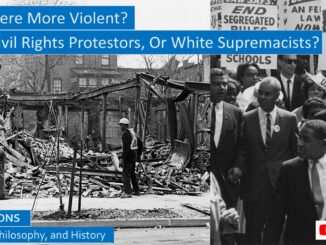
We had a recent comment on the somewhat peaceful protests organized by Martin Luther King and other civil rights leaders during the tumultuous decade of the Sixties: “They were violent rioters, not peaceful protesters.” How violent were these protesters, and how violent where the white supremacists they were confronting? And […]

Jimmy Carter, Raising Crops and Livestock, and Health and Hygiene, in Rural Georgia During the Depression
Civil Rights

Jimmy Carter, Raising Crops and Livestock, and Health and Hygiene, in Rural Georgia During the Depression

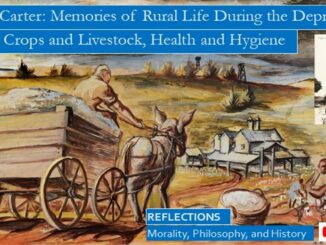
Although both blacks and whites experienced health and hygiene challenges during the Depression, poor health was more prevalent among black laborers and sharecroppers. Jimmy Carter remembers: “The life expectancy of black men and women was less than fifty years.” “During most of the year, they ate only two meals a day, usually cornmeal, fatback, molasses, and perhaps sweet potatoes. The more industrious families also had small gardens that provided some seasonal corn, Irish potatoes, collards, turnips, and cabbage, with a few rows of peas and beans planted alongside the garden fence. The combination of constant and heavy work, inadequate diet, and excessive use of tobacco was devastating to the health of our poorer neighbors.” His mother encouraged her black neighbors to grow vegetables in their own gardens, and shared with them the vegetables from the Carter family garden. […]

Jimmy Carter, Memories of Sharecropping, Civil Rights, and Life in Rural Deep South Georgia
Civil Rights

Jimmy Carter, Memories of Sharecropping, Hoboes, New Deal, and Civil Rights in Rural Georgia

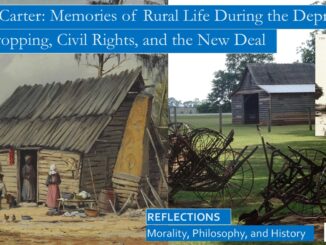
“There was an issue that troubled my mother during my political years, when the news media began to probe our family’s history. One day she said to me, “Jimmy, one thing bothers me. Reporters have criticized your daddy lately about not being for racial integration. What they don’t recognize is that he died in 1953, when there was no such thing as integration, and nobody had ever heard of Martin Luther King or any civil rights movement. Your daddy always rejected all the racist organizations that degraded or persecuted black people, and both races always knew him to be fair and helpful. I was real controversial in the community sometimes, but he supported everything I did to help black people and to treat them well.” […]

Jimmy Carter: Christmas in Plains Compared to Christmas in the White House and Afterwards
Current Events and History

Jimmy Carter: Christmas in Plains Compared to Christmas in the White House and Afterwards

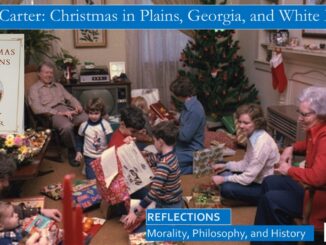
Jimmy Carter grew up on his family farm in Archery, Georgia, several miles from Plains. He remembers: “In those earlier days, all my close neighbors were black families.” Their children “were my intimate friends with whom I played, fought, fished, hunted, and worked with in the cotton and peanut fields that were owned by my father.” When he went into town to sell peanuts, and when he started school, he felt that he “was in an alien environment in Plains, away from my black friends.”
Jimmy Carter continues: “The Great Depression was a time of almost incredible poverty, not only in rural Georgia but all over the country. Although my father was a landowner, cash money was scarce for us and for everyone else. Land seemed to have the only permanent economic value, and hard work was the key to survival. The celebration of Christmas during these times was quite different from what we know today: much more frugal, but with a degree of personal intimacy that brings back warm recollections.” […]

Jimmy Carter Biography Presidency Carter Center
Abortion

Jimmy Carter, His Presidency, and Founding the Carter Center

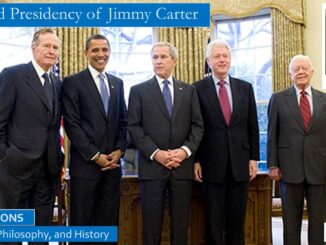
Jimmy Carter was elected as President when many voters wanted an honest President after the nation witnessed the Watergate scandal and coverup by a criminal president who was facing impeachment. Not only was Jimmy Carter seen as an honest man, but he was also a sincere born-again Christian. But his support for civil rights turned many white Christians against him. In the introduction, Jimmy Carter proclaims: “Vice President Mondale summarized our administration by saying, ‘We told the truth, we obeyed the law, we kept the peace.’ I would add, ‘We championed human rights.’” […]