Book Reviews and Miscellaneous
Book and Lecture Reviews of Ancient Greek History and Philosophy
Since we seek to draw moral lessons from history, we favor the Lives of Great Greeks and Romans by Plutarch. […]
Since we seek to draw moral lessons from history, we favor the Lives of Great Greeks and Romans by Plutarch. […]

To a Stoic Philosopher, the question of Theodicy, or why God permits bad things to happen to good people, why God permits suffering, is simply absurd. The fact is, we do suffer, we will face injustices, we will suffer illnesses and death, and the rain falls on both the good man and the bad man. God will not shield us from suffering and injustice, but God will provide us with the strength to endure the challenges of this life. […]
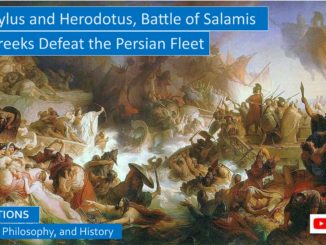
The Greek playwright Aeschylus fought in the Greco-Persian Wars, and in his play, The Persians, he includes an emotional memory of the naval Battle of Salamis, where the outnumbered Greek fleet sinks a large portion of the mighty Persian fleet. […]
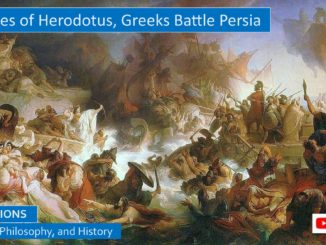
Herodotus tells us in his first paragraph that he wrote his Histories “so that human achievements may not be forgotten in time, and great and marvelous deeds, some displayed by Greeks, some by barbarians, may not be without their glory; and especially to show why the two peoples fought with each other. […]
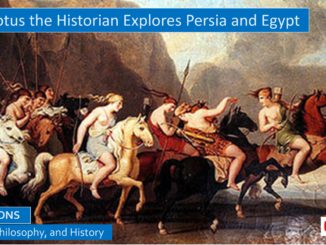
Why did Herodotus write his Histories? Herodotus tells us in his first paragraph, “so that human achievements may not be forgotten in time, and great and marvelous deeds, some displayed by Greeks, some by barbarians, may not be without their glory; and especially to show why the two peoples fought with each other.” Just as in the Iliad, the Greek soldiers and sailors in the Histories of Herodotus fight for cleos, or glory, and warriors in these warrior societies are immortalized by their great and marvelous deeds on the battlefield. Herodotus is interested in recording any mighty deeds of both the Greeks and the Persians, although the glory was earned mostly by the Greeks. […]
Copyright 2017