Biblical Interpretation

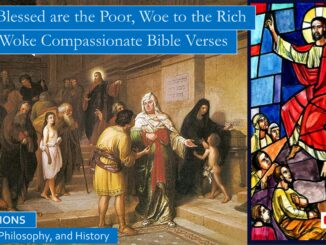
Blessed Are the Poor, Woe to the Rich, and Other Woke Compassionate Bible Verses

Among the Church Fathers, St Ambrose teaches us,
“Blessed are the poor. Not all the poor are blessed, for poverty is neutral. The poor can be either good or evil,” unless he is the blessed pauper described by Proverbs 19:22, “’A righteous poor man is better than a rich liar.’ Blessed is the poor man in whom the prince of this world finds nothing. Blessed is the poor man who is like that poor Man who, although he was rich, became poor for our sake,” […]
History

Pope John XXIII Opening Address to Vatican II, and Yves Congar, True and False Reform, Conclusion

Pope John Paul XXIII opens his speech with:
“A positive proof of the Catholic Church’s vitality is furnished by every single council held in the long course of the centuries.” “And now the Church must once more reaffirm that teaching authority of hers which never fails but will endure until the end of time.”
This echoes Congar’s sentiments that true reform must rediscover the ancient traditions of the church, that the moral teachings never change, but history itself does change, and the church must change with history. […]

History

Yves Congar, True and False Reform, Part 2, True Reform by Returning to Tradition

Yves Congar reflects: Who were the successful reformers? Who were the divisive reformers? Successful reformers are those reformers who respect the tradition of the church, whose reforms seek to return the church to its ancient traditions recently forgotten, to return to the ancient sources of the faith. These successful reformers include St Francis of Assisi, and St Thomas Aquinas, and he contrasts them with reformers who broke with the church, including Peter Waldo and Luther, while being careful to acknowledge when these divisive reformers did provide valuable spiritual and practical insights. […]

History

Yves Congar, True and False Reform, Part 1, Finding Common Ground

When Archbishop Angelo Roncalli, the future Pope John XXIII, reflected on this book, he asked, “A reform of the church? Is such a thing really possible?” Yves Congar reflects, What is the role of the church? Is the church the hierarchy in the Curia; or is the church the parishioners in the pews? What are the sacraments? What is the church’s definition of commonly misunderstood concepts, such as infallibility?
This book, along with help by the Holy Spirit, encouraged the pope to call for a church council, and helped set the tone for Vatican II. As Yves Congar teaches us, spiritual reform cannot be a revolution, false reform divides rather than unites. […]

Abortion

Regarding Abortion, Should Christians Be Pro-Compassion? Answering Questions, Further Reflections

How should we, as Christians, approach moral problems? This is similar to a related question; How should we interpret the Scriptures and Church teaching to guide us to live a godly life? St Augustine, in his seminal work, On Christian Teaching, or On Christian Doctrine, teaches us that “whoever thinks he understands the Holy Scriptures,” “but interprets them in a way that does not build up this two-fold Love of God and love of neighbor, does not truly understand the Scriptures.” […]

AntiSemitism

Viktor Frankl’s Logo-therapy, Man’s Search For Meaning in Life, Love, and Suffering

Viktor Frankl’s book, Man’s Search for Meaning, is a life-changing book and one of my favorites, it touched me deeply when I first read it many years ago. The main theme of the book is no matter what challenges you face in your life, or how busy you are, you always have time to be kind to all those whom you encounter, to be a positive influence on the lives whom you touch. Although he does not directly mention stoicism, his account of how he survived Auschwitz is a living example how a stoic mindset can help you survive and thrive through any challenge life may throw at you. […]

Abortion

Supreme Court Dobbs Case Overruling Roe v Wade: Should Christians be Pro-Compassion? Pro-Doctors?

There are some really heart-breaking situations involving abortion. Should abortion be allowed if the mother’s and/or the baby’s life is in danger? Should abortion be allowed in case of rape or incest? Should abortion be permitted if it is likely the mother would otherwise commit suicide? Should abortion be permitted to reduce the number of deaths caused by botched abortions by coat hangers or Lysol? […]

Biblical Interpretation

Do Christians Need To Go To Church? Which Type of Church Should You Attend?

St Augustine’s memorable reflection on our question appear in his Confessions, which is really one of the first testimonials. St Augustine tells us the story of Victorinus, a philosopher who studies the Gospels and the Church Fathers but declines to attend services, asking “Do the walls of the Church make you a Christian?” Victorinus was a learned man, an erudite pagan Platonic philosopher, the Word of the Lord spoke directly to him from the page, perhaps he felt intellectually superior to many simple Christians he knew.

In the words of St Augustine, in his studies Victorinus became “resolute, he was seized by the fear that Christ might deny him before the holy angels if he was too faint-hearted to acknowledge Christ before men, and he felt himself guilty of a great crime in being ashamed of the sacraments instituted by the Word of God in his lowly state.” […]

AntiSemitism

Our Reflections on Morality, Philosophy, and History: Ancient and Modern Classics

To a Stoic Philosopher, the question of Theodicy, or why God permits bad things to happen to good people, why God permits suffering, is simply absurd. The fact is, we do suffer, we will face injustices, we will suffer illnesses and death, and the rain falls on both the good man and the bad man. God will not shield us from suffering and injustice, but God will provide us with the strength to endure the challenges of this life. […]

Book Reviews and Miscellaneous

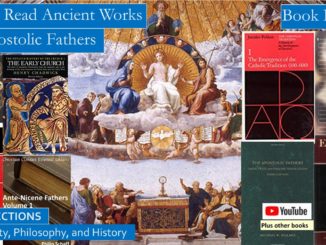
Book Reviews on Apostolic and Early Church Fathers

These quick book reviews include links to our YouTube videos and blogs on the Apostolic and Early Church Fathers, plus related topics. We will also discuss how to read ancient works, and the problems scholars face when translating ancient works, and the 38-volume set of the writings of the Ante-Nicene, ante meaning before, Nicene, and Post-Nicene Church Fathers, translated into English. […]