Protestantism, Catholicism, Orthodoxy, and Judaism: Which Is True
christianity

Protestantism, Catholicism, Orthodoxy, and Judaism: Which Is True?

We agree with CS Lewis when, in his Preface to Mere Christianity, he states that “the reader should be warned that I offer no help to anyone who is hesitating between two Christian denominations. You will not learn from me whether you ought to become an Anglican, a Methodist, a Presbyterian, or a Roman Catholic.” CS Lewis compares his Mere Christianity to a central hall opening up to many rooms, representative of the various denominations, saying that this hall is a place to wait while you try the different doors.
CS Lewis continues: “There is no mystery of my own position. I am a very ordinary layman of the Church of England, not especially high, nor especially low, nor especially anything else.” […]

St George the Dragon Slayer, From the Golden Legend and Butler’s Lives of the Saints
Lives of Saints

St George the Dragon Slayer, From the Golden Legend and Butler’s Lives of the Saints

Dacian then sought to trick St George with persuasion, and our saint played along. St George was led into a pagan temple where the people expected he would sacrifice to the gods. “But instead of sacrificing, St George knelt and prayed for the Lord to destroy the temple and all its idols, and destroy it so completely that, for the glory of God and the conversion of the people, absolutely nothing was to be left. At once fire fell from heaven and burnt the temple, its idols and priests, to a cinder, and the earth gaped open and swallowed up the remains.” […]

Book Reviews: Golden Legend, Butler’s, OCA, and Pope Benedict XVI’s Lives of Saints
Book Reviews and Miscellaneous

Book Reviews: Golden Legend, Butler’s, OCA, and Pope Benedict XVI’s Lives of Saints

The compiler of the Golden Legend was the Dominican friar Jacobus de Voragine. The Dominicans historically have been concerned about historical accuracy to guard the faith against heresy. He lists as his three primary sources the lives from Ecclesiastical History by Eusebius, bishop and advisor to Emperor Constantine; the Tripartite History by Cassiodorus; and the Scholastic History by Peter Comestor. In addition, he refers to more than 120 other sources. He was also influenced by earlier collections of lives of the saints by two other Dominican scholars. When his sources were apocryphal and not trustworthy, he points this out. When possible, he tries to reconcile dates and details, but is more concerned with the spiritual lessons than historical accuracy. […]

Summary of St Augustine’s Confessions of Faith and Repentance
Morality

Summary of St Augustine’s Confessions of Faith and Repentance

The Confessions are both a testimonial and a prayer. St Augustine tells us how he embraced Christianity after he was active in the Manichean sect, a New Age dualistic system where good and evil competed more or less evenly, and where Jesus was totally divine without a trace of mortality. St Augustine had many of the same questions that we hear atheists and agnostics raise today, such as: How can intelligent and sophisticated men believe in superstitions about an Almighty God? How can God be Almighty when sin has such a hold in the world? What is the nature of evil? […]

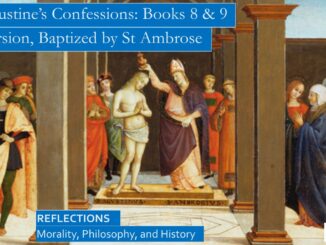
St Augustine’s Confessions, His Conversion, Baptism, St Monica’s Death, and Philosophy, Books 8 & 9
Morality

St Augustine’s Confessions, His Conversion, Baptism, St Monica’s Death, and Philosophy, Books 8 & 9

Baptism and confession in ancient Rome were very viewed much more seriously in the ancient world than they are today, as the Christian persecutions were in living memory. St Augustine was baptized in the year 387 while the former Emperor Constantine the Great started favoring Christianity in the year 312, putting to an end the vicious persecution of Christians under the preceding Emperor Diocletian, which was only seventy-five years ago.

Although the severe Diocletian persecutions were fading into history, many Christians had parents or grandparents who suffered and martyred for their Christian faith. There was a strong feeling among the Christians that they needed to be serious about baptism, that committing mortal sins after baptism could endanger their immortal soul. Constantine was baptized on his deathbed since he feared damnation for those enemies that were killed on the battlefield. Monica had delayed her son’s baptism because she was not sure he could repent of the inevitable sins teenagers with raging hormones would commit, and he declined to be baptized until he left the Manichean heresy in his middle age. Many Christians in the time of St Augustine desired to be as serious about their faith as the martyrs were about the faith that they sacrificed their life for.

This explains Augustine’s anxieties as he prepares himself for the challenge of living as perfect a Christian life as possible after his baptism. His anxiety was that he could not control his passions, a common concern in a Roman world so deeply influenced by Stoic philosophy. St Augustine tells us several conversion stories that were shared with him before his own conversion story. […]