Mere Morality and the Cardinal Virtues in CS Lewis’ Mere Christianity: Prudence, Temperance, and Justice
CS Lewis

Mere Morality and the Cardinal Virtues in CS Lewis’ Mere Christianity: Prudence, Temperance, and Justice

CS Lewis has “two bits of evidence that the Somebody,” whom we worship as the Almighty God, truly exists. “One is the universe he made.” “The other bit of evidence is that Moral Law which He has put into our minds. And this is a better bit of evidence than the other because it is inside information.” In the Judeo-Christian traditions, “we conclude that the Being behind the universe is intensely interested in right conduct: in fair play, unselfishness, courage, good faith, honesty and truthfulness.” […]

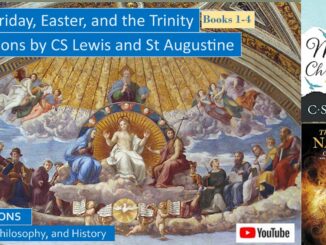
Good Friday, Easter, and the Trinity SMALL CS Lewis Mere Christianity, the Chronciles of Narnia, and St Augustine
CS Lewis

Good Friday, Easter, and Trinity: CS Lewis’ Mere Christianity, Narnia, & St Augustine’s Confessions

How can we make sense of Jesus’ crucifixion on Good Friday and his resurrection on Easter Sunday? CS Lewis proclaims, “The central Christian belief is that Christ’s death has somehow put us right with God and given us a fresh start.” “We are told that Christ was killed for us, that His death has washed out our sins, and that by dying He disabled death itself. That is the formula. That is Christianity.” CS Lewis discusses how atonement erases the stain of original sin from mankind, but he avoids using these Catholic-sounding words. […]

Was CS Lewis a Closet Catholic- Reflections on Mere Christianity
CS Lewis

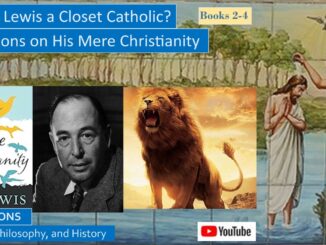
Was CS Lewis a Closet Catholic? Reflections on his Mere Christianity

In the Preface, CS Lewis states that “the reader should be warned that I offer no help to anyone who is hesitating between two Christian denominations. You will not learn from me whether you ought to become an Anglican, a Methodist, a Presbyterian, or a Roman Catholic.” “There is no mystery of my own position. I am a very ordinary layman of the Church of England, not especially high, nor especially low, nor especially anything else.” He states he avoids discussions that divide, such as the controversies on the exact nature of the Virgin Mary, and avoiding topics like birth control. […]

Preparing the Way for Vatican II: CS Lewis' Mere Christianity
CS Lewis

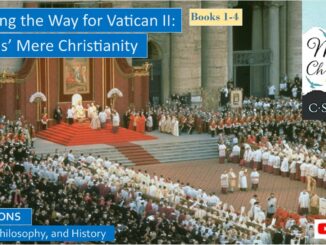
Preparing the Way for Vatican II: CS Lewis’ Mere Christianity

CS Lewis did not wave the flag of ecumenicism, attending this conference or that on interfaith dialogues, but instead prepares the way, saying that what denominational creed you profess is less important than whether you truly believe the core Christian teaching of the two-fold Love of God and neighbor. This was the key change wrought by Vatican II, no longer did the Catholic Church believe you needed to be Catholic to be saved. Likewise, CS Lewis is against the notion that Catholics cannot be saved. […]

Why I Joined Rotary
Business and Science

History and Philosophy of Rotary International, and My Personal Experience

Early in its history, the Rotary Clubs adopted the Four Way Test. The Rotary website states that “the Four-Way Test is a nonpartisan and nonsectarian ethical guide for Rotarians to use for their personal and professional relationships.
Of the things we think, say, or do:
Is it the TRUTH?
Is it FAIR to all concerned?
Will it build GOODWILL and BETTER FRIENDSHIPS?
Will it be BENEFICIAL to all concerned?” […]

Anders Nygren, On Christian Agape-Love and Eros-Love in Gospels and Pauline Epistles
Biblical Interpretation

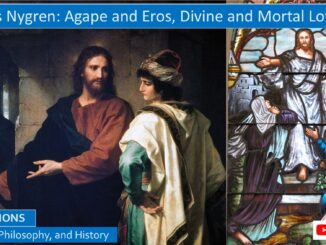
Anders Nygren, On Christian Agape-Love and Eros-Love in Gospels and Pauline Epistles

Anders Nygren emphasizes that “Old Testament piety with its devotion to the Law was by no means the external legalism it is often assumed to have been. There was an inward bond that held the godly man to the Law. The righteous felt no sense of external compulsion when confronted by the Law, but a sense of inner solidarity with it. Its observance gave him value and made him acceptable to God. His prevailing mood was expressed in Psalm 1,” the Psalm that sings of Law as Gospel. […]

Major Roman Stoic Philosophers, My Favorite Maxims: Epictetus, Rufus, Seneca & Marcus Aurelius
Philosophy

Major Roman Stoic Philosophers, My Favorite Maxims: Epictetus, Rufus, Seneca & Marcus Aurelius

Many of the writings of the Stoics sound like passages from the Pauline Epistles. Indeed, Seneca was a contemporary of St Paul. There are epistles written between them, though nearly all scholars think they are spurious. Was St Paul inspired by the Stoic writings of Seneca? Although the Jewish rabbinic tradition was the primary source of inspiration for the Epistles and the Gospels, stoicism was an important secondary influence. In particular, stoicism deeply influenced the desert monastic tradition, which in turn influenced medieval monasticism. […]

Medieval Jewish and Christian Commentators, My Gentile Defense of Judaism, Part 1
Judaism

Medieval Jewish and Christian Commentators, My Gentile Defense of Judaism, Part 1

At roughly the time of Jesus, an inquirer requested of both Rabbi Shammai and Rabbi Hillel, “Convert me to Judaism on condition that you will teach me the entire Torah while I stand on one foot.” Shammai pushed the man away with the building rod he was holding. Undeterred, the man then came before Hillel with the same request. Hillel responded, “That which is hateful unto you, do not do unto your neighbor. This is the whole Torah; all the rest is commentary. Now, go and study.” […]

Platonic Dialogue: Protagoras and Socrates Debate: Can Virtue Be Taught?
Philosophy

Platonic Dialogue: Protagoras and Socrates Debate: Can Virtue Be Taught?

Socrates wants his students to think for themselves, so we cannot assume that Socrates really believes that virtue cannot be taught. After all, at the end of the dialogue, Socrates asserts that true knowledge leads to virtue. Perhaps he seeks to dissuade the youths in Athens from studying under the Sophists, who claim to be able to teach anything, for a fee, a generous fee, of course.
What example comes to mind if we assert that virtue can be taught? We need to go no further than the Book of Judges, which is filled with horrible stories that atheists love to parade as proof that God is not a loving god. We must keep in mind the constant theme of the Book of Judges: Everyone in Israel did what was right IN HIS OWN EYES. Which is the slogan of the Sophists. […]

Q & A on Topic: Why Did You Leave Your Religion?
Biblical Interpretation

Q & A on Topic: Why Did You Leave Your Religion?

To the ancients who lived in a warrior culture, Stoic philosophy is very appealing. The Stoics don’t ask the question: Why do bad things happen to good people? Instead, they admit that good and bad things happen to everyone, that the rain falls on both the bad and the good. Bad things happen to good people, that is part of life. The real question is: How can God help us endure and prevail over our suffering? […]