

Why was the story of how St George slew the dragon so popular with medieval Christians?
Was there actually a martyr called St George, and was he a soldier?
In the story of how St George slew the dragon, what does the dragon represent?
Why can’t martyrs survive beheading?
YouTube video for this blog: https://youtu.be/XpbBdh4hpIc
TOWNSPEOPLE OFFER SHEEP AND CHILDREN TO THE DRAGON
The Orthodox Church in America’s lives of the saints website states that “the Holy Great Martyr George the Victory-Bearer, was a native of Cappadocia,” a district in today’s Turkey, “and he grew up in a deeply believing Christian family. His father was martyred for Christ when George was still a child. His mother, owning lands in Palestine, moved there with her son and raised him in strict piety.”
“When he became a man, St George entered into the service of the Roman army. He was handsome, brave and valiant in battle, and he came to the notice of the emperor Diocletian (284-305) and joined the imperial guard with the rank of military commander.”[1]
The life of St George as recounted in the Golden Legend continues: Close to Silena in Libya “was a vast lake” where a “dragon had its lair. The people had often risen in arms against it, but the dragon always put them to flight, and would venture right up to the city walls and asphyxiate everyone with its noxious breath. So the citizens were compelled to feed it two sheep every day to allay its fury,” but when the number of sheep dwindled, “the citizens offered one sheep and one citizen. The names of the victims were drawn by lot,” but “one day the lot fell on the daughter of the king.”
“The king was heartbroken” as he lamented: “Take my gold and silver, take half my realm, and let my daughter go!”
But the people responded in fury: “It was you who issued this decree, your majesty, and now all our children are dead, and you want to save your own daughter! If you do not sacrifice your daughter, and do not do what you forced all the rest of us to do, we will burn you alive, you and all your household!”
“Woe is me!” the king cried. “My sweetest child,” “what can I say? Can I no more hope to see your wedding day?”
Turning to the people, the king beseeched them, “I beg you, grant me a week’s grace in which to mourn my daughter.” “This the people agreed to.”
At the end of the week, “seeing that he could not save his daughter, dressed her in all her regal finery and, embracing her, said tearfully,” “Alas, my sweet daughter, I thought to see you rear royal children at your bosom, and now you are going to be devoured by the dragon!”
The king kissed his daughter and let her go with a final word: “Oh, my daughter, would I had died before you, rather than lose you in this way!”
“The king’s daughter then fell at her father’s feet, asking his blessing, and when in a flood of tears he had blessed her, she set off towards the lake.”
This story is similar to the ancient Athenian myth of the Minotaur, a ferocious half-man, half-bull beast, a half-man with the head of a bull, who lived in the maze below the palace in Crete. King Minos of Crete had formerly defeated the ancient city of Athens, and demanded of them every nine years a ransom of seven young men and seven virgins to be fed to the Minotaur.
ST GEORGE PROMISES TO SUBDUE THE DRAGON
“Now St George happened to be passing that way, and when he saw her weeping, he asked her what was the matter.”
After she told him the full story, St George said, “My child, do not be afraid, for in the name of Christ I will help you.”
“You are a brave knight,” she replied. “But do not perish with me. It is enough that I die, for you cannot save me, you would only die with me.”
“While they were talking, the dragon suddenly lifted its head from the lake.” Trembling, the princess cried: “Flee, good lord, make haste and flee!”
“But St George mounted his horse, armed himself with the sign of the cross, and bravely went to meet the dragon as it came towards him. Brandishing his lance and commending himself to God, he dealt the beast such a deadly wound that he threw it to the ground.”
St George called to the princess: “Throw your girdle round the dragon’s neck! Do not be afraid, child!”
“She did as he told her, and the dragon followed her as meekly as a puppy. She led it into the city, but when the people saw it, they ran for the mountains, crying:” “Help! We are done for!”
“But St George waved at them to come back.”
“Do not be afraid,” our saint told them. “The Lord has sent me to free you from the tyranny of the dragon. Only believe in Christ and be baptized, and I will slay your dragon!” I suppose that if they didn’t get baptized, St George would not slay the dragon.
THE PEOPLE ARE BAPTIZED, AND THE DRAGON IS SLAIN
Why are the king and his daughter not named? In ancient stories, the meaning of their name reveals their true character, but if they are not named, they are often considered to be insignificant. Indeed, all of the Golden Legends have incredibly fanciful and concocted meanings of the names of the main character, and we discussed this incredulous etymology of St George in our introductory reflection on the Golden Legend. Perhaps the author is not impressed with the virtue and character of the king and his princess, especially since they need to be baptized before the dragon is slain.
Book Reviews: Golden Legend, OCA, and Butler’s Lives of the Saints
https://seekingvirtueandwisdom.com/book-reviews-golden-legend-oca-and-butlers-lives-of-the-saints/
https://youtu.be/RFUeBLPMyqI
The Golden Legend continues: “The king and all the people were baptized, and St George drew his sword and slew the dragon, and gave orders that it should be carried outside the city walls. Four pairs of oxen dragged the beast out of the city and left it on the broad open plain. That day twenty thousand were baptized, not counting women and children.”
What is the meaning of this number? Perhaps this is four times the five thousand that Jesus fed with a single fish and loaf of bread?
Why was St George so quick to slay the dragon? In these ancient myths, the mightier the monster, the quicker he is slain. In Plutarch’s biography of the King Theseus, the founding king of Athens, he volunteers to be one of the citizens sacrificed to be led into the maze to face the Minotaur. Likewise, Plutarch has him slay the mighty Minotaur in one sentence to win the heart of Ariadne, the Cretan king’s daughter.
Mighty Deeds of Theseus, First King of the Commonwealth of Athens, in Plutarch’s Lives
http://www.seekingvirtueandwisdom.com/mighty-deeds-of-theseus-first-king-of-the-commonwealth-of-athens-in-plutarchs-lives/
https://youtu.be/jOgNKSf9IT4
“The king built a large and splendid church there in honor of the Blessed Mary and St George, and from its altar there still issues a natural spring whose waters cure all illnesses. The king also offered St George a vast sum of money, but the saint refused to accept it and ordered it to be given to the poor.”
“St George then gave the king four brief rules of life:
- To cherish the Church of God.
- To honor priests.
- To be scrupulous in attending Mass.
- To always be mindful of the poor.”
“With that, he kissed the king farewell and left. We read in some sources, however, that when the dragon was rushing towards the girl to devour her, St George armed himself with a cross and then attacked and killed the dragon.”
In the apocryphal Infancy Gospel of Pseudo-Matthew, Jesus tamed the dragons when his parents rested in a cave during their travels. This infancy gospel says: “Suddenly, many dragons came out of the cave.” “Jesus got down from his mother’s lap and stood on his feet before the dragons. They worshipped him and backed away, fulfilling the words of Daniel the prophet: ‘You dragons of the earth, praise the Lord, you dragons and creatures of the abyss.’ Then the infant Jesus walked before them and ordered them not to harm any man.’” But Jesus did not slay any of the dragons.
Did Mary Give Birth to Jesus in a Cave With a Midwife? Infancy Gospels of James and Pseudo-Matthew
https://seekingvirtueandwisdom.com/did-mary-give-birth-to-jesus-in-a-cave-with-a-midwife-infancy-gospels-of-james-and-pseudo-matthew/
https://youtu.be/qtF6znNUYG0
MARTYRDOM OF ST GEORGE THE DRAGON SLAYER
Butler’s Lives of the Saints includes a shortened version of how St George slayed the dragon, saving the life of the princess, but he does not include the story of the martyrdom of St George. But the Lives of the Saints in the Orthodox Church of America, or OCA website, includes a version of his martyrdom and how St George slayed the dragon, although many details differ.
The Golden Legend records that “during the principate of Diocletian and Maximian, the prefect Dacian started a vicious persecution of the Christians. Within a month, seventeen thousand won the crown of martyrdom, leading many Christians to give in and offer sacrifices to the gods.”
“St George was grief-stricken. He gave away all his possessions, laid aside his soldier’s uniform and dressed as a Christian. Then he ran out into the midst of the crowds and cried:” “All of the gods of the heathen are demons! It was our Lord who made the heavens!”
The prefect angrily rejoined: “How dare you presume to call our gods demons! Tell me, where do you come from, and what is your name?”
St George answered him: “My name is George, and I come from a noble family of Cappadocia. With Christ’s help I conquered Palestine, but I have left everything to be free to serve the God of heaven.”
“The prefect saw that he could not sway him and ordered him to be put to the rack and torn limb from limb with iron hooks. Brands were thrust against his sides to sear his flesh, and where his entrails showed through, the prefect had salt rubbed in the wounds. But that same night the Lord appeared to St Geroge in a great blaze of light and tenderly comforted him. So blissful was this vision and so sweet the words he spoke that St George thought nothing of his pain.”
“The following day Dacian had St George tied on a wheel fitted all around with sharp, two-edged swords, but the wheel instantly fell apart, and St George was found to be quite unhurt. In a rage, the prefect ordered him to be plunged into a cauldron of molten lead, but St George made the sign of the cross, got in and, with God’s help, found it no hotter than a refreshing bath.”
Dacian then sought to trick St George with persuasion, and our saint played along. St George was led into a pagan temple where the people expected he would sacrifice to the gods. “But instead of sacrificing, St George knelt and prayed for the Lord to destroy the temple and all its idols, and destroy it so completely that, for the glory of God and the conversion of the people, absolutely nothing was to be left. At once fire fell from heaven and burnt the temple, its idols and priests, to a cinder, and the earth gaped open and swallowed up the remains.”
After hearing what had happened, Dacian flew into a rage. “I am finished! I shall die!” he told his wife Alexandria. “I cannot bear to see this man get the better of me!”
“Cruel, murderous tyrant!” she replied. “Did I not tell you to stop persecuting the Christians, because their god was fighting on their side? And now let me tell you this: I myself want to become a Christian.”
Dumbfounded, the prefect cried: “No! This is too much for me to bear! Have you, too, been seduced by them?”
“So, he had her hung up by her hair and cruelly beaten with scourges. While she was being beaten, she said to St George:” “George, hero of the true faith, what do you think will become of me? I have not yet been reborn in the waters of baptism.”
St George answered, “Do not be afraid, my daughter, the blood you shed will be your baptism and your crown.” “Then, with a prayer on her lips, Alexandria breathed her last.”
“The following day St George was condemned to be dragged through the length and breadth of the city and then be beheaded. He prayed to the Lord that whoever implored his aid might have his prayer granted, and a heavenly voice said that his wish would be fulfilled. When he had finished praying, he was beheaded,” and saints never seem to survive beheading in these martyrdom stories. “As for Dacian, when he was returning to the palace from the place of execution, fire fell from heaven and consumed him and all his attendants.”
ST GEORGE THE DRAGON SLAYER IN BUTLER’S LIVES OF THE SAINTS
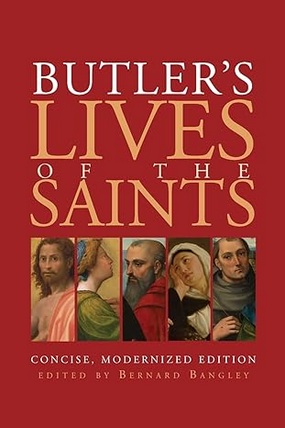
Alban Butler notes that the story of the dragon, though famous, first appeared around the twelfth century, shortly before the stories in the Golden Legend were compiled. Butler states that “there is every reason to believe that St George was a real martyr who suffered in Palestine, probably before the time of Constantine,” although the details are uncertain. He notes, “the cult is certainly early.”
Alban Butler notes that “it is not quite clear how St George was chosen as the patron saint of England. His fame had certainly travelled to the British Isles long before the Norman Conquest.” “William of Malmesbury states that St George and St Demtrius, the martyr saints, were seen assisting the Franks at the Battle of Antioch in 1098, and it seems likely that the crusaders, notably King Richard I,” thought that they were aided by St George’s powerful intercession.” “King Edward III founded the Order of the Garter, of which St George was the patron.” Later, until 1778, “his feast was a holiday of obligation for English Catholics, and Pope Benedict XIV recognized him as the Protector of the Kingdom.”[2]
DISCUSSING THE SOURCES
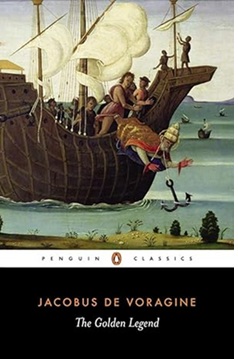
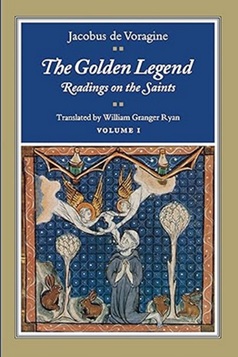
We prefer the Penguin Classics translation of the Golden Legend. This was one of the most popular medieval works, there are thousands of extant manuscripts of the Golden Legend in existence. Judging from the vast number of paintings of St George, this was also one of the more popular saints’ lives. We previously reflected on the history of the Golden Legend and Butler’s Lives of the Saints.
Book Reviews: Golden Legend, OCA, and Butler’s Lives of the Saints
https://seekingvirtueandwisdom.com/book-reviews-golden-legend-oca-and-butlers-lives-of-the-saints/
https://youtu.be/RFUeBLPMyqI
Dr Wikipedia notes that these stories were earlier attributed to St Theodore Tiro in the tenth century, and the first attributions to St George are from eleventh century. He speculates about possible earlier attributions and possible pre-Christian predecessors of St George, the Dragon Slayer.[3]
[1] https://www.oca.org/saints/lives/2018/04/23/101184-greatmartyr-victory-bearer-and-wonderworker-george
[2] Quoted from Jacobus De Voragine, The Golden Legend, Readings on the Saints, Christophe Stace, translator (New York: Penguin Classics, 1998, originally 1266), April 23, pp. 116-120, summarized by Alban Butler, Butler’s Lives of the Saints (Harper San Francisco, 1991, 1956, originally 1759), April 23, pp. 120-121.



Be the first to comment