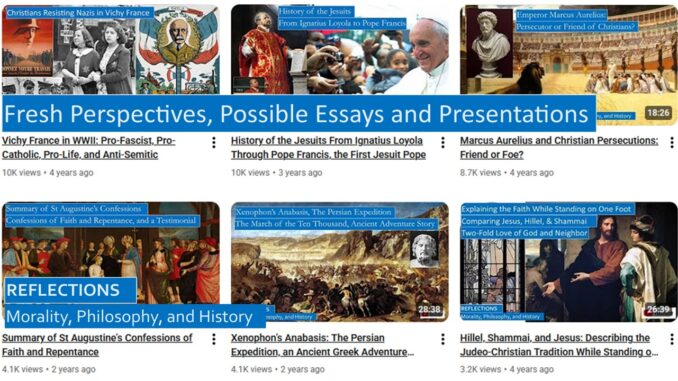
We hope you find that many of my reflections on morality, philosophy, and history do not merely repeat what others teach, but that they offer a unique perspective. We hope that many of these reflections are not so much new as they are overlooked or forgotten truths.
This reflection is addressed to:
- Our YouTube and blog subscribers, to encourage them to widen their interests.
- Editors of local, regional, and national media and publications. Some of these reflections could be interesting magazine articles.
- Fellow Rotarians and other organizations searching for speakers on unusual topics. Most of my reflections are about twenty minutes, and I can deliver most of them on a moment’s notice, since the script is already written.
The video for this blog: https://youtu.be/2HHzol1ASUs
My passion is dementia awareness. As a Treasurer, my over-55 condominium association came close to foreclosing on an owner who had advanced dementia, with no money and no family. The court assigned him a guardian, who placed him in a lockdown facility and paid off his debts.
What could have happened if he had been evicted after foreclosure proceedings? Being forced to wander, he could have drowned in a nearby ditch or canal. We will be proposing legislation to address this issue.
In this companion reflection, we list our videos on psychology, mental illness, neurological conditions, and speeches delivered at our Rotary Club of Sunrise, Florida, on these and other community service topics.
YT
Roughly speaking, the order of the reflection summaries in this listing is determined roughly by my guess about what will pique the editors’ interests, and which reflections have the most views. Most YouTube reflections have blogs with footnotes, and SlideShare Adobe files from my PowerPoint scripts with public domain paintings and photographs. My Channel Philosophy reflection also introduces the themes behind many reflections.
Our Reflections on Morality, Philosophy, and History: Ancient and Modern Classics
http://www.seekingvirtueandwisdom.com/our-philosophy-for-this-blog-reflections-on-ancient-and-modern-classics/
https://youtu.be/Si0TsO5bNr0
When you study history and philosophy, do you want to put yourself in the shoes of the original people who experienced it, or do you want to learn the narrative that is currently in vogue?
Most students, and most professors, see history and philosophy through the perspective of their teachers and professors. But to dig further into history and philosophy, ask yourself: How did the original audience or readers interpret the works? How did the current events of these past times affect their interpretation? For recent history, was the historian blind to the aftereffects of events in living memory? Many professors are often hyper-specialized: Does this blind them to connections in other fields of study? Above all, read the original work, let the historians and philosophers speak directly to you.
The ancient world was very different than the modern world. In the ancient world, infant mortality was high, many women died in childbirth, lives were much shorter, and people died at home. This meant that death was far more immediate in the ancient world, influencing their worldview. Our concepts of positive thinking and the sacredness of human life are modern notions. In contrast, the ancients were fatalists, adopting a Stoic mentality.
Is there anything new under the sun? What I hope to find is someone from the past who confirms my insights. Even when there is no direct confirmation, I sometimes find reflections from past generations that indirectly confirm, or at least do not disprove my perspectives.
For me, creativity is not a problem, so I prefer to include quotes from ancient and modern authors, to encourage my listeners to read them on their own. Why restate aphorisms in my own words when they are so inspiring when originally uttered? The eastern Church Fathers did not see a need to reword inherited ancient teachings, so why should I?
In addition to my extensive classical reading, I have listened to Great Courses college lectures, Catholic Learn25 lectures, and Yale and other college courses on YouTube for about forty years. My life experiences are detailed on LinkedIn.[1]
We will preview the following groupings of our reflections.
- Modern History, Current Events, and Politics.
- Greek and Roman Philosophy and History.
- Early Church Fathers and CS Lewis.
- Civil War and Civil Rights History.
- Particularly Interesting Reflections.
MODERN HISTORY, CURRENT EVENTS, AND POLITICS
One of my more popular series of reflections was on how Christians and Jews fared under the various Nazi and Fascist regimes in World War II and before. Modern Americans are ignorant of how much support anti-Semitism and these ideologies had before the outbreak of the war. Each country has a unique story, including Germany, Italy, Vichy France, Franco’s Spain, and America.
How the Catholic and Confessing Church Survived Under Hitler’s Pagan Regime
https://seekingvirtueandwisdom.com/christians-under-hitlers-german-nazi-regime/
https://www.youtube.com/watch?v=QP9UR8fqfvs
Vichy France Regime, Blog 1, Pro-Life, Pro-Catholic, and Fascist
http://www.seekingvirtueandwisdom.com/vichy-france-regime-blog-1-pro-life-pro-catholic-and-fascist/
Vichy France, Blog 2, Collaborating with the Germans in the Early Years, 1940-1942
http://www.seekingvirtueandwisdom.com/vichy-france-blog-2-collaborating-with-the-germans-in-the-early-years-1940-1942/
Vichy France, Blog 3, The Tide Turns, Resistance and Collaboration
http://www.seekingvirtueandwisdom.com/vichy-france-blog-3-the-tide-turns-resistance-and-collaboration/
Vichy France, Blog 4, Christianity in Vichy France
http://www.seekingvirtueandwisdom.com/vichy-france-blog-4-christianity-in-vichy-france/
Vichy France in WWII: Pro-Fascist, Pro-Catholic, Pro-Life, Anti-Semitic
https://youtu.be/yYpNrhpmsYw
Mussolini’s Fascist Regime and the Catholic Church
http://www.seekingvirtueandwisdom.com/mussolinis-fascist-regime-and-the-catholic-church/
https://youtu.be/LvNynEdZFuM
Spanish Civil War and the Catholic Church
http://www.seekingvirtueandwisdom.com/spanish-civil-war-and-the-catholic-church/
https://youtu.be/ozEioe6yyY8
Many historians updated their histories of the Catholic Church during World War II after Pope Francis opened the Vatican archives for Pope Pius XII, who was pope during the closing years of the war.
Pope Pius XXII: Back Channel Between Hitler and the Pope
https://seekingvirtueandwisdom.com/world-war-ii-back-channel-between-hitler-and-pope-pius-xii/
https://youtu.be/6xdxvchkWyY
Pope Pius XII, Wartime Pope, Axis Powers March Across Europe
https://seekingvirtueandwisdom.com/pope-pius-xii-wartime-pope-axis-powers-march-across-europe/
https://youtu.be/L1bkOQNrlzg
Pope Pius XII, Wartime Pope, Allied Powers Turn the Tide of War
https://seekingvirtueandwisdom.com/pope-pius-xii-wartime-pope-allied-powers-turn-the-tide-of-war/
https://youtu.be/pjMa3JdjW48
Pope Pius XII, Wartime Pope, Could the Pope Have Done More To Save the Jews?
https://seekingvirtueandwisdom.com/pope-pius-xii-wartime-pope-could-the-pope-have-done-more-to-save-the-jews/
https://youtu.be/ONnAcLLBNog
Scholars have discovered that the Nazi lawyers drafting the Jewish Race Laws used the US Jim Crow segregation statutes as legal precedent. Nazis were inspired in their eugenics policies on sterilization and selective breeding by American eugenicists, though their Final Solution was offensive to most Americans. There are other links between the two.
How the Racist Jim Crow Laws Served as Precedent for the Nazi Nuremberg Race Laws
http://www.seekingvirtueandwisdom.com/how-the-racist-jim-crow-laws-served-as-precedent-for-the-nazi-nuremberg-race-laws/
https://youtu.be/_td3jPGD5TI
Eugenics and Scientific Racism in the Jim Crow Deep South and Nazi Germany
https://seekingvirtueandwisdom.com/eugenics-and-scientific-racism-in-the-jim-crow-deep-south-and-in-nazi-germany/
https://youtu.be/y7xvGu3L6oA
Viktor Frankl was a psychologist who survived the Auschwitz work camps. He observed that those prisoners with a rich inner spiritual life were more likely to survive. Many who survived kept alive their hope by focusing on what brought meaning to their lives, whether that be their loved ones or their neighbors or their careers. No matter how dire your circumstances, you can always be kind to those around you.
Viktor Frankl, Man’s Search For Meaning, His Life in a Nazi Concentration Camp in WWII
http://www.seekingvirtueandwisdom.com/viktor-frankl-mans-search-for-meaning-his-life-in-a-nazi-concentration-camp-in-wwii/
https://youtu.be/O-YtC9qGWPI
In his Letter From a Birmingham Jail, Martin Luther King compared the lynchings that murdered tens of thousands of negroes to the Jewish Holocaust under the Nazi regime under Hitler.
Comparing MLK’s Letter from Birmingham Jail with Hannah Arendt’s Banality of Evil in Nazi Germany
http://www.seekingvirtueandwisdom.com/comparing-martin-luther-kings-letter-from-the-birmingham-jail-with-hannah-arendts-the-banality-of-evil/
https://youtu.be/PqFAUEXbi8k
The Second Vatican Council is unimaginable without the Catholic experience in World War II. The probable reason why the leading Vatican II scholar, William O’Malley, does not emphasize this is because this was in the air he breathed. Asking him to explain why this is would be like asking a fish to explain the water in which he swims. Future generations will be taught that the experiences of World War II influenced Christianity as much as did the Protestant Reformation, if not more.
What Happened at Vatican II, Embracing Democracy and Modernity
http://www.seekingvirtueandwisdom.com/what-happened-at-vatican-ii-embracing-democracy-and-modernity/
https://youtu.be/vHtYu6UtiuE
Vatican II Declaration on Freedom of Religion, Embracing Democracy, Rejecting Fascism
http://www.seekingvirtueandwisdom.com/vatiJcan-ii-decree-on-freedom-of-religion-embracing-democracy-rejecting-fascism/
https://youtu.be/i_zGeTW9QMI
When the future Pope John XXIII read Yves Congar’s True and False Reform of the Church, he wondered if this was possible. After he was elected pope, he called the Second Vatican Council into session, in which Yves Congar played a leading role.
William O’Malley argues that although the implementation of the decrees of the Council of Trent was reactionary, that scholars discovered that the council fathers intended that it be a reforming council, foreshadowing the Second Vatican Council, after the Vatican released the transcripts of the council proceedings early in the twentieth century.
The Second Vatican Council rejected anti-Semitism and fascist and totalitarian ideologies, while affirming that democracy can best protect the Church. Many American Catholics reject the teachings of Pope Francis and the Vatican II Council without realizing the dark past that Vatican II strives to leave behind.
Pope John XXIII Opening Address to Vatican II, and Yves Congar, True and False Reform, Conclusion
https://seekingvirtueandwisdom.com/pope-john-xxiii-opening-address-to-vatican-ii-and-yves-congar-true-and-false-reform-conclusion/
https://youtu.be/ALZozpbSrM4
Council of Trent, The Reform Council Foreshadowing Vatican II
http://www.seekingvirtueandwisdom.com/council-of-trent-the-reform-council-foreshadowing-vatican-ii/
https://youtu.be/Thq1blvzWHs
We have several reflections on the teachings of Pope Francis, who counseled balance on the abortion issue and promoted the classic Catholic teaching on Social Justice. Many trad Catholics object to these teachings, and some deny that the Second Vatican Council was a legitimate council. It will not take long for them to similarly reject the teachings of his protegee, Pope Leo XIV, who is inspired by the teachings of Pope Leo XIII, who issued the encyclical, Rerum Novarum, on the conflicts between labor and management, furthering the Catholic Social Justice doctrine.
Pope Leo XIV, First American Pope, Successor to Pope Francis and Social Justice of Pope Leo XIII
https://seekingvirtueandwisdom.com/pope-leo-xiv-first-american-pope-successor-to-pope-francis-and-social-justice-of-pope-leo-xiii/
https://youtu.be/wSns5VGhtRk
Pope Leo XIII: Catholic Social Justice and Rerum Novarum, Confronting the Modern World
https://seekingvirtueandwisdom.com/pope-leo-xiii-catholic-social-justice-and-rerum-novarum-confronting-the-modern-world/
https://youtu.be/YojqhGBJtOY
We reflected on the history and writings of Pope Leo the Great, who persuaded Attila the Hun to refrain from sacking Rome, based solely on his moral persuasion, plus a generous tribute. The historian Peter Brown argued that Rome did not suddenly fall, but that the transition from the Roman Empire to the barbarian kingdoms and European nation-states was a gradual process. We go further and ask: How can we even say that there was anything in Rome to fall? Was the Roman Empire just a veneer where emperors sought tribute? Does the Parable of the Good Samaritan and the ancient Roman novel, The Golden Ass by Apuleius, reveal that in ancient Israel and even in Roman Italy, Roman authority did not even attempt to guarantee personal security for ancient Romans, particularly in the rural areas? Of course, the Roman Empire did guarantee overall security when it defended its populace from other empire or forces.
Pope Leo the Great, Confronting Attila the Hun, and the Fourth Ecumenical Council of Chalcedon
https://seekingvirtueandwisdom.com/pope-leo-the-great-confronting-attila-the-hun-and-his-role-in-fourth-ecumenical-council-of-chalcedon/
https://youtu.be/4XwZYxDWAtA
Did Rome Fall, or Evolve Into the Barbarian Kingdoms? Sacks of Rome, and Attila the Hun’s Invasions
https://seekingvirtueandwisdom.com/did-rome-fall-or-evolve-to-barbarian-kingdoms-sack-of-rome-and-attila-the-huns-invasions/
https://youtu.be/0pVNIggTbnM
Regarding abortion: The debate between pro-life and pro-choice positions is poorly formed. Pro-life advocates presume that their enemies are pro-death. Pro-choice advocates are seen by their opponents as advocating a world where morals do not matter, that everyone can choose to harm those around them.
A better narrative is to frame the abortion debate as PRO-COMPASSION, and PRO-DOCTOR. The pro-compassion position seeks to understand why a mother would consider aborting their unborn child, and what they can do to improve their life situation. The pro-doctor truly enables the doctor to take actions that will preserve the health and lives of both the mother and the unborn child. Doctors should be free to make these determinations without governmental interference and threats. If doctors are compelled to wait until the mother’s life is in danger, often that is too late, as the mother may be too near death to prevent her death.
We agree with the Catholic Catechism’s sections on abortion; they are closer to the Democratic position than most people realize.
A Democrat Christian Ponders Abortion and Morality
http://www.seekingvirtueandwisdom.com/a-democrat-christian-ponders-abortion-and-morality/
https://youtu.be/C4rH6qhhw70
Supreme Court Dobbs Case Overruling Roe v Wade: Should Christians be Pro-Compassion? Pro-Doctors?
https://seekingvirtueandwisdom.com/supreme-court-dobbs-case-overruling-roe-v-wade-should-christians-be-pro-compassion-pro-doctors/
https://youtu.be/Jb_vUFnAf3g
Regarding Abortion, Should Christians Be Pro-Compassion? Answering Questions, Further Reflections
https://seekingvirtueandwisdom.com/regarding-abortion-should-christians-be-pro-compassion-answering-questions-further-reflections/
https://youtu.be/ll9wOR0t2yQ
Several major magazines have recently run essays on the faith journey of several Christians who do not believe in Trump and his MAGA movement, so this is my spiritual journey over many decades. We answer the question: Protestantism, Catholicism, Orthodoxy, and Judaism: Which Is True? The answer is: I believe in CS Lewis’ Mere Christianity. I have deep personal experiences attending Lutheran, Episcopalian, Orthodox, and Catholic Churches, and have also read many of the medieval rabbinic commentaries.
Protestantism, Catholicism, Orthodoxy, and Judaism: Which Is True?
https://seekingvirtueandwisdom.com/protestantism-catholicism-orthodoxy-and-judaism-which-is-true/
https://youtu.be/EAXyZtZpgYk
If Trump had not been reelected in 2024, I would likely be Orthodox or Catholic. Although there are fewer blatantly MAGA Orthodox or Catholic priests than MAGA evangelical pastors, another issue is the coffee hour after church. Hebrews states that we should not neglect attending church so we can encourage one another, and acrimonious, endless MAGA debates hinders this encouragement. I was looking for a church where thirty percent or more of the worshipers in the pews were black, because few Fox News MAGA believers will attend a church like that. Not arguing over Trump is heaven. Under Trump, the Republican Party and most white evangelicals prefer cruelty over compassion.[2]
Should You Leave Your MAGA Church? Or Should You Stay?
https://seekingvirtueandwisdom.com/should-you-leave-your-maga-church/
https://youtu.be/_OqgGK6N20U
On a lighter note: Do Christians need to attend church? Which type of church should they attend? Is Luke the Woke Gospel, when he exhorts us: Blessed are the poor, and woe to the rich!
Do Christians Need To Attend Church? Which Type of Church Should You Attend?
https://seekingvirtueandwisdom.com/do-christians-need-to-go-to-church-which-type-of-church-should-you-attend/
https://youtu.be/LvfH9DIAVxU
Blessed Are the Poor, Woe to the Rich, and Other Woke Compassionate Bible Verses
https://seekingvirtueandwisdom.com/blessed-are-the-poor-woe-to-the-rich-and-other-woke-bible-verses/
https://youtu.be/576TYemgA8o
Most Episcopalian Churches in America welcome homosexuals, both individuals and couples, in their churches. We reviewed the book containing the Zondervan debates between theologians on homosexuality. In the end, our Zondervan debaters come to roughly the same conclusions that are drawn in our previous reflection on the current Catholic debates on homosexuality, where we compared the differing views by Pope Benedict XVI and Father Martin, editor of the Jesuit magazine America, who was encouraged to continue his LGBTQ+ ministry by Pope Francis.
Their views differ because their pastoral experiences differ. Pope Benedict first became aware of the seriousness and extent of the clerical sexual abuse scandal when he was a Cardinal in the Vatican. His perspective is that of a Vatican policeman, adjudicating horrifying cases where pedophile priests were abusing their young parishioners.
On the other hand, Father Martin encounters the LGBTQ+ issues from the perspective of a confessor and confidant of ordinary laity and priests. While Pope Benedict XVI argued that homosexuals should not be permitted in the priesthood, Father Martin is more sympathetic. He states that many homosexual priests treasure chastity. Since they do not like being pressured to start a family, this adds to their joy in serving the church.
We also review the sections of the Catholic Catechism that discuss homosexuality.
Homosexuality, the Bible, and the Church: The Zondervan Debates
https://seekingvirtueandwisdom.com/homosexuality-the-bible-and-the-church/
https://youtu.be/jiPlfJ01Blo
Building Bridges to LGBT Community: Father Martin and Popes Benedict and Francis
https://seekingvirtueandwisdom.com/the-church-the-catholic-catechism-and-the-lgbt-community/
https://youtu.be/F3BmZFYlqiU
Planned future reflections: Were the Talmudic references summarized in Rambam’s Mishneh Torah the source for St Paul’s condemnation of lesbianism? There are no explicit Old Testament references that address lesbianism, only male homosexuality.
Review of John Boswell’s Christianity, Social Tolerance, and Homosexuality, which encouraged the conversation on LGBTQ+ issues within churches after its publication in 1980.
Transsexualism is real, though far rarer than many LGBTQ+ advocates claim.
Is AI More Artificial Than Intelligent? Is Wikipedia Better Than AI Chatbots ChatGPT & Google Bard? My second career was in Information Technology, my first computer had no hard drive, and I have used all successful Windows releases since Windows 3.1.
Some contrarian questions:
- What is the exact definition of artificial intelligence, intelligence, and consciousness? Weren’t computers always speeding up or replacing human labor?
- Should ChatGPT accurately tell you which sources it used?
- Who would be so foolish as to delegate tasks to AI bots without supervising them?
- If we require pilots to fly planes, why shouldn’t we require human drivers to drive massive trucks?
- Is one of the reasons why large companies like AI is because customers can no longer call support to ask for legitimate refunds?
Is Artificial Intelligence More Artificial Than Intelligent? Is Wikipedia Better Than AI Chatbots ChatGPT & Google Bard?
https://seekingvirtueandwisdom.com/is-artificial-intelligence-more-artificial-than-intelligent-is-wikipedia-better-than-ai-what-is-ai/
OLD VERSION: Planning to update https://youtu.be/-exRKoIl9O8
The blog has superior opening paragraphs and several revisions.
GREEK AND ROMAN MORAL PHILOSOPHY AND HISTORY
The teachings of the Church Fathers, particularly the monastic Church Fathers, were deeply influenced by Stoic Philosophy. Many works by the major Roman Stoic Philosophers sound like the New Testament Epistles and Gospels, including Epictetus, Rufus, Seneca, Cicero, Plutarch, and Marcus Aurelius. We can learn how to lead a godly life by studying both the works of the Stoic moral philosophers and the works of the Church Fathers.
In my experience, when you quote Scripture, people think you are preaching. But they are often far more receptive to listening to quotes by the Stoics, which often discuss the same truths as Scripture.
Major Roman Stoic Philosophers, My Favorite Maxims: Epictetus, Rufus, Seneca & Marcus Aurelius
https://seekingvirtueandwisdom.com/major-roman-stoic-philosophers-my-favorite-maxims-epictetus-rufus-seneca-marcus-aurelius/
https://youtu.be/E0qQgqGkoOE
Greek Stoic and Cynic Philosophers: My Favorite Maxims: Heraclitus, Antisthenes, Diogenes, and Zeno
https://seekingvirtueandwisdom.com/greek-stoic-and-cynic-philosophers-my-favorite-sayings/
https://youtu.be/rq3oRftjM4c
Modern Stoic Philosophers: My Favorite Maxims: Viktor Frankl, Nelson Mandela, and Others
https://seekingvirtueandwisdom.com/modern-stoic-philosophers-my-favorite-maxims-viktor-frankl-nelson-mandela-and-others/
https://youtu.be/rq3oRftjM4c
Although Epictetus despised Epicurus and his philosophy, Seneca was inspired by Epicurus. This was likely because Seneca was a wealthy aristocrat who, when he was not serving at court, lived a life of leisure on his vast estates, while Epictetus, a former slave of a former slave, lived a much simpler life. Modern Americans live an Epicurean lifestyle, living for the weekend, looking forward to movies, sports, and other entertainment.
Was Epicurus Really a Stoic-Lite Philosopher? Were all Epicureans hedonists?
http://www.seekingvirtueandwisdom.com/was-epicurus-really-a-stoic-lite-philosopher-were-all-epicureans-hedonists/
Epicurus, Aristippus, and Lucretius: History of Epicurean Philosophy
http://www.seekingvirtueandwisdom.com/epicurus-aristippus-and-lucretius-history-of-epicurean-philosophy/
Epicurus, Aristippus, and Lucretius: Were the Epicureans Stoic-Lite Philosophers?
https://youtu.be/49Qv3Be86Jw
One of our most popular videos reflected whether Roman Emperor Marcus Aurelius persecuted Christians, whether he was friend or foe. On the one hand, we know that, during his reign, there were vigorous local persecutions of Christians and that St Justin, a Church Father and philosopher, was martyred in Rome. On the other hand, we have no direct evidence that he personally ordered any persecutions of Christians.
Marcus Aurelius, Blog 1, Friend, or Foe, or Both, of Christianity?
http://www.seekingvirtueandwisdom.com/marcus-aurelius-blog-1-friend-or-foe-or-both-of-christianity/
https://youtu.be/-uQxq1O9xSY
Did the Stoic Roman Emperor Marcus Aurelius Actively Persecute the Christians?
https://seekingvirtueandwisdom.com/did-the-stoic-roman-emperor-marcus-aurelius-actively-persecute-the-christians
https://youtu.be/7xEeggL9wKs
Marcus Aurelius was truly a philosopher-king that Plato longed for, writing the famous stoic tract, the Meditations. Many of his Mediations remind us of New Testament teachings, For example: “Love of one’s neighbor and truth and modesty are properties of the rational soul.” Unfortunately, another passage in his Meditations seems to confirm that Marcus Aurelius did witness Christians being martyred in the arena. He criticizes how quickly some Christians volunteer for martyrdom, and denies the resurrection of both the body and the soul.
Marcus Aurelius Blog 2, Others will be irritating, but not I!
http://www.seekingvirtueandwisdom.com/marcus-aurelius-blog-2-others-will-be-irritating-but-not-i/
Marcus Aurelius Blog 3 Genuine Friends Don’t Keep Scorecards
http://www.seekingvirtueandwisdom.com/marcus-aurelius-blog-3-genuine-friendships-have-no-scorecards/
Marcus Aurelius Blog 4 Be critical of yourself, be gracious towards your neighbor
http://www.seekingvirtueandwisdom.com/marcus-aurelius-blog-4-be-critical-of-yourself-be-gracious-towards-your-neighbor/
Marcus Aurelius Blog 5 Seeing life’s misfortunes through the eyes of our neighbor
http://www.seekingvirtueandwisdom.com/marcus-aurelius-blog-5-seeing-lifes-misfortunes-through-the-eyes-of-our-neighbor/
Marcus Aurelius: Meditations: Stoic View of Life
https://youtu.be/0qHpReZYhv4
Amazingly, the ancient church historian Eusebius recounts a battlefield miracle when Marcus Aurelius was battling the Germanic barbarians. As his Christian soldiers prayed to God, a thunderbolt struck that “drove the enemy to flight and destruction.” The rain that fell revived the Roman army that was “on the point of perishing from thirst.” Eusebius says that Marcus wrote letters stating that in Germany his army was saved from thirst “by the Christians’ prayers, and Marcus threatened to execute any who attempted to accuse us.” This is the same Eusebius who recounts the widespread persecution of Christians in Gaul during the reign of Marcus Aurelius.
This miracle is repeated in the Epistle of Marcus Aurelius to the Roman Senate, which in the Ante-Nicene Church Fathers collection is appended to St Justin Martyr’s Apology to the Emperor. All competent scholars will conclude that this is a spurious epistle, especially since there is absolutely no mention of Marcus Aurelius converting to Christianity. However, what this does reveal is that many early Christians wanted to believe this, since his philosophy so clearly aligns with Christian principles.
Much of the good that Marcus Aurelius achieved was undone by his son Commodus, who ranks with Nero as one of the worst Roman Emperors.
St Justin Martyr, Blog 1, First Apology to the Emperor
http://www.seekingvirtueandwisdom.com/st-justin-martyr-blog-1-first-apology-to-the-emperor-2/
https://youtu.be/s1Gz3pwImO8
Roman Emperors Before Marcus Aurelius
https://seekingvirtueandwisdom.com/roman-emperors-before-marcus-aurelius/
https://youtu.be/6i–hVIpg1k
History of Christian Persecutions, New Testament Through Marcus Aurelius
https://seekingvirtueandwisdom.com/history-of-christian-persecutions-new-testament-through-marcus-aurelius/
https://youtu.be/9THdbyx-jHU
Biography of Marcus Aurelius, Stoic Philosopher and Roman Emperor
https://seekingvirtueandwisdom.com/biography-of-marcus-aurelius-roman-emperor-and-stoic-philosopher/
https://youtu.be/nvWYu8ofhCA
The Cruel Roman Emperor Commodus, Son of the Good Stoic Emperor Marcus Aurelius
https://seekingvirtueandwisdom.com/the-cruel-roman-emperor-commodus-son-of-the-good-stoic-emperor-marcus-aurelius/
https://youtu.be/iXHVCzW0YOQ
Most Greek and Roman moral philosophers, including Plato, are primarily concerned with ethics and morals, and only secondarily concerned with metaphysics. Plato was an innovator; he was not the only student of Socrates. Other important students include Xenophon, the Cynic philosopher Antisthenes, and the Cyrenaic Aristippus, may have influenced Epicurus. Xenophon, Aristotle, and the Cynic philosophers influenced the later Greek and Roman Stoic philosophers.
How did the ancient Athenians interpret Plato’s dialogues? They likely were seen as commentaries of the recent Peloponnesian Wars, where the Spartans, with Persian financial backing, defeated the Athenians. Especially traumatic was the bloody civil strife under the rule of the Thirty Tyrants, placed in power by the victorious Spartan General Lysander, which many historians compare to the bloodbath of the French Revolution. Many of the characters of Plato’s dialogues were either allied with the Thirty Tyrants or were victims of these tyrants. This history is most evident in both Plato’s and Xenophon’s accounts of the trial and execution of Socrates.
A question Socrates poses in several of Plato’s dialogues, including Protagoras, is: Can Virtue Be Taught?
Pondering the Death of Socrates in Xenophon, Plato, and Aristophanes
http://www.seekingvirtueandwisdom.com/pondering-the-death-of-socrates-in-xenophon-plato-and-aristophanes/
https://youtu.be/Mip1vgRKH1E
Trial of Socrates in Apology and Crito, Blog 1
http://www.seekingvirtueandwisdom.com/trial-of-socrates-in-apology-and-crito-blog-1/
Sentencing and Execution of Socrates in Apology and Crito, Blog 2
http://www.seekingvirtueandwisdom.com/sentencing-and-execution-of-socrates-in-apology-and-crito-blog-2/
Plato: Euthyphro, Who Won’t Listen
http://www.seekingvirtueandwisdom.com/plato-euthyphro-who-wont-listen/
https://youtu.be/etK0eIpYPPg
Socrates, Aristophanes and The Clouds, Capitol Riots, Georgia, and the Big Lie
http://www.seekingvirtueandwisdom.com/aristophanes-socrates-georgia-and-the-capital-riots/
https://youtu.be/Pn7wYntimjo
Why do so few ancient Greek scholars make this connection between the Platonic dialogues and the Peloponnesian Wars? Over the years, I have listened to dozens of college-level lectures on these topics, and I get the impression that this may be due to academic overspecialization. But, since the Platonic Dialogues were likely completed long after the Athenians first heard the histories of Thucydides and Xenophon, the ancient Athenians hearing the Platonic dialogues would certainly make this connection, especially since many would be acquaintances of either the characters or their families.
Part of the reason why more students do not regard Plato as a moral philosopher is because of the older translations. Most professors claim that the translator does not matter, but I disagree. If you wish to view Plato and Socrates as moral philosophers, you will prefer Robin Waterfield’s translations. We compare his translation to Benjamin Jowett’s translation of the Republic: where Jowett translates the Greek as justice, Waterfield translates it as morality. IMHO, this makes Robin Waterfield’s translation more internally consistent. Robin Waterfield translates both the major ancient Greek historians as well as Plato and the major Stoic Philosophers who write in Greek. His footnotes and introductions are informative.
Plato’s Republic, Book 1, On Aging and Morality, a Better Word for Justice
https://seekingvirtueandwisdom.com/platos-republic-book-1-on-aging-and-morality-a-better-word-for-justice/
https://youtu.be/JY1ILO3weZI
Many of the early Church Fathers, including the Cappadocian Church Fathers and St Augustine, were Neoplatonists. St Gregory of Nyssa explains how Christians, once they climb out of Plato’s Cave of Ignorance in the Republic, can continue their climb up the mountain of God to the salvation of increasing virtue. CS Lewis speculates that Christians in heaven continue this allegorical climb up this mountain to the presence of God in his book, The Great Divorce.
We are planning a series of reflections on the remaining ancient books comprising Plato’s Republic.
St Gregory of Nyssa, Beatitudes, Blog 1, The Allegory of the Cave
http://www.seekingvirtueandwisdom.com/st-gregory-of-nyssa-beatitudes-blog-1-the-allegory-of-the-cave/
CS Lewis’ Great Divorce, An Allegory of Hell and Plato’s Cave
http://www.seekingvirtueandwisdom.com/cs-lewis-great-divorce-an-allegory-of-hell-and-platos-cave/
St Gregory Of Nyssa on Beatitudes, Plato’s Allegory of the Cave, and CS Lewis and the Great Divorce
https://youtu.be/wuqwy3GyO_4
Why do so many professors denigrate the works of Xenophon? Like Plato, most of his works have survived, and Xenophon was as revered as Plato in both the ancient world and the Renaissance. Xenophon wrote his own version of Plato’s most memorable dialogues, including the Apology of Socrates, recounting his trial and execution. Many people preferred Xenophon as his works are easy to read, his Socrates is a Stoic Socrates.
Xenophon’s Cyropaedia, or his life of Cyrus the Great, extolling the virtues of an enlightened monarch, may be a response to Plato’s Republic. This work was more highly regarded in the ancient world and the Renaissance than it is today. Many scholars deprecate this biography since Herodotus’ Histories are more likely to be true: Herodotus describes how Cyrus realistically died in battle, while Xenophon reports a differing tradition that he died in his sleep late in life. This history was also likely an allegory representing the life of Cyrus the Younger, whom he served under in Persia. [3]
Xenophon’s Cyropaedia, Biography of Cyrus the Great, King of Persia
https://seekingvirtueandwisdom.com/xenophons-cyropaedia-biography-of-cyrus-the-great-king-of-persia/
https://youtu.be/E4BFSIpHHGk
What is an ancient hagiography without the pithy moral sayings of King Cyrus the Great? This was the same King Cyrus who released the Jews and other nations from Babylon, rebuilding their temple. Xenophon does not mention this tidbit. Perhaps these were sayings of Cyrus the Younger, or perhaps he followed the lead of Thucydides, repeating those moral sayings that Cyrus must have said.
Xenophon’s Cyropaedia, Moral Sayings of Cyrus the Great, King of Persia
https://seekingvirtueandwisdom.com/xenophons-cyropaedia-moral-sayings-of-cyrus-the-great-king-of-persia/
https://youtu.be/Y3ULbvPEmik
The Stoic Socrates of Xenophon
http://www.seekingvirtueandwisdom.com/the-stoic-socrates-of-xenophon/
https://youtu.be/LWfoHhtNY8I
We reflected on the plight of horses both in combat and in the culture at large from antiquity to modernity. Our sources included Xenophon’s essay on cavalry and a Civil War letter on how horses suffered in the Civil War, plus an account of how horses were a problem in urban cities before the invention of the automobile.
Horses and Cavalry from Xenophon in Ancient Greece to the American Civil War, and in New York City
https://seekingvirtueandwisdom.com/horses-and-cavalry-from-xenophon-in-ancient-greece-to-the-american-civil-war-and-in-new-york-city/
https://youtu.be/lB6x-__GHy4
Xenophon influenced Alexander the Great in his work, the Anabasis, or the Persian Expedition. In fact, the ancient historian Appian also named his account of how Alexander conquered Persia the Anabasis. These were extremely popular ancient adventure stories.
The Persian satrap Cyrus the Younger funded the Spartan fleet in the last phase of the Peloponnesian Wars, leading to the defeat of Athens. Xenophon was too young to serve in these wars, but he did join the Greek mercenary army that Cyrus employed to overthrow his brother, King Artaxerxes. Mostly Spartans served, but Greeks from other city-states joined, such as the Athenian Xenophon.
The Greeks won the battle, but lost the war when Cyrus the Younger was slain in battle when he charged his brother’s bodyguards. A generation later, Alexander the Great successfully in charged the bodyguards of King Darius, winning that battle and that war. He succeeded in part because he was an experienced soldier, while this was Cyrus the Younger’s first battle.
The Greek mercenaries were now stuck in the middle of the Persian Empire. The Persians hesitated to attack them. Instead, the duplicitous Persians murdered the Greek general and his leading officers at a peace banquet. Then Greeks simply elected Xenophon as a replacement general, and he bravely marched them one thousand miles north through hostile Persian territory until they reached relative safety among the Greek colonists on the southern shore of the Black Sea.
Xenophon’s Anabasis: The Persian Expedition, an Ancient Adventure Story
https://seekingvirtueandwisdom.com/xenophons-anabasis-the-persian-expedition-an-ancient-adventure-story/
https://youtu.be/DBG3JvyLP1E
The Historian Robin Waterfield Reflects on Xenophon’s Anabasis in Persia, and Other Greco-Persian Conflicts
https://seekingvirtueandwisdom.com/the-historian-robin-waterfield-reflects-on-xenophons-anabasis-in-persia-and-other-greco-persian-conflicts/
https://youtu.be/sOZAKFfEnKw
Robin Waterfield’s book on the history of the Anabasis includes many details of the life of Xenophon. Out of gratitude, the Spartans awarded his family an estate in the Peloponnese Peninsula. Later, his son would join the Athenian cavalry. Even after the trauma of the Peloponnesian Wars, many Athenians felt an affinity for Sparta. Perhaps the intent of Plato’s speculations in his Republic was to ponder the strengths and weaknesses of both the Athenian and Spartan cultures and governments.
The Life, Adventures, and Philosophy of Xenophon, General and Student of Socrates
https://seekingvirtueandwisdom.com/the-life-adventures-and-philosophy-of-xenophon-general-and-student-of-socrates/
https://youtu.be/lU59WBQu3bc
Xenophon’s History of Our Times began with the closing phases of the Peloponnesian War, after the account by Thucydides ended abruptly.
Spartan Lysander Shows Mercy on Athens, Ending the Peloponnesian Wars
https://seekingvirtueandwisdom.com/spartan-lysander-shows-mercy-on-athens-ending-the-peloponnesian-wars/
https://youtu.be/giNzqNoOH3Y
Plato and Xenophon wrote separate versions of the Symposium, the famous dinner party where Socrates delivers a speech on love. Socrates’ speech, as well as the dinner guests, differ in the two Symposia, and the guests in both Symposia are split between supporters of the Thirty Tyrants and their victims.
While Xenophon tolerates pederasty and homosexuality; he does not celebrate it, but Plato’s dialogue has passages that condone and passages that condemn these practices. In each Symposium, or dinner and drinking party, first the guests deliver a series of speeches, and in Plato’s Symposium, these guests’ speeches celebrate carnal romantic love. Each of these Symposia have a different guest list.
Xenophon and Plato, Socratic Dialogue, Symposium, Romantic and Carnal Love, Part 1
https://seekingvirtueandwisdom.com/xenophon-and-plato-socratic-dialogue-symposium-romantic-and-carnal-love-part-1/
https://youtu.be/OIe5pn2S1Ls
Then Socrates, in each Symposium, delivers the capstone speech on Divine Love. In Plato’s Symposium, the drunken Alcibiades crashes the dinner party after Socrates finishes his uplifting discourse on how Diotima taught him the virtues of Divine Love. Although Alcibiades remembers how he tried to seduce his friend Socrates, he respected his teacher’s preference for a friendship based on Divine Love.
Xenophon and Plato, Socratic Dialogue, Symposium, Divine and Noble Love, Part 2
https://seekingvirtueandwisdom.com/xenophon-and-plato-socratic-dialogue-symposium-divine-and-noble-love-part-2/
https://youtu.be/z6X3pwVTdrc
The next dialogue is between the young Phaedrus and Socrates, and they discuss whether Phaedrus should allow Lysias to seduce him into a homosexual relationship. There is mild flirting between Socrates and his young student, again pursuing more a divine than an erotic love.
The first part of the dialogue discusses how many people misuse rhetoric, delivering speeches that manipulate and mislead rather than inform. Socrates critiques the seductive written speech of Lysias, exposing its faults. He unsuccessfully tries to improve the speech, but finds that it is impossible to purify a deceitful speech.
Plato’s Dialogue of Phaedrus on Carnal Love and Rhetoric, Part 1
https://seekingvirtueandwisdom.com/platos-dialogue-of-phaedrus-on-carnal-love-and-rhetoric-part-1/
https://youtu.be/JFw5ThfwUAg
Socrates scraps the speech, replacing it with a memorable speech on Divine Love with the delightful allegory of the heavenly chariot. This chariot, driven by mortals, has both an immortal steed that seeks to ascend to the heavens, representing Divine Love, and a mortal steed that seeks to descend to the earth, representing carnal pleasures. In the Phaedrus, the charioteer mediates in the struggle between divine love and carnal love represented by these two steeds.
Plato’s Dialogue of Phaedrus on Divine Love and the Heavenly Chariot, Part 2
https://seekingvirtueandwisdom.com/platos-dialogue-of-phaedrus-on-divine-love-and-the-heavenly-chariot-part-2/
https://youtu.be/BOtavup_N4g
The friendship between Alcibiades and Socrates is explored further in Alcibiades 1. Alcibiades dominated the second phase of the Peloponnesian Wars. He restarted the wars as an Athenian oligarchy, then advised the Spartans when the Athenians unjustly brought charges against him in court. After that, he advised the Persian satrap. Then through his powers of persuasion, he was elected commander of the Athenian fleet on the island of Samos, nearly winning the war for Athens. But once again, he was falsely accused by his many enemies and tried. We agree with the ancient and medieval scholars who accept that this is an authentic Platonic dialogue, though it may be penned by his student under his direction.
Platonic Dialogue Alcibiades 1, On Friendship, Leadership, and Love
https://seekingvirtueandwisdom.com/platonic-dialogue-alcibiades-1-on-friendship-leadership-and-love/
https://youtu.be/WbCARvApLNk
Does Socrates condone pederasty? In his dialogue with the young Lysis, Socrates discusses the nature of friendship. Hippothales, an older companion, asks Socrates to introduce him to Lysis, the handsome young man he has a crush on. Several old men are watching these teenagers work out nude in the gymnasium in Athens. There is no hint of condemnation of pederasty in this dialogue.
Lysis, Platonic Dialogue on Love and Friendship, Where Old Men Ogle Boys at the Gymnasium
https://seekingvirtueandwisdom.com/lysis-platonic-dialogue-on-love-and-friendship-where-old-men-ogle-boys-at-the-gymnasium/
https://youtu.be/HrSZ5SPUZ7Y
In our summary of these Platonic dialogues on love, we include the commentary by Copleston and Anders Nygren, whose Eros and Agape ponder divine and carnal love from the New Testament and Plato through the Reformation.
Anders Nygren, On Christian Agape-Love and Eros-Love in Gospels and Pauline Epistles
https://seekingvirtueandwisdom.com/anders-nygren-on-christian-agape-love-and-eros-love-in-gospels-and-pauline-epistles/
https://youtu.be/KniBalQMemMrf
Summary of Platonic Dialogues on Love and Friendship, With Commentary by Copleston and Anders Nygren
https://seekingvirtueandwisdom.com/summary-of-platonic-dialogues-on-love-and-friendship/
https://youtu.be/cjXRXQc6Ff4
The Greeks defeated the mighty Persian army not once, but twice, in the decades preceding the Peloponnesian Wars. Offended by the Athenians, King Darius thought he could easily conquer the divided Greeks with a simple show of force, but his Persian forces were soundly thrashed by the Athenian hoplite soldiers at the Battle of Marathon. A generation later, his son, King Xerxes, marched a much larger Persian army to Greece, shadowed by the Persian fleet. First, the Persian fleet was destroyed, and the next year the army the king left behind was soundly thrashed. The playwright Aeschylus wrote an eyewitness account of the naval battle.
Herodotus’ Histories is the main source for these wars, and he also reviews the histories of Persia, Egypt, and Scythia to provide background on why these wars were fought. We also reflect on the role Draco, Solon, and Cleisthenes played in the development of democracy and justice in Ancient Athens before the Peloponnesian Wars.
Herodotus, Histories of Persia, Egypt and Scythia Before the Greco-Persian Wars
http://www.seekingvirtueandwisdom.com/herodotus-histories-of-persia-egypt-and-scythia-before-the-greco-persian-wars/
https://youtu.be/YwUojwMIQEw
Histories of Herodotus, The Greeks Defeat the Mighty Persians in the Greco-Persian Wars
http://www.seekingvirtueandwisdom.com/histories-of-herodotus-the-greco-persian-wars/
https://youtu.be/JjNcyLo54ko
The Greeks Triumph in the Battle of Salamis, Aeschylus and Herodotus: The Greco-Persian Wars
http://www.seekingvirtueandwisdom.com/aeschylus-and-herodotus-the-battle-of-salamis-greco-persian-wars/
https://youtu.be/cabAkQwHnlk
Draco, Solon, and Cleisthenes, Democracy and Justice in Ancient Greece
http://www.seekingvirtueandwisdom.com/draco-solon-and-cleisthenes-democracy-and-justice-in-ancient-greece/
https://youtu.be/6sNSaOoQoJs
After the Greco-Persian Wars, Athens formed the Delian League to protect Greece from another Persian invasion, after the Spartan hubris offended the Greek city-states in Ionia, located on what is now the western coast of Turkey. Athens dominated the Delian League, and it evolved into an Athenian Empire, financing the building of the Acropolis, which amazes many tourists today.
Many historians compare Pericles Funeral Oration to Lincoln’s Gettysburg Address, and we also compare it to Winston Churchill’s Battle of Britain Speech. Pericles was the Winston Churchill of ancient Athens.
Plutarch: Lives of Aristides and Cimon, Formation of the Delian League After the Greco-Persian Wars
http://www.seekingvirtueandwisdom.com/plutarch-lives-of-aristides-and-cimon-formation-of-the-delian-league-after-the-greco-persian-wars/
https://youtu.be/QabwtFANCDc
Thucydides and Plutarch: Pericles and the Radical Democracy Before the Peloponnesian Wars
http://www.seekingvirtueandwisdom.com/thucydides-and-plutarch-pericles-and-the-radical-democracy-before-the-peloponnesian-wars/
https://youtu.be/uhtGzfxVdzk
Thucydides and Plutarch: Pericles and the Beginning of the Peloponnesian War Between Athens and Sparta
http://www.seekingvirtueandwisdom.com/thucydides-and-plutarch-pericles-and-the-beginning-of-the-peloponnesian-war-between-athens-and-sparta/
https://youtu.be/1ra58mg33nM
Pericles Funeral Oration & Plague, Lincoln Gettysburg Address, Churchill Battle of Britain Speech
https://seekingvirtueandwisdom.com/pericles-funeral-oration-plague-lincoln-gettysburg-address-churchill-battle-of-britain-speech/
https://youtu.be/wyjWBAG6xrc
The Peloponnesian Wars were the World Wars of ancient Greece, involving much of the Greek world, from Ionia to Sicily to Egypt. The first phase was about as long as World War I, interrupted by the Peace of Nicias negotiated after a major Spartan defeat.
Alcibiades broke the peace by persuading the Athenians to conquer the Greek colony of Syracuse on the island of Sicily, which was a Spartan ally. If he had been allowed to continue as general, Alcibiades likely would have succeeded. But when the Athenian Assembly unjustly indicted him on trumped-up charges, he fled to Sparta. The timid and cowardly Nicias lost a large portion of the Athenian fleet, as well as his own life and the lives of most of the Greek soldiers and sailors serving under him. Ironically, Plato’s dialogue Laches features Nicias discussing what is true courage.
From the Death of Pericles to the Peace of Nicias, Peloponnesian War, Thucydides and Plutarch
https://seekingvirtueandwisdom.com/from-the-death-of-pericles-to-the-peace-of-nicias-peloponnesian-war-thucydides-and-plutarch/
https://youtu.be/szi7-9QQWI0
Aristophanes’ Comedy on the Peace of Nicias, Peloponnesian Wars
https://seekingvirtueandwisdom.com/aristophanes-comedy-on-the-peace-of-nicias-peloponnesian-wars/
https://youtu.be/UHRzKH-asoo
Thucydides, Moral Lessons Drawn from Histories of the Peloponnesian War
https://seekingvirtueandwisdom.com/thucydides-moral-lessons-drawn-from-histories-of-the-peloponnesian-war/
https://youtu.be/yECl8cKCzao
Athens’ Disastrous Defeat at Syracuse in the Sicilian Expedition, the Peloponnesian Wars
https://seekingvirtueandwisdom.com/athens-disastrous-defeat-at-syracuse-in-the-sicilian-expedition-the-peloponnesian-wars/
https://youtu.be/SaIqQ35ysl4
After Alcibiades got the Spartan king’s wife pregnant, he was kicked out of Sparta. Making his way to the island of Samos, he convinced the Athenian fleet to elect him as the commander. After an amazing string of victories, he was welcomed back, winning more victories for Athens. But his enemies once again brought likely false charges, and he fled the city once again. The Athenian generals foolishly left the fleet unguarded when the sailors were on leave, and were easily defeated by the Spartans, who destroyed the Athenian fleet.
The city of Athens was now defenseless, fearing that the Spartans would enslave the women and children, plunder the city, and massacre the military-age men. But, the Spartan general Lysander, remembering the brave Athenians who, alone, defeated the Persian army and navy a generation before, spared the city and her citizens, installing the aristocratic Thirty Tyrants as rulers. These tyrants greedily instituted a reign of terror, killing many fellow aristocrats, seizing their land and property. These were the traumatic events that deeply influenced Athenian culture and the Platonic dialogues.
Comeback of Alcibiades in Peloponnesian War, according to Plutarch, Thucydides, and Xenophon
https://seekingvirtueandwisdom.com/comeback-of-alcibiades-in-peloponnesian-war-according-to-plutarch-thucydides-and-xenophon/
https://youtu.be/b7QLp1HrOMs
Spartan Lysander Shows Mercy on Athens, Ending the Peloponnesian Wars
https://seekingvirtueandwisdom.com/spartan-lysander-shows-mercy-on-athens-ending-the-peloponnesian-wars/
https://youtu.be/giNzqNoOH3Y
Thirty Tyrants Ruling Athens After Spartan Victory in the Peloponnesian Wars
https://seekingvirtueandwisdom.com/thirty-tyrants-ruling-athens-after-spartan-victory-in-the-peloponnesian-wars/
https://youtu.be/rrcwdHyvIEg
Summary of the Peloponnesian Wars Between Athens and Sparta
https://seekingvirtueandwisdom.com/summary-of-the-peloponnesian-wars-between-athens-and-sparta/
https://youtu.be/SW9Zq4IiLF0
Although ancient, medieval, and modern scholars all regard Zeno as the father of Stoicism, you can trace the origin of many Stoic ideas back to Homer’s Iliad and Odyssey. These stories are set in mythical times when the gods interfered on both sides of the struggle between the Greeks and Trojans, and provide insight into Greek values and culture. The Greeks were ancient Vikings, raiding the cities surrounding Troy.
The Iliad begins with a quarrel between Agamemnon and Ulysses over their concubines captured in these raids. The ancient Greek and Jewish cultures were warrior societies with martial values, and resemble the warrior cultures of the American Indians.
Iliad, Blog 1, Why Should a Christian Read the Iliad?
http://www.seekingvirtueandwisdom.com/iliad_blog01/
The Iliad, the Basis of Greek Culture and the Western Philosophical Tradition
https://youtu.be/DpmuhZJUJn0
Iliad Blog 2, Captured Concubines in the Iliad and the Torah
http://www.seekingvirtueandwisdom.com/iliad_blog02/
The Iliad, blog 4, Briseis, Chryseis, Aren’t all Concubines the Same?
http://www.seekingvirtueandwisdom.com/the-iliad-blog-4-briseis-chryseis-arent-all-concubines-the-same/
Concubines in the Iliad, Old Testament and Christian Tradition
https://youtu.be/bGHHD7XTvr0
Iliad, Blog 3, Visiting the Enemy Camp, Greeks vs Indians
http://www.seekingvirtueandwisdom.com/iliad-blog-3-visiting-the-enemy-camp-greeks-vs-indians/
The Warrior Cultures of the Iliad and the American Indian, Bravely Visiting the Enemy Camp
https://youtu.be/ynIx-AVI2f8
The Iliad Blog 5, the Tide of Battle Turns Against the Greeks
http://www.seekingvirtueandwisdom.com/the-iliad-blog-5-the-tide-of-battle-turns-against-the-greeks/
The Iliad Blog 6, Embassy to Achilles, Oration, Failed Meeting
http://www.seekingvirtueandwisdom.com/the-iliad-blog-6-embassy-to-achilles-oration-failed-meeting/
The Iliad Blog 7, the deaths of Patroclus and Hector
http://www.seekingvirtueandwisdom.com/the-iliad-blog-7-the-deaths-of-patroclus-and-hector/
The Iliad of Homer: Glory, Honor, Madness and Futility of War
https://youtu.be/7lI2ZQ50wRc
When Odysseus returns home after a journey of many years, he confronts the armed suitors with the help of his loyal slave and the goddess Athena in disguise.
Odyssey, Blog 1, Waiting Those Very Long Years For Odysseus
http://www.seekingvirtueandwisdom.com/odyssey-blog-1-waiting-those-very-long-years-for-odysseus/
Odyssey, Blog 2, Odysseus Sings His Adventures
http://www.seekingvirtueandwisdom.com/odyssey-blog-2-odysseus-sings-his-adventures/
Odyssey, Blog 3, Odysseus Returns Home to Ithica
http://www.seekingvirtueandwisdom.com/odyssey-blog-3-odysseus-returns-home-to-ithica/
Odyssey, Blog 4, The Slaughter of the Suitors
http://www.seekingvirtueandwisdom.com/odyssey-blog-4-the-slaughter-of-the-suitors/
Odyssey of Homer: Xenia, the Need for Hospitality
https://youtu.be/bUW4ZT9zpt8
Ancient societies were warrior societies. In the modern world, we look forward to the security of Social Security and retirement. In the ancient world, they worried whether an enemy would defeat and plunder their city-state, slaughter their military age men, and enslave their women and children, as Homer depicted in the Iliad and the Odyssey. Many puzzling Old Testament verses and stories make more sense when you interpret them in light of the warrior culture of the Old Testament kings and patriarchs, which was similar to the warrior culture of ancient Greece.
We have all heard the old joke:
Question: What is the difference between employees and slaves?
Answer: Employees can change their masters.
It is just not fair to condemn the Bible because it does not condemn slavery, as slaves were truly the employees of the ancient world, and some slaves held management positions. Were ancient slaves treated better than slaves in the Deep South before the Civil War? Slaves were not distinguished by race in the ancient world, and mostly they were treated better. But slaves in both ancient times who worked in the fields on plantations and in the mines often lived short, brutal lives. Women have always been abused, both as employees and as slaves, although abusing slaves usually could not be punished. But the Stoics and Christians slowly improved the lot of slaves over the centuries.
Slaves in the Ancient World, Blog 1, Were Slaves the Employees of the Ancient World?
http://www.seekingvirtueandwisdom.com/slaves-in-the-ancient-world-blog-1-were-slaves-the-employees-of-the-ancient-world/
Slaves in Ancient Greece and Rome, Blog 2
Teachings about Slavery in the Bible, the Stoics, and by the Early Church Fathers
http://www.seekingvirtueandwisdom.com/teachings-about-slavery-in-the-bible-and-by-the-early-church-fathers/
https://youtu.be/poyvJajCXnE
Why Doesn’t the Bible Condemn Slavery? Perspectives from Jewish, Christian, and Stoic Traditions
https://seekingvirtueandwisdom.com/why-doesnt-the-bible-condemn-slavery/
https://youtu.be/Tz8EVYLuYoc
Why Doesn’t the Bible Condemn Slavery? Perspectives from Jewish, Christian, and Stoic Traditions
https://seekingvirtueandwisdom.com/why-doesnt-the-bible-condemn-slavery/
https://youtu.be/Tz8EVYLuYoc
Ancient Warrior Societies, Blog 1, The Warrior Ethos of Ancient Greece, Rome, and Israel
https://seekingvirtueandwisdom.com/ancient-warrior-societies-blog-1-the-warrior-ethos-of-ancient-greece/
https://youtu.be/7QAZ_s6zw4E
CORE JUDEO-CHRISTIAN BELIEFS, EARLY CHURCH FATHERS, AND CS LEWIS
What is the core teaching of the Judeo-Christian tradition? The two-fold Love of God and neighbor, that we should Love God with all our heart and with all of our soul and with all of our strength and with all of our all, and that we love our neighbor as ourselves.
How should we interpret Holy Scriptures? If any section of Scripture appears to violate this two-fold Love of God and neighbor, then we are to read it allegorically. For example, the Psalm that delights in bashing the Babylonian babies’ heads against the rocks has been interpreted by the Church Fathers to mean we should avoid all sins, even the little sins.
The theme of the Book of Deuteronomy is the Love of God and love of neighbor. The Love of God is restated in several dozen formulations in this book.
We agree with the message in the country song: You Don’t Love God If You Don’t Love Your Neighbor.[4]
Hillel and Jesus, Reflections on Rabbi Telushkin’s Observations
http://www.seekingvirtueandwisdom.com/hillel-and-jesus-reflections/
Comparing Hillel and Shammai to Jesus
http://www.seekingvirtueandwisdom.com/comparing-hillel-and-shammai-to-jesus/
More Stories and Sayings of Hillel and Shammai
http://www.seekingvirtueandwisdom.com/more-stories-and-sayings-of-hillel-and-shammai/
Jesus, Hillel, and Shammai, Loving God and Neighbor
https://youtu.be/ygxn2qqGnOI
St Augustine: On Christian Teaching, aka On Christian Doctrine, How To Read Scripture
http://www.seekingvirtueandwisdom.com/st-augustine-on-christian-teaching-how-to-read-scripture/
https://youtu.be/uQCnAJMPoos
Medieval Jewish and Christian Commentators, My Gentile’s Defense of Judaism, Part 1
https://seekingvirtueandwisdom.com/medieval-jewish-and-christian-commentators-my-gentile-defense-of-judaism-part-1/
https://youtu.be/mN765l5O2f8
Loving God in Deuteronomy, My Gentile’s Defense of Judaism, Part 2
https://seekingvirtueandwisdom.com/loving-god-in-deuteronomy-and-a-gentiles-defense-of-judaism-part-2/
https://youtu.be/1f-rAs-rBI0
The earliest of the Apostolic Church writings after the New Testament was the Didache, the Teachings of the Twelve Apostles, when there were roving apostles like St Paul. The Didache opens with the admonition that we should Love God and love our neighbor as ourselves.
Many early Christian communities included the Shepherd of Hermas in their liturgy. It is one of the most curious Apostolic works. It was not included in the canon because it was a later writing with simplistic theology.
The New Testament includes two or more Epistles to the troublesome Corinthians, and St Clement of Rome continues this tradition. Like St Paul, St Ignatius writes several epistles while he is traveling to Rome for his martyrdom.
We have reflections on several more epistles from the second generation of Christian leaders.
Didache: Early Church Writing, Teachings of the Twelve Apostles
http://www.seekingvirtueandwisdom.com/didache-early-church-writing/
https://youtu.be/vcNK5_xpEh4
Shepherd of Hermas on Envy, Dangers of Luxury, and Salvation
http://www.seekingvirtueandwisdom.com/shepherd-of-hermas/
https://youtu.be/NFQ3fGocis0
Clement of Rome, Epistle to Corinthians
http://www.seekingvirtueandwisdom.com/clement-of-rome-epistle-to-corinthians/
https://youtu.be/ntcFn7T_POU
Epistles of St Ignatius to the Romans and Polycarp
http://www.seekingvirtueandwisdom.com/epistles-of-st-ignatius-to-the-romans-and-polycarp/
St Ignatius Epistles to the Ephesians, Magnesians, and Smyrnaeans
http://www.seekingvirtueandwisdom.com/st-ignatius-epistles-to-the-ephesians-magnesians-and-smyrnaeans/
Epistles of St Ignatius of Antioch, Early Church Martyr
https://youtu.be/CM31T6J4bXo
We also have a series of reflections on the Eastern Monastic Church Fathers in the Philokalia, and St John Climacus’ classic, the Ladder of Divine Ascent. Two interesting reflections are St Mark the Ascetic’s essay, No Righteousness By Works, and St John Cassian’s essays on monasticism. Cassian moved to modern-day France, inspiring the monasticism of St Benedict.
The Philokalia, Classics by the Eastern Church Fathers, the Love of the Beautiful
https://seekingvirtueandwisdom.com/introduction-to-the-philokalia-the-love-of-the-beautiful/
https://youtu.be/rKVBhdHWHGI
John Climacus: First Step of the Ladder of Divine Ascent
http://www.seekingvirtueandwisdom.com/st-john-climacus-first-step-on-the-ladder-of-divine-ascent/
https://youtu.be/Fco0W3bt5GA
St Mark the Ascetic, No Righteousness By Works
http://www.seekingvirtueandwisdom.com/st-mark-the-ascetic-blog-1-no-righteousness-by-works/
https://youtu.be/7Heuz7tRlBc
John Cassian and the Vice of Gluttony, Blog 1
http://www.seekingvirtueandwisdom.com/john-cassian-and-the-vice-of-gluttony-blog-1/
St John Cassian on the Other Seven Vices, Blog 2
http://www.seekingvirtueandwisdom.com/st-john-cassian-on-the-other-seven-vices-blog-2/
St John Cassian, Philokalia, Link Between East and West
https://youtu.be/BDzxATWWdyY
Why is St Augustine my favorite Catholic saint? St Augustine explicitly restates the need to Love God and to love our neighbor as ourselves in nearly all of his major works. St Augustine restates this two-fold Love repeatedly in his Confessions, which are both his confessions of sins and confessions of faith. The Confessions are a spiritual biography, remembered in his prayer to God which we, the reader, overhear.
St Augustine, as a bishop, remembers one incident in detail, how he and his friends stole pears from a neighbor’s orchard. Many modern readers read this and ask, Why does he dwell so deeply on such childish mischief? What children don’t get into minor trouble occasionally? This hardly seems like delinquent behavior.
St Augustine teaches us spiritual lessons through the events in his life. This is a spiritual biography remembered as parables. This mischievous childhood story symbolizes our Original Sin, where Adam and Eve plucked the forbidden fruit from the Tree of Knowledge of Good and Evil. He remembers how he and his friends stole many pears, not so they could eat the pears, not to feed the hogs, but for the joy of committing the sin!
Confessions of St Augustine, Youth and Adolescence, Books 1 and 2
https://seekingvirtueandwisdom.com/confessions-of-st-augustine-youth-and-adolescence-books-1-and-2/
https://youtu.be/gdK1a3AbI9w
As a youth, St Augustine had many of the same doubts today’s youths experience. His father was a pagan, and he thought the Christianity of his mother was superstitious and primitive. Although he spent many years as a heretical Gnostic Manichean, he experienced an initial conversion to Neoplatonic Philosophy after reading Cicero’s Hortensius. During his youth, he took a concubine. They named their son Adeodatus, or gift from God.
St Augustine’s Confessions: Manichaeism, NeoPlatonic Philosophy, and Monica’s Prayers, Books 3, 4, and 5
https://seekingvirtueandwisdom.com/st-augustines-confessions-manichaeism-neoplatonic-philosophy-and-monicas-prayers/
https://youtu.be/ydskqlgZSrE
St Augustine’s Confessions: Mother Monica, Concubine, Marriage, and Philosophy, Books 6 & 7
https://seekingvirtueandwisdom.com/st-augustines-confessions-mother-monica-concubine-marriage-and-philosophy-books-6-7/
https://youtu.be/AjGbBozIReY
After he moved first to Rome, then Milan, to teach at the Roman court, he converted back to the Catholicism of his youth after hearing the elegant Latin sermons of St Ambrose. Although his baptism was the culmination of his Confessions, St Augustine only reveals its spiritual meaning. To learn how ancient Roman catechumens prepared for and were eventually received by baptism, we consulted Peter Brown’s excellent biography of St Augustine.
St Augustine’s Confessions, His Conversion, Baptism, St Monica’s Death, and Philosophy, Books 8 & 9
https://seekingvirtueandwisdom.com/st-augustines-confessions-his-conversion-baptism-st-monicas-death-and-philosophy-books-8-9/
https://youtu.be/Vijtjxm3Ta0
Many modern readers choose to skip the last four chapters of his Confessions, but these are equally fascinating. These books explore how St Augustine, once he converted to the true faith, was truly enlightened in his philosophical and scientific views of both the world and Scripture. In particular, he shares the truth of the Creation Account in Genesis as compared to the Gnostic heresy of the Manichees.
St Augustine’s Confessions has heavily influenced the Western tradition, influencing Kierkegaard, Pascal, Heidegger, Wittgenstein, Husserl, and other philosophers.[5] His Confessions is credited as an early psychological work since it explores our inner spiritual world. St Augustine answers many of the objections that modern skeptics pose about Christianity. St Augustine skillfully threads hundreds of scriptural verses and psalms into references into the long-running prayer that comprises this work.
St Augustine’s Confessions: On Soul, Mind, Memory, Stoicism, Salvation, and True Happiness, Book 10
https://seekingvirtueandwisdom.com/st-augustines-confessions-on-soul-mind-memory-stoicism-salvation-and-true-happiness-book-10/
https://youtu.be/xTHmGhGG6Bk
St Augustine’s Confessions, Creation in Genesis, Manicheism, and Pagan Myths, Books 11 Through 13
https://seekingvirtueandwisdom.com/st-augustines-confessions-creation-in-genesis-manicheism-and-pagan-myths-books-11-through-13/
https://youtu.be/Ff-XsE5CuSo
Summary of St Augustine’s Confessions of Faith and Repentance
https://seekingvirtueandwisdom.com/summary-of-st-augustines-confessions-of-faith-and-repentance/
https://youtu.be/sIpx5qJMGvw
We reflect on many of St Augustine’s other essays, including his essay on the faith and the Apostle’s Creed.
St Augustine’s Treatise on the Faith and the Apostles’ Creed, De Fide et Symbolo
http://www.seekingvirtueandwisdom.com/st-augustines-treatise-on-the-faith-and-the-creed/
https://youtu.be/np21ooy5Nwg
There is a great interest in our reflections on anti-Semitism, and on Dr Viktor Frankl’s book, Man’s Search for Meaning, where he discuss how those men who found meaning in their lives, through family or a selfless cause, were best able to survive the work camps of Auschwitz. Many scholars wonder whether the Epistle of Barnabas initiates a strain of anti-Semitism in the Christian tradition, as does a polemic work by St John Chrysostom condemning the Judaizers. This is very different from his other works, and when we read this work after our memories of the Holocaust, it is quite disturbing. Could the scribes copying this manuscript have added or amplified the anti-Semitic comments in this work?
Later, Martin Luther penned some incredibly offensive anti-Semitic essays late in life. His views were so extreme that Hitler quoted him to support his persecution of the Jews.
Viktor Frankl, Man’s Search For Meaning, His Life in a Nazi Concentration Camp in WWII
http://www.seekingvirtueandwisdom.com/viktor-frankl-mans-search-for-meaning-his-life-in-a-nazi-concentration-camp-in-wwii/
https://youtu.be/O-YtC9qGWPI
Epistle of Barnabas, Beginnings of Anti-Semitism?
http://www.seekingvirtueandwisdom.com/epistle-of-barnabas-blog-1/
https://youtu.be/J8cxz5uUvdw
John Chrysostom, Justin Martyr, and the Church Fathers Preach Against the Judaizers and the Jews
https://www.seekingvirtueandwisdom.com/the-church-fathers-preach-against-the-judaizers/
St John Chrysostom, St Justin Martyr, Were Some Church Fathers Anti-Semitic?
https://youtu.be/fVVyupNwydw
Martin Luther’s Catechisms on Do Not Envy, and Confronting Luther’s Anti-Semitism
http://www.seekingvirtueandwisdom.com/martin-luther-large-catechism-on-decalogue-do-not-envy-and-anti-semitism/
https://youtu.be/FQmBggJAhKg
We must emphasize that St John Chrysostom is one of the most revered church fathers, both in the Catholic and Orthodox traditions, and his anti-Semitic diatribe is not representative of his other works.
We also have an excellent reflection on how the Church Fathers, Reformers, and Commentators interpreted the Parable of Lazarus and the Rich Man.
We also have a comparison of the views by Voltaire’s Candide, Leibnitz, and St John Chrysostom on why a compassionate God permits earthquakes.
St John Chrysostom, Voltaire, and Leibniz Ask: Why Would a Loving God Permit Earthquakes?
https://seekingvirtueandwisdom.com/st-john-chrysostom-voltaire-and-leibniz-ask-why-would-a-loving-god-permit-earthquakes/
https://youtu.be/e7FaAqnOwto
St John Chrysostom: Lazarus and the Rich Man: When Are the Poor Unworthy? On Wealth and Poverty
https://seekingvirtueandwisdom.com/st-john-chrysostom-lazarus-and-the-rich-man-when-are-the-poor-unworthy-on-wealth-and-poverty/
https://youtu.be/jOi6SNDlo74
St John Chrysostom On Reading Scriptures, Preaching, and Chariot Races
https://seekingvirtueandwisdom.com/st-john-chrysostom-on-reading-scriptures-and-preaching/
https://youtu.be/IPnryRK7SYc
Parable of Lazarus and the Rich Man: Church Fathers, Reformers, and Commentators
https://seekingvirtueandwisdom.com/parable-of-lazarus-and-the-rich-man-church-fathers-reformers-and-commentators/
https://youtu.be/zI-7IGuctkg
This short history of the Jesuits is a favorite of many YouTubers. The writings of the Neoplatonist Pseudo-Dionysius the Areopagite heavily influenced medieval Christianity. Erasmus’ In Praise of Folly was a key work preceding the Protestant Reformation.
We refer to St John of the Cross’ Dark Night of the Soul often. He teaches us that we should choose only those as close friends who will increase in our heart our Love of God.
History of the Jesuits From Ignatius Loyola Through Pope Francis, the First Jesuit Pope
http://www.seekingvirtueandwisdom.com/history-of-the-jesuits/
https://youtu.be/16HRnyenOVc
Pseudo-Dionysius the Areopagite, Influence of Neo-Platonism on Mystical Christianity
https://seekingvirtueandwisdom.com/pseudo-dionysius-the-areopagite-influence-of-neo-platonism-on-mystical-christianity/
https://youtu.be/wlr55ddb-lc
Erasmus, Luther’s Predecessor, The Praise of Folly
https://seekingvirtueandwisdom.com/erasmus-luthers-predecessor-the-praise-of-folly/
Did Erasmus’ On Praise of Folly Influence the Protestant Reformation?
https://youtu.be/FYuIbYlIx5U
St John of the Cross, Dark Night of the Soul, Seven Capital Sins and Best Type of Close Friend
https://seekingvirtueandwisdom.com/st-john-of-the-cross-dark-night-of-the-soul-seven-capital-sins-and-best-type-of-close-friend/
https://youtu.be/DgL7Y5pIFAU
CS Lewis’s Mere Christianity was developed from a series of BBC broadcasts he delivered to encourage the British citizens during the dark days of World War II, when they faced the Nazi bombing blitzes which destroyed so many London homes, killing many Londoners. His ecumenical approach revealed many truths from Church Fathers without contradicting Protestant dogmas, possibly helping to prepare Christendom for the Second Vatican Council.
Was CS Lewis a Closet Catholic? Reflections on Mere Christianity, Books 2-4
https://seekingvirtueandwisdom.com/was-cs-lewis-a-closet-catholic-reflections-on-his-mere-christianity/
https://youtu.be/ksWomcEg8C0
Good Friday, Easter, and Trinity: CS Lewis’ Mere Christianity, Narnia, & St Augustine’s Confessions, Books 1-4
https://seekingvirtueandwisdom.com/good-friday-easter-and-trinity-cs-lewis-mere-christianity-narnia-st-augustines-confessions/
https://youtu.be/c71ygBqvPoY
Facing the Nazi Menace: CS Lewis’ Mere Christianity and Viktor Frankl’s Memoirs on Auschwitz, Books 1-4
https://seekingvirtueandwisdom.com/facing-the-nazi-menace-cs-lewis-mere-christianity-and-viktor-frankls-mans-search-for-meaning/
https://youtu.be/x-9FeH9Gyng
Preparing the Way for Vatican II: CS Lewis’ Mere Christianity, Books 1-4
https://seekingvirtueandwisdom.com/preparing-the-way-for-vatican-ii-cs-lewis-mere-christianity/
https://youtu.be/udJQzmqst34
CS Lewis explored morality and the Cardinal Virtues of prudence, temperance, justice, and fortitude, and the Theological Virtues of faith, hope, and love, the greatest of which is love. He explores forgiveness, pride, and envy; and intimacy, marriage, and divorce.
Morality and the Cardinal Virtues in CS Lewis’ Mere Christianity: Prudence, Temperance, Justice, and Fortitude, Books 1-3
https://seekingvirtueandwisdom.com/mere-morality-and-the-cardinal-virtues-in-cs-lewis-mere-christianity-prudence-temperance-and-justice/
https://youtu.be/Djbzmeb2nc0
Faith, Hope, Charity, and Love in CS Lewis’ Mere Christianity: The Theological Virtues, Book 3
https://seekingvirtueandwisdom.com/faith-hope-charity-and-love-in-cs-lewis-mere-christianity-the-theological-virtues/
https://youtu.be/avesW8whRSQ
CS Lewis’ Mere Christianity: Forgiveness, Pride, and Envy. Can Pride Ever Be Good?, Book 3
https://seekingvirtueandwisdom.com/cs-lewis-mere-christianity-forgiveness-pride-and-envy-can-pride-ever-be-good/
https://youtu.be/Pmu6hzU5RaQ
CS Lewis’ Mere Christianity: Intimacy, Romance, Marriage, and Divorce, Books 2-3
https://seekingvirtueandwisdom.com/cs-lewis-mere-christianity-reflections-on-intimacy-romance-marriage-and-divorce/
https://youtu.be/fZcOip3WGe8
CS Lewis asks: Is living the Christian life hard or easy? We reflect on JRR Tolkien’s Lord of the Rings: Was it influenced by Nordic Mythology, Homer’s Iliad, and Catholicism?
CS Lewis’ Mere Christianity: Is Living the Christian Life Hard or Easy?, Book 4
https://seekingvirtueandwisdom.com/cs-lewis-mere-christianity-is-christianity-easy-or-hard/
https://youtu.be/jZuWmInLh7s
Summary of CS Lewis’ Mere Christianity, WWII Ecumenical Broadcast: Morality Not Polemics
https://seekingvirtueandwisdom.com/summary-of-cs-lewis-mere-christianity-wwii-ecumenical-broadcast-morality-not-polemics/
https://youtu.be/6-Hc4X0NN8k
JRR Tolkien’s Lord of the Rings: Was It Influenced of Nordic Mythology, Homer’s Iliad, and Catholicism?
https://seekingvirtueandwisdom.com/jrr-tolkien-lord-of-the-rings-influenced-by-nordic-mythology-homer-iliad-and-catholicism/
https://youtu.be/jqBbckMEyGA
We plan to reflect on CS Lewis’ Screwtape Letters, which are imagined letters by demons plotting to win the soul of a devout Christian through deceit. One bit of advice: If you can’t prevent him from attending church, then ruin the experience by tempting him towards hypocrisy and spiritual pride. This is one of my favorite books by CS Lewis, but the reflection may be as difficult for me to summarize as it was for him to compose it.
CIVIL WAR AND CIVIL RIGHTS HISTORY
Our reflections on the first three generations of black leaders are popular. Before the Civil War, Frederick Douglass escaped from slavery, taught himself how to read, and became a best-selling author with his autobiography of his life as a slave. He was a leading abolitionist activist orator.
After the Civil War, another former slave, Booker T Washington, learned how to read. He impressed the head of Hampton Institute, and was recommended as founder and first President of Tuskegee Institute, an Alabama trade college. He raised money from northern industrialists, including Andrew Carnegie, and was the leading second-generation black leader.
Washington publicly feuded with WEB Du Bois, the third-generation black leader who was a co-founder of the NAACP and a prolific writer. Washington’s role as a major fundraiser and educator compelled him to accommodate the white elites who financed his college. Privately, he supported the NAACP and other civil rights leaders who were activists. WEB Du Bois penned Black Reconstruction, celebrating the blacks’ contribution to the Union Victory and the rejuvenated democracy in the Deep South, which challenged the then-dominant narrative of the Lost Cause.
Three Generations of Leading Black Leaders, Frederick Douglass, Booker T Washington, and WEB Du Bois
https://seekingvirtueandwisdom.com/three-generations-of-leading-black-leaders-frederick-douglass-booker-t-washington-and-web-du-bois/
https://youtu.be/DAEg463i-Tc
Frederick Douglass Tells Us About His Life as a Slave in his Autobiography
http://www.seekingvirtueandwisdom.com/frederick-douglass-tells-us-about-his-life-as-a-slave-in-his-autobiography/
https://youtu.be/7VkzhyNnuQk
Up From Slavery: Autobiography of Booker T Washington
http://www.seekingvirtueandwisdom.com/up-from-slavery-autobiography-of-booker-t-washington/
https://youtu.be/yxDnJ6sBoJc
Refuting the Lost Cause: Black Reconstruction by WEB Du Bois
http://www.seekingvirtueandwisdom.com/refuting-the-lost-cause-black-reconstruction-by-web-dubois/
https://youtu.be/JeRCM4PAqPk
We also have reflections on WEB Du Bois’ autobiography and David Levering Lewis’ biography, and WEB Du Bois’ Soul of Black Folk.
WEB Du Bois: The Souls of Black Folk, Personal Essays From Reconstruction Era
http://www.seekingvirtueandwisdom.com/web-dubois-souls-of-black-folk-fighting-for-dignity/
https://youtu.be/x212gx1lNIA
Tensions Between WEB Du Bois and Booker T Washington, Accommodation or Activism?
https://seekingvirtueandwisdom.com/tensions-between-web-du-bois-and-booker-t-washington/
https://youtu.be/Ntjl4xqQSfw
WEB Du Bois and the NAACP, Continuing the Fight For Civil Rights
https://seekingvirtueandwisdom.com/web-du-bois-and-the-naacp-continuing-the-fight-for-civil-rights/
https://youtu.be/MNhkq69CIfo
Was WEB Du Bois a Communist? The Later Years of WEB Du Bois
https://seekingvirtueandwisdom.com/was-web-du-bois-a-communist-the-later-years-of-web-du-bois/
https://youtu.be/YwgrKvIjoc0
Why were the citizens of the Northern states so eager to volunteer to fight to preserve the Union? To answer this question, you need to study the events during Andrew Jackson’s Presidency when South Carolina threatened secession over the tariff issue, prompting the speeches of Daniel Webster that were recited by several generations of American schoolchildren.
Yale University has twenty-four lectures on YouTube covering two undergraduate courses on the Civil War and the Civil Rights years. We summarized these lectures in five reflections, encouraging you to view the complete series. And we invite you to experience the Civil War struggle through paintings and illustrations, and Matthew Brady’s still photographs.
We recorded a series of reflections on Ron Chernow’s biography of Grant, and Ulysses S Grant’s autobiography from his youth to the end of the Civil War. This includes his account of the Mexican-American War, the Civil War, his role as Commanding General during the Civil War and under President Johnson after the war, and as a two-term President of the United States.
How Did the Speeches of Daniel Webster Inspire the North to Fight To Preserve the Union?
https://seekingvirtueandwisdom.com/how-did-the-speeches-of-daniel-webster-inspire-the-north-to-fight-to-preserve-the-union/
https://youtu.be/etLbkY_zgY0
Civil War Struggle Through Paintings
http://www.seekingvirtueandwisdom.com/civil-war-struggle-through-paintings/
https://youtu.be/2hoBOSOBUP8
American Slavery and the Abolitionists: Yale Lecture Notes
http://www.seekingvirtueandwisdom.com/american-slavery-and-the-abolitionists-yale-lecture-notes/
https://youtu.be/kmLg8CDjOOY
Summary of Youth, West Point, and Generalship of Ulysses S Grant, From Mexican-American War to Civil War
https://seekingvirtueandwisdom.com/summary-of-youth-west-point-and-generalship-of-ulysses-s-grant-from-mexican-american-war-to-civil-war/
https://youtu.be/LZQMZpouncI
We only reflected on those major battles that illustrated aspects of General Grant’s character, including Shiloh, Vicksburg, and Appomattox. For the Battle of Appomattox, where Robert E Lee surrendered to General Grant, our sources also included General Longstreet’s battlefield memoirs.
Both Ida B Wells and WEB Du Bois documented over ten thousand lynchings in the decades following the Civil War, particularly after the end of Reconstruction. The Fifteenth Amendment abolishing slavery included a curious clause that permitted convict labor, which many Southern states took undue advantage of, arresting blacks for vagrancy so they could re-enslave them.
The leading Civil War historian Eric Foner aptly describes the three Reconstruction Amendments abolishing slavery, granting due process to all citizens, and guaranteeing that all citizens have the right to vote, as a Second Founding of the Republic of the United States.
Robert E Lee Surrendering to Grant at Appomattox, Ending the American Civil War
https://seekingvirtueandwisdom.com/surrender-at-appomattox-courthouse-ending-the-american-civil-war/
https://youtu.be/_Dr7qia6XkQ
Ida B Wells, Journalist, Brave Woman, and Anti-Lynching Activist
http://www.seekingvirtueandwisdom.com/ida-b-wells-journalist-brave-woman-and-anti-lynching-crusader/
https://youtu.be/sLDHs0AigvY
Slavery By Another Name, Convict Labor in the Jim Crow Deep South
https://seekingvirtueandwisdom.com/slavery-by-another-name-convict-labor-in-the-jim-crow-deep-south/
https://youtu.be/2TCXcEpohaM
Second Founding: The Reconstruction Amendments to the Constitution, by Eric Foner
http://www.seekingvirtueandwisdom.com/second-founding-the-reconstruction-amendments-to-the-constitution/
https://youtu.be/UciDV5laOLg
David Levering Lewis also penned the authorized biography of Martin Luther King, which is the subject of a series of reflections.
The NAACP attorneys Thurgood Marshall and Charles Houston paved the way for Martin Luther King to challenge Jim Crow segregation in the Deep South by successfully arguing for greater civil rights in the courts. This culminated in the Supreme Court Brown v Board of Education decision that effectively ended legal segregation.
In a little-known story from the early Civil Rights era, Father Augustine Tolton learned how to read after his family fled North during the Civil War. He was the first slave to be ordained a priest; he attended a seminary in Rome when he was denied admission to American Catholic seminaries. He is now being considered for sainthood.
Robert P Jones, a Baptist minister and educator, wrote several books on American Evangelicals, Civil Rights, and Republican Politics.
Martin Luther King, Summary of Biography by David Levering Lewis
https://seekingvirtueandwisdom.com/martin-luther-king-summary-of-biography-by-david-levering-lewis/
https://youtu.be/XtdVGx2C3Cc
NAACP Attorneys Thurgood Marshall and Charles Houston Challenge Jim Crow in the Courts
https://seekingvirtueandwisdom.com/naacp-attorneys-thurgood-marshall-and-charles-houston-challenge-jim-crow-in-the-courts/
https://youtu.be/fBSNQXDziDU
Father Augustine Tolton, From Slave to Priest
http://www.seekingvirtueandwisdom.com/father-augustine-tolton-from-slave-to-priest/
https://youtu.be/dZbzWJkAf5k
American Evangelicals, Civil Rights, and Republican Politics
http://www.seekingvirtueandwisdom.com/american-evangelicals-civil-rights-and-republican-politics/
https://youtu.be/XekOz29oWL0
Doris Kearns Goodwin has penned many memorable biographies of Presidents. She was an Aide for Lyndon Johnson, and he asked her to write his biography. Her primary source was the copious notes of his running commentary she transcribed while bouncing in his Texas ranch pickup truck after his Presidency. Later she married Richard Goodwin, who was a speechwriter for both John F Kennedy and Lyndon Johnson, and then Eugene McCarthy and Robert F Kennedy. Decades later, she penned An Unfinished Love Story: A Personal History of the 1960s, using her husband’s boxes of memorabilia and documents from his White House days. We also wrote reflections of her biographies of Theodore Roosevelt and Franklin Roosevelt, and plan more in the upcoming years.
Lyndon Baines Johnson, Youth, Schooling, and Rise to Power
https://seekingvirtueandwisdom.com/lyndon-baines-johnson-youth-schooling-and-rise-to-power/
https://youtu.be/hBYD1yDo9eE
Presidency of Lyndon Baines Johnson, Civil Rights, Great Society, and Vietnam War
https://seekingvirtueandwisdom.com/presidency-of-lyndon-baines-johnson-civil-rights-great-society-and-vietnam-war/
https://youtu.be/lydW8mfpJGQ
Lyndon Johnson, Enacting the Great Society and Vietnam, Review of an Unfinished Love Story
https://seekingvirtueandwisdom.com/lyndon-johnson-enacting-the-great-society-and-vietnam-review-of-an-unfinished-love-story/
https://youtu.be/MgVEipHdvfM
John F Kennedy, Cuba, Russia, and Civil Rights, Book Review of An Unfinished Love Story
https://seekingvirtueandwisdom.com/john-f-kennedy-cuba-russia-and-civil-rights-review-of-an-unfinished-love-story/
https://youtu.be/krkJki2vQ2o
On our hard drive, we have a series of reflections on the lives of Franklin and Eleanor Roosevelt using their many biographies as sources which explore:
- Their early childhoods and school years, and how this influenced their politics.
- FDR’s early political career, ending with his election as Governor of New York.
- How FDR founded the March of Dimes, one of the first national fundraising charities, which sought to prevent and treat polio.
- The New Deal Years of FDR and Eleanor.
- The World War II Years of FDR and Eleanor.
- How Eleanor Roosevelt was an advocate for civil rights as a newspaper columnist and activist while her husband was President, and as a post-war delegate to the United Nations.
FDR’s Four Freedoms, his goals for post-war Europe, echoed the ideals of the New Deal. Political freedoms, such as Freedom of Speech and Freedom of Worship, are meaningless if all full-time working men, no matter how humble their occupation, do not enjoy Freedom From Want and Freedom From Fear.
We plan to market these to magazines and the high school and college book publishers before publishing them in our blogs and YouTube Channel.
These are a sampling of our dozen reflections on Jimmy Carter, which have a disappointing number of views. His inspirational daily Bible devotions include many interesting personal observations of foreign leaders and events. His autobiography, which he wrote when he was ninety, has interesting reflections on his fascinating life, where the Plains farm boy who plowed the fields with mules became the Navy commander of a nuclear submarine. His most fascinating memoir, An Hour Before Daylight, tells us what it was like to live in rural Georgia during the depression. We learn about his memories of sharecropping, hoboes, the New Deal, and the Civil Rights struggles as experienced in rural Georgia.
We also have a series of reflections by the tour guide of the Carter Presidential Library in Atlanta.
Jimmy Carter Inspirational Daily Devotions: Bible Stories, Reflections on Historical Events
https://seekingvirtueandwisdom.com/jimmy-carter-inspirational-daily-devotions-bible-stories-reflections-on-historical-events/
https://youtu.be/b24kTvwmuU0
Jimmy Carter’s Youth and Navy Years: From Plowing With Mules to Nuclear Submarines
https://seekingvirtueandwisdom.com/jimmy-carters-youth-and-navy-years-from-plowing-with-mules-to-nuclear-submarines/
https://youtu.be/em5snF_iKkE
Jimmy Carter Presidency, then Carter Center, Diplomacy and Charity
https://seekingvirtueandwisdom.com/jimmy-carter-his-presidency-and-founding-the-carter-center/
https://youtu.be/sN3MQevsDa4
Jimmy Carter, Memories of Sharecropping, Hoboes, New Deal, and Civil Rights in Rural Georgia
https://seekingvirtueandwisdom.com/jimmy-carter-memories-of-sharecropping-civil-rights-and-life-in-rural-deep-south-georgia/
https://youtu.be/P8CCK4cGlVw
PARTICULARLY INTERESTING REFLECTIONS
These reflections are among my favorites. The original Pinocchio is a far different Pinocchio than in the Disney movie: he is far more mischievous and suffers a great deal before he is transformed into a young boy. This is a book about constant repentance, and Pinocchio has many more adventures than in the movie, suffering for several years as a donkey.
Was Pinocchio inspired by the man who turns himself into a Golden Ass in the ancient Roman novel by Apuleius? This is a very different story indeed, as our Golden Ass retains the reason of a man but can only bray like a donkey. This is a raucous, randy tale as our donkey eavesdrops on many clandestine affairs. In the end, he is turned back into a man by a priest of the cult of Isis, but he is not repentant like Pinocchio, and he was not born as a puppet.
We compare the Gnostic Acts of Thomas to Eeyore’s birthday party, partly to emphasize that neither book is Scripture. Although Thomas ruins the doctrine of the Divine Incarnation of Jesus as God by posing as his twin, the book has a remarkable take on how he built a castle for the king in Heaven. The king was upset because while he had hired Thomas to build a castle on Earth, he discovered that instead Thomas gave this money to the poor. But the King’s dead brother saved his life by revealing to the king in a dream his wonderful castle built by Thomas in the hereafter.
The Original Pinocchio, Deeply Repentant, Unlike the Disney and Jordan Peterson Pinocchio
https://seekingvirtueandwisdom.com/the-original-pinocchio-deeply-repentant-unlike-the-disney-and-jordan-peterson-pinocchio/
https://youtu.be/SsnZamvvhdw
Metamorphosis of Apuleius, the Golden Ass, Possible Inspiration for Pinocchio
https://seekingvirtueandwisdom.com/metamorphosis-of-apuleius-the-golden-ass-possible-inspiration-for-pinocchio/
https://youtu.be/PZuFkxhfOaI
Do Not Envy: Lessons from Eeyore’s Birthday Party and the Gnostic Acts of Thomas
https://seekingvirtueandwisdom.com/do-not-envy-lessons-from-eeyores-birthday-party-and-the-gnostic-acts-of-thomas/
https://youtu.be/Nq_UwpKe84A
Who says ordinary people can’t have a major impact on history? In World War II, the double agent Garbo was an ordinary Spanish farmer who played a major role in defeating Nazi Germany. He fooled the Nazis by creating a web of fake agents in England, deceiving them of the Allied intentions on D-Day, causing Hitler to keep his tanks and troops waiting in Calais while the Allies landed in Normandy.
Double Agent Garbo: The Ordinary Person Who Played a Major Role in Defeating Nazi
https://seekingvirtueandwisdom.com/double-agent-garbo-the-ordinary-person-who-played-a-major-role-in-defeating-nazi/
https://youtu.be/-ccnaGxrAWA
We are disappointed in the low number views for our series of reflections on the Ten Commandments, consulting the works of the Church Fathers, the Catholic and Lutheran Catechisms, the Reformed Theologians, Dr Laura and her rabbi, and the medieval rabbinic commentators. These are some of the reflections on the commandment, Do Not Envy, or Do Not Covet. We have already listed reflections on Envy by Martin Luther, St Basil, Shepherd of Hermas, and the apocryphal Acts of Thomas. The Ladder of Divine Ascent and the Philokalia also have additional essays on Envy.
Do Not ENVY: Teachings from the Medieval Rabbis: Rashi, Rambam, Ramban, and the Talmud
https://seekingvirtueandwisdom.com/the-decalogue-in-the-torah-blog-4-coveting-the-sin-that-leads-to-many-other-sins/
https://seekingvirtueandwisdom.com/the-decalogue-in-the-torah-blog-5-coveting-tempts-you-to-harm-your-neighbor/
https://youtu.be/TOJr5J7N9Xc
Do Not Envy: Dr Laura and Her Rabbi Stewart Vogel on Ten Commandments
http://www.seekingvirtueandwisdom.com/dr-laura-and-her-rabbi-stewart-vogel-on-ten-commandments-do-not-envy/
https://youtu.be/4G-k8NfvZJ8
Do Not Slander, Church Fathers, Preachers, and Catholic Catechism, CCC 2464
http://www.seekingvirtueandwisdom.com/do-not-slander-church-fathers-and-preachers-and-catholic-catechism-introduction-ccc-2464/
https://youtu.be/CZADtl6Yz74
St Cyprian on Envy, Jealousy, Covetousness, and Patience
http://www.seekingvirtueandwisdom.com/st-cyprian-on-envy-and-jealousy/
https://youtu.be/_LIwHZCzDfg
We are also planning a series of reflections later in 2026 on marriage and divorce. Plus, the Catholic teachings on the Theology of the Body by Pope John Paul II are interesting. We plan to consult a variety of spiritual teachings, such as we are doing for our Decalogue series.
Many Protestant and Catholic Churches implement the thirteen DVD counselor sessions for those who are separated or divorced.[6] There is a similar set of Catholics Surviving Divorce DVDs that includes the Catholic teaching on annulments.[7]
[1] https://www.linkedin.com/in/bruce-strom-gp/
[2] https://www.theatlantic.com/ideas/archive/2018/10/the-cruelty-is-the-point/572104/
[3] https://associationforiranianstudies.org/content/death-cyrus-great
[4] https://www.youtube.com/watch?v=IR2rpVd5Lwo
[5] https://en.wikipedia.org/wiki/Confessions_(Augustine)

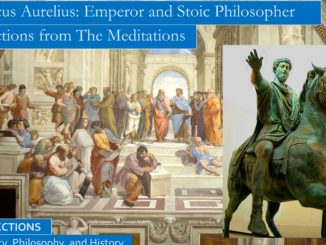
Be the first to comment