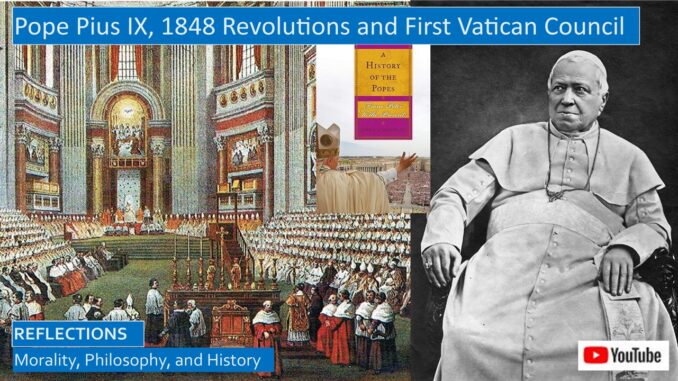
Pope Pius IX was best known as the pope who called the First Vatican Council into session.
How did the Revolutions of 1848 affect Pope Pius IX personally? How did they affect the Papal States and the Vatican?
Why did Pope Pius IX resist the Italian Unification movement? Why did he oppose democracy and freedom of religion?
Why did he call the First Vatican Council when French troops were holding back the Italian forces? What happened when the French troops withdrew?
Why was Pope Pius IX the first “Prisoner of the Vatican?”
YouTube video for this blog: https://youtu.be/XmeiBrQcMcw
POPE PIUS IX RESPONDS TO REVOLUTIONS OF 1848
Although Pope Pius IX, who called the First Vatican Council, became a reactionary conservative after the bloody 1848 Revolutions that spread across Europe, he was initially a liberal chosen in 1846 to counter the over-conservatism of Pope Gregory XVI.
When we learned that the new American pope chose to be named Pope Leo XIV, signaling his respect for the nineteenth-century Pope Leo XIII, we wanted to provide a short biography of this past pope in context of the history of the Church. Like in many human endeavors, many of these popes took one step backward for every two steps forward, so we reflected both on how the nineteenth and early twentieth century popes drew from the outdated policies of their predecessors, as well as how they prepared the Catholic Church for her evolving role in the modern world. Pope Pius IX was succeeded by Pope Leo XIII.
Council of Trent, The Reform Council Foreshadowing Vatican II
http://www.seekingvirtueandwisdom.com/council-of-trent-the-reform-council-foreshadowing-vatican-ii/
https://youtu.be/Thq1blvzWHs
Quoting our author, John O’Malley: After the Council of Trent, the implementation of the decrees “of Trent became an ongoing part of the pope’s job description.”[1]
In our prior reflection, we covered the popes from the Council of Trent to Vatican I, including the papacy of Pope Pius VI, who shepherded the church both through the French Revolution and Napoleon.
Catholic Popes from Trent to French Revolution and Napoleon to Vatican I
https://seekingvirtueandwisdom.com/popes-from-trent-to-french-revolution-and-napoleon-to-vatican-i/
https://youtu.be/XkmuUvrDWNg
Our author, John O’Malley, writes that Pope Pius IX faced “formidable political challenges” they faced after the Congress of Vienna restored the monarchies of Europe, including the Papal States. “Besides the unrest in the Papal States, the Risorgimento, the movement for Italian unification, gained increasing momentum, especially among intellectuals and the bourgeoisie.” The two major obstacles to Italian unification were the northern Italian states occupied by Austria and the central Papal states ruled by the Pope.
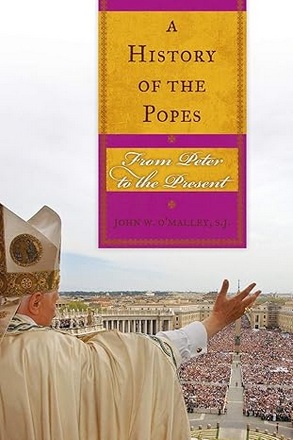
What was Pope Pius IX like? O’Malley tells us that “he came from a noble, fairly well-off family that” “showed a qualified sympathy for the new political and social ideals.” His initial ambition was to serve as a simple parish priest. “Handsome, witty, and usually a pleasure to be with, he had sudden and severe mood swings that left his associates wary.” Some thought he was “intellectually limited.”
Immediately after his election, he pushed through several reforms, including freeing political prisoners, increasing the role of laymen, dismantling the Jewish ghetto in Rome, and suggesting that he favored Italian unification. Unlike his predecessor, he embraced new technologies, installing gas lights and introducing railroads into Rome.
Events during the Revolutions of 1848 changed the political outlook of Pope Pius IX. His refusal to join a war to expel Austria from Italy was controversial. Soon after his prime minister was assassinated in broad daylight, our pope fled for his life to the town of Gaeta, eighty miles south of Rome. The Romans then declared a Republic. In 1849, French troops marched on Rome to restore the papacy, reinstalling him as pope in 1850.
Understandably, after the Revolutions of 1848, Pope Pius IX no longer a liberal, as he did not favor liberal secular republics that deposed popes and sought to minimize the role of the church in daily life. The pope was now a stalwart opponent of Italian unification.
What effect did this have on later church history? In America, the young republic of the United States guaranteed freedom of religion, and the church was never dependent on the state. Although there was some persecution of Catholics in America, democracy was not the enemy of the church.
But in Europe, the French revolutionaries had stolen church properties, both churches and other income-producing properties. Napoleon could not return this property to the church. But he allowed Catholics to hold services in the churches and cathedrals, and the state paid the salaries of the clergy, which made the church dependent on a hostile clerical state. In Europe, the Church saw democracy as the enemy of the church. Indeed, many European governments were run by radical secularists seeking to limit the influence of the church.
SPIRITUAL REFORMS OF POPE PIUS IX
Many reforms implemented by Pope Pius IX encouraged more devotion among Catholic believers. Devotion to and the veneration of the Virgin Mary, Mother of God, had been central to Catholicism since the earliest years of the church. Not only was this devotion encouraged, in 1854, Pope Pius IX proclaimed, on his own authority, as Catholic dogma, that the Virgin Mary was born without the taint of original sin, that this was an Immaculate Conception. This was the first time a pope declared a belief as dogma on his own authority.
In the 1800s, the popes, more and more, became teachers rather than simply administrators, relying on papal encyclicals addressed to both the clergy and the laity. Whereas his immediate predecessors issued only one or two encyclicals, Pope Pius IX issued thirty-eight encyclicals, and his successor, Pope Leo XIII, issued seventy-five encyclicals. These encyclicals advanced the concept of the Magisterium, the papal teaching office. Now, due to modern media, popes were personalities. Ordinary Catholics not only knew who the current pope was, but they could also recognize his face. This was not true for most of the church’s history.
Unfortunately, one of the encyclicals issued was the Syllabus of Errors, in which eighty errors of modern times were condemned. These errors included:
- Rationalism and religious indifferentism, or Freedom of Religion.
- Atheism, socialism, and communism.
- Protestant Bible societies and secret societies.
- Divorce.
The popes still hoped for the return of the Papal States to the papacy, so Pope Pius XI did not want to renounce secular power, and also opposed the separation of church and state.
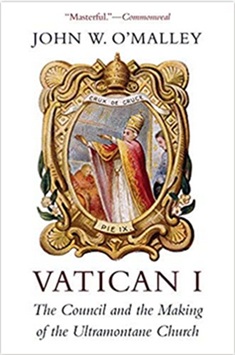
In 1860, the Papal States were captured and incorporated into the newly unified Italian state, while the French troops of Napoleon III protected Rome. In late 1864, Pope Pius IX issued the Syllabus of Errors, strengthening his spiritual power over Catholic souls while his temporal power over Italy was fading. In 1868, Pope Pius IX boldly announced that an ecumenical church council would meet in late 1869: the First Vatican Council. Seven hundred bishops attended; only about forty percent were Italian. About a hundred of these bishops were from Africa and Asia, although most of them were born in European countries.
Why did Pope Pius IX call the council? John O’Malley notes: “Some people speculated he wanted it solemnly to confirm the Syllabus of Errors. He may have wanted it as a show of Catholic strength worldwide against the church’s enemies, especially in Italy.”
O’Malley continues: “Despite the broad agenda that was anticipated, the council dealt with only two items. The first was the relationship between revealed truth and the powers of human reason.” The council affirmed both the distinction and compatibility between them. With that resolved, the council planned to discuss “church-state relations and the role of the bishops, but with the encouragement of Pius it bypassed them and moved directly to consider” “papal primacy and papal infallibility.”
Papal primacy was not new; the Catholic Church had held this view for fifteen hundred years. But the pope and many bishops felt that the church needed to definitively state that the pope had full authority, not only over matters of faith and morals, but also over discipline and governance for the church worldwide, for both clergy and laity.
More controversial was the issue of papal infallibility. Some bishops did not believe in this doctrine no matter how it was defined. On the other hand, some ultra-conservative Ultramontanist bishops thought that every word the pope uttered was infallible. But this was an issue near and dear to the pope’s heart. The definition that finally passed stated that only certain rare formal pronouncements by the pope were infallible.
For a papal pronouncement to be considered infallible, the pope, or the pope and the College of Bishops, must declare that the doctrine ex cathedra, in the exercise of the pope’s teaching office, for matters concerning faith or morals. This pronouncement must be a formal declaration following proper form. Many Catholics believe that Pope Pius IX’s proclamation of the Immaculate Conception, which was proclaimed before the Council, and Pope Pius XII’s proclamation of the Assumption of Mary, plus perhaps five other historical statements, were likely proclaimed ex cathedra. None of the post-Vatican II popes have declared any pronouncement ex cathedra, and Pope Benedict XVI and Pope John Paul II said they never would exercise this right. Nobody claims that Pope Francis’ speculations to reporters on the papal plane were declared ex cathedra.
O’Malley writes: “On almost the very day the final vote” on papal infallibility “was taken, the Franco-Prussian War broke out, and Napoleon III was forced to withdraw his troops from Rome. The bishops dispersed. When Napoleon III lost a decisive battle” “and was taken prisoner, it was clear French protection was over. Eighteen days later” “the Italian troops breached the walls of Rome after not much more than token resistance by the papal army. On that day, almost a millennium and a half of history came to an end. Rome was declared the capital of the new kingdom of Italy, and shortly thereafter, King Victor Emmanuel III took up official residence in the Quirinal Palace.”
A month later, as O’Malley writes, “the pope formally adjourned, but did not close, the council. He declared himself a ‘prisoner of the Vatican,’ even though the Italians placed no restrictions on his movements. Since Pope Pius IX would not deal with his enemies, the Italian authorities, unilaterally through the Law of Guarantees, tried to regularize the situation.” The Italian state proposed paying the pope a generous annual stipend to compensate for the loss of the Papal States, but the pope refused the stipends.
Pope Pius IX chose to maintain his self-imposed ‘prisoner in the Vatican’ status for the remaining eight years of his life. He forbade Catholics to participate in politics, which was only partially effective. This ban lasted into the twentieth century. The infallibility pronouncement hardened attitudes. It enflamed anti-clerical attitudes among liberals, while he was seen as a type of martyr among some devout Catholics. On his death, many Catholics called for his canonization.[2]
The popes who succeeded him would continue this self-exile as “Prisoners of the Vatican,” until over fifty years later Pope Pius XI signed the Lateran Accords with Mussolini in 1929, establishing the Vatican City as a sovereign mini-state comprising 109 acres in the middle of Rome, plus jurisdiction over several churches and a palace outside the walls in Rome proper.[3]
We will also reflect on brief biographies of the remaining popes through the two Great Wars in the twentieth century:
- Pope Leo XIII, who issued the influential encyclical Rerum Novarum, on Labor and Capital, that encouraged the Catholic Social Justice movement.
- Pope Pius X, the reactionary pope who encouraged greater piety among the faithful.
- Pope Benedict XV and Pope Pius XI, who guided the Catholic Church during the trying times of World Wars I and II.
We also reflected on David Kertzer’s biographies and histories of Pope Pius XI and Pope Pius XII, the two popes who guided the Catholic Church during the perilous Second World War. This reflection includes more details on how Pope Pius IX negotiated the Lateran Treaty with Mussolini.
Each of these popes prepared the church for the Second Vatican Council in their own way.
Pope Leo XIII: Catholic Social Justice and Rerum Novarum, Confronting the Modern World
https://seekingvirtueandwisdom.com/pope-leo-xiii-catholic-social-justice-and-rerum-novarum-confronting-the-modern-world/
Pope Pius X, Promoting Piety, Rejecting Modernism
https://seekingvirtueandwisdom.com/pope-pius-x-promoting-piety-rejecting-modernism/
Pope Benedict XV and Pope Pius XI: Confronting World War I and World War II, and Fascism
https://seekingvirtueandwisdom.com/pope-benedict-xv-and-pope-pius-xi-confronting-world-war-i-and-world-war-ii-and-fascism/
We also reflected on David Kertzer’s biographies and histories of Pope Pius XI and Pope Pius XII, the two popes who guided the Catholic Church during the perilous Second World War. Pope Pius IX also negotiated the Lateran Treaty with Mussolini that regularized relations between the Vatican and the Italian state, a treaty that is still in force today.
Mussolini’s Fascist Regime and the Catholic Church
http://www.seekingvirtueandwisdom.com/mussolinis-fascist-regime-and-the-catholic-church/
https://youtu.be/LvNynEdZFuM
After Pope Francis opened the Vatican archives for the wartime years, David Kertzer updated his biography and history of Pope Pius XII during the Second World War.
Pope Pius XXII: Back Channel Between Hitler and the Pope
https://seekingvirtueandwisdom.com/world-war-ii-back-channel-between-hitler-and-pope-pius-xii/
https://youtu.be/6xdxvchkWyY
Pope Pius XII, Wartime Pope, Axis Powers March Across Europe
https://seekingvirtueandwisdom.com/pope-pius-xii-wartime-pope-axis-powers-march-across-europe/
https://youtu.be/L1bkOQNrlzg
Pope Pius XII, Wartime Pope, Allied Powers Turn the Tide of War
https://seekingvirtueandwisdom.com/pope-pius-xii-wartime-pope-allied-powers-turn-the-tide-of-war/
https://youtu.be/pjMa3JdjW48
Pope Pius XII, Wartime Pope, Could the Pope Have Done More To Save the Jews?
https://seekingvirtueandwisdom.com/pope-pius-xii-wartime-pope-could-the-pope-have-done-more-to-save-the-jews/
https://youtu.be/ONnAcLLBNog
The Second Vatican Council is unimaginable without the experiences of the Catholic Church as it survived World War II. These experiences led it to embrace the American form of democracy and freedom of religion, and to restate the Catholic faith of Trent in a positive manner, seeking dialogue with all Christians and also with all faith traditions.
Vatican II Declaration on Freedom of Religion, Embracing Democracy, Rejecting Fascism
http://www.seekingvirtueandwisdom.com/vatiJcan-ii-decree-on-freedom-of-religion-embracing-democracy-rejecting-fascism/
https://youtu.be/i_zGeTW9QMI
Vatican II Decree on Freedom of Religion, Embracing Democracy, Rejecting Fascism
http://www.seekingvirtueandwisdom.com/vatican-ii-decree-on-freedom-of-religion-embracing-democracy-rejecting-fascism/
https://youtu.be/i_zGeTW9QMI
Pope John XXIII Opening Address to Vatican II, and Yves Congar, True and False Reform, Conclusion
https://seekingvirtueandwisdom.com/pope-john-xxiii-opening-address-to-vatican-ii-and-yves-congar-true-and-false-reform-conclusion/
https://youtu.be/ALZozpbSrM4
Council of Trent, The Reform Council Foreshadowing Vatican II
http://www.seekingvirtueandwisdom.com/council-of-trent-the-reform-council-foreshadowing-vatican-ii/
https://youtu.be/Thq1blvzWHs
DISCUSSING THE SOURCES
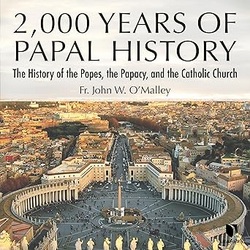
The Jesuit priest and professor John O’Malley specialized in the study of the Council of Trent and the First and Second Vatican Councils. He is an excellent writer, and this book is geared towards educating the layman on this history, and all his books are easily accessible to laymen. John O’Malley is one of our favorite authors.
Plus, we have a separate video of book reviews of the many sources for our reflections of the Councils of Trent, the First Vatican Council, and the Second Vatican Council.
Book Reviews, Reform Councils of Trent and Vatican II, and Vatican I
http://www.seekingvirtueandwisdom.com/book-reviews-reform-councils-of-trent-and-vatican-ii/
https://youtu.be/cuKVG24Bf78
[1] John O’Malley, A History of the Popes, From Peter to the Present (New York: Sheed and Ward, 2010), Chapter 21, The New Rome, p. 209.
[2] John O’Malley, A History of the Popes, Chapter 24, Beleaguered, Infallible, and Prisoner Again, pp. 241-250 and https://en.wikipedia.org/wiki/Papal_infallibility

1 Trackback / Pingback