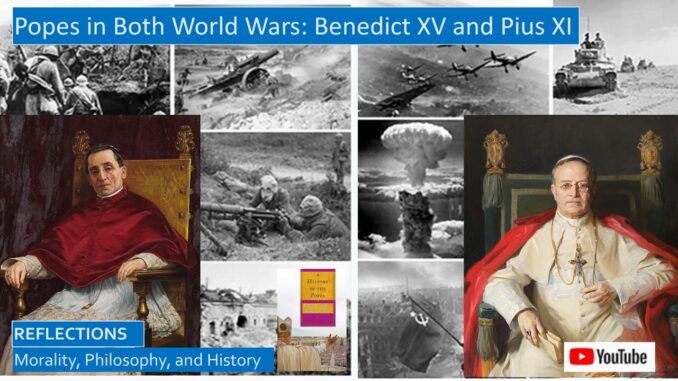
How did Pope Benedict XV respond to the First World War? Which side did the Vatican support?
Were Popes Benedict XV and Pius XI Prisoners of the Vatican? Did they resolve the Roman question?
How did these two popes encourage their missionary churches to become more independent?
Was Mussolini, who negotiated the Lateran Treaty with Pope Pius XI, a practicing Catholic?
YouTube video using this script: https://youtu.be/htUyyrkm5cQ
POPE FROM COUNCIL OF TRENT THROUGH THE WORLD WARS
When we learned that the new American pope chose to be named Pope Leo XIV, signaling his respect for the nineteenth-century Pope Leo XIII, we wanted to provide a short biography of this past pope in context of the history of the Church after the Council of Trent.
Pope Leo XIV, First American Pope, Successor to Pope Francis and Social Justice of Pope Leo XIII
https://seekingvirtueandwisdom.com/pope-leo-xiv-first-american-pope-successor-to-pope-francis-and-social-justice-of-pope-leo-xiii/
https://youtu.be/wSns5VGhtRk
This is one in a series of reflections on the relevant history of the popes from the Council of Trent through the two world wars which preceded the Second Vatican Council. Pope Leo XIII was preceded by Pope Pius IX, who called the First Vatican Council, and was succeeded by Pope Pius X, who was later sanctified as Saint Pius X. We compared Mussolini to the Emperor Napoleon, who also negotiated a concordat with the Catholic Church.
Catholic Popes from Trent to French Revolution and Napoleon to Vatican I
https://seekingvirtueandwisdom.com/popes-from-trent-to-french-revolution-and-napoleon-to-vatican-i/
https://youtu.be/XkmuUvrDWNg
Pope Pius IX, 1848 Revolutions and First Vatican Council
https://seekingvirtueandwisdom.com/pope-pius-ix-1848-revolutions-and-first-vatican-council/
https://youtu.be/XmeiBrQcMcw
Pope Leo XIII: Catholic Social Justice and Rerum Novarum, Confronting the Modern World
https://seekingvirtueandwisdom.com/pope-leo-xiii-catholic-social-justice-and-rerum-novarum-confronting-the-modern-world/
https://youtu.be/YojqhGBJtOY
Pope Pius X, Promoting Piety, Rejecting Modernism
https://seekingvirtueandwisdom.com/pope-pius-x-promoting-piety-rejecting-modernism/
https://youtu.be/IVzrd-ygkJA
POPE BENEDICT XV RESPONDS TO THE FIRST WORLD WAR
In the summer of 1914, the young men of Europe eagerly volunteered for what they thought would be a short, glorious war that would be over by Christmas. Little did they know that this long slog of a war would last for over four years, result in over seventeen million deaths, and cause the breakup of the Ottoman Empire, the Austro-Hungarian Empire, and the Russian Empire, ending many centuries-old dynasties in Europe.[1]
In late summer, the cardinals met to elect a new pope, Pope Benedict XV, a diplomat pope who could lead the Catholic Church through these perilous times. He had served in the papal diplomatic corps before his elevation. His first act was to select a more conciliatory Secretary of State. He maintained a strict neutrality for the Vatican, even towards Italy, denouncing the war as a senseless massacre, which earned him no friends. His attempts to broker peace were ignored, as was his proposal for a just peace made near the end of the war.
Pope Benedict XV was more successful in efforts to aid the victims of this long war. Our author John O’Malley writes: “He opened a bureau in the Vatican for reuniting prisoners-of-war with their families. The bureau received 170,000 requests for information, assisted with 40,000 reparations, and communicated with 50,000 families. The pope persuaded Switzerland to receive soldiers suffering from tuberculosis.” The Vatican also assisted with the wounded, refugees, and war orphans. These efforts came close to bankrupting the Vatican, which became known as the Second Red Cross.
Pope Benedict XV canonized Joan of Arc, which successfully improved relations between the Vatican and France, which had been completely ruptured under his predecessor, Pope Pius X.
Pope Benedict XV also sought to resolve the Roman question, repairing the rupture that happened in 1870, when Rome was incorporated into the united Italian state. In 1919, he blessed the efforts of the Popular Party, enabling Catholic Italians to participate in politics, supporting democracy.
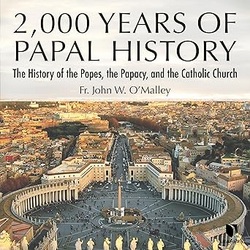
Pope Benedict XV also prepared the Catholic Church for the Second Vatican Council by encouraging local control of missionary churches. O’Malley writes: “With his encyclical Maximum Illud, 1919, he initiated a crucially important new phase in Catholic missionary activity by insisting that bishops cultivate vocations among the indigenous population, and that they separate themselves from their image as representatives of Western governments. He rebuked the ‘indiscreet zeal’ of bishops guilty of promoting the political and economic interests of their homelands.” This was effective, because “twenty years after the encyclical, native bishops headed some fifty mission territories.”
POPE PIUS XI: NEGOTIATING LATERAN TREATY WITH MUSSOLINI
In early 1922, Pope Benedict XV died unexpectedly from pneumonia. His successor, Pope Pius XI, was elected after the fourteenth ballot, and although he was a conservative, he was also a scholarly pope, enhancing the Vatican library. He rehabilitated some scholars who had been censured during the Modernist crisis, and dialed back the excessive conservatism of his predecessor.
Pope Pius XI continued the efforts of his predecessor in internationalizing the Catholic Church, appointing many foreign-born bishops. The College of Cardinals, by the time of his death, had twenty-seven non-Italians among the sixty-two total cardinals. Also, the number of indigenous clergy rose from three thousand to seven thousand. He also helped pave the way for Vatican II by encouraging the formation of Catholic Action groups of laypersons who were active in the church.
Mussolini signaled in a speech that he was open to negotiating the Roman question. Mussolini was not a practicing Catholic and was famously a serial philanderer. Like Napoleon before him, Mussolini realized that it was in his political interest to settle this issue and regularize the status of the Vatican City.
O’Malley writes: “The most momentous aspect of the Lateran Agreements was the establishment of the Vatican City as a fully independent and sovereign state, with its own postal service, police force, full diplomatic corps, and so forth. The Italian state agreed never to interfere in the free functioning of Vatican City and ensured full and safe access to it by anyone the papacy wanted to receive. The papacy agreed never to try directly or indirectly to reestablish the Papal States, and it relinquished in perpetuity all claims to the city of Rome.”
The Vatican was paid a generous indemnity for the loss of this territory, and the state would pay an annual stipend for the upkeep of historical monuments. In addition to the 103 acres in Vatican City, the pope could also use several churches and castles traditionally at the church’s disposal.[2]
The story of how Mussolini and Hitler dealt with Popes Pius XI and XII during World War II has been explored in a more in-depth reflection in two books by David Kertzner.
Although Mussolini was a friend of the Catholic Church in the 1920s, a deepening rift developed between him and Pope Pius XI when Mussolini fell increasingly under the spell of Hitler, going full Nazi, persecuting Italian Jews in the years preceding the outbreak of World War II.
Mussolini’s Fascist Regime and the Catholic Church
http://www.seekingvirtueandwisdom.com/mussolinis-fascist-regime-and-the-catholic-church/
https://youtu.be/LvNynEdZFuM
The story of how Mussolini and Hitler dealt with Popes Pius XI and XII during World War II has been explored in a more in-depth reflection of the two books by David Kertzner. During World War II, Rome was controlled first by a friendly Italy, then by a hostile Germany. Hitler planned to dismantle the Catholic Church after his victory in World War II.
Pope Pius XXII: Back Channel Between Hitler and the Pope
https://seekingvirtueandwisdom.com/world-war-ii-back-channel-between-hitler-and-pope-pius-xii/
https://youtu.be/6xdxvchkWyY
Pope Pius XII, Wartime Pope, Axis Powers March Across Europe
https://seekingvirtueandwisdom.com/pope-pius-xii-wartime-pope-axis-powers-march-across-europe/
https://youtu.be/L1bkOQNrlzg
Pope Pius XII, Wartime Pope, Allied Powers Turn the Tide of War
https://seekingvirtueandwisdom.com/pope-pius-xii-wartime-pope-allied-powers-turn-the-tide-of-war/
https://youtu.be/pjMa3JdjW48
Pope Pius XII, Wartime Pope, Could the Pope Have Done More To Save the Jews?
https://seekingvirtueandwisdom.com/pope-pius-xii-wartime-pope-could-the-pope-have-done-more-to-save-the-jews/
https://youtu.be/ONnAcLLBNog
Vatican II Declaration on Freedom of Religion, Embracing Democracy, Rejecting Fascism
http://www.seekingvirtueandwisdom.com/vatiJcan-ii-decree-on-freedom-of-religion-embracing-democracy-rejecting-fascism/
https://youtu.be/i_zGeTW9QMI
We are planning a summary reflection of the popes from Trent and Vatican II, reflecting on how these popes prepared the way for the Second Vatican Council.
DISCUSSION OF SOURCES
The Jesuit priest and professor John O’Malley specialized in the study of the Council of Trent and the First and Second Vatican Councils, and later on the history of all the leading popes. He is an excellent writer, and this book is geared towards educating the layman on this history, and all his books are easily accessible to laymen. John O’Malley is one of our favorite authors.
Plus, we have a separate reflection of book reviews of the many sources for our reflections of the Councils of Trent, the First Vatican Council, and the Second Vatican Council.
Book Reviews, Reform Councils of Trent and Vatican II, and Vatican I
http://www.seekingvirtueandwisdom.com/book-reviews-reform-councils-of-trent-and-vatican-ii/
https://youtu.be/cuKVG24Bf78
[1] https://en.wikipedia.org/wiki/World_War_I
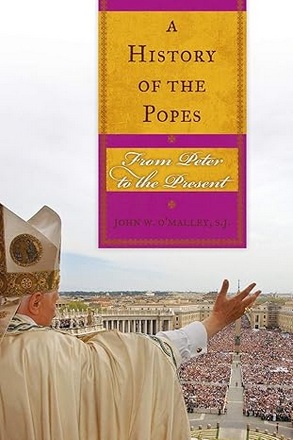
[2] John O’Malley, A History of the Popes, From Peter to the Present (New York: Sheed and Ward, 2010), Chapter 27, War, Peace, Fascism, pp. 271-278.


1 Trackback / Pingback