How did the ancient Greeks, Romans ,and Jews view homosexuality? Was there an ancient consensus on whether homosexuality should be condoned? Was this a controversial topic in the ancient world?
Leviticus has several verses denigrating homosexuality. How did Leviticus define homosexuality? Why doesn’t the Old Testament mention lesbianism? What about the New Testament?
In the ancient world, how were the ancient beliefs and attitudes on slavery, concubines, and homosexuality intertwined?
Why did the ancient Romans and early Christians condemn homosexuality?
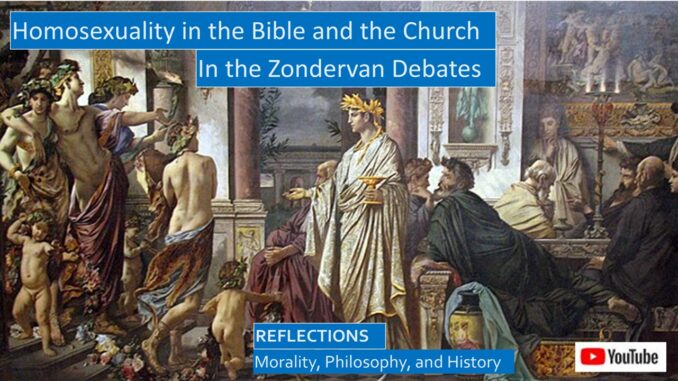
The thumbnail is a drunken Alcibiades, who unsuccessfully attempts to initiate a homosexual relationship with Socrates, crashing his Symposium dinner party, where the sober guests are delivering speeches on the nature of love. Socrates’ response is that he prefers divine love over carnal love.
DISCUSSING THE SOURCE
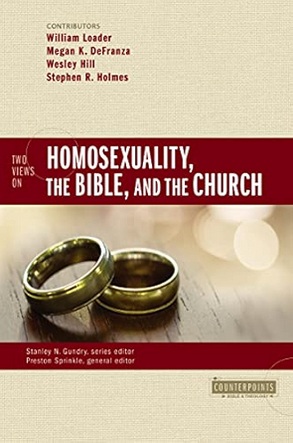
Zondervan Press’ Counterpoint series has theologians debate various contentious issues. We will reflect on the debates on Homosexuality, the Bible, and the Church. Preston Sprinkle, editor of Zondervan, and writes about LGBTQ+ issues in the church. He pens a quick introduction and summary.
We will not track the exact debate points expressed by the two affirming professors and the two traditional professors, but will rather reflect on the history and arguments we find interesting and pertinent.
MODERATOR: Zondervan Press Editor Preston Sprinkle.
AFFIRMING VIEW:
William Loader, professor in Mainz, Germany, is a leading scholar on sexuality in ancient Judaism and Christianity. He is a member of the Uniting Church of Australia, comprised of mostly Methodist and Presbyterian Churches.
Megan DeFranza, who is in a conventional marriage, is a leading theologian on sex, gender, and sexuality. She is a professor at the Jesuit Marquette University in Minnesota.
TRADITIONAL VIEW:
Wesley Hill, an Episcopal Priest who has come out as a gay Christian, identifies with the Augustinian view of sexuality. He teaches at the University of Durham in England. This book includes his personal experiences of growing up as both homosexual and Christian.[1]
Stephen Holmes is a professor at King’s College at London.
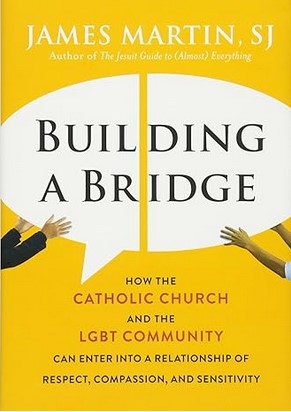
In the end, our Zondervan debaters come to roughly the same conclusions that are drawn in our previous reflection on the current Catholic debates on homosexuality, where we compared the differing views by Pope Benedict XVI and Father Martin, editor of the Jesuit magazine America, who was encouraged to continue his LGBTQ+ ministry by Pope Francis.
Their views differ because their pastoral experiences differ. Pope Benedict first became aware of the seriousness and extent of the clerical sexual abuse scandal when he was a Cardinal in the Vatican. His perspective is that of a Vatican policeman, adjudicating horrifying cases where pedophile priests were abusing their young parishioners.
On the other hand, Father Martin encounters the LGBTQ+ issues from the perspective of a confessor and confidant of ordinary laity and priests. While Pope Benedict XVI argued that homosexuals should not be permitted in the priesthood, Father Martin is more sympathetic. He states that many homosexual priests treasure chastity. Since they do not like being pressured to start a family, this adds to their joy in serving the church.
Building Bridges to LGBT Community: Father Martin and Popes Benedict and Francis
https://seekingvirtueandwisdom.com/the-church-the-catholic-catechism-and-the-lgbt-community/
https://youtu.be/F3BmZFYlqiU
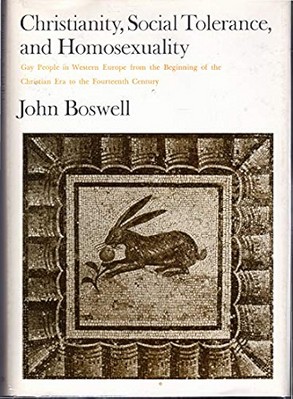
The Zondervan editor Preston Sprinkle points out that Biblical scholars were most silent on homosexuality before 1980, when John Boswell, a Yale professor, published his book, Christianity, Social Tolerance, and Homosexuality. Although many disagreed with his thesis that early Christian tradition through the twelfth century tolerated same-sex couples and that the Bible only prohibits exploitive homosexual behavior, this work sparked a wider debate.[2] John Boswell was gay, but had a monogamous partner for many years. He died of AIDS when he was forty-seven.
Both the ancient and modern church have been tolerant of human weakness when intimacy is involved. Jesus may have exhorted us to be faithful to our spouses, but if the church shunned those who have married more than once, the pews would be vacant. If you cheated on your first wife, and she was friends with many in the congregation, you may need to switch churches. There, strangers will welcome you, urging you to be loyal to your next wife. Dr Wikipedia’s summary of Boswell’s book states that toleration of homosexuality waxed and waned in the early church, but by the fourteenth century, the consensus opinion was that homosexuality could not be tolerated.[3] We are planning a reflection of this book imminently.
YT: John Boswell reflection
Many priests in the ancient Roman Church tolerated concubines, or common law wives, who may not have been able to marry their partner since they were from a lower class. St Augustine’s concubine gave birth to his only son, Adeodatus, which means a gift from God. He repented that he gave into his mother’s wishes, putting away his concubine to marry into a wealthy Christian family. After his conversion, he called off the marriage.
St Augustine’s Confessions: Mother Monica, Concubine, Marriage, and Philosophy, Books 6 & 7
https://seekingvirtueandwisdom.com/st-augustines-confessions-mother-monica-concubine-marriage-and-philosophy-books-6-7/
https://youtu.be/AjGbBozIReY
We consulted philosopher Michel Foucault’s multi-volume History of Sexuality for his reflections on the Platonic dialogues of love. He was homosexual himself, and was involved in several tawdry, hedonistic, and abusive homosexual relationships. His history seeks to justify hedonism, which is the opposite of Socrates’ viewpoint.[4] We put it back on the bookshelf, although the circular file would be a more fitting place. Your moral virtue would be weakened, not strengthened, by consuming the ideas in these books.
Instead, in our summary of Plato’s dialogues on love, we included the Lutheran theologian Anders Nygren’s famed cultural study of love in the Christian tradition, including the Platonic dialogues. His Agape and Eros, written in the interwar years, has inspired many scholars.
Summary of Platonic Dialogues on Love and Friendship, With Commentary by Copleston and Anders Nygren
https://seekingvirtueandwisdom.com/summary-of-platonic-dialogues-on-love-and-friendship/
https://youtu.be/cjXRXQc6Ff4
WHAT ARE MY PERSONAL VIEWS ON HOMOSEXUALITY?
Since I am a layman, and not part of the clergy, I need not share my personal beliefs on homosexuality. I am not even obligated to form an opinion on this issue. All I care about is a simple question that derives the core foundation of the Judeo-Christian tradition: Do I truly Love God? Do I truly love my neighbor as myself? And that means all my neighbors, we cannot choose whom we will and will not love. Everything we say or do should be inspired by this two-fold love of God and neighbor.
Hillel and Jesus, Reflections on Rabbi Telushkin’s Observations
http://www.seekingvirtueandwisdom.com/hillel-and-jesus-reflections/
Comparing Hillel and Shammai to Jesus
http://www.seekingvirtueandwisdom.com/comparing-hillel-and-shammai-to-jesus/
More Stories and Sayings of Hillel and Shammai
http://www.seekingvirtueandwisdom.com/more-stories-and-sayings-of-hillel-and-shammai/
Jesus, Hillel, and Shammai, Loving God and Neighbor
https://youtu.be/ygxn2qqGnOI
Based on these criteria, the simple question I need to confront as a layman is: Should I be cruel[5] or compassionate to my neighbor who is homosexual?
The Zondervan debates quote a pastor, struggling with the issue of homosexuality, who asked: “A lesbian couple came to church for the first time last Sunday, and they both came forward, hand-in-hand, to accept Jesus. Now what do I do?”[6]
Recently, I joined an Episcopalian Church that is truly biracial, a welcome respite from the MAGA-infected churches I had been attending. Plus, the Episcopalian Church is ecumenical at its core: it is the home of CS Lewis and Mere Christianity. I enjoy studying all the works of the Church Fathers, Reformers, Rabbis, and all Moral Philosophers who comprise the Judeo-Christian tradition. In the Episcopalian Church, I am not pressured to believe that my denomination is superior to all others.
For many years, the Episcopalian Church has welcomed homosexuals and homosexual couples into its fold. When I registered to attend the Episcopalian Cursillo retreat weekend, my spiritual sponsor was a godly homosexual man who also chairs the ministry committee. There is not a trace of unselfishness in this kind man, he seeks to Love God and love his neighbor as himself. How can I not treat him with dignity and respect?
Protestantism, Catholicism, Orthodoxy, and Judaism: Which Is True?
https://seekingvirtueandwisdom.com/protestantism-catholicism-orthodoxy-and-judaism-which-is-true/
For better or worse, most of us choose our intimate partners, and build our world around that choice. If a homosexual couple is accepted by the clergy of your church, what good can come from telling them they are going to burn in hell if they do not repent? We are only responsible for our own personal salvation, it is not our job, particularly if we are laymen, to speculate on whether our neighbor will be saved. That is between them and Jesus, and nobody else.
My goal is not to change your mind about homosexuality. What is my goal? That if you do not accept that it is possible to be both a Christian and homosexual, that you will refrain from telling them they are damned to burn in hell, but would instead refer them to an Episcopalian Church, or another church where they would be welcome.
Jesus will judge us all in front of the great IMAX theater in the sky, where we will need to account for the decisions we made in our lives as they are displayed on that screen forty feet wide and forty feet tall. Jesus is the judge; we should not seek to do his job. Instead, we work out our own salvation, judging our own actions rather than our neighbor’s.
HOW THE ANCIENT AND MODERN WORLDS DIFFER?
These Zondervan debates emphasize a primary theme: That the ancient world was a very different place than the modern world, and that to properly understand the Biblical prohibitions and exhortations, we must ponder these differences.
What distorts our view of homosexuality in the ancient world is that most modern authors who specialize in this topic are themselves homosexual. Although homosexuality was more accepted in the ancient world, like today, there was a spectrum of attitudes.
Many years ago, I attended a talk by the Jewish Professor Amy-Jill Levine on homosexuality in the Old Testament. There is a practical problem encountered when translating Scriptures that are thousands of years old: scholars often are not precisely sure what the abstract words describing moral attributes actually mean. Plus, the Old Testament itself only condemns male homosexuality, it does not mention lesbians. Do these verses condemn male homosexuality itself, or instead abusive male homosexual relationships? Scholars disagree. And in the New Testament, only one verse in Romans condemns lesbianism. There are no Bible verses that explicitly condone homosexuality.
Our traditional Stephen Holmes admits that here is one important difference between the ancient and modern worlds: “Lifelong, exclusive, equal same-sex partnerships are virtually unknown outside the contemporary West. Same-sex sexual activity is common, but it almost never takes this cultural form.”[7] Same-sex marriage is likewise a thoroughly modern construct.
With this in mind, we can frame the moral question differently. Assuming that homosexuality is sinful: Would Jesus be more likely to be forgiving if the homosexual partners truly cared for each other, with the love shown when we love our neighbor as we love ourselves?
Does this differ from the scenario where the husband cheats on his first wife, who divorces him, but years later he marries a second time and, having matured, is now a devoted husband who truly loves his spouse as himself? According to the strict definition in the Scriptures, he, too, is living in sin.
It is well known that in ancient Greece, homosexuality was bound up in men-boy relationships where grown men mentored teenage youths in exchange for their companionship and other things. However, there are references to homosexual relationships between grown men in ancient Greece, beginning with Achilles and Patroclus in the Iliad. Another well-known example is the Sacred Band of Thebes, the hundred and fifty male couples of Theban hoplites that were an elite fighting force in the Corinthian Wars, which followed the Peloponnesian Wars.[8] Concubines and slavery were also accepted in ancient Greece and ancient Israel, as concubines were often young women captured in war. Indeed, the opening quarrel in the Iliad was over two Trojan beauties who were kidnapped concubines captured in military raids. The Torah exhorts the Jews to treat captured concubines as if they were Jewish wives.
Iliad Blog 2, Captured Concubines in the Iliad and the Torah
http://www.seekingvirtueandwisdom.com/iliad_blog02/
The Iliad, blog 4, Briseis, Chryseis, Aren’t all Concubines the Same?
http://www.seekingvirtueandwisdom.com/the-iliad-blog-4-briseis-chryseis-arent-all-concubines-the-same/
Concubines in the Iliad, Old Testament and Christian Tradition
https://youtu.be/bGHHD7XTvr0
Several of Plato’s dialogues reflect on divine love versus carnal love, including friendship and homosexual love. In all these dialogues on love, Socrates does not encourage homosexual love himself, but rather encourages his students to prefer divine love over carnal love. His Symposium has a memorable Socratic speech drawing from Diotima, while the Phaedrus has the famous image of the eternal chariot driven by a pair of steeds: a divine steed seeking divine love pulling upwards while the mortal steed pulls down to base carnal desires. Socrates urges the youth Phaedrus to reject the carnal homosexual seduction of an older youth.
Both Xenophon and Plato penned a Symposium dialogue, taking place at a dinner party where the main entertainment is the speeches Socrates and the other guests deliver impromptu speeches on love. Other than Socrates, each has differing guest lists. Two of Xenophon’s guests are the attractive youth Autolycus, and his father Lycon, who is protective of his son, shielding him from lecherous advances from the other guests.
Xenophon and Plato, Socratic Dialogue, Symposium, Romantic and Carnal Love, Part 1
https://seekingvirtueandwisdom.com/xenophon-and-plato-socratic-dialogue-symposium-romantic-and-carnal-love-part-1/
https://youtu.be/OIe5pn2S1Ls
Xenophon and Plato, Socratic Dialogue, Symposium, Divine and Noble Love, Part 2
https://seekingvirtueandwisdom.com/xenophon-and-plato-socratic-dialogue-symposium-divine-and-noble-love-part-2/
https://youtu.be/z6X3pwVTdrc
Plato’s Dialogue of Phaedrus on Carnal Love and Rhetoric, Part 1
https://seekingvirtueandwisdom.com/platos-dialogue-of-phaedrus-on-carnal-love-and-rhetoric-part-1/
https://youtu.be/JFw5ThfwUAg
Plato’s Dialogue of Phaedrus on Divine Love and the Heavenly Chariot, Part 2
https://seekingvirtueandwisdom.com/platos-dialogue-of-phaedrus-on-divine-love-and-the-heavenly-chariot-part-2/
https://youtu.be/BOtavup_N4g
The Platonic Dialogue Alcibiades 1 reflects on friendship, leadership, and love. But, in the Platonic Dialogue Lysis, old men ogle naked boys exercising at the gymnasium. Socrates initially plans to introduce the youth Lysis to his older companion, but abandons this plan, instead discussing friendship with Lysis.
A footnote in Robin Waterfield’s translation of Lysis refers to an Athenian court case which holds that older men were forbidden to flirt with younger boys in a public gymnasium. Although no public opinion polls were conducted in the ancient world, we can be sure that, like today, there were differences in opinion regarding homosexuality, although it was tolerated more in the ancient world than today.
Platonic Dialogue Alcibiades 1, On Friendship, Leadership, and Love
https://seekingvirtueandwisdom.com/platonic-dialogue-alcibiades-1-on-friendship-leadership-and-love/
https://youtu.be/WbCARvApLNk
Lysis, Platonic Dialogue on Love and Friendship, Where Old Men Ogle Boys at the Gymnasium
https://seekingvirtueandwisdom.com/lysis-platonic-dialogue-on-love-and-friendship-where-old-men-ogle-boys-at-the-gymnasium/
https://youtu.be/HrSZ5SPUZ7Y
Summary of Platonic Dialogues on Love and Friendship, With Commentary by Copleston and Anders Nygren
https://seekingvirtueandwisdom.com/summary-of-platonic-dialogues-on-love-and-friendship/
https://youtu.be/cjXRXQc6Ff4
Anders Nygren, On Christian Agape-Love and Eros-Love in Gospels and Pauline Epistles
https://seekingvirtueandwisdom.com/anders-nygren-on-christian-agape-love-and-eros-love-in-gospels-and-pauline-epistles/
https://youtu.be/KniBalQMemMrf
Megan DeFranza notes that “thirty was the ideal age for men to marry in both Roman and Jewish circles,” which was true also for the ancient Greeks, as by then the men would have established their financial independence. Usually, their wives were about fourteen years old, with little, if any, education.
William Loader’s summary states that in Athenian Greece, homosexual relationships were expected to cease when men turned thirty, at which time they should marry and start a family. But Sparta differed; military training began in boyhood, and soldiers slept in their barracks until they were in their thirties. They were encouraged to marry and start a family in their teens and twenties, but they had to sneak out to sleep with their wives! Homosexual relationships between men were tolerated, even encouraged, and the demographic challenges of the Spartan state were exacerbated when some men chose not to sneak out of their barracks at night.
Ordinary Life and Justice in Ancient Athens, Rome, and Israel
http://www.seekingvirtueandwisdom.com/ordinary-life-and-justice-in-the-ancient-world/
https://youtu.be/vl8KGL5Yx2w
Ordinary Life for Romans Under Stoic Emperor Marcus Aurelius
https://seekingvirtueandwisdom.com/ordinary-life-for-romans-under-stoic-emperor-marcus-aurelius/
https://youtu.be/9hgSbcgbCJw
Unique Spartan Warrior Culture and History, Plutarch’s Life of Lycurgus, Lawgiver of Sparta
https://seekingvirtueandwisdom.com/unique-spartan-warrior-culture-and-history-plutarchs-life-of-lycurgus-lawgiver-of-sparta/
https://youtu.be/_hYwZsxmC3s
Spartan Women, Marriage, Family Life and Sayings, From Plutarch’s Life of Lycurgus
https://seekingvirtueandwisdom.com/spartan-women-marriage-family-life-and-sayings-from-plutarchs-life-of-lycurgus/
https://youtu.be/q8kgoaaeCLg
DeFranza continues: “Even when married, husbands were encouraged to have sex with their wives solely for the purpose of procreation and to find other outlets for their erotic passions. Sex with slaves and prostitutes was considered a ‘moral’ alternative.”[9] Sexual abuse of slaves was rampant in all slave societies, both ancient and modern, and especially in America before the Civil War. Indeed, many thought it was impossible to rape a slave, since you could do as you wished with your property.
We Fought the Civil War to Preserve Slavery, Confederate Leaders Proclaimed
https://seekingvirtueandwisdom.com/we-fought-the-civil-war-to-preserve-slavery-confederate-leaders-proclaimed/
https://youtu.be/vBt81M6EWk0
The affirming William Loader observes that “first century marriages in both Jewish and Greco-Roman cultures were bound up with the household, and the household was the cornerstone of society and welfare of its citizens. Fathers negotiated with each other about the best pairings. Self-negotiated marriage or romantic engagements were frowned upon. What was at stake was the future of the household and all its members.”[10]
What would married life be like for a thirty-year-old man marrying a fourteen-year-old girl? Was she more like an elder daughter than a wife? Did the husband feel like he was training his wife? Did these imbalanced ancient marriages encourage men to find friendship with other men rather than their wives?
The affirming William Loader observes: “Roman law treated same-sex relations between citizens as a criminal offense but tolerated it between a Roman citizen and someone inferior, like a slave or a foreigner. Romans sometimes deplored same-sex relations as a Greek disease and typically self-indulgent, to which Greeks responded by deploring the fact that Romans usually did not expect such relations to cease when a young man turned thirty.”
Why did the early Christian Church, and many ancient Romans, condemn homosexuality? They were chiefly concerned with the abuses of pederasty, or men-boy relationships. Also, both pagan and Christian Romans, including St Paul and the early Church Fathers, and Philo and Josephus, decried men who were effeminate, assuming female characteristics and mannerisms.[11]
Several Roman emperors indulged in public homosexual relationships. Nero “married” the youth Sporus, who resembled his murdered wife, castrating him, compelling him to appear in public as his wife.[12] During his short reign, Elagabalus married multiple times and had several homosexual relationships.[13] The good emperor Hadrian was homosexual, which is why he adopted the aged Senator and future Emperor Antoninus Pius to guarantee a peaceful succession. Hadrian had a favored youth Antinous, who died either by drowning or suicide in his twentieth year. Hadrian deified Antinous after his death, his cult was popular among the Romans.[14]
Roman Emperors Before Marcus Aurelius
https://seekingvirtueandwisdom.com/roman-emperors-before-marcus-aurelius/
https://youtu.be/6i–hVIpg1k
Our affirming Megan DeFranza further reveals how predatory ancient Greek and Roman societies could be: “Slave traders captured and at times mutilated boys to create more exotic living sex toys for those with the means to pay.” “Traffickers stole or sought boys, cut off or mutilated their testes to preserve a prepubescent beauty, and sold them to wealthy individuals and pimps who prostituted their bodies for money. Many ancient men lusted after the soft, effeminate bodies of these castrated males because androgynous features were considered more alluring than feminine beauty.”[15]
What was the source for most slaves? Many women and children were enslaved when their city-state was defeated in war. Many were kidnapped by pirates. For example, Odysseus purchased a loyal slave from pirates, and the Cynic philosopher Diogenes of Sinope was kidnapped and sold into slavery in Corinth. Another source of slaves was the many unwanted children abandoned in the marketplace, sometimes by families too poor to care for them.
Slaves in the Ancient World, Blog 1, Were Slaves the Employees of the Ancient World?
http://www.seekingvirtueandwisdom.com/slaves-in-the-ancient-world-blog-1-were-slaves-the-employees-of-the-ancient-world/
Slaves in Ancient Greece and Rome, Blog 2
http://www.seekingvirtueandwisdom.com/slaves-in-ancient-greece-and-rome-blog-2/
https://youtu.be/O67cmVRvBtA
Teachings about Slavery in the Bible, the Stoics, and by the Early Church Fathers
http://www.seekingvirtueandwisdom.com/teachings-about-slavery-in-the-bible-and-by-the-early-church-fathers/
https://youtu.be/poyvJajCXnE
Odyssey, Blog 1, Waiting Those Very Long Years For Odysseus
http://www.seekingvirtueandwisdom.com/odyssey-blog-1-waiting-those-very-long-years-for-odysseus/
Odyssey, Blog 2, Odysseus Sings His Adventures
http://www.seekingvirtueandwisdom.com/odyssey-blog-2-odysseus-sings-his-adventures/
Odyssey, Blog 3, Odysseus Returns Home to Ithica
http://www.seekingvirtueandwisdom.com/odyssey-blog-3-odysseus-returns-home-to-ithica/
Odyssey, Blog 4, The Slaughter of the Suitors
http://www.seekingvirtueandwisdom.com/odyssey-blog-4-the-slaughter-of-the-suitors/
Odyssey of Homer: Xenia, the Need for Hospitality
https://youtu.be/bUW4ZT9zpt8
Greek Cynic Philosophers
http://www.seekingvirtueandwisdom.com/diogenes-and-the-greek-cynic-philosophers/
https://youtu.be/zAAal5p8AX8
A cautionary note when pondering what life was like in the ancient world is that the ancient sources often describe the life of prosperous city dwellers, which was a small portion of the population. We know very little about what life was like on ancient Greek farms. We only know what life was like in Athens and Sparta. What about Thebes and Corinth? Alexander the Great either killed or enslaved the Thebans, razing their city to the ground.[16] Later, the Romans likewise destroyed Corinth, slaying and enslaving the inhabitants.[17]
BIBLICAL VERSES ON HOMOSEXUALITY
This verse in Leviticus prohibits homosexuality:
“You shall not lie with a male as with a woman; it is an abomination.”[18]
Our affirming Megan DeFranza argues that the Greek in Septuagint suggests that this could be read as: “Do not sleep with a man (arsenos) as one beds (koiten) like a woman: that is detestable,”[19] which also applies to this next verse:
“If a man lies with a male as with a woman, both of them have committed an abomination; they shall be put to death; their blood is upon them.”[20]
Although it is not evident in the English translation, the original Greek in St Paul’s exhortations to the Corinthians refers to effeminate men:[21]
“Do you not know that wrongdoers will not inherit the kingdom of God? Do not be deceived! Fornicators, idolaters, adulterers, male prostitutes, sodomites, thieves, the greedy, drunkards, revilers, robbers—none of these will inherit the kingdom of God.”[22]
In the myth of Zeus and Ganymeade as depicted in the painting in our video, Zeus seduces the youth Ganymede. Taking the form of an eagle, he flies Ganymeade to Mount Olympus, where he becomes Zeus’ cupbearer.[23]
Likewise, in 1 Timothy, the original Greek suggests that St Paul is also referring to kidnappers when he refers to slave traders:[24]
“The law is laid down not for the innocent but for the lawless and disobedient, for the godless and sinful, for the unholy and profane, for those who kill their father or mother, for murderers, fornicators, sodomites, slave traders, liars, perjurers, and whatever else is contrary to the sound teaching that conforms to the glorious gospel of the blessed God, which he entrusted to me.”[25]
This verse in Mark may be referring to the sexual abuse of a child:
“If any of you put a stumbling block before one of these little ones who believe in me, it would be better for you if a great millstone were hung around your neck and you were thrown into the sea.”[26] That is because the Greek word for causing the child to stumble is also the root word for scandal, which implies sexual wrongdoing.[27]
Another ancient work, the Sibylline Oracles, read by both early Jews and Christians, combine pagan mythology with Judeo-Christian legends, stories and homilies. They accuse Romans of male homosexuality, pederasty, and prostitution.[28]
Megan DeFranza quotes this verse in Romans: “Welcome those who are weak in faith, but not for the purpose of quarreling over opinions.”[29] Does this encourage us to welcome homosexuals in our church, even when we are conflicted on this issue?
Also, these debates do not highlight the fact that the Old Testament, and the Book of Leviticus in particular, prohibits male homosexuality but is silent on lesbianism. Consequently, many modern rabbis tolerate lesbianism.
Lesbianism is explicitly forbidden in the New Testament in only a single verse in St Paul’s Epistle to the Romans. What was St Paul’s source? Probably the Jewish oral law summarized by the medieval rabbi Rambam in his compilation of the Mishneh Torah, on which we plan a future reflection. Rambam drew from the Hebrew Torah, or the first five books of the Old Testament, and from the Biblical commentary in the Talmud.[30]
YT Rambam
UNCOMFORTABLE QUESTIONS
William Loader, affirming, begins with some uncomfortable questions. “Does our understanding of Scripture need to change? What if we can show that the Bible does not condemn homosexuality or homosexual acts after all?”
What does change is our deeper understanding of medical science and how our neurology is bound up with our emotions, and even our free will.
Regarding “homosexual passions, some argue that Scripture does not judge a person because of their orientation, including their feelings, but condemns only the act and the intent to act. For many this has been a huge relief. It is okay for them to be gay and have homosexual feelings as long as they do not act on them.”
William Loader continues: “As we shall see, this softening of the Biblical position does not do justice to the text, which sees the orientation itself as a symptom of sin. It has, however, enabled many to accept their homosexuality without feeling guilty about it, and to hold together their understanding of themselves and their understanding of Scripture by binding themselves never to express their sexuality, at least not in the forms of those acts which are condemned.”
“Thus, some make this choice of lifelong celibacy, and there are many stories, some of them very moving, of people who have chosen this path and hold to it heroically, which some, however, might deem as tragic. For others, this is not a realistic or, at least, a healthy option. Choosing celibacy is one thing. Obliging it by implication on all who are gay, so that they must never give natural expression to the sexuality, is another.”[31]
William Loader: “As a person of faith, I welcome the increasing recognition both in the wider community and in the church that being gay is not something from which one needs to be healed. This does justice to all concerned.”[32]
In his summary, the Zondervan editor Preston Sprinkle observes: “The question is not whether the Bible is authoritative, but how it is authoritative.”[33]
Why did the early Roman Christians, as well as the consensus of the ancient Roman culture, reject homosexuality? A strong argument supports the view that pederasty, or man-boy carnal love, helped turn the ancient Romans against male homosexuality, and many modern Christians share this concern.
[1] Homosexuality, the Bible, and the Church (Zondervan, 2016), Wesley Hill, pp. 124-126 and https://www.westernsem.edu/faculty/hill/
[2] Homosexuality, the Bible, and the Church, Introduction, Preston Sprinkle, pp. 12-15 and https://en.wikipedia.org/wiki/Bill_Loader
[3] https://en.wikipedia.org/wiki/Christianity,_Social_Tolerance,_and_Homosexuality and https://en.wikipedia.org/wiki/John_Boswell
[4] https://en.wikipedia.org/wiki/Michel_Foucault
[5] https://www.theatlantic.com/ideas/archive/2018/10/the-cruelty-is-the-point/572104/?gift=CDDZsE8kHh4NvI8xwvhZXjt4D_vBNbWpTLdB0JvtRsk&utm_source=copy-link&utm_medium=social&utm_campaign=share and https://en.wikipedia.org/wiki/John_Boswell
[6] Homosexuality, the Bible, and the Church, Ending, Preston Sprinkle, p. 225.
[7] Homosexuality, the Bible, and the Church, Megan DeFranza, p. 53.
[8] https://en.wikipedia.org/wiki/Sacred_Band_of_Thebes
[9] Homosexuality, the Bible, and the Church, Megan DeFranza, p. 79.
[10] Homosexuality, the Bible, and the Church, William Loader, p. 105.
[11] Homosexuality, the Bible, and the Church, William Loader, pp. 33-35.
[12] https://en.wikipedia.org/wiki/Sporus
[13] https://en.wikipedia.org/wiki/Elagabalus
[14] https://en.wikipedia.org/wiki/Antinous
[15] Homosexuality, the Bible, and the Church, Megan DeFranza, pp. 54, 72.
[16] https://www.thecollector.com/destruction-thebes-alexander-the-great/
[17] https://en.wikipedia.org/wiki/Ancient_Corinth
[18] https://www.biblegateway.com/passage/?search=leviticus%2018%3A22&version=NRSVCE
[19] Homosexuality, the Bible, and the Church, Megan DeFranza, p. 73.
[20] https://www.biblegateway.com/passage/?search=leviticus%2020%3A13&version=NRSVCE
[21] Homosexuality, the Bible, and the Church, Megan DeFranza, p. 51.
[22] https://www.biblegateway.com/passage/?search=1%20Corinthians%206%3A9-10&version=NRSVCE
[23] https://en.wikipedia.org/wiki/Ganymede_(mythology)
[24] Homosexuality, the Bible, and the Church, Megan DeFranza, pp. 78-79.
[25] https://www.biblegateway.com/passage/?search=1%20timothy%201%3A9-11&version=NRSVCE
[26][26] https://www.biblegateway.com/passage/?search=mark%209%3A42&version=NRSVCE
[27] Homosexuality, the Bible, and the Church, William Loader, pp. 32-33.
[28] Homosexuality, the Bible, and the Church, William Loader, pp. 24-25.
[29] https://www.biblegateway.com/passage/?search=romans%2014%3A1-4&version=NRSVCE
[30] https://en.wikipedia.org/wiki/Mishneh_Torah
[31] Homosexuality, the Bible, and the Church, William Loader, p. 19.
[32] Homosexuality, the Bible, and the Church, William Loader, p. 66.
[33] Homosexuality, the Bible, and the Church, Conclusion, Preston Sprinkle, p. 219


Continuing with our study of the Gemara of Kiddushin. משנה תורה, קידושין אב משנה, סוגיה ב’. ואשה בפחות מש”פ, לא מקניא נפשה
Our Av Mishna in this mesechta – restricts. Just as שוה פרוטה restricts so too and how much more so age and maturity of the child restricts. Scholarship in Talmudic common law does not read words printed on a page and react like as does statute law and reactionary newspaper intellectuals. Torah common law requires of any talmid in any generation or Era to make the critical סדור דיוקים – logical inferences. The term סידור refers specifically to the Jewish prayer book and generally relates to the order of logical order of tefillot according to פרדס logic or reasoning. מערות דיוקים – another way of expressing logical inference deductions. For example: in three Av ברכות an one תולדה blessing of this זימן גרמא מצוה the key term פרנסה established in each of the 4 blessings.
Av time-oriented commandments sanctify מלאכה rather than simply עבודה. The latter verb defines the תולדות מצוות שלא צריך כוונה. Therefore the repeated reference to פרנסה functions as a רמז (words within words) pun upon מלאכה as פרנסה. A father has a Torah obligation to teach his children a trade. Professionals in a “trade union” earn higher wages than simple common minimum wage workers. Herein defines the “mussar rebuke” of the k’vanna of ברכת המזון as a time-oriented מלאכה מצוה.
Every time a scholar elevates a תולדה מצוה שלא צריך כוונה to a Av tohor time-oriented commandment, herein defines the meaning of חידושי תורה. Torah scholarship, like expressed through statute law assimilated Karaism Judaism, denies the existence of זימן גרמא חידושי תורה. This idea: “זימן גרמא חידושי תורה” refers to instances that provoke intellectual engagement in the study of Torah, emphasizing the depth and complexity of mitzvot that require skill and thought, rather than simple or rote actions.
The post Rambam Civil War projects to this day the karaite philosophy of doing mitzvot by rote. Its this basic must fundamental יסודי סוד which permanently separates Jewish common law פרדס Judaism from Karaim Orthodox Judaism both in the days of the Tzeddukim – who like the later Karaim rejected the Oral Torah פרדס judicial common law legalism. They all sought to substitute an “orthodox Jewish religion” to replace Sanhedrin courtroom authority. The Tzeddukim Cohonim heretics, no different from the korban offered by Cain – a barbeque dedicated unto Heaven מצוה עבודת השם שלא לשמה. “Post the Rambam Civil War” the Tzeddukim and Karaim preceded the rote “tradition” of Greek\Roman statue law substitute for Jewish common law through Yad, Tur, Shulkan Aruch alien Goyim-like halachic codes.
The tefillah דאורייתא of ברכת המזון rote reading printed words in the bencher utterly fails to distinguish and separate מלאכה from עבודה. Absolutely no different from Yeshiva students who study Talmud for years, and yet can not distinguish judicial common law from Roman statute law. Based upon the mitzva of Shabbat, this mitzva serves as the Av model of all time-oriented commandments. Just as both קידוש והבדלה separate and distinguish between מלאכה מן עבודה, all other Torah Av time-oriented commandments require a Havel k’vanna which remembers the Avot brit oaths as מלאכת עיקר or מלאכה יסודי.
Roman statute law, by definition, has no “family genetic” “DNA” connections with the wisdom of מלאכה; just as race does not define the chosen Cohen people, but rather Jews who keep and follow the culture and customs practiced by the Cohen people as determined through T’NaCH, Talmud, Midrashim, & Siddur – herein the precise precondition placed upon all Gere Tzeddik. The Rambam, Karaim, Tzeddukim. Samaritans who converted to Judaism, typically referred to as “כנעניים” (Ken’anim), like as expressed in a Mishna in Baba Kama. Whereas mesechta Sanhedrin refers to Gere Toshav, temporary Goyim residents, by the term: bnai Noach. Specifically expressed through the 7 mitzvot “bnai Noach”.
This learning today relies extensively upon the Oral Torah middah רב חסד which means מאי נפקא מינא או תמיד מעשה בראשית. The latter metaphor, twice repeated in the opening blessing prior to ק”ש שחרית, refers to the vision of מלאכה as the wisdom which for ever “creates” the Chosen Cohen bnai brit people from nothing in all generations throughout time. The av tuma avoda zara abomination of “virgin birth” negates the Torah sanctification of Av tohor time oriented commandments.
ולרב הונא דאמר חופה קונה מק”ו למיוטי מאי? למעוטי חליפין.(Tzedduki, Canaani, Karaite, Rambam, Tur, Shulkan Aruch, substitute statute halachic religious law.) ס”ד אמינא הואיל (דתנן: האשה נקנית) וגמר קיחה קיחה משדה עפרון, מה שדה מקניא בחליפין אף אשה נמי מקניא בחליפין קמ”ל – למעוטי חליפין (The halachot of statute halachic religious Orthodox Judaism religious law – null and void.)