
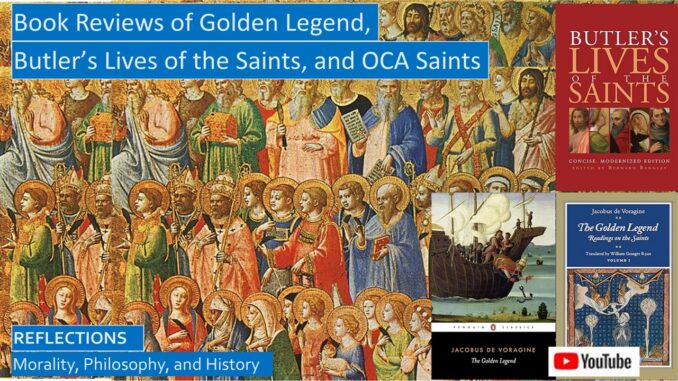
When we were compiling our reflection on the Infancy Gospels of Jesus, we discovered that one of the medieval stories was included in the Golden Legend, and that this collection of saint stories was one of the most popular books read and recited in the Middle Ages. These stories reveal the spirituality of the early and medieval churches.
Did Mary Give Birth to Jesus in a Cave With a Midwife? Infancy Gospels of James and Pseudo-Matthew
https://seekingvirtueandwisdom.com/did-mary-give-birth-to-jesus-in-a-cave-with-a-midwife-infancy-gospels-of-james-and-pseudo-matthew/
https://youtu.be/qtF6znNUYG0
YouTube video for this blog: https://youtu.be/RFUeBLPMyqI
The compiler of the Golden Legend was the Dominican friar Jacobus de Voragine. The Dominicans historically have been concerned about historical accuracy to guard the faith against heresy. He lists as his three primary sources the lives from Ecclesiastical History by Eusebius, bishop and advisor to Emperor Constantine; the Tripartite History by Cassiodorus; and the Scholastic History by Peter Comestor. In addition, he refers to more than 120 other sources. He was also influenced by earlier collections of lives of the saints by two other Dominican scholars. When his sources were apocryphal and not trustworthy, he points this out. When possible, he tries to reconcile dates and details, but is more concerned with the spiritual lessons than historical accuracy.
Jacobus de Voragine was born about 1229 and entered the Dominican Order in Genoa in 1244, eventually becoming the prior of several convents, during which time he wrote the Golden Legend between 1259 and 1266. In 1292, he was chosen to be the archbishop of Genoa. In this office, he mediated between the local feuding Guelf and Ghibelline families. He died in 1298 and was beatified by Pope Pius VIII in 1816.
In his introduction to the Penguin translation of the Golden Legend, Richard Hamer states that the “Golden Legend was one of the most widely disseminated books throughout Europe from its completion in 1266 until the end of the Middle Ages,” and is essential for understanding medieval history, especially for “students of the history of art, since so many depictions of the saints and events relating to the liturgical feasts in paintings, stained glass and other media are based on” accounts from the Golden Legend. Next to the Bible, it was the most widely read book in the Middle Ages.
In his introduction to the Princeton translation of the Goden Legend, William Granger Ryan notes that “the miracle stories, if they are to make any sense to modern readers, require” “that they try to see life and the world the way medieval Christians did. For them, God was not a philosophical abstraction but was a living, ever-present, caring actor, the creator and giver of life.”
“Their life was a pilgrimage through a world that was passing, to which they were not to become attached, since the reason for their being was to be united with God in heaven. Meanwhile, they grubbed a hard living from the reluctant earth.”
Ryan continues: “The world was a scene of warfare between good and evil, a world peopled with demons and angels. The demons, to deceive and mislead God’s children, resorted to a marvelous bag of tricks, but always wound up looking foolish. The angels protected God’s people. The Church, the sacraments, the mysteries of Christ celebrated in the liturgy, formed a milieu for the Christian’s progress from birth to death, from earthly life to eternal life.”
“To people who saw the hand of God working in the world and in the miracles of the saints, these miracles, wonderworks, cures, control of natural forces, foreknowledge, while astonishing, were unquestionably believable.”
The earliest surviving dated manuscript is from 1265. Dr Wikipedia states that there are over a thousand surviving manuscripts of the Golden Legend. These lives were translated into most European languages, plus the Latin and vernacular editions were among the earliest printed books. Some versions included additional lives of local saints.[1]
We have purchased two collections of the Golden Legend, a one-volume translation published by Penguin Classics of 71 Lives of the Saints, and a two-volume translation published by Princeton with a complete collection of 182 Lives of the Saints and religious holy days. The Penguin Classics translations by Christopher Stace are much easier to comprehend than the Princeton translations. However, the Princeton Golden Legend includes expositions of many holy days, all of which are omitted from the Penguin compilation.
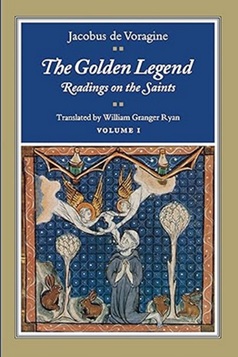
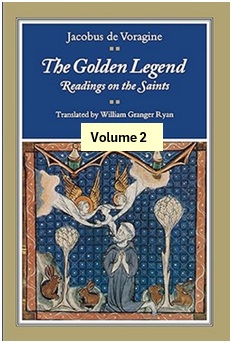
The Penguin translations also omit entirely the absurdly fanciful etymologies, or word histories, and the often inaccurate manuscript history from the original Golden Legend. We will reflect on these when they sound plausible, but we will usually ignore them.
Initially, I was skeptical that this introductory material would be so absurd that it was meaningless, until I scanned several of the lives. For example, this is the etymology and manuscript history of the Life of St George the Dragon Slayer:
“The name George is derived from geos, meaning earth, and orge, meaning to work; hence one who works the earth, mainly his own flesh.” “Or George comes from gero, pilgrim, gir, cut off, and ys, counselor, for he was a pilgrim in his contempt for the world, cut off by gaining the crown of martyrdom, and a counselor in his preaching of the Kingdom.” Which is totally absurd and obviously manufactured.
The first statement in his manuscript history is inaccurate: “At the Council of Nicaea his legend was included among the apocryphal writings because there is no sure record of his martyrdom.” Nearly all scholars agree that not only there is no record that the Council of Nicaea discussed the canon, that it would not make sense since discussions on what books should be included in the biblical canon were initiated much later.
The additional manuscript history for St George the Dragon Slayer is reasonable when he observes that, in Bede’s Calendar, he is martyred in the Persian city of Dyaspolis, which was formerly called Lidda. Also, some accounts say he was martyred under the Persian emperor named Dacian.[2]
St George the Dragon Slayer, From the Golden Legend and Butler’s Lives of the Saints
https://seekingvirtueandwisdom.com/st-george-the-dragon-slayer-from-the-golden-legend-and-butlers-lives-of-the-saints/
https://youtu.be/XpbBdh4hpIc
BUTLER’S LIVES OF THE SAINTS AND OTHER SOURCES
Alban Butler was born in England in 1710, and is best known for his Lives of the Saints, written over a period of thirty years, and published between 1756 and 1759. He was ordained as a priest and taught philosophy and theology to other candidates for the priesthood. Over the centuries, these Lives were reprinted many times. Butler used as his primary source the Acta Sanctorum, and earlier collection of the lives of the saints, published in 1643.[3] Quite likely, the Golden Legend was an important source for that Acta Sanctorum, and thus also for Butler’s summaries of the Lives of the Saints. In addition, he included lives of Anglo-Saxon saints, of which many were not included in the Golden Legend.
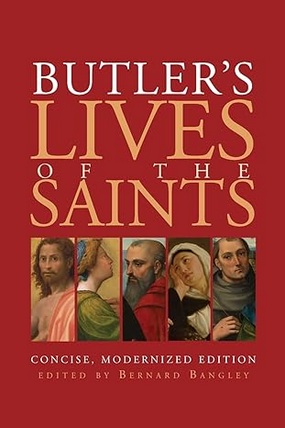
Whereas the Golden Legend and Butler’s Lives of Saints are both hagiographies, which means that they are non-critical portraits of the saints, since they are, indeed, holy men. Although they include many fantastic stories, the authors do make an effort to report factual details accurately.
Pope Benedict XVI also penned a two-volume collection of short biographies of Church Fathers from Apostolic times to Peter Lombard, and also Great Christian Thinkers from Apostolic times to the present, which hew closer to modern scholarly sensibilities, avoiding the wild stories of the earlier saints’ lives. The most influential Church Fathers are covered in more depth. Some Church Fathers are discussed in both sets of books, we presume there is some duplication. As he is a good writer and accomplished scholar, we look forward to reflecting on these biographies.
We also consulted the website of the Orthodox Church of America, or OCA, which lists the lives of many saints from the first millennium, plus later Orthodox saints. They use as their primary source the Reference Book for Clergy-Servers published by the Moscow Patriarchate, and quite likely the Golden Legend was ultimately an original source for that as well. In our blog, we list more details on this work. Although these lives are likely more historically accurate than the lives of the saints in the Golden Legend, we favor the Golden Legend accounts. Many scholars use the stories in the Golden Legend in interpreting medieval paintings and iconography. Often these stories can be used to interpret Orthodox iconography as well.
https://www.oca.org/saints/lives/2025/05/27
The second of our reflections on the Lives of Saints in the Golden Legend and Butler’s Lives is on St George, the Dragon Slayer. We may do about one a month, we are looking at the life St Basil, using both these lives and a biography of saints by Pope Benedict XVI. Going forward, we will start with some of the more interesting early saint stories, plus some lives of the Early Church Fathers.
St George the Dragon Slayer, From the Golden Legend and Butler’s Lives of the Saints
https://seekingvirtueandwisdom.com/st-george-the-dragon-slayer-from-the-golden-legend-and-butlers-lives-of-the-saints/
https://youtu.be/XpbBdh4hpIc
SOURCES FOR OCA WEBSITE LIVES OF THE SAINTS
Quoted from the OCA website: “The primary source for the Monthly Saints Accounts translated here by Fr. Stephen Janos is Tome 2 and Tome 3 of the series Reference Book for Clergy-Servers published by the Moscow Patriarchate, Moscow 1978 & 1979. This translation is copyright © Stephen Janos, 1997-2001, All Rights Reserved.
We are supplementing this translation with original material for the Orthodox Saints of North America developed by the Department of History and Archives of the Orthodox Church in America, Syosset, NY. Additional text resources are being utilized to expand the collection of saints’ lives made available on the OCA web site. The complete text of the “Lives of the Georgian Saints” is used with permission from St. Herman Press, P.O. Box 70, Platina, CA 96076. The book can be purchased online from the St. Herman Press catalog or by contacting the Press via email: stherman@stherman.com”[4]
[1] Richard Hamer, Introduction to Jacobus De Voragine, The Golden Legend, Christophe Stace, translator (New York: Penguin Classics, 1998, originally 1266), pp. ix-xxx and https://en.wikipedia.org/wiki/Golden_Legend and William Granger Ryan, Introduction to Jacobus De Voragine, The Golden Legend, Readings on the Saints, William Granger Ryan, translator (Princeton University Press, 1993, originally 1266), pp. xiii-xviii.
[2] Jacobus De Voragine, The Golden Legend, Readings on the Saints, William Granger Ryan, translator, April 23, p. 238.
[3] Micheal Walsh, Editor’s Introduction for Alban Butler, Butler’s Lives of the Saints (Harper San Francisco, 1991, 1956, originally 1759), pp. vii-viii and https://en.wikipedia.org/wiki/Alban_Butler and https://en.wikipedia.org/wiki/Acta_Sanctorum

1 Trackback / Pingback