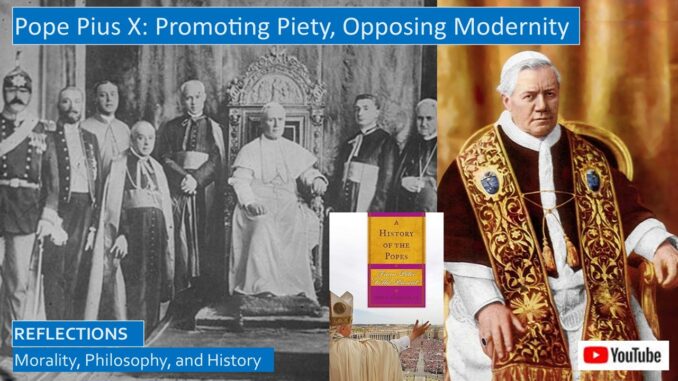
How did Pope Pius X differ from his processor, Pope Leo XIII?
How did his initiatives affect Catholic worship and the liturgy? Was he able to increase lay participation in the Mass?
Why was his papacy hostile to independent scholarship? Why did Catholic theologians have to limit their studies to the philosophy of St Thomas Aquinas?
Did he found the Society of St Pius X, or SSPX?
YouTube video for this blog: https://youtu.be/IVzrd-ygkJA
POPES PRECEDING POPE PIUS X
When we learned that the new American pope chose to be named Pope Leo XIV, signaling his respect for the nineteenth-century Pope Leo XIII, we wanted to provide a short biography of this past pope in the context of the history of the Church after the Council of Trent.
Pope Leo XIV, First American Pope, Successor to Pope Francis and Social Justice of Pope Leo XIII
https://seekingvirtueandwisdom.com/pope-leo-xiv-first-american-pope-successor-to-pope-francis-and-social-justice-of-pope-leo-xiii/
https://youtu.be/wSns5VGhtRk
Quoting our author, John O’Malley: After the Council of Trent, the implementation of the decrees “of Trent became an ongoing part of the pope’s job description.”[1]
Council of Trent, The Reform Council Foreshadowing Vatican II
http://www.seekingvirtueandwisdom.com/council-of-trent-the-reform-council-foreshadowing-vatican-ii/
https://youtu.be/Thq1blvzWHs
In our prior reflection, we covered the popes from the Council of Trent to Vatican I, including the papacies of Pope Pius VI and Pope Pius VII, who shepherded the church both through the French Revolution and Napoleon’s reign.
Catholic Popes from Trent to French Revolution and Napoleon to Vatican I
https://seekingvirtueandwisdom.com/popes-from-trent-to-french-revolution-and-napoleon-to-vatican-i/
https://youtu.be/XkmuUvrDWNg
Pope Pius IX, who called the First Vatican Council, had to contend with the subsequent Revolutions of 1848. This time the Papal States were lost for good. The Council was dissolved when the papal army was defeated in the Risorgimento, or unification of Italy. Pope Pius IX refused to negotiate with the new government, declaring that he was a ‘Prisoner of the Vatican.’
Pope Pius IX, 1848 Revolutions and First Vatican Council
https://seekingvirtueandwisdom.com/pope-pius-ix-1848-revolutions-and-first-vatican-council/
This standoff continued under his successor, Pope Leo XIII, who famously issued the papal encyclical Rerum Novarum, on Capital and Labor, that greatly encouraged the development of Catholic Social Justice, or the Preferential Option for the Poor.
Pope Leo XIII: Catholic Social Justice and Rerum Novarum, Confronting the Modern World
https://seekingvirtueandwisdom.com/pope-leo-xiii-catholic-social-justice-and-rerum-novarum-confronting-the-modern-world/
POPE PIUS X: A PASTORAL POPE WHO TENDED THE FLOCK
After the long and momentous papacy of Pope Leo XIII, the cardinals sought a candidate who would be a pastoral pope. They chose Guiseppe Sarto, who had spent his entire priestly life as a pastor, last serving as patriarch of Venice. He was from a family of modest means, and for nine years he served as a priest in a country parish. His formal education was meager, he studied at a seminary in Padua.
Our author John O’Malley explains: “Pope Pius X had never set foot outside Italy. He saw things in terms of black and white. While still Patriarch of Venice, he wrote to a friend: ‘When we speak of the Vicar of Christ, we must not quibble. We must obey. We must not evaluate his judgments or criticize his directions lest we do injury to Jesus Christ himself. Society is sick. The one hope, the one remedy, is the pope.’ The words ring like an Ultramontanist manifesto.”
Pope Pius X recognized that his inexperience meant he needed wise counsel as pope, so he appointed the strong-willed Cardinal Rafael Merry Del Val as Secretary of State, who negotiated with hostile and anti-clerical governments, including those in France and Portugal. But sometimes his diplomacy was blunt and uncompromising.
The greatest achievement of Pope Pius X was enriching the liturgy and encouraging more lay participation in the liturgy. The missal and breviary were revised and simplified to encourage greater participation. Under his encouragement, the liturgy and Sunday Mass because the center of Catholic piety. The Gregorian Chant was encouraged, and more of the Mass, including the Creed and the Gloria, was sung, and congregational singing was encouraged.
The greater lay participation in the liturgy organically led to the translation of the Latin prayers in the Mass into English so the parishioners could understand them. But for many, the next logical step was to ask: Why not simply recite the prayers in the vernacular language, like English? This would lead to further liturgical reform in Vatican II.
Before the papacy of Pope Pius X, most Catholics received the Eucharist only once or twice a year. More frequent partaking was encouraged so that by the middle of the twentieth century, most Catholics received the Eucharist weekly. If you attended morning mass, you could receive the Eucharist daily.
Like his predecessor, he was wary of the modern historical methods of biblical interpretation, so he founded the Pontifical Biblical Institute in Rome, run by the Jesuits, to counter the liberalism of these methods. However, as the years passed, the professors in this school came to terms with these new scholarly methods of interpretation, adopting some of them.
COMBATTING MODERNISM, ENCYCLICAL PACENDI
Pope Pius X went further than his predecessors in his condemnations of modernity, especially in his encyclical Pacendi Dominici Gregis, or Feeding the Lord’s Flock, where he summarized the heresies advanced by the Modernists, who were often critical of the theology of St Thomas Aquinas.
O’Malley writes: The Modernist “heresy tests on two false principles:
- The rejection of metaphysical reason, which led to skepticism regarding rational proofs for God’s existence.
- The rejection of the supernatural, which led to the idea that Christian doctrine derived solely from religious experience.”
O’Malley notes that Pope Pius “especially rejected the idea that ‘dogma is not only able to but ought to evolve and to be changed, for at the head of what the Modernists teach is their doctrine of evolution.’” Pope Pius X regarded “Modernism as not so much a heresy as ‘the synthesis of all heresies.’”
How was the encyclical to be implemented and enforced? O’Malley writes:
- “First, greater insistence on the teaching of St Thomas Aquinas.
- Second, anybody found showing a ‘love of novelty in history, archeology, or biblical exegesis’ was to be excluded from all teaching positions.
- Third, bishops were to establish a Vigilance Council whose function was to inform the bishop of anybody possibly tainted with heresy.
- Fourth, every three years they were required to submit to the Vatican a sworn report on how these provisions were being fulfilled.”
What exactly was Modernism? Which new scientific discoveries were merely “new novelties?” Did the Catholic Church seek to punish mere curiosity? Was this a papal reign of terror?
O’Malley writes: “A veritable purge followed, with excommunications, dismissals from office, and banning of books reaching epidemic proportions.” Many innocently curious scholars were stigmatized, many careers were ruined, and Catholic intellectual life was throttled through the reign of the next two popes also named Pius.
The Catholic intellectuals who were forbidden to teach include many of the leading theologians of the Second Vatican Council, including Yves Congar. His landmark book, True and False Reform in the Church, was not only was banned by the Vatican, but he was prevented from teaching or publishing after 1954. But it inspired the next pope, Pope John XXIII, to call the Second Vatican Council, and when he did, he appointed Yves Congar to preparatory theological commission planning the council.
Yves Congar – Meaning of Tradition, Blog 1
http://www.seekingvirtueandwisdom.com/yves-congar-meaning-of-tradition-blog-1/
Yves Congar – Meaning of Tradition, Blog 2
http://www.seekingvirtueandwisdom.com/yves-congar-meaning-of-tradition-blog-2/
https://youtu.be/f0gQ_Y9tROo
Yves Congar, True and False Reform, Part 1, Finding Common Ground
https://seekingvirtueandwisdom.com/yves-congar-true-and-false-reform-part-1-finding-common-ground/
https://youtu.be/yYp7yFZqc3s
Yves Congar, True and False Reform, Part 2, True Reform by Returning to Tradition
https://seekingvirtueandwisdom.com/yves-congar-true-and-false-reform-part-2-true-reform-by-returning-to-tradition/
https://youtu.be/1xqY0kN1eKk
Pope John XXIII Opening Address to Vatican II, and Yves Congar, True and False Reform, Conclusion
https://seekingvirtueandwisdom.com/pope-john-xxiii-opening-address-to-vatican-ii-and-yves-congar-true-and-false-reform-conclusion/
https://youtu.be/ALZozpbSrM4
Another side-effect of this silencing of scholars by the pre-Vatican II popes was that subsequently the Catholic Church was reluctant to silence critics of the church. Hans Kung, an old college friend of Pope Benedict XVI, was only silenced after he repeatedly called press conferences over many years openly criticizing the Catholic Church, rather than being satisfied with writing his best-selling books. And YES, we conclude that good Catholics are permitted to read the works of Hans Kung.
Can Good Catholics Read the Works of Hans Kung?
http://www.seekingvirtueandwisdom.com/can-good-catholics-read-hans-kung-should-devout-catholics-read-hans-kung/
https://youtu.be/Nbtinm3ATgI
O’Malley concludes: “Pope Pius X died on August 20, 1914, just a few days after World War I broke out. Even those who disagreed with his policies saw him as a man of sincere, even if simplistic, piety. While he was still alive, he was spoken of as a saint. Forty years after his death, in 1954, Pope Pius XII confirmed that opinion by canonizing him.”[2]
FOUNDING THE SOCIETY OF ST PIUS X (SSPX) IN 1970
Many years later, in 1970, the breakaway Archbishop Marcel Lefebvre founded the Society of Saint Pius X. He especially objected to freedom of religion, religious tolerance, abandonment of the Tridentine mass, and rejected ecumenism in favor of Catholic exclusivism. Both Pope Paul VI and Pope John Paul II tried to reconcile Lefebvre to the Catholic Church but failed, as he refused to assent to the Vatican II decrees. SSPX priests who were elevated to bishops without the blessings of the Vatican were excommunicated.
Lefebvre died from cancer in 1991. Pope Benedict XVI lifted the excommunication of the four surviving SSPX bishops, explaining this was due to doctrinal rather than disciplinary reasons, but he did not recognize their canonical status, nor did he recognize the canonical status of the SSPX.[3] Pope Benedict XVI was embarrassed when it was revealed that one of these four “pardoned” bishops was a Holocaust denier.[4] Lefebvre also spoke approvingly of the French Vichy regime led by Marshal Petain that collaborated with the Nazis during World War II, and has been accused of being anti-Semitic. Dr Wikipedia has a long list of controversies surrounding SSPX.[5]
POPES SUCCEEDING POPE PIUS X
We will also reflect on brief biographies of Pope Pius X’s successors, Pope Benedict XV and Pope Pius XI, who guided the Catholic Church during the trying times of World War I, then World War II.
Pope Benedict XV and Pope Pius XI: Confronting World War I and World War II, and Fascism
https://seekingvirtueandwisdom.com/pope-benedict-xv-and-pope-pius-xi-confronting-world-war-i-and-world-war-ii-and-fascism/
We also reflected on David Kertzer’s biographies and histories of Pope Pius XI and Pope Pius XII, the two popes who guided the Catholic Church during the perilous Second World War. This reflection includes more details on how Pope Pius XI negotiated the Lateran Treaty with Mussolini.
Mussolini’s Fascist Regime and the Catholic Church
http://www.seekingvirtueandwisdom.com/mussolinis-fascist-regime-and-the-catholic-church/
https://youtu.be/LvNynEdZFuM
After Pope Francis opened the Vatican archives for the wartime years, David Kertzer updated his biography and history of Pope Pius XII during the Second World War.
Pope Pius XXII: Back Channel Between Hitler and the Pope
https://seekingvirtueandwisdom.com/world-war-ii-back-channel-between-hitler-and-pope-pius-xii/
https://youtu.be/6xdxvchkWyY
Pope Pius XII, Wartime Pope, Axis Powers March Across Europe
https://seekingvirtueandwisdom.com/pope-pius-xii-wartime-pope-axis-powers-march-across-europe/
https://youtu.be/L1bkOQNrlzg
Pope Pius XII, Wartime Pope, Allied Powers Turn the Tide of War
https://seekingvirtueandwisdom.com/pope-pius-xii-wartime-pope-allied-powers-turn-the-tide-of-war/
https://youtu.be/pjMa3JdjW48
Pope Pius XII, Wartime Pope, Could the Pope Have Done More To Save the Jews?
https://seekingvirtueandwisdom.com/pope-pius-xii-wartime-pope-could-the-pope-have-done-more-to-save-the-jews/
https://youtu.be/ONnAcLLBNog
The Second Vatican Council is unimaginable without the experiences of the Catholic Church as it survived World War II. These experiences led it to embrace the American form of democracy and freedom of religion, and to restate the Catholic faith of Trent in a positive manner, seeking dialogue with all Christians and also with all faith traditions.
Vatican II Declaration on Freedom of Religion, Embracing Democracy, Rejecting Fascism
http://www.seekingvirtueandwisdom.com/vatiJcan-ii-decree-on-freedom-of-religion-embracing-democracy-rejecting-fascism/
https://youtu.be/i_zGeTW9QMI
Vatican II Decree on Freedom of Religion, Embracing Democracy, Rejecting Fascism
http://www.seekingvirtueandwisdom.com/vatican-ii-decree-on-freedom-of-religion-embracing-democracy-rejecting-fascism/
https://youtu.be/i_zGeTW9QMI
Pope John XXIII Opening Address to Vatican II, and Yves Congar, True and False Reform, Conclusion
https://seekingvirtueandwisdom.com/pope-john-xxiii-opening-address-to-vatican-ii-and-yves-congar-true-and-false-reform-conclusion/
https://youtu.be/ALZozpbSrM4
DISCUSSING THE SOURCES
The Jesuit priest and professor John O’Malley specialized in the study of the Council of Trent and the First and Second Vatican Councils. He is an excellent writer, and this book is geared towards educating the layman on this history, and all his books are easily accessible to laymen. John O’Malley is one of our favorite authors.
Plus, we have a separate reflection of book reviews of the many sources for our reflections of the Councils of Trent, the First Vatican Council, and the Second Vatican Council.
Book Reviews, Reform Councils of Trent and Vatican II, and Vatican I
http://www.seekingvirtueandwisdom.com/book-reviews-reform-councils-of-trent-and-vatican-ii/
https://youtu.be/cuKVG24Bf78
[1] John O’Malley, A History of the Popes, From Peter to the Present (New York: Sheed and Ward, 2010), Chapter 21, The New Rome, p. 209.
[2] John O’Malley, A History of the Popes, From Peter to the Present (New York: Sheed and Ward, 2010), Chapter 26, Pius X: Confronting Modern Culture, pp. 261-268 and https://en.wikipedia.org/wiki/Yves_Congar and John O’Malley, What Happened At Vatican II, Chapter 2, The Long Nineteenth Century, p. 74.
[3] https://en.wikipedia.org/wiki/Society_of_Saint_Pius_X
[4] https://en.wikipedia.org/wiki/Richard_Williamson_(bishop)
[5] https://en.wikipedia.org/wiki/Controversies_surrounding_the_Society_of_Saint_Pius_X


Be the first to comment