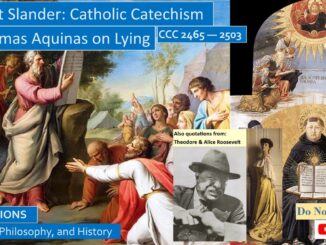
Decalogue: Do Not Slander, Catholic Catechism 2465-2503, and St Thomas Aquinas
Command 8 Do Not Bear False Witness

Decalogue: Do Not Slander, Catholic Catechism and St Thomas Aquinas CCC 2465-2503

The Eight Commandment in the Catholic Catechism exhorts, “You shall not bear false witness against your neighbor.” Many people shorten this commandment to, You shall not lie, and although lying is usually sinful, this is a shallow understanding of this commandment. The positive form of the commandment is we should guard the reputation of our neighbor, it is possible to slander someone while speaking the truth about them. Gossip can be harmful whether it is truthful or not. […]
Modern Catholic Popes

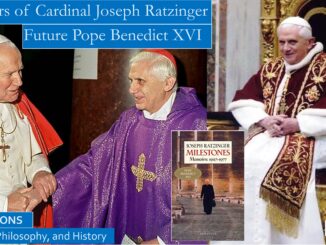
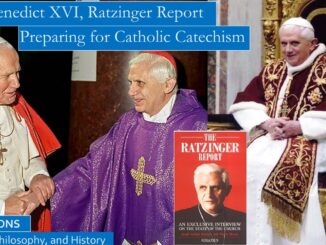
Ratzinger Report, by Future Pope Benedict XVI, Preparing for Catholic Catechism

Cardinal Ratzinger teaches us: “Every council that bears fruit must be followed by a wave of holiness. Thus it was after Trent, and it achieved its aim of real reform for this reason. Salvation for the Church comes from within her,” not solely “from the decrees of the hierarchy. Whether Vatican II and its results will be considered as a luminous period of Church history will depend upon all the Catholics who are called to give it life. As Pope John Paul II said in his commemoration of Charles Borromeo in Milan, ‘the Church of today does not need any new reformers, the Church needs new saints.’” […]

Modern Catholic Popes

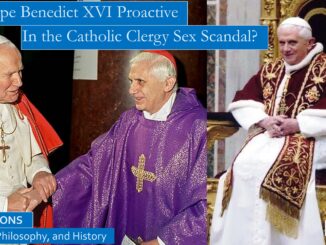
Was Pope Benedict XVI proactive in the pedophile priest sex scandal?

Penance is what Christians do; Christians repent. Unfortunately, many secular media interpreted these gestures by Pope Benedict as an admission of personal guilt.
During this time Cardinal Ratzinger confessed, “The greatest persecution of the Church comes not from her enemies without but arises from sin within the Church.” “The Church has a deep need to relearn penance, to accept purification, to learn forgiveness on the one hand, but also the need for justice.”
The media can be unfair at times. Pope Benedict XVI said that “we must be grateful for every disclosure. The truth, combined with love rightly understood, is primary. The media could not have reported these incidents had there not been evil in the Church herself.” […]

Modern Catholic Popes

Milestones: Memoirs of Cardinal Joseph Ratzinger, Future Pope Benedict XVI

Archbishop Ratzinger teaches us that “this psalm from the wisdom tradition shows the straits of faith that comes from the absence of earthly success. When you stand on the side of God, you do not necessarily stand on the side of success.” “When the psalmist stands in before God, in the presence of God, he grasps the ultimate insignificance of material wealth and success and recognizes what is truly necessary and what brings salvation.” […]

Current Events and History

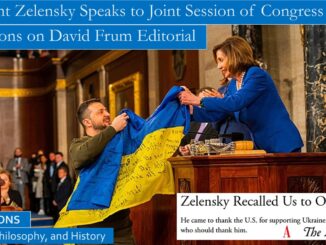
Ukrainian President Zelensky Speaks to Joint Session of Congress, Reflections on David Frum Editorial in Atlantic Magazine

David Frum writes, “Zelensky came to Washington to speak for his nation. He came to Washington to ask for assistance. But above all, he came to Washington to recall Americans to themselves. He came to say, My embattled people believe in you. Embedded in his words of trust was a challenge: If we believe in you, perhaps you can again believe in yourselves?” […]

Civil Rights

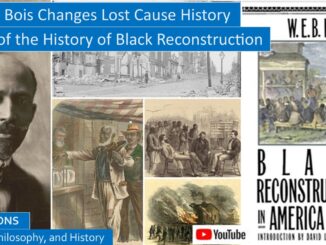
History of History of WEB Dubois’ Black Reconstruction, Challenging Lost Cause Myth and Dunning School

The established dogma was that the Reconstruction Era following the Civil War was a dark period in American history, where black rule bred corruption and unwanted federal interference in the governments of the Deep South. WEB Du Bois counters by claiming that the Jim Crow Redemptionist Era following Reconstruction was the dark era when blacks lost the right to vote and any semblance of due process and fair play, that many blacks were, in effect, re-enslaved in a more brutal segregationist society, and that the Reconstruction was a time of greater democracy where the civil rights and liberties of all races and classes were respected. […]

History

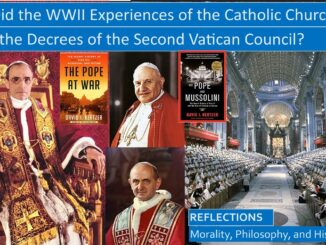
How Did the Experiences of World War II Influence the Second Vatican Council?

Vatican II marks a shift in the Church’s attitude towards the modern secular world. Gone are the anathemas of the Council of Trent and many other councils that condemn those who may disagree with the teachings of the church, instead Vatican II seeks dialogue with the modern world in with a pastoral rather than a condemning attitude. The Vatican II decree on religious freedom announced that democracy and freedom of religion and conscience were the friends of the church, that a totalitarian form of government could never be a trustworthy friend of the Catholic or Christian Church. […]

History

Pope John XXIII Opening Address to Vatican II, and Yves Congar, True and False Reform, Conclusion

Pope John Paul XXIII opens his speech with:
“A positive proof of the Catholic Church’s vitality is furnished by every single council held in the long course of the centuries.” “And now the Church must once more reaffirm that teaching authority of hers which never fails but will endure until the end of time.”
This echoes Congar’s sentiments that true reform must rediscover the ancient traditions of the church, that the moral teachings never change, but history itself does change, and the church must change with history. […]

History

Yves Congar, True and False Reform, Part 1, Finding Common Ground

When Archbishop Angelo Roncalli, the future Pope John XXIII, reflected on this book, he asked, “A reform of the church? Is such a thing really possible?” Yves Congar reflects, What is the role of the church? Is the church the hierarchy in the Curia; or is the church the parishioners in the pews? What are the sacraments? What is the church’s definition of commonly misunderstood concepts, such as infallibility?
This book, along with help by the Holy Spirit, encouraged the pope to call for a church council, and helped set the tone for Vatican II. As Yves Congar teaches us, spiritual reform cannot be a revolution, false reform divides rather than unites. […]

History

Pope Pius XII, Wartime Pope, Could the Pope Have Done More To Save the Jews?

The major questions raised about the wartime policies of Pope Pius XII were:
Why did the pope say so little when the Nazis were committing brutal atrocities, both against Jews and also Catholics in Poland?
Why did the pope not protest more forcefully against the persecution of the Jews?
We wonder why Hitler, when the Nazis occupied Rome, didn’t simply march into the Vatican and capture or at least intimidate the pope? […]