Greek and Roman History

Plutarch: Lives of Aristides and Cimon, Formation of the Delian League After the Greco-Persian Wars

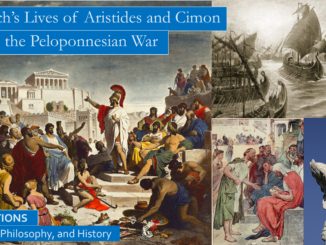
Why did the Ionian Greeks reject the Spartan leadership under the Pausanius, and why did they plead for Athens to take up the liberation of the Asian Greek colonies from the Persians, leading to the founding of the Delian League? Simply put, the Delian allies were impressed by both the military acumen and integrity of the two Athenian generals Aristides the Just, and Cimon. Also, the Spartans embarrassed Cimon, who sought to reconcile Athens and Sparta, which contributed to the outbreak of the Peloponnesian Wars. […]
Greek and Roman History

Thucydides and Plutarch: Pericles and the Beginning of the Peloponnesian War Between Athens and Sparta

This is second video and blog where we examine both history and Plutarch’s moral biographies of the key Athenian leaders before and in the first years of the war. In the first video we reflected on Pericles and his reforms leading to the Radical Democracy of Athens in the years […]

Greek and Roman History

Draco, Solon, and Cleisthenes, Democracy and Justice in Ancient Greece

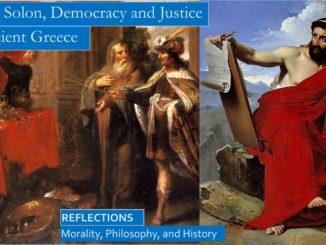
Homer’s Odyssey depict the deep Greek past where might makes right, where brave soldiers fight for justice, where grievances and murders are settled by blood feuds. As Greek emerged from its Dark Ages in the seventh century, the Greeks in Athens sought to establish a more systematic system of justice with laws governing the state. Draco was appointed by the ruling aristocracy to be a lawmaker to codify new laws to replace justice by feuds, now the Senate of the Areopagus would hear cases of homicide. […]

Epicurean Philosophy

Epicurus, Aristippus, and Lucretius: History of Epicurean Philosophy

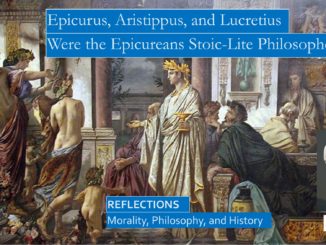
Was Epicureanism a cult? Or perhaps we should ask, was Epicureanism like a philosophical fraternity? One prominent scholar, AA Long, suggests that Epicurus’ school of philosophy was more a philosophical community centering on personal friendship than it was a formal school of philosophy. Many ancient philosophers wrote about the virtues of friendship, but the virtues of friendship are core to the Epicurean experience, and the Epicureans sought pleasure through their friendships. This community was egalitarian, it was one of the few in ancient world that admitted women and slaves, and in his letters, Epicurus expresses deep affection for his friends and followers. AA Long says this, “those who committed themselves to Epicurus we not so much students ‘reading for a course’ as men and women dedicated to a certain style of life.” […]

Epicurean Philosophy

Was Epicurus Really a Stoic-Lite Philosopher? Were all Epicureans hedonists?

Epicurus would have been horrified by the sex, drugs, and rock and roll culture of the sixties. Baird and Kaufmann describe his beliefs thus: “Epicurus declares that pleasure is the highest good, though some pleasures are unnatural and unnecessary. In contrast to modern understanding of the word epicurean, Epicurus opposed exotic meals and profuse consumption. Such indulgences never bring permanent pleasure and frequently lead to its opposite: pain. Instead Epicurus advocates enjoying only the ‘natural’ pleasures – those most likely to lead to contentment and repose.” […]