Modern Catholic Popes

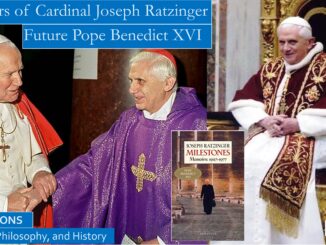
Milestones: Memoirs of Cardinal Joseph Ratzinger, Future Pope Benedict XVI

Archbishop Ratzinger teaches us that “this psalm from the wisdom tradition shows the straits of faith that comes from the absence of earthly success. When you stand on the side of God, you do not necessarily stand on the side of success.” “When the psalmist stands in before God, in the presence of God, he grasps the ultimate insignificance of material wealth and success and recognizes what is truly necessary and what brings salvation.” […]
History

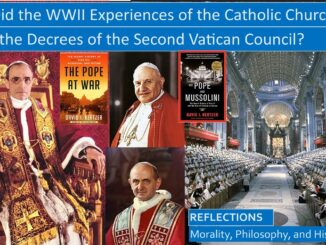
How Did the Experiences of World War II Influence the Second Vatican Council?

Vatican II marks a shift in the Church’s attitude towards the modern secular world. Gone are the anathemas of the Council of Trent and many other councils that condemn those who may disagree with the teachings of the church, instead Vatican II seeks dialogue with the modern world in with a pastoral rather than a condemning attitude. The Vatican II decree on religious freedom announced that democracy and freedom of religion and conscience were the friends of the church, that a totalitarian form of government could never be a trustworthy friend of the Catholic or Christian Church. […]

History

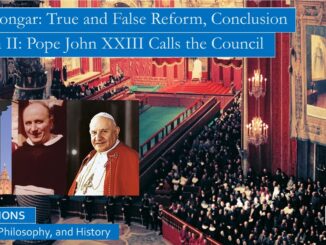
Pope John XXIII Opening Address to Vatican II, and Yves Congar, True and False Reform, Conclusion

Pope John Paul XXIII opens his speech with:
“A positive proof of the Catholic Church’s vitality is furnished by every single council held in the long course of the centuries.” “And now the Church must once more reaffirm that teaching authority of hers which never fails but will endure until the end of time.”
This echoes Congar’s sentiments that true reform must rediscover the ancient traditions of the church, that the moral teachings never change, but history itself does change, and the church must change with history. […]

History

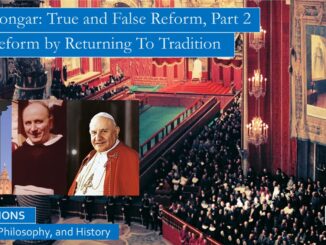
Yves Congar, True and False Reform, Part 2, True Reform by Returning to Tradition

Yves Congar reflects: Who were the successful reformers? Who were the divisive reformers? Successful reformers are those reformers who respect the tradition of the church, whose reforms seek to return the church to its ancient traditions recently forgotten, to return to the ancient sources of the faith. These successful reformers include St Francis of Assisi, and St Thomas Aquinas, and he contrasts them with reformers who broke with the church, including Peter Waldo and Luther, while being careful to acknowledge when these divisive reformers did provide valuable spiritual and practical insights. […]

History

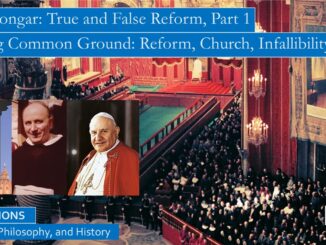
Yves Congar, True and False Reform, Part 1, Finding Common Ground

When Archbishop Angelo Roncalli, the future Pope John XXIII, reflected on this book, he asked, “A reform of the church? Is such a thing really possible?” Yves Congar reflects, What is the role of the church? Is the church the hierarchy in the Curia; or is the church the parishioners in the pews? What are the sacraments? What is the church’s definition of commonly misunderstood concepts, such as infallibility?
This book, along with help by the Holy Spirit, encouraged the pope to call for a church council, and helped set the tone for Vatican II. As Yves Congar teaches us, spiritual reform cannot be a revolution, false reform divides rather than unites. […]

Five Minute History

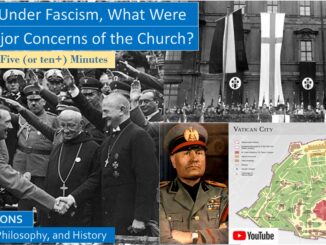
Christians Surviving Fascism in World War II: Under Hitler’s Brutal Nazi Regime, Were Brave Protests Ever Successful?

Hitler’s Nazi regime in Germany was an incredibly brutal regime. We must ask, Were Brave Protests Ever Successful in Nazi Germany?

The answer is a surprising YES, sometimes brave protests against one of the most evil regime in modern times were successful and did cause the Nazi state to retreat from its brutal policies. […]

Biblical Interpretation

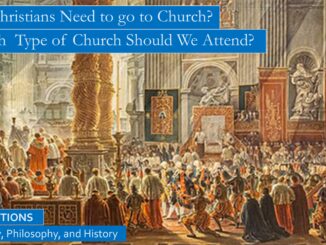
Do Christians Need To Go To Church? Which Type of Church Should You Attend?

St Augustine’s memorable reflection on our question appear in his Confessions, which is really one of the first testimonials. St Augustine tells us the story of Victorinus, a philosopher who studies the Gospels and the Church Fathers but declines to attend services, asking “Do the walls of the Church make you a Christian?” Victorinus was a learned man, an erudite pagan Platonic philosopher, the Word of the Lord spoke directly to him from the page, perhaps he felt intellectually superior to many simple Christians he knew.

In the words of St Augustine, in his studies Victorinus became “resolute, he was seized by the fear that Christ might deny him before the holy angels if he was too faint-hearted to acknowledge Christ before men, and he felt himself guilty of a great crime in being ashamed of the sacraments instituted by the Word of God in his lowly state.” […]

AntiSemitism

Our Reflections on Morality, Philosophy, and History: Ancient and Modern Classics

To a Stoic Philosopher, the question of Theodicy, or why God permits bad things to happen to good people, why God permits suffering, is simply absurd. The fact is, we do suffer, we will face injustices, we will suffer illnesses and death, and the rain falls on both the good man and the bad man. God will not shield us from suffering and injustice, but God will provide us with the strength to endure the challenges of this life. […]

History

What Happened at Vatican II, Embracing Democracy and Modernity

Pope Benedict once said that both the supporters and opponents of the Second Vatican Council have one characteristic in common, and that is, most of them have never read the decrees or the history of Vatican II and are ignorant of the actual teachings of the council. His solution was to draft the Catholic Catechism, but unfortunately, nobody reads that either. […]

Book Reviews and Miscellaneous

Book Reviews, Reform Councils of Trent and Vatican II, and Vatican I

IMHO, you cannot truly understand the modern Catholic Church without reading William O’Malley’s histories of Trent and Vatican II. O’Malley argues that Vatican II restated the theology of Trent, countering the notion that Trent was a reactionary rather than a reforming council. This polemic view of Trent was influenced by the fact that the Vatican had closed the archives of the Trent Council until early in the twentieth century. […]