Summary of Papacies Between Trent and Vatican II. How Did These Popes Prepare the Way for Vatican II?
History

Summary of Papacies Between Trent and Vatican II. How Did These Popes Prepare the Way for Vatican II?

How did the Catholic Church survive the French Revolution, the conquests of Napoleon, and the Revolutions of 1848? Was the Second Vatican Council a continuation of Vatican I? Was Pope Leo XIII, who issued Rerum Novarum, the social justice encyclical that sympathized with the working man, a conservative or a […]
Pope Benedict XV and Pope Pius XI: Confronting World War I and World War II, and Fascism
History

Pope Benedict XV and Pope Pius XI: Confronting World War I and World War II, and Fascism

Mussolini signaled in a speech that he was open to negotiating the Roman question. Mussolini was not a practicing Catholic and was famously a serial philanderer. Like Napoleon before him, Mussolini realized that it was in his political interest to settle this issue and regularize the status of the Vatican City.
O’Malley writes: “The most momentous aspect of the Lateran Agreements was the establishment of the Vatican City as a fully independent and sovereign state, with its own postal service, police force, full diplomatic corps, and so forth. The Italian state agreed never to interfere in the free functioning of Vatican City and ensured full and safe access to it by anyone the papacy wanted to receive. The papacy agreed never to try directly or indirectly to reestablish the Papal States, and it relinquished in perpetuity all claim to the city of Rome.”
The Vatican was paid a generous indemnity for the loss of this territory, and the state would pay an annual stipend for the upkeep of historical monuments. In addition to the 103 acres in Vatican City, the pope could also use several churches and castles traditionally at the church’s disposal. […]

The Boy in the Striped Pajamas- Does This Children’s Book Whitewash the Horrors of the Holocaust
AntiSemitism

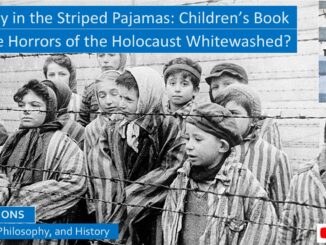
The Boy in the Striped Pajamas: Does This Children’s Book Whitewash the Horrors of the Holocaust?

My deeper objection to this book is the thought that the young son of the commandant could be so naïve that he would not realize that making a friend of a Jewish boy would be seen as repugnant. The reality was that anti-Semitism was a core belief of the Nazi state, and this was an important virtue that the Nazi engrained in the lessons taught to impressionable youngsters both in the Nazi Youth clubs and in the public school system. Furthermore, children were taught that the Nazi virtues prohibited them from associating with Jews. […]

Modern Catholic Popes

Was Pope Benedict XVI proactive in the pedophile priest sex scandal?

Penance is what Christians do; Christians repent. Unfortunately, many secular media interpreted these gestures by Pope Benedict as an admission of personal guilt.
During this time Cardinal Ratzinger confessed, “The greatest persecution of the Church comes not from her enemies without but arises from sin within the Church.” “The Church has a deep need to relearn penance, to accept purification, to learn forgiveness on the one hand, but also the need for justice.”
The media can be unfair at times. Pope Benedict XVI said that “we must be grateful for every disclosure. The truth, combined with love rightly understood, is primary. The media could not have reported these incidents had there not been evil in the Church herself.” […]

History

How Did the Experiences of World War II Influence the Second Vatican Council?

Vatican II marks a shift in the Church’s attitude towards the modern secular world. Gone are the anathemas of the Council of Trent and many other councils that condemn those who may disagree with the teachings of the church, instead Vatican II seeks dialogue with the modern world in with a pastoral rather than a condemning attitude. The Vatican II decree on religious freedom announced that democracy and freedom of religion and conscience were the friends of the church, that a totalitarian form of government could never be a trustworthy friend of the Catholic or Christian Church. […]

History

Pope John XXIII Opening Address to Vatican II, and Yves Congar, True and False Reform, Conclusion

Pope John Paul XXIII opens his speech with:
“A positive proof of the Catholic Church’s vitality is furnished by every single council held in the long course of the centuries.” “And now the Church must once more reaffirm that teaching authority of hers which never fails but will endure until the end of time.”
This echoes Congar’s sentiments that true reform must rediscover the ancient traditions of the church, that the moral teachings never change, but history itself does change, and the church must change with history. […]

History

Yves Congar, True and False Reform, Part 2, True Reform by Returning to Tradition

Yves Congar reflects: Who were the successful reformers? Who were the divisive reformers? Successful reformers are those reformers who respect the tradition of the church, whose reforms seek to return the church to its ancient traditions recently forgotten, to return to the ancient sources of the faith. These successful reformers include St Francis of Assisi, and St Thomas Aquinas, and he contrasts them with reformers who broke with the church, including Peter Waldo and Luther, while being careful to acknowledge when these divisive reformers did provide valuable spiritual and practical insights. […]

History

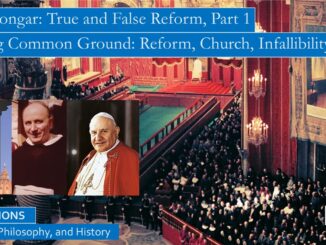
Yves Congar, True and False Reform, Part 1, Finding Common Ground

When Archbishop Angelo Roncalli, the future Pope John XXIII, reflected on this book, he asked, “A reform of the church? Is such a thing really possible?” Yves Congar reflects, What is the role of the church? Is the church the hierarchy in the Curia; or is the church the parishioners in the pews? What are the sacraments? What is the church’s definition of commonly misunderstood concepts, such as infallibility?
This book, along with help by the Holy Spirit, encouraged the pope to call for a church council, and helped set the tone for Vatican II. As Yves Congar teaches us, spiritual reform cannot be a revolution, false reform divides rather than unites. […]

History

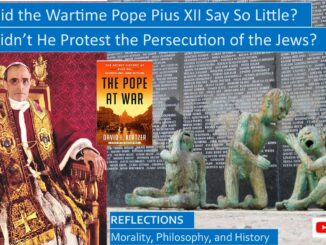
Pope Pius XII, Wartime Pope, Could the Pope Have Done More To Save the Jews?

The major questions raised about the wartime policies of Pope Pius XII were:
Why did the pope say so little when the Nazis were committing brutal atrocities, both against Jews and also Catholics in Poland?
Why did the pope not protest more forcefully against the persecution of the Jews?
We wonder why Hitler, when the Nazis occupied Rome, didn’t simply march into the Vatican and capture or at least intimidate the pope? […]

History

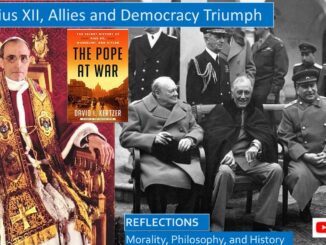
Pope Pius XII, Wartime Pope, Allied Powers Turn the Tide of War

When do the Italians first realize that Mussolini and Hitler might possibly lose the war? Our beloved author gives us a hint exactly halfway through his book, The Pope At War, when, “late on the night of October 22, 1942, wave after wave of British bombers swooped below the clouds over Genoa, Italy, and released hundreds of bombs.” Later, Milan and Turin would be bombed. Soon after, Rommel’s Afrika Corps would be defeated, and American soldiers waded ashore in North Africa in Operation Torch. […]