Paul Tournier, Christian Psychologist on Marriage and Widows in Old Age and Retirement
Aging

Paul Tournier, Christian Psychologist on Marriage and Widows in Old Age and Retirement

What is the ideal, according to Paul Tournier? “Growing old together, husband and wife can come to know a love which is, in a way, a prefiguration of heaven, for it is less tumultuous than the love of youth, being less directed towards selfish pleasure-seeking, and because a slow advance in mutual comprehension permits more authentic communication.” […]

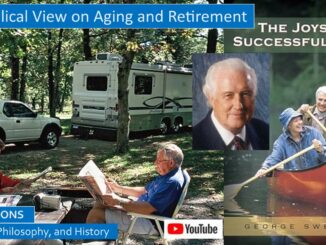
Joys of Successful Aging, by Evangelical George Sweeting, Moody Bible Institute
Aging

Joys of Successful Aging, by Evangelical George Sweeting, Moody Bible Institute

George Sweeting writes: “Age adds maturity and richness to life. Age smooths the rough edges of life and adds gentleness and compassion. They say: ‘The older the violin, the sweeter the music.’ Some speak of seniors as ancient, faded, frail, shriveled, senile, withered, wrinkled, and worthless!” I prefer to say seniors are “experienced, dependable, mature, patient, seasoned, steady, wise, tested, survivor, and veteran!” […]

Opposing Suicide: According to the Bible, Catholic Catechism, and St Augustine’s City of God
Command 6 Do Not Murder

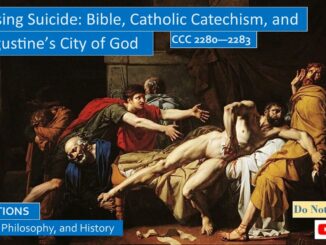
Opposing Suicide: Biblical Exhortations, Catholic Catechism, and St Augustine’s City of God

CCC 2281. “Suicide contradicts the natural inclination of the human being to preserve and perpetuate his life. It is gravely contrary to the just love of self. It likewise offends love of neighbor because it unjustly breaks the ties of solidarity with family, nation, and other human societies to which we continue to have obligations. Suicide is contrary to love for the living God.” […]

Epictetus, Eminent Roman Stoic Philosopher, on Living Well, Dying Well, and Opposing Suicide
Aging

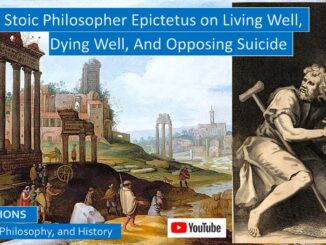
Epictetus, Eminent Roman Stoic Philosopher, on Living Well, Dying Well, and Opposing Suicide

Is it wise to complain? Epictetus observes: “If someone dies young, he blames the gods because he is being taken before his time. If someone lingers on into extreme old age, he too blames the gods.” “Despite this, at the approach of death, he wants to stay alive; he sends for the doctors and begs him to do all he can.” “It is quite remarkable to see how people want neither to live nor to die.”
“Is health good and illness bad? No, man. What, then? Health managed well is good, but when badly managed, it is bad.”
Epictetus points out: “If you look at yourself in isolation, it is natural for you to live to an old age, to be rich, to be healthy. But if you look at yourself as a human being and as part of some whole, for the sake of that whole, it may be appropriate for you to be ill, or risk your life at sea, or be poor, or die young. Why get angry then?” “What is a human being? A part of a city made up of gods and human beings,” “a small copy of the universal city.” […]
Roman Stoic Philosopher Cicero on Aging and Death
Philosophy

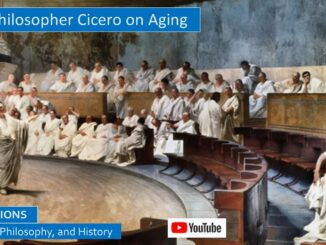
Roman Stoic Philosopher and Politician Cicero on Aging and Death

Cicero advises us: “Enjoy the blessing of strength while you have it, and have no regrets when it has gone, any more than young men should regret the end of boyhood, or those approaching middle age lament the passing of youth. Life’s course is invariable: nature has one path only, and you cannot travel along it more than once. Every stage of life has its own characteristics: boys are feeble, youths in their prime are aggressive, middle-aged men are dignified, while the elderly are mature. Each of these qualities is ordained by nature for harvesting in due season.”
Cicero continues: “Age must be overcome; its faults need vigilant resistance. We must combat them as we should fight a disease: following a fixed regime, exercising in moderation, and consuming enough food and drink to strengthen” but not too much. “The mind and spirit need even more attention than the body, for old age easily extinguishes them, like lamps” with too little oil. […]

Seneca on Aging Death and Suicide
Aging

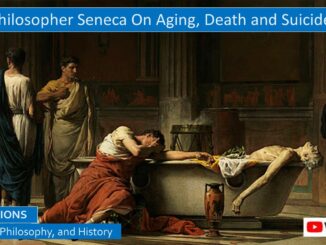
Roman Stoic Philosopher Seneca on Aging, Death, and Suicide

Seneca reminds us: “There is indeed a limit fixed to us,” “but none of us knows how near he is to this limit. Therefore, let us so order our minds as if we had come to the very end. Let us postpone nothing. Let us balance life’s account every day.” “Let us begin at once to live and count each separate day as a separate life.” What is important is “not how long you live, but how nobly you live. And often living nobly means that you cannot live long.” […]

Roman Stoic Philosopher Seneca on Aging, Retirement, and Death
Aging

Roman Stoic Philosopher Seneca on Old Age and Retirement

Seneca faces old age and death as only a Stoic could. “Old age is a time of life that is weary rather than crushed.” Nevertheless, I am thankful, “for age has not damaged my mind, though I feel its effects on my constitution. Only my vices” “have reached senility; my mind is strong,” “it is alert,” “it declares that old age is when it blooms.” “My mind bids me to consider how much this peace of mind and moderation of character I owe to wisdom and how much to my time of life; it bids me to distinguish carefully what I cannot do and what I do not want to do.” “There is only one chain that binds us to life, and that is the love of life.” […]

Classical Christian Psychologist Paul Tournier on Old Age, Death, and Faith
Aging

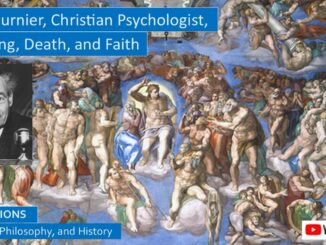
Classical Christian Psychologist Paul Tournier on Old Age, Death, and Faith

Tournier reminds us that we may experience many successes, but as we grow older, “success retreats, and escapes us, it is limited, unfulfilled.” “When one comes to the end, a man’s life is nothing much.” “Professional life is over, and it finishes unfinished. This is a prefiguration of death, in which the whole of life will finish it, too, being unfinished. That is the dramatic contradiction of death.” Quoting Robert Mehl: “An end, but not a fulfilment, that is the face of death.” […]

Paul Tournier on Aging and Retirement
Aging

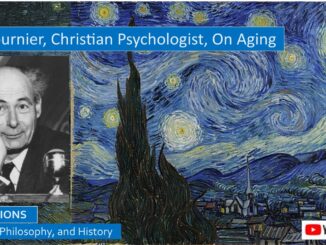
Classical Christian Psychologist Paul Tournier on Old Age and Retirement

Paul Tournier notes: “Freud defined psychological health under the double heading of aptitude for love and for work.” But Paul Tournier cautions that “the superficial relationships of working life and of sexual attraction must lead to a deeper personal commitment. And I believe that no commitment can be truly personal unless it takes on a transcendent dimension and become love, in the biblical meaning of the word.”
Paul Tournier is grateful: “As an intellectual, I am specially privileged. It is true that the better educated people are, the more chance they have to enjoy their retirement. First, intellectual work” is not physically taxing. “Second, the capacity for intellectual work is retained longer than physical ability. It can even increase in old age as long as disease does not affect the mental faculties. But most of all, the more one exercises one’s mind, the more pleasure it gives to exercise it. The more one learns, the more one wants to learn, and the easier study becomes.” […]

Major Roman Stoic Philosophers, My Favorite Maxims: Epictetus, Rufus, Seneca & Marcus Aurelius
Philosophy

Major Roman Stoic Philosophers, My Favorite Maxims: Epictetus, Rufus, Seneca & Marcus Aurelius

Many of the writings of the Stoics sound like passages from the Pauline Epistles. Indeed, Seneca was a contemporary of St Paul. There are epistles written between them, though nearly all scholars think they are spurious. Was St Paul inspired by the Stoic writings of Seneca? Although the Jewish rabbinic tradition was the primary source of inspiration for the Epistles and the Gospels, stoicism was an important secondary influence. In particular, stoicism deeply influenced the desert monastic tradition, which in turn influenced medieval monasticism. […]