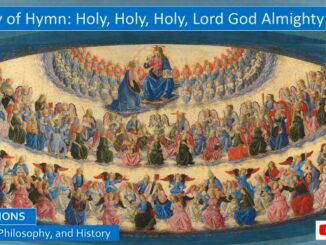
History of Hymn: Holy, Holy, Holy, Lord God Almighty
Hymns and Their Inspirations

History of Hymn: Holy, Holy, Holy, Lord God Almighty

This hymn was written by the Anglican Bishop Reginald Heber. This is one of the most beloved of the roughly hundred hymns that he penned in the early 1800s, when the Anglican authorities frowned on singing hymns in church, except for the metrical chanting of Psalms. By closely reflecting the biblical verses, he sought to avoid the excessive emotionalism that Anglican authorities hoped to discourage. The Brightest and Best is another of his acclaimed hymns.
Heber pursued his literary interests, including composing hymns, while serving as a parish priest for many years. Later in life, he was appointed as bishop of Calcutta, India, seeking to improve the spiritual life and living conditions of his flock. He traveled the countryside, but due to his workload, the hostile climate, and his poor health, he passed away three years after his appointment in India. […]
Anders Nygren, On Christian Agape-Love and Eros-Love in Gospels and Pauline Epistles
Biblical Interpretation

Anders Nygren, On Christian Agape-Love and Eros-Love in Gospels and Pauline Epistles

Anders Nygren emphasizes that “Old Testament piety with its devotion to the Law was by no means the external legalism it is often assumed to have been. There was an inward bond that held the godly man to the Law. The righteous felt no sense of external compulsion when confronted by the Law, but a sense of inner solidarity with it. Its observance gave him value and made him acceptable to God. His prevailing mood was expressed in Psalm 1,” the Psalm that sings of Law as Gospel. […]

Catholic Middle Ages and Beyond

Dark Night of the Soul, by St John of the Cross, and Mystical Theology of Pseudo-Dionysus

What is the Dark Night of the Soul? Many are misled into thinking that the dark night of the soul is a dark place, but St John of the Cross views the dark night of the soul not from his mortal perspective, but from perspective of the eternal, the unknowing, where light we cannot perceive is so luminous that we see it as darkness, this Mystical Theology he draws from the poetry of Dionysius. […]