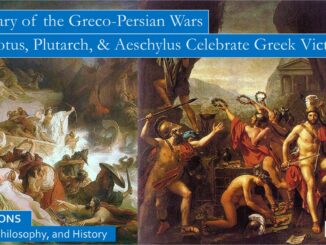
Summary of Greco-Persian Wars, Herodotus, Plutarch and Aeschylus Celebrate Greek Victory
Greek and Roman History

Summary of Greco-Persian Wars, Ancient Historians Herodotus, Plutarch and Aeschylus Celebrate Greek Victory

The wars between Greek city-states, and Persian influence in these wars, continued after a short peace, and lasted another generation, exhausting the Greek city-states, leading to their subjection of Philip of Macedon and Alexander the Great. The lesson that Alexander learned from of all these wars, starting with the Greco-Persian Wars, and from Xenophon’s leading the Greek mercenary armies from the heart of the Persian Empire, Babylon, back to Greek territory, was that the Greek hoplite armies were vastly superior to the Persian fighting forces. This meant for Alexander the Great that the Persian Empire was ripe for the taking. […]
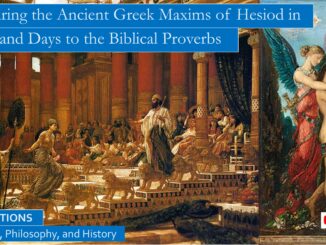
Hesiod Works and Days
Philosophy

Hesiod: Works and Days, Early Greek Moral Philosophy

Hesiod is a grouchy old farmer who mistrusts ‘lords’” but does not advocate changing the society. “He believes in justice, honesty, conventional piety, self-reliance, self-denial, foresight, and above all, WORK. He dislikes city folk, the sea, women, gossip and LAZINESS. He delivers a maxim like ‘Don’t urinate where the Sun can see you’ with the same earnest convict that he advises judges not to take bribes, his brother to avoid pride, and the farmer to get two nine-year-old oxen and a forty-year-old hired hand. […]

Apeleius Golden Ass
Literature and Myths

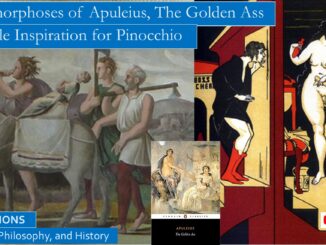
Metamorphosis of Apuleius, the Golden Ass, Possible Inspiration for Pinocchio

The basic plot of the book is our young man Lucius spies a witch who has learned to transform herself into various types of birds. When she is gone, he tries out the same potions, but by grabbing the wrong flask, he is turned into a donkey, not a talking donkey, but a braying donkey who has kept his human intelligence and human tastes. Though there are scattered penitential regrets, mostly our donkey is able to spy on the crimes and indiscretions of both robbers and cheating lovers to provide the reader with many titillating tales. In the final chapter, the goddess Isis appears to him in a dream, telling him what he needs to do to be transformed back into a human. […]

Philosophy

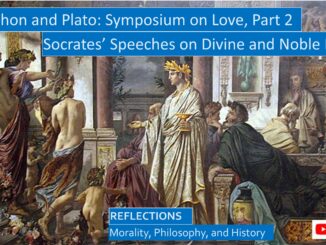
Xenophon and Plato, Socratic Dialogue, Symposium, Divine and Noble Love, Part 2

Both of these commandments are the Divine Love that Plato describes in the Symposium. Like the country song suggests, If you don’t love your neighbor, you don’t Love God. As we learned from St John of the Cross, if our love for our neighbor or our love does not increase in us our Love of God, then it is not love at all. Which means that you cannot talk about two types of love, one mortal, one divine, as do the speakers like Agathon in the Symposium, though you could talk about love and lust, love being unselfish, and lust being selfish, caring only about yourself, not caring about the well-being of your partner or friend. […]

Bible Stories and Parables

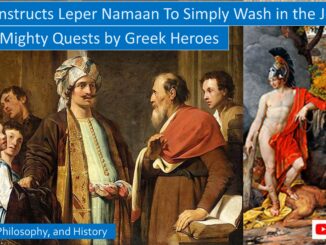
Elisha Cures Naaman of Leprosy, Not With Mighty Deeds, But By Simply Washing in the Jordan

Naaman, in the story, is not asked to perform mighty deeds by Elisha, as befits an ancient warrior and hero, but rather to perform the rather simple task of washing in the shallow, muddy Jordan River.

Ancient readers living in their ancient warrior culture would pick up on this contrast immediately, but modern readers often totally miss it. Which makes this one of my favorite stories, since one of the themes of this channel is that, when interpreting the Old Testament stories, you must always remember that most ancient peoples lived in a warrior culture much like that of the Iliad, where life was uncertain, when armies could appear over the horizon, slaughter all the men of military age, and enslave the women and children. […]

Catholic Middle Ages and Beyond

St John of the Cross, Dark Night of the Soul, Seven Capital Sins and Best Type of Close Friend

Before you can truly deepen your interior life of prayer and communion with God, you must first purify your soul by combating your spiritual capital vices, strengthening your inner virtues, which are revealed by how you think of your neighbor, what you say about your neighbor, how you act towards your neighbor, and how eagerly you seek to forgive and overlook the shortcomings of your neighbor. […]