Catholic Catechism

Do Not Covet, Do Not Envy, Early Church Fathers and Others

St Gregory Palamas teaches us that the command not to covet is not only a negative THOU SHALT NOT command but is more a SHALL positive command, that we shall be generous and show charity and lend to our less fortunate neighbor, and to watch after our neighbor’s interests, returning to him lost items you may find.  “Covetousness, conceived in the soul, produces sin; and sin, when committed, results in death (James 1:5).  Refrain from coveting what belongs to others and avoid filching things out of greediness.  Rather you should give from what you possess to whoever asks of you, and you should, as much as you can, be charitable to whoever is in need of charity, and you should not refuse whoever wants to borrow from you (Matthew 5:42).  Should you find some lost article, you should keep it for its owner, even if the owner is hostile towards you, perhaps your kindness will change him and your kindness will overcome evil, as Christ commands.” […]
Morality

Yves Congar, Meaning of Tradition, Blog 2

By abandoning diatribes, by abandoning the proclaiming of anathemas against those who disagree with Catholic doctrine, the post-Vatican II Catholic Church now explicitly believes that both Catholics and Protestants can both attain Salvation through the grace of God and His Son Jesus Christ.  By opening a dialogue, the Church teaches we can learn from both Catholic and Protestant theologies, and this also infers that this encourages study, effort, and dedication.  In the spirit of Vatican II, we should strive to view these as differences of emphasis rather than as differences that divide. […]

Morality

Yves Congar, Meaning of Tradition, Blog 1

The cleric whose writings most influenced the decrees of Vatican II was Yves Congar, including his work on the Meaning of Tradition. He examined what the Church Fathers taught us about tradition throughout Church History, and as expected, since it was not hotly debated until the Reformation, there was a great many teachings on what tradition meant. […]

AntiSemitism

John Chrysostom, Justin Martyr, and the Church Fathers Preach Against the Judaizers and the Jews

John Chrysostom is the most strident of the early Church writers in his writings opposing the Judaizers where he warned his flock that Christians should not adopt Jewish customs and practices, that Christians needed to celebrate the Church festivals rather than the Jewish festivals, that Christians should not attend services at the synagogue. His work “Against the Judaizers” is so polemic that it is far more anti-Semitic than the writings of Barnabas and St Justin Martyr and many other church fathers, it is painful for us modern readers to read, we who remember the horrific events of the Holocaust. This work is not in the standard collection of the works of the Nicene and Anti-Nicene Fathers, but it was widely read in medieval times and afterward, and unfortunately was used to justify the European and Russian pogroms and persecutions against the Jews.[2]

One scholar who has pondered the problems posed polemic stands against the Judaizers by St John Chrysostom and also St Cyril is Robert Wilken. In this book “John Chrysostom and the Jews,” he explores the history of the early church to better understand the world of the early Church Fathers. We cannot totally excuse the errors in the teachings of the early Church Fathers, but neither can we blindly judge and condemn them for not knowing the lessons of the Holocaust. There is nothing wrong with reading the Church Fathers as they apply to our modern world, but particularly in this case we should also let the Church Fathers in their ancient historical context, we need to do both lest we have a distorted understanding of the history of our faith. […]

Evagrios the Solitary

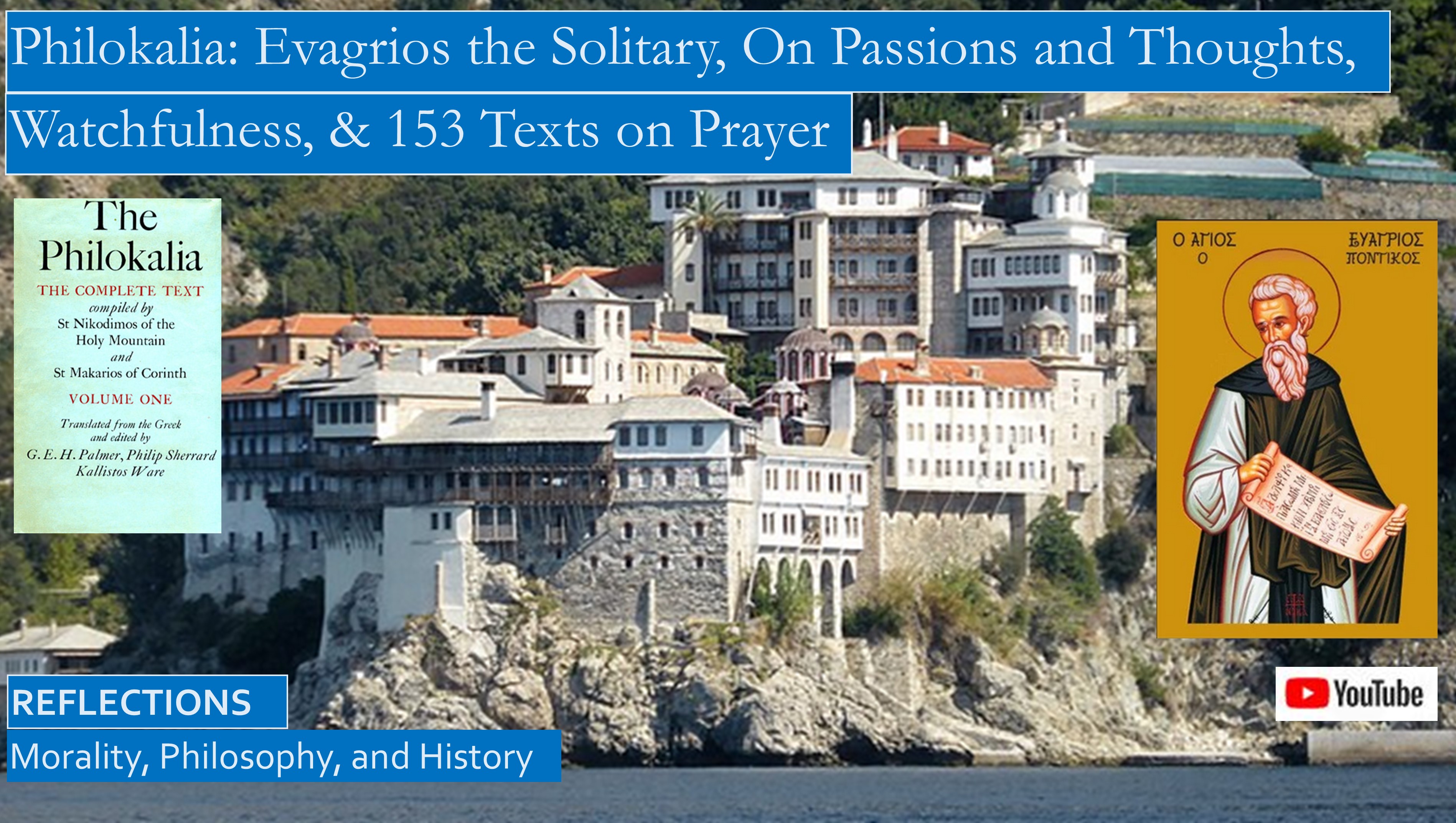
Evagrios the Solitary, 153 Texts On Prayer

Evagrios compares the persistence of prayer to the seven years of labor by Jacob to gain the hand of Rachel, his gazelle, for Jacob so loved Rachel that the seven years he labored for her hand seemed to him to be but a day. On his wedding night Leah, her sister, was substituted for Rachel, and Jacob labored yet another seven years for the hand of Rachel. […]

Evagrios the Solitary

Evagrios the Solitary, Blog 2, Text on Discrimination of Passions and Thoughts

The demons tempt us through our passions, they tempt us through our perceptions, they tempt us through our memories of past pleasures that tempt us, through painful memories of those who have harmed us, and if this was true in the days of Evagrios, how much more true it is today when the media bombards us with images of pleasure and pain and cruelty.  Evagrios warns us, “all thoughts producing anger or desire in a way that is contrary to nature are caused by demons.”  If Evagrios could visit us today, what would he say about the wisdom of Christians attending church on Sundays and watching horror movies or violent movies on Friday nights?  Are we inviting demons into our souls to tempt us, to crowd us the compassionate thoughts in our soul?  We should guard ourselves against the demons of anger and rancor who seek for us to replay over and over in our mind the wrongs that others have done to us in the past. […]

Evagrios the Solitary

St Evagrios, On Asceticism and Stillness in the Solitary Life

Evagrios begins by quoting Jeremiah, “You shall not take a wife in this place.”  The primary meaning of this verse is advice not to bear sons and daughters in time of war and troubles, but Evagrios interprets this allegorically, that we should not bear worldly thoughts and desires in our heart.  These worldly thoughts and desires are weak and sickly and lead to death, and “have no place in heavenly life.” […]

Early Church Writing

Epistles of St Ignatius to the Romans and Polycarp

Repeatedly St Ignatius begs the Romans not to seek a pardon to prevent his martyrdom. He writes his rhapsody, “in the fullness of life I am yearning for death with all the passion of a lover. Earthly longings have been crucified; in me there is left no spark of desire for mundane things, but only a murmur of living water that whispers within me, ‘Come to the Father’. There is no pleasure for me in any meats that perish, or in the delights of this life; I am fain for the bread of God, even the flesh of Jesus Christ, who is the seed of David; and for my drink I crave that Blood of His which is Love imperishable.” “I am His wheat, ground fine by the lion’s teeth to be made purest bread for Christ.” […]