
Homosexuality, the Bible, and the Church: The Zondervan Debates
christianity

Homosexuality, the Bible, and the Church: The Zondervan Debates

For better or worse, most of us choose our intimate partners, and build our world around that choice. If a homosexual couple is accepted by the clergy of your church, what good can come from telling them they are going to burn in hell if they do not repent? We are only responsible for our own personal salvation, it is not our job, particularly if we are laymen, to speculate on whether our neighbor will be saved. That is between them and Jesus, and nobody else.
My goal is not to change your mind about homosexuality. My goal is: If you do not accept that it is possible to be both a Christian and homosexual, that you will refrain from telling them they are damned to burn in hell, but would instead refer them to an Episcopalian Church, or other church where they would be welcome.
Jesus will judge us all in front of the great IMAX theater in the sky, where we will need to account for the decisions we made in our lives as they are displayed on that screen forty feet wide and forty feet tall. Jesus is the judge; we should not seek to do his job. Instead, we work out our own salvation, judging our own actions rather than our neighbors’. […]

JRR Tolkien’s Lord of the Rings: How Was It Influenced by Nordic Mythology and Catholicism
History

JRR Tolkien’s Lord of the Rings: Was It Influenced by Nordic Mythology, Homer’s Iliad, and Catholicism?

What inspirations did JRR Tolkien draw from for his best-selling series The Lord of the Rings, and the Hobbit? Like his friend CS Lewis, Tolkien was an English Professor specializing in medieval and ancient literature and languages. When CS Lewis was contemplating whether to return to his Episcopalian roots, abandoning his youthful agnostic views, Tolkien argued that he should convert to Catholicism. CS Lewis resisted these pleas. IMHO, though CS Lewis was conducive to Catholicism, and may have even confessed his sins to a priest, he likely thought he would be more effective evangelizing through his books as an Episcopalian.
Both JRR Tolkien and CS Lewis fought in the trenches in France as British soldiers during World War I, they both lost many friends who fought beside them: they both experienced the horrors of war. Both were too old to serve in World War II, but this struggle against the evils of Naziism directly influenced CS Lewis’ Mere Christianity and Tolkien’s Lord of the Rings, both released shortly after the war. […]

Horses and Cavalry from Xenophon in Ancient Greece to the American Civil War, and in New York City
Greek and Roman History

Horses and Cavalry from Xenophon in Ancient Greece to the American Civil War, and in New York City

From antiquity, in combat, horses had three roles: hauling supplies, fighting in highly mobile cavalry regiments, sometimes pulling chariots in ancient times, and enabling generals to quickly survey the battlefield. From ancient times, in both war and peace time, technological improvements meant horses could be used more effectively. Improved harnesses made chariot warfare common throughout the Ancient Near East, quite often several archers would ride in the chariot. In the Old Testament, we read that King Ahab died when an arrow struck him in his chariot, likely he was standing next to an archer. […]

Summary of Homer’s Iliad: Warrior Culture of Ancient Greece
History

Summary of Homer’s Iliad: Warrior Culture of Ancient Greece

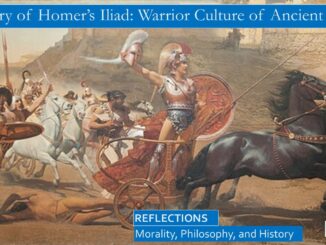
All ancient cultures were warrior cultures, out of necessity. War was a deadly business, if an ancient city-state lost the war the city would be plundered, often the military age men would be slain, and the women and children would be sold into slavery. In ancient Athens, a quarter of the population were slaves, and in ancient Rome about forty percent of the population were slaves. Most of these slaves were either born into slavery or were captured during war, some were captured and sold by pirates. […]

Ancient Warrior Culture, Slavery, Concubines, Ancient Greece, Rome, and Israel
History

Ancient Warrior Culture, Blog 1, War, Slaves, and Concubines in Ancient Greece, Rome, and Israel

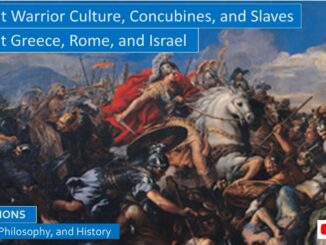
The Greeks were the most formidable fighting force in the Near East. The mighty Persian empire loaded their army on ships to fight what they thought would be an easy victory, but were decisively defeated by Athens and Sparta and their allies both on land and on sea in two separate wars. This established the reputation of the Greeks, later a Persian prince, Cyrus the Younger, hired a Greek hoplite infantry army to fight for the crown of Persia. The Greeks dominated the battle, but Cyrus was killed in the fighting. Losing their patron, the Greeks were forced to fight their way through the Persian Empire back to the Black Sea and then to Greece. This showed that the mighty Persians were vulnerable, later Alexander the Great of Macedon would conquer all of Persia and some of India also.

The Greeks may have been the founders of Western Civilization, but they were first and foremost a warrior society. If the Greeks weren’t formidable warriors they would have been conquered by the mighty Persian Empire, which means that there would be no Socrates, no Plato, no Xenophon, the Greeks would not have been able to leave us a cultural legacy. […]

Philosophy

Xenophon and Plato, Socratic Dialogue, Symposium, Divine and Noble Love, Part 2

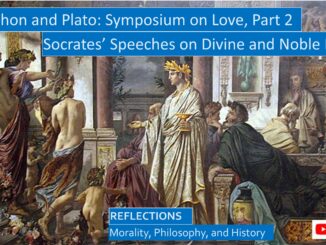
Both of these commandments are the Divine Love that Plato describes in the Symposium. Like the country song suggests, If you don’t love your neighbor, you don’t Love God. As we learned from St John of the Cross, if our love for our neighbor or our love does not increase in us our Love of God, then it is not love at all. Which means that you cannot talk about two types of love, one mortal, one divine, as do the speakers like Agathon in the Symposium, though you could talk about love and lust, love being unselfish, and lust being selfish, caring only about yourself, not caring about the well-being of your partner or friend. […]

History

Odyssey, Blog 4, The Slaughter of the Suitors

When Odysseus had seen his departed mother in Hades she said from the shades, “your father stays among the fields, and comes to town no more. Bed he has none, no robes, no bright-hued rugs. Through the winter he sleeps in the house where the servants sleep, in the dust besides the fire, and wears upon his body sorry clothes. . . . There he lies in distress, woe waxing strong within him, longing for your return; and hard old age comes on. Even so I also died and met my doom. . . . longing for you, your wise ways, glorious Odysseus, and your tenderness, took joyous life away.” […]

History

Odyssey, Blog 3, Odysseus Returns Home to Ithaca

We get a rare glimpse into the lives of the slaves, the lives spent serving their masters, when Odysseus, disguised as a beggar, approaches the hovel of his swineherd Eumaeus, who chases away the dogs who snap at the stranger, offering hospitality to even an old beggar. “Old man, my dogs had nearly torn you to pieces here, all of a sudden, and so you would have brought reproach upon me. Ah well! The gods have given me other griefs and sorrows; for over my matchless master I sit and sign and groan, and tend fat hogs for other men to eat; while my master, hungry, wanders among lands and men who speak alien tongues, if he still lives and feels the sunshine. But follow me, old man, into the lodge, so that when you have eaten and drunk your fill, you may tell me where you come from and what troubles you have borne.” The good swineherd is more concerned about the beggar’s troubles than who he is. […]

History

Odyssey, Blog 2, Odysseus Sings His Adventures

While the Cyclops was fast asleep from the wine, Odysseus and his men drove a large wooden stake into his one eye, blinding him. The Cyclops jumped up and tried feeling about for the men in vain. The next morning, they each escaped by hanging onto the bottom of the large sheep and rams as Cyclops let them out to pasture. After escaping the men loaded the sheep onto their ships, and Cyclops roared at them and threw boulders into the sea near their ships. […]