
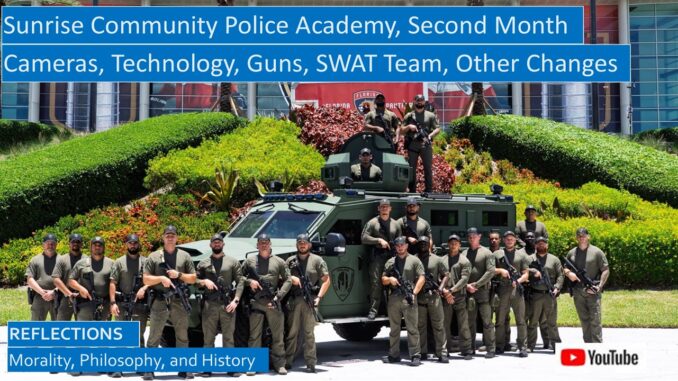
What would you do if you were a police officer, and you were responding, gun drawn, cocked, and raised, to a call dispatching to an active shooter situation, where you encountered an agitated, disturbed man waving a big black Glock around his head, threatening to blow his brains out?
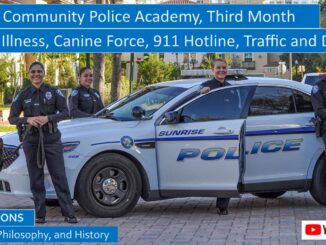
This was a simulation at the Sunrise Community Police Academy of what policemen sometimes experience. Such simulations are based on actual police academy training, emphasizing how police officers risk their lives responding to calls. When someone is packing a pistol, you can never predict exactly what they will do. This academy is offered free to citizens interested in learning more about the challenges faced by the police on their everyday patrols, they meet once a week in the evenings for twelve weeks.
YouTube video for this blog: https://youtu.be/PkrptOl3qLA
In this simulation, this frenetic young man was talking a mile a minute, waving his big black Glock around, then quickly popped off some rounds at each of us, a simulated police officer. Every student was shot, failing this simulation. We asked: Why be quick to shoot someone who is clearly mentally disturbed? Which would have been our last question in real life.
This was one of many simulations encountered by the police, some based on real-life encounters, some recordings of actual events. In their continued training, police officers review dozens of simulations so they can make proper split-second decisions in life and death situations, both to protect their own lives and to follow department policy.
Caution is a policeman’s main defense against bullets headed their way. Police are rarely in a rush to approach the driver during a traffic stop, nor are they in a rush to knock on the door for a domestic dispute call. If possible, they wait until other policemen arrive. The more backup, the better.
I was surprised to learn how policemen respond to other police pulling them over when they are in other jurisdictions. They politely roll down their windows, put their hands on their steering wheels, and tell them that they too are police officers. They volunteer where they have their guns, which all policemen carry. They don’t put any documentation in the glove box, because they don’t want to reach in to grab it.
They are careful to do this because they know how traffic stops are especially dangerous for police officers. Only a few traffic stops each year have the potential to turn into shooting matches, but they cannot accurately predict which ones. Whenever possible, policemen will delay a minute or two to approach the car until they have backup from other policemen, and this is especially true when they respond to domestic violence calls.
What make many policemen wary is that they can’t tell if guns are real by their appearance. They have seen Hello Kitty guns and other devices, such as power drills, disguised as guns.
We asked the police instructors: What has changed in policing?
Many respond that the biggest change is the rapidly evolving technology, especially with body cameras and microphones. Many police were wary of body cameras when first introduced, but now police see far more advantages than disadvantages. Now they are better able to defend themselves against baseless accusations that they used too much force.
These are not ordinary cameras: most cameras are far more sensitive to white light than the human eye. For example, if you take a picture of a Christmas display, the white lights will often drown out the colored lights. In contrast, at night and in low lighting, police cameras mimic human perception.
Over many decades, more police departments have permitted police officers to take their cars home, which increases their visibility. Rarely do police have partners. Their laptop is mounted permanently in the passenger seat, since all dispatching is done through the computer. Multiple police cars answer most calls: the more the better to ensure officer safety.
With today’s technology, police can now generate a three-dimensional rendition of traffic accidents and crime scenes through a combination of cameras and laser scanners. At the crime scene, bullet hole trajectory rods can help identify where the shooter was standing.
What are the most dependable types of evidence? Fingerprints and DNA. Different techniques have been developed to draw fingerprints from many types of surfaces. But even when fingerprints have not been left behind, often police can swab trace amounts of DNA from surfaces the suspect has touched, including the skin of the crime victims.
Many other types of forensic evidence are less reliable, including shoe and tire track matches, matching shell casings, and blood stain pattern analysis.
Today, there is greater awareness that eyewitness testimony can be problematic. Witnesses to crimes are under severe emotional stress: most people cannot quietly observe their surroundings when their adrenaline is flowing, particularly when their life is in danger.
What is often overlooked is how heavily policemen rely on the conscientiousness of unseen lab technicians. This is true for even very reliable types of evidence, such as fingerprints. Just because fingerprints are unique, that does not mean that there aren’t close matches. Whether really close matches are confused with direct matches depends on the diligence and judgement of the lab technicians, particularly when they are evaluating partial or obscured prints.
This is beyond the scope of this article, but you can ask Dr Google about “reliability of forensic evidence.”[1] Some articles are written by law firms, but many are written by credible independent parties. To withstand legal challenges, and fairly assess guilt, police detectives must thoroughly document the crime scene, and afterwards, closely examine the crime lab reports.
Possibly the least popular new technology items are the red-light cameras. The video recording the violations is reviewed by the police before the fine is assessed. Unfortunately, the speeding fines are set by state law, and the local police agencies cannot reduce them. Fortunately, they do not accrue points against your driver’s license. But if you contest the tickets, the court may assess additional fines since these videos are considered reliable evidence.
Many parents have complained that too many drivers ignore the school zone speed limits. In response, the City of Sunrise is installing cameras to monitor these speed limits. Initially, only warning notices will be sent. The cameras will monitor compliance with the fifteen MPH speed limit when the warning lights are flashing. Currently, the speed will be monitored thirty minutes before and after the school crossing time, though this may be extended later.
What else has changed in policing?
Police protocols have drastically changed since the tragedy of the Parkland shooting, where a teen gunman quickly shot nearly three dozen students before evading the police.[2] Before, in an active shooting scenario, police often waited until the SWAT team arrived, if practical. Now, police understand, by bitter experience, that in minutes many innocent victims can be shot by AR15s and other modern assault weapons. Police protocol has changed: Now police are expected to respond immediately.[3]
We asked an experienced officer whether movies like Dirty Harry had formed unrealistic expectations among the public that all policemen, backed up only by their Smith and Wesson, could easily defeat heavily armed suspects.[4] She pushed back, explaining that her family knew what they signed up for, that police have responsibilities towards everyone else’s children when on duty. Sometimes they are required to risk their lives. That is just part of their job.
Police protocols in dealing with barricaded armed suspects have been influenced by the urban combat experience of the military in the villages of Afghanistan, including when they serve warrants on suspects considered armed and dangerous. The big change is that, unless there are hostages, the police are reluctant to rush in. They prefer to be methodical. They only storm in as a last resort, or if any hostages are in imminent danger.
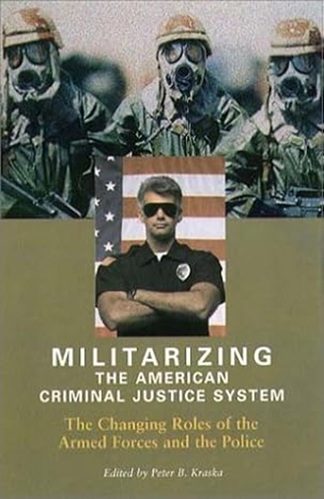
In the nineties, SWAT teams were criticized as an unwanted militarization and dehumanization of the police force, encouraging Dirty Harry behavior. However, what police have learned from the military is that, when clearing buildings of potentially hostile actors, an overwhelming show of force is often not desirable.
A joint report from the FBI and Marine Corps in 2021 stated that: “Over time, the military, and by extension law enforcement, have gone from dynamic entries to what is known as a ‘slow-clear’ entry. Slow clearing means the teams deliberately and methodically clear rooms. Instead of quickly flowing into a room, teams took the time to assess the room they were going in, issue commands, and control the room before entering.”
“There are times when a call-out is conducted before entry. A bullhorn is used to instruct everyone inside to exit.” “This is the preferred method when dealing with a barricade situation, a suicidal person, or someone with a mental illness: all these scenarios are usually reactive.”[5]
Technology gives the police more options in these situations. If they break a window, they can throw in a throw-bot with both a camera and a phone to talk to the suspects. If they can open a door, they can send in a self-propelled robot with a camera and a phone. They can use a bearcat boom to safely penetrate a building. Plus, they have tear gas to incapacitate the suspects, and flash-bang NFDD grenades to startle them.
How often is the Sunrise SWAT team called out? There are serious incidents about thirty times a year. They can also request assistance from the Broward County Sheriff’s full-time SWAT team.[6] The certified police officers keep their SWAT gear in their patrol cars. The city has two SWAT cars that are used both for SWAT calls and anytime the police request a bulletproof vehicle.
How have changes in our culture affected policing? Although there is a fentanyl epidemic our society has been dealing with, there are fewer drug violations than there were twenty years ago.
Whereas it was common for teenagers to engage in fist-fights decades ago, this is far less common today. When applicants to the police academy are asked if they have even been in a physical fight, most report that they have not.
The discussion about whether to defund the police has diminished, and the trend is for the police to become more aware of mental health issues, including dementia, autism, schizophrenia, and homelessness. Police are shedding their paramilitary reputation. Today, often police cadets have backgrounds in social work. This will be the subject of our next and last installment
[1] https://www.google.com/search?q=reliability+of+forensic+evidence
[2] https://en.wikipedia.org/wiki/Parkland_high_school_shooting
[3] https://www.sunrisefl.gov/departments-services/police/police-divisions/uniform-division/s-w-a-t-team
[4] https://www.youtube.com/watch?v=TQMcpFY4K-g
[5] Joshua Taylor, FBI, SWAT and the Military: Reevaluating the Influence of the Military on Law Enforcement (US Marine Corps Command and Staff College, 2021), https://apps.dtic.mil/sti/pdfs/AD1178326.pdf pp. 13-14.


Be the first to comment