What traits made Ulysses S Grant a successful general? What traits made Grant ill-suited for civilian life?
How did prewar events and politics contribute to the outbreak of the Civil War? How did industrialization contribute to the brutality and high casualty rates of the Civil War?
Why was Grant accused of being a butcher by the Northern press and the Confederates?
Why did Grant offer generous terms to the defeated Confederate forces at Vicksburg and Appomattox? Why did he allow the defeated Confederate cavalrymen and artillerymen to keep their horses and sidearms and sidearms?
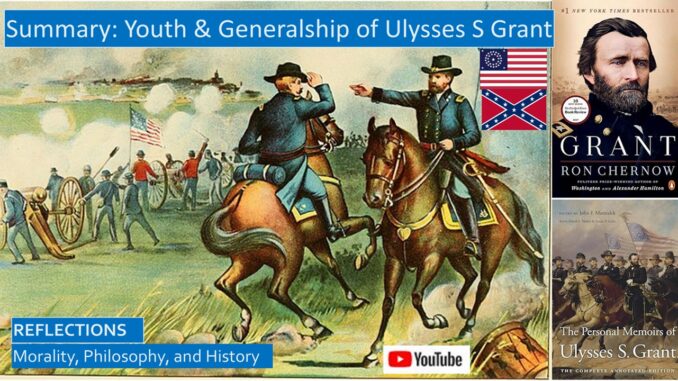
Although this video repeats sections of our series of reflections on the life of Ulysses S Grant and the Civil War, we do include additional thoughts by his biographer, Ron Chernow, near the end of the video, plus some connecting thoughts.
YouTube video for this blog: https://youtu.be/LZQMZpouncI
YOUTH AND CAREER THROUGH THE MEXICAN-AMERICAN WAR
Ron Chernow begins his biography: “On April 27, 1822, Ulysses S Grant was born in Point Pleasant, Ohio, tucked away in the rural southwestern corner of the state near Cincinnati.” “Under its slanting roof, the residence was humble, consisting of a single open room with a fireplace. Point Pleasant was little more than a nondescript cluster of makeshift cabins overlooking bustling river traffic.”[1] Like Lincoln, Ulysses was born humbly; he was the first of six children, and his father was a tanner.
Those who fought the Civil War grew up in the America of Andrew Jackson, when the giants of the second generation of American leaders fought to hold the United States together. These great orators, including Henry Clay and Daniel Webster, would later inspire Union soldiers to fight and die to preserve the Union. These were the years when the slave-owning Southern President Andrew Jackson threatened to deploy federal troops to prevent the secession of South Carolina over tariffs during the Nullification Crisis in the 1830s.
How Did the Speeches of Daniel Webster Inspire the North to Fight To Preserve the Union?
https://seekingvirtueandwisdom.com/how-did-the-speeches-of-daniel-webster-inspire-the-north-to-fight-to-preserve-the-union/
https://youtu.be/etLbkY_zgY0
Northern schoolchildren memorized portions of Webster’s patriotic speeches, which helps to explain why Union soldiers were so willing to fight and die to preserve the Union.
Why Were Union Soldiers in the Civil War Willing to Fight to Preserve the Union?
https://seekingvirtueandwisdom.com/why-were-union-soldiers-in-the-civil-war-willing-to-fight-to-preserve-the-union/
https://youtu.be/0aak9Mtt0eI
Jesse Grant enrolled his son in the West Point Military Academy because he could not afford tuition elsewhere. At West Point, Ulysses met many of the Union and Confederate generals who later fought in the Civil War. These generals fought in the same federal army during the Mexican-American War, provoked by the Democratic President James K Polk, that annexed California, Texas, and the other southwestern states to the United States. Many historians, as well as Grant, argue that this war was a cause of the bloody Civil War two decades later. In many ways, this war influenced the tactics and policies of the Civil War.
Since his term resulted in the near doubling of US continental territory, plus other beneficial policies, many historians rank James K Polk in the top tier of US presidents. Other historians demur, countering that the annexation of Texas and these vast territories exacerbated the tensions between free and slave states, leading to our bloody and divisive Civil War.[2]
Early Life and Career of Ulysses S Grant Through His Service in the Mexican American War
https://seekingvirtueandwisdom.com/early-life-and-career-of-ulysses-s-grant-through-his-service-in-the-mexican-american-war/
https://youtu.be/TJlh1D77wyA
What does Ulysses S Grant say happened shortly after the war was over? “I obtained a leave of absence for four months and proceeded to St Louis. On the 22nd of August 1848, I was married to Miss Julia Dent, the lady of whom I have spoken before. We visited my parents and relations in Ohio, and, at the end of my leave, proceeded to my post.”[3]
After the Mexican-American War, the thousands of miners who flocked to the California Gold Rush challenged the law and order of the new American territory. Grant’s regiment was ordered to California to help maintain order, but since Julia was pregnant, he had to leave her behind, as the overland passage across Panama was challenging. Grant started drinking to alleviate the boredom and loneliness he felt. Although his commanding officer did not court-martial him, he was persuaded to resign from the army to return home to his Julia. During the Civil War, Julia sometimes traveled so she could be close to him, which was not typical at the time. Grant struggled with alcoholism but kept it under control for the rest of his life.
Ulysses Grant was a kind-hearted and naïve man, and this trait often hurt him in his pocketbook. The seven years he spent in civilian life were years of struggle and failure: at one time, he was reduced to selling firewood in the streets of St Louis. Once, a business partner stole from him. At another time, he tried his hand at farming and failed. Grant was reluctant to coerce the slave the Dents gave him to work productively, choosing to emancipate him instead. Finally, he was able to achieve a modicum of financial success when he worked as a clerk at the family store just before the outbreak of the Civil War.[4]
GENERAL GRANT RISES THROUGH THE RANKS IN THE CIVIL WAR
Soon after the South bombarded Fort Sumter, sparking the Civil War, Grant volunteered to serve, but the Union Army officers were not eager to accept him at a rank his West Point credentials called for. After Lincoln created several positions for brigadier generals in Illinois, Grant was promoted to one of these slots. Soon after he was appointed brigadier general, he quickly captured Fort Henry and Fort Donelson, giving the Union of its first victories in the Civil War.[5] To put this in perspective, during the Civil War the Union had about five hundred generals, while the Confederacy had about four hundred generals, most were brigadier generals.[6] These victories quickly caught the eye of Abraham Lincoln and Secretary of War Stanton, they ensured that Grant would be free to engage the Confederates.
Capturing these river forts began the Union chokehold in the western theater of War. Control of the Mississippi River basin was a key part of the 1861 Anaconda Plan drafted by General Winfield Scott for the Union to win the Civil War: If the gunboats of the Union Army could control this mighty river, the Confederacy would be split in two, separating the men and resources of Texas from the other Confederate states.[7]
The Battle of Shiloh was another turning point early in the Civil War. Although it was a Union victory won under the stubborn persistence and tactics of Grant, the public was shocked at the number of casualties: out of 67,000 men, the Union Army suffered 13,000 casualties, including 1,700 deaths. Proportionally, the Confederate Army fared worse: out of 45,000 men, they suffered 11,000 casualties, also including about 1,700 dead. More soldiers died at the Battle of Shiloh than during the entire Revolutionary War, the War of 1812, and the Mexican-American War combined.
On the first day, the Confederates struck with an overly hasty offensive before Union Army reinforcements arrived. But Grant stayed cool, refusing to be discouraged. Realizing that the Confederate forces were overextended, he rallied his troops early the next day, pushing back and defeating the rebels.[8]
Not only was General Grant cool under fire amidst battle, but he also had an uncanny ability to read the true state of the battlefield. After the fighting on the first day, General Wallace arrived with five thousand fresh troops, in addition to the arrival of General Buell’s troops during the first day’s fighting. Grant sensed that while the Confederate forces were overextended, his Union forces were “nearly doubled in numbers and efficiency.”
Grant remembers: “So confident was I before firing had ceased that first day that the next day would bring victory to our arms if we could only take the initiative, that I visited each division commander in person before any reinforcement had reached the field. I directed them to throw out heavy lines of skirmishers in the morning as soon as they could see, and push them forward until they found the enemy, following with their entire divisions in supporting distance, and to engage the enemy as soon as found.”
Soon after 4 AM the next morning, each of the Union armies formed on the long Union line. Morale soared among the Union forces, as Grant’s optimism had infected his entire army as they fought and slogged through another rainy day.
Grant proudly recalls: “On this second day, everything was favorable to the Union side. We had now become the attacking party. The enemy was driven back all day, as we had the day before, until finally he beat a precipitate retreat,” all the way to where the battle had started the previous day,[9] and beyond.
General Ulysses S Grant’s Victory at the Bloody Battle of Shiloh, and His Earlier Civil War Battles
https://seekingvirtueandwisdom.com/general-ulysses-s-grants-victory-at-the-bloody-battle-of-shiloh-and-his-earlier-civil-war-battles/
https://youtu.be/v5rrY7Agi68
UNION VICTORIES AT GETTYSBURG AND VICKSBURG
In July 1863, the Union won two key battles that started to turn the tide of war in favor of the Union. In the Eastern Theater, the Confederate General Robert E Lee invaded Pennsylvania at Gettysburg, desperately seeking an offensive win to legitimize the Southern cause to potential allies in England and France. In the bloodiest battle of the Civil War, Robert E Lee was defeated, but the overcautious General Meade failed to pursue him into Virginia. Since the Battle of Gettysburg was a far-away battle fought by General Meade, General Grant mentions it only briefly in his Memoirs.
Gettysburg: Ordinary Soldiers and Generals Pickett and Longstreet Remember the Bloody Charges
https://seekingvirtueandwisdom.com/gettysburg-ordinary-soldiers-and-generals-pickett-and-longstreet-remember-the-bloody-charges/
https://youtu.be/ibTm3l-C8VQ
Also, in July 1863 in the Western Theater, General Grant won the Siege of Vicksburg. This victory enabled the Union gunboats to control the entire Mississippi River, cutting the Confederacy in two. After this battle, finding a general who relentlessly pursued the enemy forces, Lincoln promoted General Grant to command all the Union armies.
Siege of Vicksburg: Ordinary Union Soldiers and Generals Grant and Sherman Recount the Struggle
https://seekingvirtueandwisdom.com/siege-of-vicksburg-ordinary-union-soldiers-and-generals-grant-and-sherman-recount-the-struggle/
https://youtu.be/U6KNO6IkVQs
Should some of Robert E Lee’s forces have been sent to relieve the Confederate forces in Vicksburg? Robert E Lee told Confederate President Jefferson Davis that he doubted these forces would arrive in time, and that a better strategy would be to invade the Northern state of Pennsylvania; perhaps the Union would need to transfer some troops from the West to counter Lee’s armies. Farms in Virginia and the Shenandoah Valley were being bled dry to feed and horse both armies, now it was Pennsylvania’s turn to be plundered.

Robert E Lee had recently won major Confederate victories in the battles of Fredericksburg and Chancellorsville. If he could win another Confederate victory in Pennsylvania, perhaps France or England would support the Confederacy. Everyone remembered that French assistance was key in securing the American victory in the Revolutionary War less than a century earlier.
In hindsight, we wonder why the Confederacy thought it could win the Civil War. The reality was that likely the Confederacy had a better shot of surviving the Union attacks than did the American Revolutionaries had of surviving the British attacks. The difference was the resoluteness of purpose of Abraham Lincoln, and the Union generals Grant, Sherman, and Sheridan.
The two armies made contact on June 30th, and the Confederates won the battle on July 1st even though Robert E Lee was unable to concentrate and organize his troops as he preferred. Lee continued the battle on the next day with mixed results. The battles on July 3rd were disastrous for the Confederates, as the Confederate forces were slaughtered in the infamous Pickett’s Charge.
On the last day of the battle, General Lee ordered Pickett’s Charge, a foolhardy mile-long charge across an open field. General Longstreet desperately tried to dissuade Lee from ordering this doomed charge. During Pickett’s Charge, close to nine thousand Confederates were killed, wounded, or captured, which was three-quarters of Pickett’s forces, compared to a loss of fifteen hundred Union casualties. Although General Pickett survived, over half of his field grade officers were lost, and all of his brigade commanders fell.
Pickett remembers the futility of Pickett’s Charge: “My brave boys were full of hope and confident of victory as I led them forth, forming them in columns of attack,” though “they knew the odds against them, they eagerly offered up their lives on the altar of duty, having absolute faith in their ultimate success.”
“Over on Cemetery Ridge, the Federals beheld a scene never before witnessed on this continent,” “an army forming in line of battle in full view, under their very eyes, charging across a space nearly a mile in length over fields of waving grain and stubble and then a smooth expanse, moving with the steadiness of a dress parade, the pride and glory soon to be crushed by an overwhelming heartbreak.”
Pickett laments in a letter to his wife, “Well, it is all over now, the battle is lost, and many of us are prisoners, many are dead, many wounded, bleeding, and dying. Your Soldier lives and mourns and but for you, my darling, he would rather, a million times rather, be back there with his dead, to sleep for all time in an unknown grave.”[10]
To his credit, Robert E Lee took the blame, riding among his soldiers declaring that the disastrous charge was “all my fault.”[11]
Gettysburg was seen as a Union victory as General Meade put up a competent defense. A truce was called on July 4th as both armies gathered their dead and wounded. Afterwards, Robert E Lee’s forces retreated, crossing the Potomac back into Virginia in driving rain some days later. President Lincoln was livid that General Meade did not pursue and finish off Lee’s forces before they crossed the river.
The Battle of Gettysburg was the bloodiest battle of the Civil War. About 25,000 Confederates were casualties, which was about a third of Lee’s army. Also, one-third of Lee’s generals were casualties. About 20,000 Union soldiers were casualties, and General Meade’s command was also devastated. But the Confederates could not replace their losses, while the Union states could.[12]
Months before the Battle of Gettysburg commenced, General Grant was maneuvering to capture the last remaining Confederate position on the Mississippi River, the town of Vicksburg. He decided to take the risk of having federal gunboats and troop transport ships run the gauntlet past the formidable Confederate batteries in April 1863. These ships hugged the shore when the Union forces observed that the Confederate cannons could not point down readily. After that, Grant’s troops quickly marched on General Johnston’s position near Jackson, living off the land, preventing him from joining forces with General Pemberton’s forces, who then withdrew his forces into the town and fortifications of Vicksburg. The many battles and maneuvers before the siege of Vicksburg were like a long chess game.
After a Union charge to capture Vicksburg failed, General Grant began a long siege of Vicksburg so he would not waste lives. During the siege, Union artillery guns constantly bombarded the town of Vicksburg. The town’s residents dug caves in the hills to shelter their families from these shells. General Pemberton finally surrendered when he knew the food and supplies would run out.
Professor Gallagher says, “Grant’s Vicksburg campaign ranks among the most brilliant in American history. He abandoned his supply lines in moving east towards Jackson,” his army living off the land, capturing food and livestock from the farms they encountered. “He marched quickly and defeated the enemy in detail,” not giving the Confederates time to consolidate their forces, “capturing a thirty-thousand-man army and vast Confederate military material. His victory achieved one of the North’s major strategic goals.”[13]
Pemberton and Grant had served in the same division in the Mexican War and were old acquaintances. The terms of surrender were similar to those ending the Civil War at Appomattox. The arms of the soldiers would be stacked, but the officers would be permitted to take their sidearms, and cavalry officers could take one horse. The Confederates were fed alongside Union soldiers.
General Grant remembers: “Pemberton’s army was largely composed of men whose homes were in the Southwest; I knew many of them were tired of the war and would get home just as soon as they could.”[14]
When the Union Army advanced into the Deep South, many negro slaves, men and women, young and old, fled to the Union lines to freedom. Not only were Union generals expected to battle the Confederates, they were also compelled to look after the welfare of these runaway slaves. Quite often they assisted the Union Army as servants, sometimes they worked abandoned plantations to benefit the North and themselves, sometimes they served in the Union Army as soldiers. These generals were forced to improvise, many of these humanitarian efforts were later enacted as legislative policy by Congress. General Grant discusses how he met these challenges in his Memoirs.[15]
CIVIL WAR AFTER GETTYSBURG AND VICKSBURG
Several months after these dual victories, Lincoln promoted Ulysses S Grant to Major-General, and in early 1864 appointed him Lieutenant-General, leading all the Union Armies, a rank last held by George Washington. Grant established his headquarters with General Meade’s Army of the Potomac, and when possible, met with Lincoln and Stanton weekly to plan the war. Grant now commanded half a million men. The Union Army won the Battle of Chattanooga, Tennessee, in late 1863.
Although the momentum of the war was now with the Union, there were more bloody battles ahead in 1864 and early 1865. General Grant’s Army of the Potomac continually attacked Robert E Lee’s forces in bloody battles of the Wilderness, Spotsylvania, Cold Harbor, sometimes losing, mostly winning, especially at the Battle of Five Forks, the Waterloo of the Confederacy. Grant was always flanking the Confederates, forcing them to stretch their front lines. When Grant attacked, he did not realize that the Confederates had dug entrenchments as defenses. Although this was a defeat for Grant, he again flanked Lee, attacking, and then laying siege to Petersburg, which was a short distance from Richmond, Virginia, the Confederate capital.
Meanwhile, the other Union armies were attacking the Confederates. General Sherman captured Atlanta, and faced no resistance when his army marched across Georgia to Savannah, destroying railroads, crops, and cattle to deny the Confederate army supplies. General Lee was compelled to abandon Petersburg and Richmond to Union forces, enabling Lincoln to sit in the former office of Confederate President Jefferson Davis. The end was near for the Confederates.
We view the individual battles in our reflection on the many paintings and lithographs of the battles of the Civil War, and many were depictions of the lives of ordinary soldiers and the many who experienced that bloody conflict.
Civil War Through Paintings
https://youtu.be/2hoBOSOBUP8
WHY WAS GRANT SUCH AN EFFECTIVE GENERAL?
Grant’s biographer Ron Chernow notes: “The clarity and acuity of Grant’s vision, his uncanny ability to visualize chaotic fighting amid the fog of war, would account in no small measure for his military triumphs.”
But he was fearless and calculating on the battlefield, viewing it as a huge chessboard in motion even as bullets and cannon whizzed by. He did not let the casualties distract him from his mission, realizing that pressing on, even after a long and bloody battle, could, in the long run, shorten the war and the end of casualties.
Ron Chernow explains: “A far-seeing general, Grant adopted a comprehensive policy for all theaters of war, treating them as an interrelated whole. However brilliant Lee was as a tactician, Grant surpassed him in grand strategy, crafting the plan that defeated the Confederacy.” Studies show that the “percentage of casualties in Grant’s armies was often lower than those of many Confederate generals.”
Why was Grant accused of being a butcher? In part, because the Northerners reading the newspapers covering the battles of the Civil War were balking at the high casualties on both sides for these battles. Indeed, after the Battle of Shiloh, many newspaper editors were not celebrating the Union victory, but were railing over the tens of thousands of soldiers who were casualties, both dead and wounded.
Ron Chernow observes: “The caricature of Grant as a filthy butcher is ironic for a man who couldn’t stomach the sight of blood, studiously refrained from romanticizing warfare, and shied away from a military career. ‘I never went into a battle willingly or with enthusiasm,’ he remarked. ‘I was always glad when a battle was over.’”
Chernow continues: “Grant did not revel in war. ‘It is at all times a sad and cruel business. I hate war with all my heart, and nothing but imperative duty could induce me to engage in its work or witness its horrors.’ Grant never grew vainglorious from military fame, never gloated over enemy defeats, never engaged in victory celebrations.”[16]
There was never unanimous Northern support for the war. At one point, Lincoln was concerned that the Democrats, led by the former General McClellan, whom Lincoln had relieved for his timidity, would win the 1864 Presidential Election on a platform of calling a truce with the Confederacy, permitting them to perpetuate the institution of slavery. Even after the many victories by Generals Grant, Sherman, and Sheridan, Lincoln won with only fifty-five percent of the popular vote![17]
After the war, many in the South espoused the Lost Cause myth, that the war was not fought over slavery, that it was fought over the issue of states’ rights. One part of this myth was to glorify the role played by General Robert E Lee, and to denigrate the war record of Confederate General Longstreet and Ulysses S Grant.[18]
GENERAL ROBERT E LEE SURRENDERS AT APPOMATTOX
General Grant’s persistent pursuit and relentless attacks against the Confederates in all theaters of war exhausted both armies, but the effects on the Confederate soldiers, who were never as adequately supplied or provisioned as the Union soldiers, were more pronounced. Finally, General Lee was compelled to surrender when the Union Army cut off the Confederate escape route and when General Custer captured the Confederate supply train containing the desperately needed food and provisions.
Both Lee and Grant had attended West Point and had served under General Winfield Scott in the Mexican War in the 1840s, as had many of the leading officers of both armies. They first engaged in small talk: General Lee said he recalled meeting Grant in that war, though this may have been a courtesy. General Lee then asked what the terms of surrender would be. Robert E Lee ceremoniously offered his sword, but Grant refused it as he did not want to risk humiliating him.
Grant wrote out the terms, which paroled the Confederates on the condition that they “would not take arms against the Government of the United States.” “The arms, artillery, and public property are to be parked and stacked.” “This will not embrace the side-arms of the officers, nor their private horses or baggage. This done, each officer and man will be allowed to return to their homes, not to be disturbed by the United States authority as long as they observe their paroles and the laws in force where they may reside.”
This meant that the Union would not hold any Confederate soldiers as prisoners of war. Grant recalls that when General Lee “read over that part of the terms about side arms, horses, and private property of the officers, he remarked, with some feeling, I thought, that this would have a happy effect upon his army.”
In his memoirs, Grant showed compassion for the Confederates. “The whole country had been so raided by the two armies that it was doubtful whether they would be able to put in a crop to carry themselves and their families through the next winter without the aid of the horses they were then riding. The United States did not want them.”
Finally, as Grant remembers, “General Lee, after all was completed and before taking his leave, remarked that his army was in a very bad condition for want of food, and that they were without forage” for the horses, “that his men have been living for some days on parched corn exclusively, and that he would have to ask me for rations and forage.”
Grant instructed Lee to send his quartermaster to the captured supply trains at Appomattox Station, and that he could have all the provisions he needed. But he answered that even the federal horses had no fodder or hay; they could only graze on the grass in the fields.
When asked by Grant whether General Lee could influence the surrender of the other Confederate armies, he said that he could not do this without first conferring with the Confederate President, who had already fled south and was incommunicado.[19]
Robert E Lee Surrendering to Grant at Appomattox, Ending the American Civil War
https://seekingvirtueandwisdom.com/surrender-at-appomattox-courthouse-ending-the-american-civil-war/
https://youtu.be/_Dr7qia6XkQ
The horses often suffered even more than the soldiers in the incessant campaigning in the last year of the war, as Grant’s armies sought to grind down the Confederate armies and destroy the agricultural base of the Confederacy. We learned this from a letter from a Union cavalry officer describing how the horses on both sides suffered and died from exhaustion and starvation in large numbers.
Horses and Cavalry from Xenophon in Ancient Greece to the American Civil War, and in New York City
https://seekingvirtueandwisdom.com/horses-and-cavalry-from-xenophon-in-ancient-greece-to-the-american-civil-war-and-in-new-york-city/
https://youtu.be/lB6x-__GHy4
SUMMARY OF THE PRESIDENCY OF ULYSSES GRANT
We will next summarize the post-war biography, written by Ron Chernow, of General Grant as he served under President Johnson, and when he succeeded him as President.
After the Civil War, the Union Army once again posted soldiers on the Texas border, but this time the United States was guarding the independence of Mexico against the meddling of France and an Austrian Prince.
General Grant’s Memoirs, Civil War Diplomacy, Post-War Events in Mexico and Santo Domingo
https://seekingvirtueandwisdom.com/general-grants-memoirs-civil-war-diplomacy-post-war-events-in-mexico-and-santo-domingo/
https://youtu.be/14xYWgYmb10
Under the presidencies of Johnson and Grant, the South was unrepentant: few Southerners respected the civil rights of and due process under the law for the newly freed black slaves. The Northern Congressmen put the South under military rule, and Union soldiers guaranteed the civil rights of the freed black slaves. Murders and crimes that could not be prosecuted in local Southern courts were tried in federal courts.
But, after the Panic of 1873, a deep five-year economic depression sapped Northern patience. Popular opinion turned against perpetually stationing federal troops in the Southern states to enforce the civil rights laws. Ulysses S Grant served for two terms as President after Andrew Johnson and possibly could have been nominated by the Republicans for a third term.
General Grant Supporting Civil Rights and Reconstruction After the Civil War, and His Conflicts with Andrew Johnson
https://seekingvirtueandwisdom.com/general-grant-supporting-civil-rights-and-reconstruction-after-the-civil-war-and-his-conflicts-with-andrew-johnson/
https://youtu.be/9OJnW4hAizI
President Ulysses S Grant, First Term, Defeating the KKK, Fighting for Civil Rights
https://seekingvirtueandwisdom.com/president-ulysses-s-grant-first-term-battling-the-kkk-fighting-for-civil-rights/
https://youtu.be/-Ta7nzfdAmw
President Ulysses S Grant, Panic of 1873, White Supremacy Triumphs, and Gilded Age Corruption During his Second Term
https://seekingvirtueandwisdom.com/president-ulysses-s-grant-white-supremacy-triumphs-and-gilded-age-corruption-during-his-second-term/
https://youtu.be/vJb4VlkZrqI
We also reflected on Grant’s Indian policies and Custer’s defeat at the Battle of Little Big Horn at the end of his second term.
The Presidential Election of 1876 was contested, the white supremacist Democratic Party intimidated colored voters and nearly stole the election. Under the Compromise of 1877, the Republican Presidential Candidate was chosen by the Electoral College, and in exchange, federal troops were withdrawn from the former Confederate states. The Reconstruction Era ended, and the Jim Crow and Redemption Era began, leading to the stripping away of most civil rights for blacks in the South.
President Ulysses Grant’s Indian Policy, and Custer’s Defeat at the Battle of Little Bighorn
https://wp.me/pachSU-1hN
https://seekingvirtueandwisdom.com/president-grants-indian-policy-and-custers-battle-of-little-bighorn/
https://youtu.be/e3o94piy3rQ
After Grant: Southern Redemption and Jim Crow, Reconstruction Ends after Contested 1876 Election
https://seekingvirtueandwisdom.com/redemption-era-of-jim-crow-reconstruction-ends-after-contested-1876-election/
https://youtu.be/fal-lg4pUrw
1876 Contested Presidential Election: Precedent for January 6th Fake Elector Scheme?
https://seekingvirtueandwisdom.com/1876-contested-presidential-election-precedent-for-january-6th-elector-scheme/
https://youtu.be/Ny0iyVYatB4
The Civil War and Reconstruction historian, Eric Foner, argues that the Reconstruction Era led to a Second Founding of America, since the Reconstruction amendments ending slavery, guaranteeing due process and citizenship to former slaves, and guaranteeing all citizens the right to vote, strengthened the power and ability of the federal government to compel the states to respect the civil rights of the former slaves and all citizens. He also recounts the post-Reconstruction history up through the abolishment of the Jim Crow and segregation laws during the Civil Rights Era of the Sixties.
Second Founding: The Reconstruction Amendments to the Constitution, by Eric Foner
http://www.seekingvirtueandwisdom.com/second-founding-the-reconstruction-amendments-to-the-constitution/
https://youtu.be/UciDV5laOLg
DISCUSSION OF SOURCES
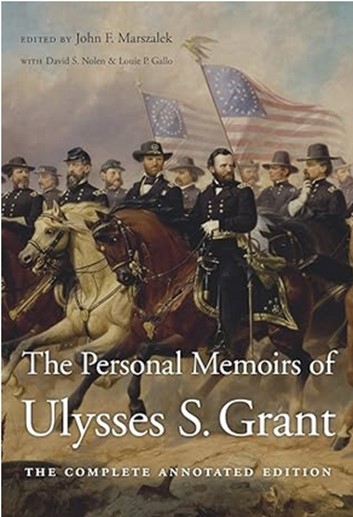
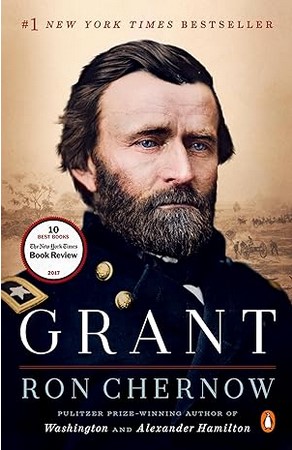
When learning about the moral characters of great men of history, we prefer to quote from their memoirs or autobiographies when they exist, and Ulysses S Grant’s Memoirs reveal not only military history and his accomplishments, but insights into his motivations and moral decisions he made. You also need to balance this with an excellent biography, such as Ron Chernow’s Grant, as the biographer can cover sensitive topics that the subject avoids. We will be quoting more extensively from Chernow when we reflect on our summary of Grant’s Presidency.
For our reflections on the Battle of Gettysburg, one primary source was a collection of Civil War letters written by ordinary soldiers, plus several letters from General Pickett, and also the post-battle correspondence between Robert E Lee and Jefferson Davis. We also reflected on the postwar memoirs of Confederate General James Longstreet. The Grants and Longstreets were family friends before and after the Civil War.
One major source we consulted was the Teaching Company lectures on the Civil War by Professor Gary Gallagher. We also reflected on Professor Gallagher’s reflections on why Union soldiers were willing to fight to preserve the Union, and how the speeches of Daniel Webster inspired many Americans to cherish the Union.
[1] Ron Chernow, Grant (New York: Penguin Books, 2017), Chapter 1, Country Bumpkin, p. 3.
[2] https://en.wikipedia.org/wiki/Manifest_destiny and https://en.wikipedia.org/wiki/Mexican%E2%80%93American_War and https://en.wikipedia.org/wiki/Adams%E2%80%93On%C3%ADs_Treaty and https://en.wikipedia.org/wiki/James_K._Polk and https://en.wikipedia.org/wiki/Gadsden_Purchase
[3] The Personal Memoirs of Ulysses S Grant (Cambridge, Massachusetts: Belknap Press of Harvard University Press, 2017, 1885), Chapter 14, Return of the Army, Marriage, Ordered to the Pacific Coast, pp. 133-134.
[4] https://en.wikipedia.org/wiki/Ulysses_S._Grant
[5] The Personal Memoirs of Ulysses S Grant, Chapter 22, Investment of Fort Donelson, Surrender of the Fort, pp. 208-213.
[6] https://en.wikipedia.org/wiki/List_of_American_Civil_War_generals
[7] https://en.wikipedia.org/wiki/Anaconda_Plan
[8] https://en.wikipedia.org/wiki/Battle_of_Shiloh and Ron Chernow, Grant, Chapter 10, A Glittering Lie, p. 206.
[9] The Personal Memoirs of Ulysses S Grant, Chapter 24, Confederate Attack at Shiloh, Retreat and Defeat of the Confederates, pp. 228-239.
[10] Civil War Letters, From Home, Camp & Battlefield, pp. 140-142.
[11] https://en.wikipedia.org/wiki/Pickett%27s_Charge
[12] Gary Gallagher, American Civil War (The Great Courses, The Teaching Company, now Wondrium, 2000), Gettysburg, Lecture 22 and https://en.wikipedia.org/wiki/Gettysburg_campaign
[13] Gary Gallagher, The American Civil War, Lecture 23: Vicksburg, Port Hudson, and Tullahoma, p.93.
[14] The Personal Memoirs of Ulysses S Grant, Chapter 38, p. 384-393.
[15] The Personal Memoirs of Ulysses S Grant, Chapter 30, p. 293-294.
[16] Ron Chernow, Grant, Introduction, p. xix-xx.
[17] https://en.wikipedia.org/wiki/1864_United_States_presidential_election
[18] https://en.wikipedia.org/wiki/Lost_Cause_of_the_Confederacy
[19] The Personal Memoirs of Ulysses S Grant, Chapter 67, pp. 721-727 and James Longstreet, From Manassas to Appomattox, Memoirs of the Civil War in America, Chapter XLIII, Appomattox, pp. 340-343.

Be the first to comment