What was Manifest Destiny? Did this belief justify American aggression in the Mexican-American War?
Why did the Republic of Texas seek independence from Mexico?
Why were the Texans and then the Americans victorious over the Mexicans, even though they were outnumbered and fighting on foreign soil?
Was the Mexican-American War a leading cause of the Civil War?
How did his experiences in the Mexican-American War prepare Grant for his rapid advancement in the Union Army during the Civil War?
YouTube video for this reflection: https://youtu.be/TJlh1D77wyA
EARLY LIFE OF ULYSSES S GRANT
Ron Chernow begins his biography: “On April 27, 1822, Ulysses S Grant was born in Point Pleasant, Ohio, tucked away in the rural southwestern corner of the state near Cincinnati. The tiny, boxy house, constructed of wood and painted white, stood a short stroll from the Ohio River with Kentucky clearly visible on the far shore. Under its slanting roof the residence was humble, consisting of a single open room with a fireplace. Point Pleasant was little more than a nondescript cluster of makeshift cabins overlooking bustling river traffic.”[1]
Like Lincoln, Ulysses was born humbly, he was the first of six children, and his father was a tanner. His parents, Jesse and Hannah Grant, had been “rabidly partisan Democrats who supported Andrew Jackson. Although he initially supported Jackson’s veto of the charter of the Second Bank of the United States, he changed his position on the national bank after he joined the new Whig Party.”
As Chernow notes: “Jesse revered Henry Clay, who led the Whigs from 1834 to 1846, endorsing” “internal improvements, high tariffs, and a national bank, an orientation later reflected in his son’s presidency.”
Why were northern soldiers so willing to fight to preserve the Union? To answer this question, we need to understand the history of the decades preceding the Civil War. How did the speeches of Daniel Webster inspire the North to fight to preserve the Union? We plan more reflections on the career of Daniel Webster and Henry Clay, who delayed the sectional conflict between the Free-Soil Northern states and the slave-holding Southern states as long as was possible. Most Americans forget that many decades before the Civil War, South Carolina had threatened secession.
Why Were Union Soldiers in the Civil War Willing to Fight to Preserve the Union?
https://seekingvirtueandwisdom.com/why-were-union-soldiers-in-the-civil-war-willing-to-fight-to-preserve-the-union/
https://youtu.be/0aak9Mtt0eI
How Did the Speeches of Daniel Webster Inspire the North to Fight To Preserve the Union?
https://seekingvirtueandwisdom.com/how-did-the-speeches-of-daniel-webster-inspire-the-north-to-fight-to-preserve-the-union/
https://youtu.be/etLbkY_zgY0
What was young Ulysses like? Chernow says that in his youth, Ulysses “seemed forgettable and colorless,” was not wayward or rambunctious or mischievous. “Like his mother, he was self-contained, as if he had trained his face to mask emotion and keep his inner life secret. Like Hannah, he was uncommonly even-tempered.” Unlike many great men of history, Ulysses in his youth had no vision of a great future and was prepared to live his life in obscurity. He was underestimated by many who met him.
Chernow describes traits that would serve him well later in life. “Never one to initiate a fight, he refused to back down when bullied. He was roused to fury if sadistic boys tormented an innocent child or a defenseless horse, and small boys embraced him as their steadfast protector.”
Ulysses was born with a love for horses. Chernow notes: “He liked to ride without a saddle or stirrups, sitting astride a blanket on the horse’s back, and he was so expert at handling horses that he began riding at age five. He became known for breaking in wild horses for local farmers.” “He tamed even the most refractory horses through a fine sensitivity to their nature rather than by his physical prowess.”
Grant once observed: “If people knew how much more they could get out of a horse by gentleness that by harshness, they would save a great deal of trouble both to the horse and to the man.”[2]
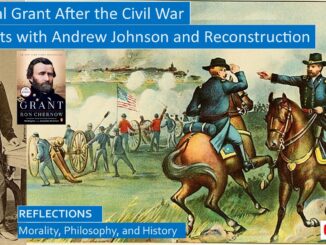
Later, during the Mexican-American War, Grant demonstrated his skill at horsemanship. When under heavy fire, someone needed to ride off to request fresh supplies, so Grant volunteered. Chernow writes: “With daredevil dexterity, Grant wound one foot around the saddle, draped an arm over the neck of the horse, and rode off at full gallop, using the horse to shield his entire body. The Mexicans got only brief, intermittent glimpses of his hidden, low-slung figure as he streaked by at high velocity.”[3]
His horsemanship and his calculating coolness and courage under fire combined to make him one of the greatest generals in American history. Plus, his compassion for the freed slaves made him a great Civil War general.
When researching the other reflections on General Grant and the Civil War, I encountered a fascinating letter from a Union cavalryman describing how horses suffered even more than the soldiers in the Civil War.
Horses and Cavalry from Xenophon in Ancient Greece to the American Civil War, and in New York City
https://seekingvirtueandwisdom.com/horses-and-cavalry-from-xenophon-in-ancient-greece-to-the-american-civil-war-and-in-new-york-city/
https://youtu.be/lB6x-__GHy4
ULYSSES S GRANT ATTENDS WEST POINT MILITARY ACADEMY
The Panic of 1837 prompted his father Jesse to economize, and he realized that if Ulysses attended the military academy at West Point, he would not need to pay tuition. At first, Ulysses objected to these plans, but relented after his father snagged a congressional appointment for his son at West Point.
By mistake, his name was listed on the application as Ulysses S Grant, the “S” not standing for anything. For the rest of his life, he was known either as US Grant, or after he gained a staunch military reputation, as Unconditional Surrender Grant.[4]
During his time at West Point, Ulysses S Grant remembers: “During my first year’s encampment, General Scott visited West Point and reviewed the candidates. With his commanding figure, his quite colossal size and showy uniform, I thought him the finest specimen of manhood my eyes had ever beheld, and the most to be envied. I could never resemble him in appearance, but I believe I did have a presentiment for a moment that someday I should occupy his place on review, although I had no intention then of remaining in the army.”[5]
Many future generals from both the Union and the Confederacy attended West Point. Ulysses S Grant had 250 cadet classmates and eighty-two cadets in his first-year class. When he graduated, his rank was twenty-first in a class of thirty-nine. If you consider those cadets who dropped out, he would have then been in the top quarter of the initial candidates. West Point emphasized math, engineering, geography, and history, also covering military skills and strategy. One favorite professor admired the battlefield strategies of Napoleon, who had been defeated at Waterloo in 1815, which was only twenty-four years before Grant entered West Point. After graduation, Grant coveted a cavalry assignment, but was instead offered an infantry commission at the Jefferson Barracks near St Louis, Missouri, which he accepted.
One of his classmates who would later become a family friend was the tall and gangly James Longstreet, who would later serve under Robert E Lee, who dubbed him “my old warhorse.” Longstreet later warmly remembered that Grant had a “girlish modesty, a hesitancy in presenting his own claims, a taciturnity born of his own modesty, but a thoroughness in the accomplishment of whatever task was assigned him.”[6] They were so close that James rode out with Ulysses to visit his new flame, Julia Dent.[7] The friendship between these two families was interrupted by the Civil War.
ULYSSES BECOMES ACQUAINTED WITH JULIA DENT
Ulysses remembers his un-courtship. “At West Point I had a classmate,” “FT Dent, whose family resided some five miles west of Jefferson barracks,” whom he rode out to visit, and “as I found the family congenial, my visits became frequent.”
Grant recalls: “There was an older daughter of seventeen, who had been spending several years in a boarding school in St Louis.” “In February, she returned to her country home. After that, I do not know, but my visits became more frequent. They certainly became more enjoyable. We would often take walks, or go on horseback to visit the neighbors, until I became quite well acquainted in that vicinity.”
Ulysses does not tell us much about his new love, Julia: details are drawn from Chernow’s biography. One gets the impression when reading Grant’s Memoirs that Julia was a benign, kindly presence who was always destined to anchor his life. Many biographers posit that he drank the most when they were long separated while he was on military assignments, and perhaps that is why he resigned from the army after the Mexican-American War.
One of Chernow’s sources is the memoirs of Julia that describe how Julia’s younger sisters swooned over our second lieutenant. Like Grant, Julia loved to read, she loved Homer’s Iliad and Odyssey, and she loved history. Her family lived on an 850-acre estate with “orchards growing peaches, apples, apricots, nectarines, plums, cherries, grapes,” and other small fruits.
The Dents owned thirteen slaves, and would own thirty in another decade, who “grew the cash crops of wheat, oats, corn, and potatoes that formed the basis of the family wealth.” In her memoirs, “Julia presented her childhood as the picturesque saga of a southern belle pampered by adoring slaves.” She recalled that the Dent slaves were all “very happy, at least in mamma’s time, though the young ones became somewhat demoralized about the beginning of the Rebellion, when all the comforts of slavery passed away forever.”
Julia had fond memories of Ulyssess: “I thought he was a knight from one of the romances I used to read.” “He entirely enchanted me,” “he was handsome, kind, honest, brave, he was scarcely real to a little girl like myself.” Chernow writes: “Julia sensed a decency about Grant that set him apart from other young soldiers.”
President John Tyler was seeking to annex Texas, which was violently discussed in Congress, the press, and among the populace. Soon after Grant left on extended leave to visit his parents in Ohio, his regiment was ordered to march to Louisiana, but he did not receive these orders for several days, and turned back, having to cross a raging creek to briefly visit the Dents.
How does Grant tell us he was madly in love with Julia Dent? “Before I mustered up the courage to make known, in the most awkward manner imaginable, the discovery I had made on learning that the 4th infantry had been ordered away from Jefferson Barracks. The young lady afterwards admitted that she, too, although until then she had never looked upon me other than as a visitor whose company was agreeable to her, had experienced a depression of spirits she could not account for when the regiment left.”
What to do now? Grant remembers: “During that time there was a constant correspondence between Miss Dent and myself, but we only met once in the period of four years and three months. In May 1845, I procured a leave for twenty days, visited St Louis, and obtained the consent of the parents for the union, which had not been asked for before.”[8]
TEXANS AND AMERICANS SEEK WAR WITH MEXICO
Ulysses S Grant and the leading generals for both the Union and Confederate Armies attended the West Point military academy before fighting in the Mexican-American War, which compelled Mexico to recognize the secession of the free state of Texas, and to sell its interests in California and other territories to the United States, which today comprises five other southwestern states.
When Spain ceded Florida to the United States in the Adams-Onis Treaty in 1819, they agreed that the land that today comprises Texas, California, and the states in between belonged to Spain. Later, when Mexico declared its independence, a subsequent treaty agreed that these remained the borders. Since these territories were sparsely populated, Mexico encouraged American settlement in these territories. However, there was friction with the Americans, since many Texan settlers owned slaves whereas Mexico had freed its slaves. Many Texans agitated first for the independence of the Texas Republic, and then its subsequent annexation by the United States.
The Democrats promoted the idea of Manifest Destiny, that Americans were destined to expand westwards to claim the continent from the Atlantic to the Pacific Oceans, and perhaps beyond. Northern Whigs and future Republicans, including an obscure Illinois Congressman in the House of Representatives named Abraham Lincoln, were less enthralled with Manifest Destiny, particularly the annexation of Texas, since that would increase the number of slave states that would be represented in the Senate and the House.
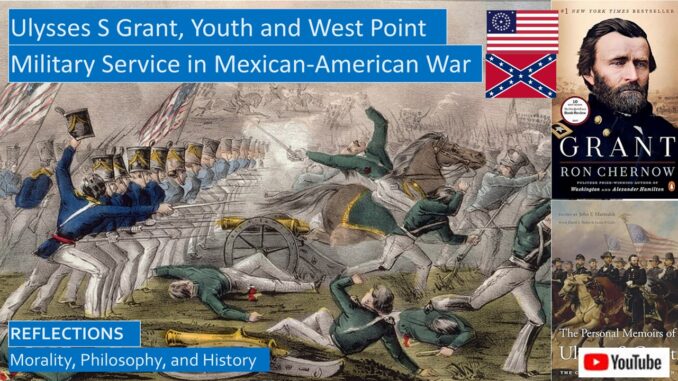
Ulysses S Grant was promoted several times in this brief war, gaining valuable battlefield experience, preparing him for leadership in the upcoming Civil War. Many of the tactics, strategies, and wartime policies of the Civil War had their origins in the Mexican-American War. Grant covers the battles he fought in greater detail, and Ron Chernow in his biography covers them in less detail, but we will provide a summary of the war from Dr Wikipedia. We are not as interested in the individual battles as we are in the interesting insights into the ordinary life of Mexicans and of soldiers on both sides, and Grant’s impressions of the war, the generals who fought in the war, and their tactics and strategy.
In October 1835, the Texans rebelled against the central government of Texas, seeking independence for the Republic of Texas. The rallying cry of “Remember the Alamo” sought revenge for the defeat and massacre of the small Texan contingent at that tiny mission in San Antonio. Although the Texans were the underdog battling the more numerous Mexican Army, they eventually defeated the Mexican forces at the Battle of San Jacinto, capturing the Mexican general Santa Anna. However, the peace treaty they compelled him to sign as a prisoner-of-war was repudiated by the Mexican Congress. Since other conflicts distracted the Mexican officials, there was no further resolution on the validity of this treaty. Whether the border between the two countries was the Rio Grande River or the more northerly Nueces River was resolved by the ensuing war.
The Democrat James K Polk won the 1844 Presidential Campaign on a Manifest Destiny platform, committing the country to annexing Texas and extending US Territory to California by any means necessary, and settling the Oregon boundary through diplomacy with Great Britain, agreeing that the forty-ninth parallel would be the border between the United States and Canada. His initial efforts to negotiate with Mexico failed, so Polk provoked the Mexicans to attack when he stationed US Troops to occupy the land bordered by the Rio Grande. This enabled Polk to prompt the US Congress to declare war on Mexico in May 1846.
Ulysses S Grant was part of the army forces stationed on the Rio Grande River. He was recognized for his initial service as a quartermaster; many historians credit this experience for his later understanding of the critical need for logistics in a large modern army during the Civil War. American forces marching south from Texas were joined by Americans landing on several Atlantic Mexican ports. Eventually, the American forces captured and occupied Mexico City before negotiating a peace treaty recognizing Texan secession and purchasing the other territories from Mexico in February 1848.
There was also tension between American settlers in California and Mexico. American soldiers were transported by the US Navy to Monterey, California, while other brigades marched overland from US territory. After several battles, Major-General Fremont in February 1848 negotiated a treaty surrendering the California territory to the United States. The territories around New Mexico were another theater of war with numerous battles, where the US Army was victorious.
The denouement to this conflict was the Gadsen Purchase in 1854. The American railroad companies realized they could more economically build a southern continental railroad through the sparsely populated desert of today’s Southern Arizona and New Mexico, so this strip of land was also purchased from Mexico.
Since his term resulted in the near doubling of US continental territory, plus other beneficial policies, many historians rank James P Polk in the top tier of US presidents. Other historians demur, countering that the annexation of Texas and these vast territories exacerbated the tensions between free and slave states, leading to our bloody and divisive Civil War.[9]
GRANT’S VIEWS ON THE MEXICAN-AMERICAN WAR
In his Memoirs, Ulysses S Grant recalls: “I was bitterly opposed to the Mexican-American War, and to this day regard this war as one of the most unjust ever waged by a stronger against a weaker nation. It was an instance of a republic following the bad example of European monarchies, in not considering justice in their desire to acquire additional territory.”
Grant continues: “Texas was originally a state belonging to the Republic of Mexico.” Since it was sparsely populated, Mexico encouraged Americans to colonize Texas. “These colonists paid very little attention to the supreme government and introduced slavery into the state almost from the start, though the constitution of Mexico did not, nor does it now, sanction that institution. Soon they set up an independent government of their own, and war existed between Texas and Mexico until 1836.”
Grant continues: “The occupation, separation, and annexation were, from the inception of the movement to its final consummation, a conspiracy to acquire territory out of which slave states might be formed for the American Union.” “Texas, as an independent state, never had exercised jurisdiction over the territory between the Nueces River and the Rio Grande. Mexico had never recognized the independence of Texas, and maintained that, even if independent, the State had no claim south of the Nueces.”
Grant continues: “I am aware that a treaty, made by the Texans with Santa Anna while he was under duress, ceded all the territory between the Nueces and the Rio Grande; but General Santa Anna was a prisoner of war when the treaty was made, and his life was in jeopardy. He knew, too, that he deserved execution at the hands of the Texans, if they should ever capture him. The Texans, if they had taken his life, would have only followed the example set by Santa Anna himself a few years before, when he executed the entire garrison of the Alamo and” nearby villagers.
Ron Chernow writes: “With potent backing from slaveholding states, James K Polk, a Tennessee Democrat, who made Texas and Oregon annexation the centerpiece of his campaign, scored a narrow victory in the Presidential race over the Whig Henry Clay. Like other Whigs, Jesse Grant feared the admission of Texas might further entrench slavery and strengthen the Democratic majority in Congress.”
On the other hand, the in-laws felt differently. Chernow adds: “Colonel Dent was equally hell-bent on absorbing Texas into the Union. Emboldened by the Democratic victory, the lame-duck Tyler administration lobbied hard for a joint congressional resolution to annex Texas, which passed in February 1845,” a month before the inauguration of the new president. “Once outgoing President Tyler signed it, Mexico severed diplomatic relations with the United States and mobilized for war.”
Grant concludes: “It is to the credit of the American nation, however, that after conquering Mexico, and while practically holding the country in our possession, we paid a round sum for the additional territory taken; more than it was worth” “to Mexico.” “The Southern rebellion was largely the outgrowth of the Mexican War. Nations, like individuals, are punished for their transgressions. We got our punishment in the most bloody, sanguinary, and expensive war of modern times.”[10]
WHY WERE THE AMERICANS VICTORIOUS?
Why were the Americans victorious when fighting a more numerous enemy in its home territory? Since this war divided American public opinion, the American soldiers bore no resentment towards their often ill-fed and abused enemy forces, resulting in more humane treatment of the Mexican soldiers and population. Plus, the American forces were far better fed, far better equipped and supplied, with superior training and morale.
The Mexican army was outmatched by the American forces. Ulysses Grant describes one of the early battles of the war. “The Mexicans immediately opened fire upon us, first with artillery and then with infantry. At first, their shots did not reach us, and the advance continued. As we got nearer, the cannon balls commenced going through the ranks. They hurt no one, however, during this advance, because they would strike the ground long before they reached our line, and ricocheted through the tall grass so slowly that the men would see them and open ranks and let them pass.”[11]
Grant continues: “The Mexican army of that day was hardly an organization. The private soldier was picked up from the lower class of the inhabitants when wanted; his consent was not asked; he was poorly clothed, worse-fed, and seldom paid. He was turned adrift when no longer wanted. The officers of the lower grades were but little superior to the men.”
Grants also remembers: “The better class” in Mexico “are very proud and tyrannize over the lower and much more numerous classes as much as a hard master does over his negroes, and they submit to it quite as humbly.”
Dr Wikipedia adds that after the American armed forces fared so poorly when battling Great Britain in the War of 1812, Congress invested heavily in the navy and created and equipped a standing army of twelve thousand men. In contrast, the Mexican army was using surplus British muskets and outdated artillery left over from the Napoleonic Wars. There was little enthusiasm for the war among Mexicans: only seven of the nineteen states of Mexico contributed funds, arms, and soldiers to the Mexican army.[12]
In his letters to his wife Julia, Grant “discovered something curious about himself” “in his maiden battle:” “he was tranquil in warfare, as if temporarily anesthetized, preternaturally cool under fire.”[13]
HUMANE TREATMENT OF THE ENEMY FORCES
Compared to many other wars, although there were exceptions, the enemy forces were treated humanely in both the Mexican-American War and the Civil War. Excepting Sherman’s March to the Sea, when he burned and destroyed whatever supplies his army encountered in Georgia and the Carolinas, and when Grant’s Union Army lived off the land before the Siege at Vicksburg, there was little looting and plundering during the Civil War, as both armies generally sought to compensate owners for any supplies seized for use by the armies. These humane practices followed precedents set during the Mexican-American War. However, Grant did notice some Texans and volunteers were guilty of violence and even murder toward the defeated Mexican civilians.[14]
Grant remembers: “General Taylor was opposed to anything like plundering by the troops.” He looked upon the Mexicans “as the aggrieved party and was not willing to injure them further than his instructions from Washington demanded. His orders to the troops enjoined scrupulous regard for the rights of all peaceable persons and the payment of the highest price for all supplies taken for the use of the army.”[15]
During the Civil War, when Grant defeated the Confederates at Vicksburg, and later at Appomattox, he simply paroled the Confederate soldiers rather than imprisoning them, knowing that they had become too weary to continue the fight. He allowed the cavalry and artillerymen to retain their horses to assist with spring planting, and also allowed them to keep their sidearms.
This precedent had been set by General Taylor’s army when they defeated the Mexicans at Monterey. Grant remembered: “Many of the Mexican prisoners were cavalry, armed with lances, and mounted on miserable little half-starved horses that did not look as if they could carry their riders out of town. The men looked in but little better condition. I thought how little interest the men before me had in the results of the war.”[16] General Scott, likewise, after his victorious capture of Mexico City, permitted the Mexican cavalrymen to retain their horses and sidearms.[17]
EVERYDAY LIFE IN TEXAS AND MEXICO
In his memoirs, Grant remembers some interesting vignettes on everyday life in Mexico. Grant remembers: “Between the Rio Grande River and the Nueces River, there was a large band of wild horses probably as numerous as the band of buffalo roaming further north” in days past. “The Mexicans used to capture these in large numbers” and sell them to the Americans, and some to the Army for eight to twelve dollars each, or wholesale for thirty-six dollars a dozen. “The horses were generally very strong, like a Norman horse, with very heavy manes and tails.” They were accustomed to grazing for forage, which was helpful since hay was often unavailable during military campaigns.[18]
Previously, Grant had remarked that he never liked to hunt and was not very good at it.[19] He especially disliked the favorite Mexican sport of bullfighting, where typically four to six bulls were sacrificed for an afternoon’s entertainment. Grant only had the stomach to attend one such performance, he wondered “how human beings could enjoy the suffering of beasts, and often of men.” It was a dangerous sport; he witnessed one mad bull rush and kill both the horse and rider. Men on horseback and on foot would antagonize the beast, pricking it with spears with explosives attached to frighten him. At last, a man on foot waves the famous red cape, “the bull rushes for it and is allowed to take it in his horns,” covering the bull’s eyes.
Grant continues: “When the bull is worked into an uncontrollable frenzy, the horsemen withdraw, and the matadors, literally murderers, enter, armed with knives with blades over a foot long, and sharp. The trick is to dodge an attack” “and stab him to the heart as he passes. If these efforts fail, the bull is lassoed, held fast, and killed by driving a knife blade into the spine just back of the horns.”[20]
WHAT WERE GRANT’S ASSESSMENTS OF GENERALS TAYLOR AND SCOTT?
Ulysses Grant learned that the “Mexican War was a political war, and the administration conducting it desired to make party capital of it. General Scott was at the head of an army,” and his claim to command was not disputed by President Polk. “Scott was a Whig while members of the administration were Democrats. General Scott was also known to have political ambitions, and nothing so popularizes a candidate for high office as military victories. It would not do therefore to give him command of the army of conquest.”
But the other general, Zachary Taylor, also a politically ambitious Whig, was lauded in the press for his victory over the Mexicans at Monterey. Grant remembers: “It was finally decided to send General Scott to Mexico in chief command, and to authorize him to carry out his own original plan: that is, to capture Vera Cruz and march upon the capital of the country,” Mexico City.[21]
Ulysses Grant would later show the same self-deprecating tendencies he noticed in General Taylor. “General Taylor was not an officer to trouble the administration with his demands, but was inclined to do the best he could with the means given him.” “He never made any great show or parade, either of uniform or retinue. In dress, he was possibly too plain, rarely wearing anything in the field to indicate his rank, or even that he was an officer; but he was known to every soldier in his army, and was respected by all.” “No soldier could face either danger or responsibility more calmly than he.”[22]
Grant remembers, “General Taylor never wore a uniform, but dressed himself entirely for comfort. He moved about the field” “to see through his own eyes the situation.” “General Scott was the exact reverse. He always wore all the uniform prescribed” “when he inspected his lines, notifying them of the hour when the commanding general might be expected. This was done so that all the army might be under arms to salute their chief as he passed. On these occasions he wore his dress uniform, cocked hat, aiguillettes, saber and spurs.”
The communication styles of these two generals contrasted strongly. Grant recalls: “General Scott was precise in language,” “was proud of his rhetoric,” “and could bestow praise upon the person he was talking about without the least embarrassment. Taylor was not a conversationalist, but,” like Grant when later writing his orders and his Memoirs, “on paper could put his meaning so plainly that there could be no mistaking it,” with carefully selected “well-chosen words”, avoiding “high-sounding sentences.”
Grant concludes: “But with their opposite characteristics, both were great and successful soldiers; both were true and patriotic in all their dealings. Although both were pleasant to serve under, Taylor was pleasant to serve with.”
“Scott saw more through the eyes of his staff officers than through his own. His plans were deliberately prepared and fully expressed in orders. Taylor saw for himself, and gave orders to meet the emergency without reference to how they would read in history.”[23]
In the end, Grant notes that President Polk’s efforts “to kill off politically the two successful Whig generals made them both candidates for the Presidency. General Taylor was nominated by the Whigs in 1848, and was elected. Four years later, General Scott received the Whig nomination but was badly beaten, and the party nominating him died with his defeat.”[24]
General Winfield Scott served under seven Presidents, but in the 1860s he was in his seventies, and was so obese that he had to be hoisted on and off his horse with a crane. But he was still a sharp general, and his Anaconda Plan was the strategy that would win the war, and this Great Snake picture was printed in the newspapers across the country in 1861. This plan called for a naval blockade that strangled the commerce of the Confederacy, the Union forces seizing control of the Mississippi River, then Union forces marching through the heart of the Confederacy.[25]
JULIA DENT BECOMES A MILITARY WIFE
What does Ulysses S Grant say happened shortly after the war was over? “I obtained a leave of absence for four months and proceeded to St Louis. On the 22nd of August 1848, I was married to Miss Julia Dent, the lady of whom I have spoken before. We visited my parents and relations in Ohio, and, at the end of my leave, proceeded to my post.”[26]
SUCCEEDING REFLECTIONS ON THE LIFE OF ULYSSES S GRANT
After frustrating years of trying to feed his family his family after resigning from the military, Grant reenlisted at the start of the Civil War, earning steady promotions, earning a hard-won victory on the second day of the Battle of Shiloh, after the Confederates had surprised the Union troops the first day, pushing them back.
On July 4th, 1863, two Confederate armies were defeated at Vicksburg by General Grant, giving the Union control over the entire Mississippi River, cutting the Confederacy in two, and General Meade defeated Robert E Lee at the bloody Battle of Gettysburg. After some months, Grant was promoted to lead all the Union armies, leading to the victory and the Confederate surrender at Appomattox.
Planned Reflection: Colonel Ulysses S Grant Enlists, Wins a Hard-Fought Victory at the Battle of Shiloh
Siege of Vicksburg: Ordinary Union Soldiers and Generals Grant and Sherman Recount the Struggle
https://seekingvirtueandwisdom.com/siege-of-vicksburg-ordinary-union-soldiers-and-generals-grant-and-sherman-recount-the-struggle/
https://youtu.be/U6KNO6IkVQs
Gettysburg: Ordinary Soldiers and Generals Pickett and Longstreet Remember the Bloody Charges
https://seekingvirtueandwisdom.com/gettysburg-ordinary-soldiers-and-generals-pickett-and-longstreet-remember-the-bloody-charges/
https://youtu.be/ibTm3l-C8VQ
Robert E Lee Surrendering to Grant at Appomattox, Ending the American Civil War
https://seekingvirtueandwisdom.com/surrender-at-appomattox-courthouse-ending-the-american-civil-war/
https://youtu.be/_Dr7qia6XkQ
Although I was not planning to reflect on the battles of the Civil War, I changed my mind when I discovered how many paintings and lithograph prints were made of the battles and soldiers of the Civil War. However, we were more interested in the politics and consequences of the war than the tactics of each individual battle.
Civil War Through Paintings
https://youtu.be/2hoBOSOBUP8
After the Civil War, the Union Army once again posted soldiers on the Texas border, but this time the United States was guarding the independence of Mexico against the meddling of France and an Austrian Prince.
The South was unrepentant: few Southerners respected the civil rights of and due process under the law for the newly freed black slaves. The Northern Congressmen put the South under military rule, Union soldiers guaranteed the civil rights of the freed black slaves. Murders and crimes that could not be prosecuted in local Southern courts were tried in federal courts. But, after the Panic of 1873, a deep five-year economic depression sapped Northern patience, popular opinion turned against perpetually stationing federal troops in the Southern states to enforce the civil rights laws.
General Grant’s Memoirs, Civil War Diplomacy, Post-War Events in Mexico and Santo Domingo
https://seekingvirtueandwisdom.com/general-grants-memoirs-civil-war-diplomacy-post-war-events-in-mexico-and-santo-domingo/
https://youtu.be/14xYWgYmb10
General Grant Supporting Civil Rights and Reconstruction After the Civil War, and His Conflicts with Andrew Johnson
https://seekingvirtueandwisdom.com/general-grant-supporting-civil-rights-and-reconstruction-after-the-civil-war-and-his-conflicts-with-andrew-johnson/
https://youtu.be/9OJnW4hAizI
President Ulysses S Grant, First Term, Defeating the KKK, Fighting for Civil Rights
https://seekingvirtueandwisdom.com/president-ulysses-s-grant-first-term-battling-the-kkk-fighting-for-civil-rights/
https://youtu.be/-Ta7nzfdAmw
President Ulysses S Grant, Panic of 1873, White Supremacy Triumphs, and Gilded Age Corruption During his Second Term
https://seekingvirtueandwisdom.com/president-ulysses-s-grant-white-supremacy-triumphs-and-gilded-age-corruption-during-his-second-term/
https://youtu.be/vJb4VlkZrqI
We also reflected on Grant’s Indian policies and Custer’s defeat at the Battle of Little Big Horn at the end of his second term.
The Presidential Election of 1876 was contested, the white supremacist Democratic Party intimidated colored voters and nearly stole the election. Under the Compromise of 1877, the Republican Presidential Candidate was chosen by the Electoral College, and in exchange federal troops were withdrawn from the former Confederate states. The Reconstruction Era ended, and the Jim Crow and Redemption Era began, leading to the stripping away of most civil rights for blacks in the South.
President Ulysses Grant’s Indian Policy, and Custer’s Defeat at the Battle of Little Bighorn
https://wp.me/pachSU-1hN
https://seekingvirtueandwisdom.com/president-grants-indian-policy-and-custers-battle-of-little-bighorn/
https://youtu.be/e3o94piy3rQ
After Grant: Southern Redemption and Jim Crow, Reconstruction Ends after Contested 1876 Election
https://seekingvirtueandwisdom.com/redemption-era-of-jim-crow-reconstruction-ends-after-contested-1876-election/
https://youtu.be/fal-lg4pUrw
1876 Contested Presidential Election: Precedent for January 6th Fake Elector Scheme?
https://seekingvirtueandwisdom.com/1876-contested-presidential-election-precedent-for-january-6th-elector-scheme/
https://youtu.be/Ny0iyVYatB4
DISCUSSING THE SOURCES
Ulysses Grant was an economical, sparing writer, and this style of writing combined with his natural humility results in an understated account of the events in his life. If you are looking for an autobiography that reveals how Grant feels, you will be disappointed. In his day, men, particularly military men, were not permitted to have feelings. But he does reveal himself to be compassionate and kind, revulsed at any display of cruelty to men, horses, and beasts. Thankfully, Ron Chernow fills in many of the blanks unfilled by Grant in his Memoirs using other sources.
An important source for the early life of Grant is his Memoirs, and another important source is the memoirs written by his wife, Julia Grant, initially for their children and grandchildren, and first published in 1975. Caches of letters are important sources before the invention of the telephone, and Ron Chernow published a collection of over eighty letters hurriedly written by Grant to his precious Julia, often in the thick of battle. Usually, most of the footnotes for the early chapters of a biography are from the autobiography, but in the case of Grant, there are a large number of other memoirs and recollections.
What we didn’t cover: history of his parents, details of the battles in the Mexican-American War, and the details of his failures in civil life during his frustrating interwar years.
[1] Ron Chernow, Grant (New York: Penguin Books, 2017), Chapter 1, Country Bumpkin, p. 3.
[2] Ron Chernow, Grant, Chapter 1, Country Bumpkin, pp. 8-13.
[3] Ron Chernow, Grant, Chapter 3, Rough and Ready, p. 48.
[4] Ron Chernow, Grant, Chapter 1, Country Bumpkin, pp. 16-18.
[5] The Personal Memoirs of Ulysses S Grant (Cambridge, Massachusetts: Belknap Press of Harvard University Press, 2017, 1885), Chapter 2, West Point and Graduation, p. 23.
[6] Ron Chernow, Grant, Chapter 2, The Darling Young Lieutenant, pp. 19-31.
[7] James Longstreet, From Manassas to Appomattox, Memoirs of the Civil War in America, Chapter i, The Ante-Bellum Life of the Author, p. 3.
[8] The Personal Memoirs of Ulysses S Grant, Chapter 3, Army Life, Causes of the Mexican War, Camp Salubrity, pp, 28-31, and Ron Chernow, Grant, Chapter 2, The Darling Young Lieutenant, pp. 32-37.
[9] https://en.wikipedia.org/wiki/Manifest_destiny and https://en.wikipedia.org/wiki/Mexican%E2%80%93American_War and https://en.wikipedia.org/wiki/Adams%E2%80%93On%C3%ADs_Treaty and https://en.wikipedia.org/wiki/James_K._Polk and https://en.wikipedia.org/wiki/Gadsden_Purchase
[10] The Personal Memoirs of Ulysses S Grant, Chapter 3, Army Life, Causes of the Mexican War, Camp Salubrity, pp, 33-35, and Ron Chernow, Grant, Chapter 3, Rough and Ready, pp. 38-59.
[11] The Personal Memoirs of Ulysses S Grant, Chapter 7, The Mexican War, Early Battles, General Taylor, p. 62.
[12] Ron Chernow, Grant, Chapter 3, Rough and Ready, p. 46 and The Personal Memoirs of Ulysses S Grant, Chapter 12, Promotion to First Lieutenant, Capture of Mexico City, Peace Negotiations, p. 115 and https://en.wikipedia.org/wiki/Mexican%E2%80%93American_War and https://en.wikipedia.org/wiki/War_of_1812 and https://www.army.mil/article/35252/improving_the_u_s_army
[13] Ron Chernow, Grant, Chapter 3, Rough and Ready, p. 44.
[14] Ron Chernow, Grant, Chapter 3, Rough and Ready, p. 46, quoting Grant’s letters to his wife Julia.
[15] The Personal Memoirs of Ulysses S Grant, Chapter 6, Advance of the Army, Crossing the Colorado, the Rio Grande, p. 55.
[16] The Personal Memoirs of Ulysses S Grant, Chapter 8, Advance on and Battle of Monterey, the Surrender of the City, p. 76.
[17] Ron Chernow, Grant, Chapter 3, Rough and Ready, p. 51.
[18] The Personal Memoirs of Ulysses S Grant, Chapter 4, Corpus Christi, Mexican Smuggling, Spanish Rule in Mexico, Supplying Transportation, p. 44.
[19] The Personal Memoirs of Ulysses S Grant, Chapter 5, Army of Occupation, Supplying Transportation, p. 48.
[20] The Personal Memoirs of Ulysses S Grant, Chapter 13, Treaty of Peace, Mexican Bull Fights, pp. 121-122.
[21] The Personal Memoirs of Ulysses S Grant, Chapter 9, Political Intrigue, Siege and Capture of Vera Cruz, pp. 78-79.
[22] The Personal Memoirs of Ulysses S Grant, Chapter 8, Advance on and Battle of Monterey, the Surrender of the City, p. 65.
[23] The Personal Memoirs of Ulysses S Grant, Chapter 10, Scott and Taylor, pp. 93-94.
[24] The Personal Memoirs of Ulysses S Grant, Chapter 12, Promotion to First Lieutenant, Capture of the City of Mexico, Peace Negotiations, p. 120.
[25] https://en.wikipedia.org/wiki/Anaconda_Plan
[26] The Personal Memoirs of Ulysses S Grant, Chapter 14, Return of the Army, Marriage, Ordered to the Pacific Coast, pp. 133-134.


Be the first to comment