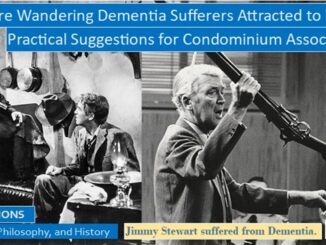
Why Are Dementia Patients Who Wander So Drawn to Water? Why Do They Drown?
Dementia and Alzheimers Disease

Why Are Wandering Dementia Patients Drawn to Water? Why Do They Drown?

The biggest objection property managers and association boards raised against performing health and wellness checks on their owners and residents is they are not nursing homes: they do not want to be held responsible for the welfare of their owners and residents. But even if they wanted to, they cannot take on the responsibility of care. Instead, they should call the police and request that they conduct a health and wellness check. They should inform the police about the possible foreclosure of a dementia patient, as this will better enable them to receive any care they may need. Any known family members must also be informed.
Alternatively, or additionally, they can request that the Broward County Council of Aging, or an appropriate local agency, refer the case to a professional. The Alzheimer’s Association 24/7 support hotline at 800-272-3900 is also an excellent resource. […]
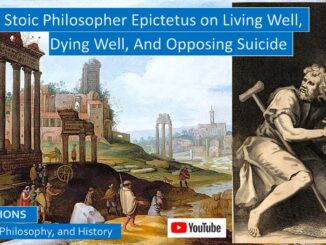

Epictetus, Eminent Roman Stoic Philosopher, on Living Well, Dying Well, and Opposing Suicide
Aging

Epictetus, Eminent Roman Stoic Philosopher, on Living Well, Dying Well, and Opposing Suicide

Is it wise to complain? Epictetus observes: “If someone dies young, he blames the gods because he is being taken before his time. If someone lingers on into extreme old age, he too blames the gods.” “Despite this, at the approach of death, he wants to stay alive; he sends for the doctors and begs him to do all he can.” “It is quite remarkable to see how people want neither to live nor to die.”
“Is health good and illness bad? No, man. What, then? Health managed well is good, but when badly managed, it is bad.”
Epictetus points out: “If you look at yourself in isolation, it is natural for you to live to an old age, to be rich, to be healthy. But if you look at yourself as a human being and as part of some whole, for the sake of that whole, it may be appropriate for you to be ill, or risk your life at sea, or be poor, or die young. Why get angry then?” “What is a human being? A part of a city made up of gods and human beings,” “a small copy of the universal city.” […]

Doris Day, Que Sera Sera, Que Sepa Sepa
Aging

Doris Day, Everyone’s Girl Next Door: Que Será, Será? Que Sepa, Sepa?

Doris Kappelhoff was born in 1922, she was both a leading movie star and singer from the 1940’s through the early 1960’s, when many movies were musicals. In her youth she was hoping to be a dancer, but when she broke her leg when the car she was riding in collided with a freight train, she instead became a singer. She started singing in the hospital out of boredom, and since her voice was so clear her mother enrolled her in voice lessons.
In the late thirties Doris began her career as a big band singer, recording more than six hundred songs. Early in her career she adopted the stage name of Doris Day, inspired by the song Day After Day, as her original surname was too long to fit on marquees. She made her film debut in 1948, starring in dozens of movies with many leading men of Hollywood, many of them romantic comedies, including Rock Hudson, Jimmy Stewart, Clark Gable, Ronald Reagan, Cary Grant, David Niven, and many others.
Her public persona was the virtuous girl next door, so she declined the leading role in the Graduate. In that movie, the role of the randy mother-in-law went to Ann Bancroft, who seduced her future son-in-law, Dustin Hoffman. What was not explored in the movie was what the family holiday dinners were like after he married her daughter. Doris Day was not willing to transition to the Free Love climate of the Sixties, which quickly ended her movie and recording careers. […]

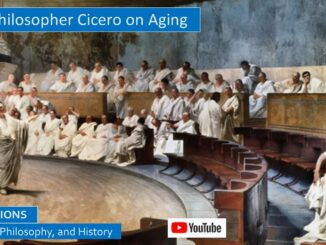
Roman Stoic Philosopher Cicero on Aging and Death
Philosophy

Roman Stoic Philosopher and Politician Cicero on Aging and Death

Cicero advises us: “Enjoy the blessing of strength while you have it, and have no regrets when it has gone, any more than young men should regret the end of boyhood, or those approaching middle age lament the passing of youth. Life’s course is invariable: nature has one path only, and you cannot travel along it more than once. Every stage of life has its own characteristics: boys are feeble, youths in their prime are aggressive, middle-aged men are dignified, while the elderly are mature. Each of these qualities is ordained by nature for harvesting in due season.”
Cicero continues: “Age must be overcome; its faults need vigilant resistance. We must combat them as we should fight a disease: following a fixed regime, exercising in moderation, and consuming enough food and drink to strengthen” but not too much. “The mind and spirit need even more attention than the body, for old age easily extinguishes them, like lamps” with too little oil. […]

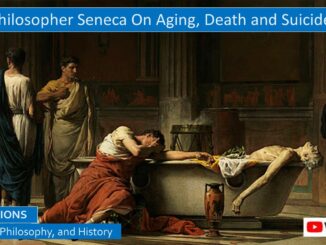
Seneca on Aging Death and Suicide
Aging

Roman Stoic Philosopher Seneca on Aging, Death, and Suicide

Seneca reminds us: “There is indeed a limit fixed to us,” “but none of us knows how near he is to this limit. Therefore, let us so order our minds as if we had come to the very end. Let us postpone nothing. Let us balance life’s account every day.” “Let us begin at once to live and count each separate day as a separate life.” What is important is “not how long you live, but how nobly you live. And often living nobly means that you cannot live long.” […]

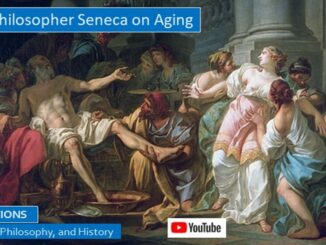
Roman Stoic Philosopher Seneca on Aging, Retirement, and Death
Aging

Roman Stoic Philosopher Seneca on Old Age and Retirement

Seneca faces old age and death as only a Stoic could. “Old age is a time of life that is weary rather than crushed.” Nevertheless, I am thankful, “for age has not damaged my mind, though I feel its effects on my constitution. Only my vices” “have reached senility; my mind is strong,” “it is alert,” “it declares that old age is when it blooms.” “My mind bids me to consider how much this peace of mind and moderation of character I owe to wisdom and how much to my time of life; it bids me to distinguish carefully what I cannot do and what I do not want to do.” “There is only one chain that binds us to life, and that is the love of life.” […]

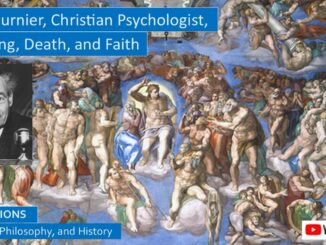
Classical Christian Psychologist Paul Tournier on Old Age, Death, and Faith
Aging

Classical Christian Psychologist Paul Tournier on Old Age, Death, and Faith

Tournier reminds us that we may experience many successes, but as we grow older, “success retreats, and escapes us, it is limited, unfulfilled.” “When one comes to the end, a man’s life is nothing much.” “Professional life is over, and it finishes unfinished. This is a prefiguration of death, in which the whole of life will finish it, too, being unfinished. That is the dramatic contradiction of death.” Quoting Robert Mehl: “An end, but not a fulfilment, that is the face of death.” […]

Paul Tournier on Aging and Retirement
Aging

Classical Christian Psychologist Paul Tournier on Old Age and Retirement

Paul Tournier notes: “Freud defined psychological health under the double heading of aptitude for love and for work.” But Paul Tournier cautions that “the superficial relationships of working life and of sexual attraction must lead to a deeper personal commitment. And I believe that no commitment can be truly personal unless it takes on a transcendent dimension and become love, in the biblical meaning of the word.”
Paul Tournier is grateful: “As an intellectual, I am specially privileged. It is true that the better educated people are, the more chance they have to enjoy their retirement. First, intellectual work” is not physically taxing. “Second, the capacity for intellectual work is retained longer than physical ability. It can even increase in old age as long as disease does not affect the mental faculties. But most of all, the more one exercises one’s mind, the more pleasure it gives to exercise it. The more one learns, the more one wants to learn, and the easier study becomes.” […]

St John Chrysostom, Voltaire, and Leibniz Ask: Why Would a Loving God Permit Earthquakes?
Early Church Writing

St John Chrysostom, Voltaire, and Leibniz Ask: Why Would a Loving God Permit Earthquakes?

Theodicy is the term that Gottfried Leibniz coined in 1710 to describe this so-called problem of how an Almighty God permits suffering in the world.[1] The famed textual critic Bart Ehrman describes how he lost his faith over his concern about Theodicy in his book, On God’s Problem: Why We Suffer. As he points out, different books of the Bible answer this question differently. Many of the prophets, like St John Chrysostom, proclaim that natural disasters are often punishment meted out because we do not take care of the widows, orphans, and the poor.
On the other hand, in the Book of Job God does not give a reason for Job’s suffering, instead asking if Job can fathom the purposes of any of God’s inscrutable actions. why God permits the actions of God.  Although I often do not agree with Bart Ehrman’s conclusions, I rarely disagree with the evidence he cites in his works. Another recent best seller is by Rabbi Harold Kushner: When Bad Things Happen to Good People. We plan to reflect on both these works sometime in 2025. […]

Michael J Fox and Parkinsons: Symptoms and Struggles
Philosophy

Michael J Fox and Parkinson’s Disease: His Symptoms and Struggles

Where does Parkinson’s disease fall on the spectrum of neurological diseases? On one extreme, dementia, including Alzheimer’s disease, degrades the patient’s cognition, including memory and reasoning. Their motor functions decline only as their overall health declines. On the other extreme, ALS or Lou Gehrig’s disease degrades the patient’s motor functions, often starting with the legs, then the arms, then they have trouble breathing. […]