Good Friday, Easter, and the Trinity SMALL CS Lewis Mere Christianity, the Chronciles of Narnia, and St Augustine
CS Lewis

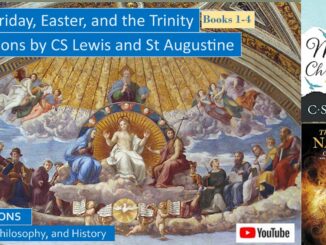
Good Friday, Easter, and Trinity: CS Lewis’ Mere Christianity, Narnia, & St Augustine’s Confessions

How can we make sense of Jesus’ crucifixion on Good Friday and his resurrection on Easter Sunday? CS Lewis proclaims, “The central Christian belief is that Christ’s death has somehow put us right with God and given us a fresh start.” “We are told that Christ was killed for us, that His death has washed out our sins, and that by dying He disabled death itself. That is the formula. That is Christianity.” CS Lewis discusses how atonement erases the stain of original sin from mankind, but he avoids using these Catholic-sounding words. […]
Was CS Lewis a Closet Catholic- Reflections on Mere Christianity
CS Lewis

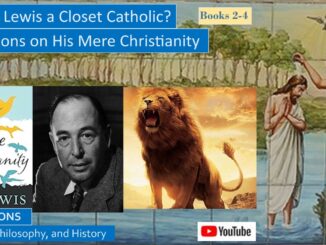
Was CS Lewis a Closet Catholic? Reflections on his Mere Christianity

In the Preface, CS Lewis states that “the reader should be warned that I offer no help to anyone who is hesitating between two Christian denominations. You will not learn from me whether you ought to become an Anglican, a Methodist, a Presbyterian, or a Roman Catholic.” “There is no mystery of my own position. I am a very ordinary layman of the Church of England, not especially high, nor especially low, nor especially anything else.” He states he avoids discussions that divide, such as the controversies on the exact nature of the Virgin Mary, and avoiding topics like birth control. […]

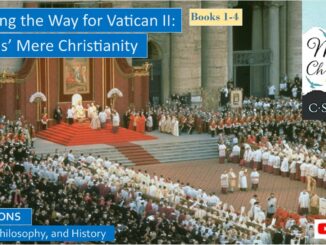
Preparing the Way for Vatican II: CS Lewis' Mere Christianity
CS Lewis

Preparing the Way for Vatican II: CS Lewis’ Mere Christianity

CS Lewis did not wave the flag of ecumenicism, attending this conference or that on interfaith dialogues, but instead prepares the way, saying that what denominational creed you profess is less important than whether you truly believe the core Christian teaching of the two-fold Love of God and neighbor. This was the key change wrought by Vatican II, no longer did the Catholic Church believe you needed to be Catholic to be saved. Likewise, CS Lewis is against the notion that Catholics cannot be saved. […]

Facing the Nazi Menace: CS Lewis' Mere Christianity and Viktor Frankl's Man's Search for Meaning
CS Lewis

Facing the Nazi Menace: CS Lewis’ Mere Christianity and Viktor Frankl’s Man’s Search for Meaning

Mere Christianity was compiled from a series of radio addresses by CS Lewis explaining the tenets of Christianity which were broadcast during the dark days of World War II, when Londoners fled to the safety of the underground subway tunnels while Nazi bombers destroyed their homes above. We will reflect on the many instances where CS Lewis referred often to this monumental struggle, one of the rare political struggles that actually pitted the forces of good and evil against each other, in Mere Christianity. […]

Do Not Steal: Dr Laura and Her Rabbi Stewart Vogel on Ten Commandments, and Excuses People Make
Command 7 Do Not Steal

Do Not Steal and Excuses People Make: Dr Laura and Her Rabbi Stewart Vogel on Ten Commandments

Dr Laura opens this reflection: “People spend a lot of time redefining stealing in order to increase their comfort zone as they assert themselves in a world of needs, wants, possessions, power struggles, fame, fortune, desire, envy, loss, hurt, greed, and antisocial personalities.” This observation implies that many people steal because they feel that they are being taken advantage of, or they themselves were the target of loss, hurt, and greed, and they want to get even with the world, though she does not develop this thought in depth. […]

Anders Nygren, On Christian Agape-Love and Eros-Love in Gospels and Pauline Epistles
Biblical Interpretation

Anders Nygren, On Christian Agape-Love and Eros-Love in Gospels and Pauline Epistles

Anders Nygren emphasizes that “Old Testament piety with its devotion to the Law was by no means the external legalism it is often assumed to have been. There was an inward bond that held the godly man to the Law. The righteous felt no sense of external compulsion when confronted by the Law, but a sense of inner solidarity with it. Its observance gave him value and made him acceptable to God. His prevailing mood was expressed in Psalm 1,” the Psalm that sings of Law as Gospel. […]

Loving God in Deuteronomy, and a Gentile’s Defense of Judaism, Part 2
Judaism

Loving God in Deuteronomy, and a Gentile’s Defense of Judaism, Part 2

When studying the rabbinical commentaries on Deuteronomy, I was struck by the number of times the commandment to Love God was repeated in various forms, including the commandment to Fear God, which is roughly equivalent, so I decided to count them, there are about twenty repetitions. This was surprising to me as a Christian, for as St Paul exhorts, “the letter” of the law “kills, but the Spirit gives life.” […]

Medieval Jewish and Christian Commentators, My Gentile Defense of Judaism, Part 1
Judaism

Medieval Jewish and Christian Commentators, My Gentile Defense of Judaism, Part 1

At roughly the time of Jesus, an inquirer requested of both Rabbi Shammai and Rabbi Hillel, “Convert me to Judaism on condition that you will teach me the entire Torah while I stand on one foot.” Shammai pushed the man away with the building rod he was holding. Undeterred, the man then came before Hillel with the same request. Hillel responded, “That which is hateful unto you, do not do unto your neighbor. This is the whole Torah; all the rest is commentary. Now, go and study.” […]

Jimmy Carterm Inspirational Devotions SMALL
Bible Stories and Parables

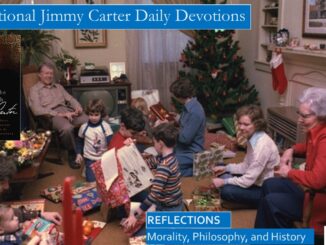
Jimmy Carter Inspirational Daily Devotions: Bible Stories, Reflections on Historical Events

One of Bonhoeffer’s most famous books carried the title, The Cost of Discipleship. In it he condemns what he calls cheap grace. He insists one cannot follow Christ without full commitment, wherever that commitment might lead. In his case it led to a Nazi gallows.”

Dietrich Bonhoeffer and Karl Barth were leaders in the Confessing Church that resisted the Nazi infiltration and cooption of German Christianity, opposing the Nazi notion that Jesus wasn’t Jewish and that Christianity should condone the persecution of the Jews. […]

Martin Luther, Do Not Steal, Lutheran Catechisms, and German Peasants' Revolt
Command 7 Do Not Steal

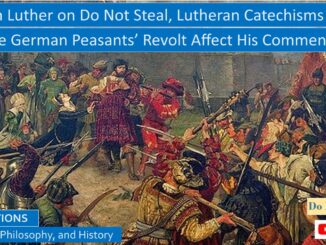
Martin Luther, Do Not Steal, Lutheran Catechisms, and German Peasants’ Revolt

Luther concludes by restating the positive and negative forms of the commandment, noting that tolerating theft by others by doing nothing also is a moral violation. “On one hand, we are forbidden to do our neighbor any injury or wrong in any way imaginable, whether by damaging, withholding, or interfering with his possession and property. We are not even to consent to or permit such a thing but are rather to avert and prevent it. On the other hand, we are commanded to promote and further our neighbor’s interests, and when he suffers want, we are to help, share, and lend to both friends and foes.” […]