Pope Benedict XV and Pope Pius XI: Confronting World War I and World War II, and Fascism
History

Pope Benedict XV and Pope Pius XI: Confronting World War I and World War II, and Fascism

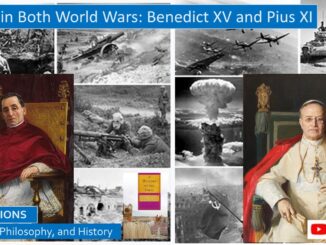
Mussolini signaled in a speech that he was open to negotiating the Roman question. Mussolini was not a practicing Catholic and was famously a serial philanderer. Like Napoleon before him, Mussolini realized that it was in his political interest to settle this issue and regularize the status of the Vatican City.
O’Malley writes: “The most momentous aspect of the Lateran Agreements was the establishment of the Vatican City as a fully independent and sovereign state, with its own postal service, police force, full diplomatic corps, and so forth. The Italian state agreed never to interfere in the free functioning of Vatican City and ensured full and safe access to it by anyone the papacy wanted to receive. The papacy agreed never to try directly or indirectly to reestablish the Papal States, and it relinquished in perpetuity all claim to the city of Rome.”
The Vatican was paid a generous indemnity for the loss of this territory, and the state would pay an annual stipend for the upkeep of historical monuments. In addition to the 103 acres in Vatican City, the pope could also use several churches and castles traditionally at the church’s disposal. […]
Pope Pius X, Promoting Piety, Rejecting Modernism
History

Pope Pius X, Promoting Piety, Rejecting Modernism

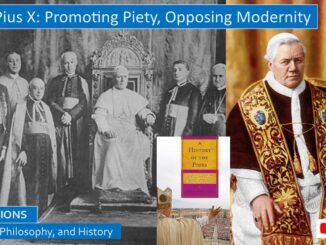
After the long and momentous papacy of Pope Leo XIII, the cardinals sought a candidate who would be a pastoral pope. They chose Guiseppe Sarto, who had spent his entire priestly life as a pastor, last serving as patriarch of Venice. He was from a family of modest means, and for nine years he served as a priest in a country parish. His formal education was meager, he studied at a seminary in Padua.
Our author John O’Malley explains: “Pope Pius X had never set foot outside Italy. He saw things in terms of black and white. While still Patriarch of Venice, he wrote to a friend: ‘When we speak of the Vicar of Christ, we must not quibble. We must obey. We must not evaluate his judgments or criticize his directions lest we do injury to Jesus Christ himself. Society is sick. The one hope, the one remedy, is the pope.’ The words ring like an Ultramontanist manifesto.” […]

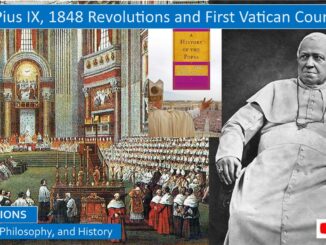
Pope Pius IX, 1848 Revolutions and First Vatican Council
History

Pope Pius IX, 1848 Revolutions and First Vatican Council

Why did Pope Pius IX call the council? John O’Malley notes: “Some people speculated he wanted it solemnly to confirm the Syllabus of Errors. He may have wanted it as a show of Catholic strength worldwide against the church’s enemies, especially in Italy.”
O’Malley continues: “Despite the broad agenda that was anticipated, the council dealt with only two items. The first was the relationship between revealed truth and the powers of human reason.” The council affirmed both the distinction and compatibility between them. With that resolved, the council planned to discuss “church-state relations and the role of the bishops, but with the encouragement of Pius it bypassed them and moved directly to consider” “papal primacy and papal infallibility.”
Papal primacy was not new; the Catholic Church had held this view for fifteen hundred years. But the pope and many bishops felt that the church needed to definitively state that the pope had full authority, not only over matters of faith and morals, but also over discipline and governance for the church worldwide, for both clergy and laity. […]

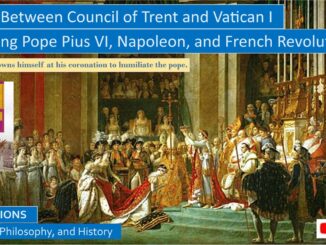
Popes Between Trent and Vatican I, Including Napoleon, the French Revolution, and Pope Pius VI
History

Catholic Popes from Trent to French Revolution and Napoleon to Vatican I

Negotiations for a Concordat between France and the Pope dragged on for thirteen months and over two dozen drafts. O’Malley writes: “Pope Pius VII and” his secretary of state “Consalvi stalled for time, intent on getting out of Napoleon every concession they could. The delay drove Napoleon crazy. He threw tantrums. He threatened to become a Protestant. He threatened to have his troops march on Rome. But finally, on July 15, 1801, the concordat was signed.”
What were the terms of the concordat? Although it acknowledged that most French were Catholics, there was freedom of religion, and Catholicism was not the state religion of France. O’Malley notes: “The buildings and real estate seized from the church during the Revolution were to remain in the hands of the new owners, but cathedrals and churches needed for worship were put at the disposal of clergy as needed. The clergy, who must swear to uphold the government, were paid by the state, which is the first time in history for such a provision.” It reaffirmed that “the state had the right to nominate bishops, subject to the approval of the papacy.” […]

Pope Leo XIV, First American Pope, Successor to Pope Francis and Social Justice of Pop Leo XIII
Modern Catholic Popes

Pope Leo XIV, First American Pope, Successor to Pope Francis and Social Justice of Pope Leo XIII

Pope Leo XIV notes: “What is striking about these two attitudes is their relevance today. They embody notions that we could easily find on the lips of many men and women in our own time, even if, while essentially identical, they are expressed in different language.”
“Even today, there are many settings in which the Christian faith is considered absurd, meant for the weak and unintelligent. Settings where other securities are preferred, like technology, money, success, power, or pleasure.” […]

Pope Francis Autobiography SMALL
Modern Catholic Popes

Pope Francis’ Autobiography: Be Compassionate to the Poor and Marginalized

Pope Francis concludes his autobiography: “To learn to live, we must all learn to love. Let us not forget this! This is the most important lesson we can learn, to love, since love conquers all. By loving we can pull down barriers, we can win battles, we can defeat indifference and hate, we can melt and transform hearts.” “A disinterested love can change the world and the course of history. How many things would have gone differently if love and prayer had motivated us, rather than the thirst for power. Remember, the world need prayer more and more!” […]

Modern Catholic Popes

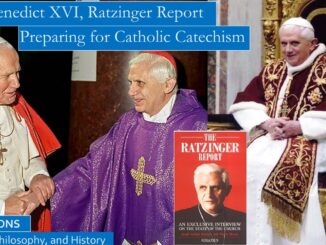
Ratzinger Report, by Future Pope Benedict XVI, Preparing for Catholic Catechism

Cardinal Ratzinger teaches us: “Every council that bears fruit must be followed by a wave of holiness. Thus it was after Trent, and it achieved its aim of real reform for this reason. Salvation for the Church comes from within her,” not solely “from the decrees of the hierarchy. Whether Vatican II and its results will be considered as a luminous period of Church history will depend upon all the Catholics who are called to give it life. As Pope John Paul II said in his commemoration of Charles Borromeo in Milan, ‘the Church of today does not need any new reformers, the Church needs new saints.’” […]

Modern Catholic Popes

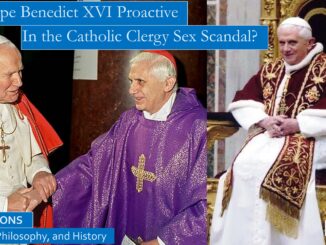
Was Pope Benedict XVI proactive in the pedophile priest sex scandal?

Penance is what Christians do; Christians repent. Unfortunately, many secular media interpreted these gestures by Pope Benedict as an admission of personal guilt.
During this time Cardinal Ratzinger confessed, “The greatest persecution of the Church comes not from her enemies without but arises from sin within the Church.” “The Church has a deep need to relearn penance, to accept purification, to learn forgiveness on the one hand, but also the need for justice.”
The media can be unfair at times. Pope Benedict XVI said that “we must be grateful for every disclosure. The truth, combined with love rightly understood, is primary. The media could not have reported these incidents had there not been evil in the Church herself.” […]

Modern Catholic Popes

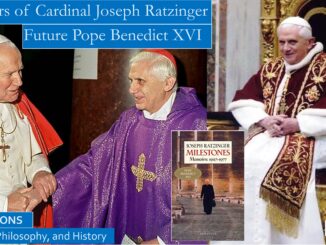
Milestones: Memoirs of Cardinal Joseph Ratzinger, Future Pope Benedict XVI

Archbishop Ratzinger teaches us that “this psalm from the wisdom tradition shows the straits of faith that comes from the absence of earthly success. When you stand on the side of God, you do not necessarily stand on the side of success.” “When the psalmist stands in before God, in the presence of God, he grasps the ultimate insignificance of material wealth and success and recognizes what is truly necessary and what brings salvation.” […]