Thucydides, Moral Lessons Drawn from Histories of the Peloponnesian War
Thucydides draws out moral lessons from the history and speeches of the Revolt of Mytilene, the Revolution at Corcyra, and the Melian Dialogue. […]
We will compare and contrast Abraham Lincoln’s Gettysburg Address, the Funeral Oration of Pericles, and Winston Churchill’s speech honoring those pilots who saved democracy after the Battle of Britain. […]
Why did the Ionian Greeks reject the Spartan leadership under the Pausanius, and why did they plead for Athens to take up the liberation of the Asian Greek colonies from the Persians, leading to the founding of the Delian League? Simply put, the Delian allies were impressed by both the military acumen and integrity of the two Athenian generals Aristides the Just, and Cimon. Also, the Spartans embarrassed Cimon, who sought to reconcile Athens and Sparta, which contributed to the outbreak of the Peloponnesian Wars. […]
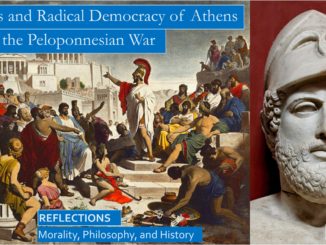
This is second video and blog where we examine both history and Plutarch’s moral biographies of the key Athenian leaders before and in the first years of the war. In the first video we reflected on Pericles and his reforms leading to the Radical Democracy of Athens in the years […]
Why study the Peloponnesian Wars? Simple, you cannot understand Greek philosophy and history without studying these wars. Socrates lived through and fought in these wars and was tried and executed after these wars. Many dialogues respond to issues and questions raised by these wars. […]
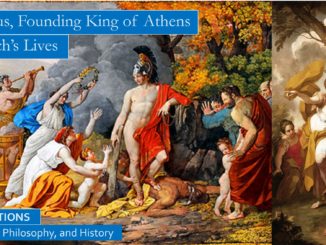
Theseus and Romulus both built mighty cities, Athens and Rome, both are warriors sprung from the gods, “both stand charged with the rape of women, neither could avoid domestic misfortunes nor jealousy at home.” Youtube video for this blog: https://youtu.be/jOgNKSf9IT4 YouTube script with book links: https://www.slideshare.net/BruceStrom1/mighty-deeds-of-theseus-first-king-of-athens-in-plutarchs-lives Plutarch passes down us […]
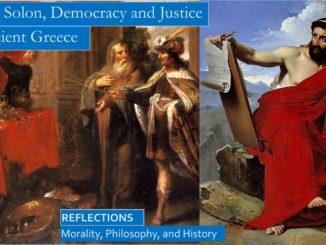
Homer’s Odyssey depict the deep Greek past where might makes right, where brave soldiers fight for justice, where grievances and murders are settled by blood feuds. As Greek emerged from its Dark Ages in the seventh century, the Greeks in Athens sought to establish a more systematic system of justice with laws governing the state. Draco was appointed by the ruling aristocracy to be a lawmaker to codify new laws to replace justice by feuds, now the Senate of the Areopagus would hear cases of homicide. […]
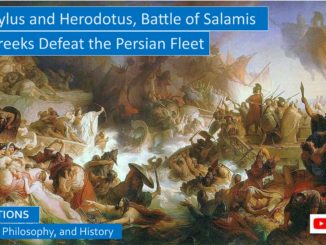
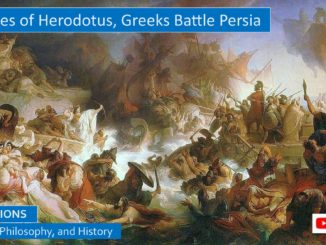
The Greek playwright Aeschylus fought in the Greco-Persian Wars, and in his play, The Persians, he includes an emotional memory of the naval Battle of Salamis, where the outnumbered Greek fleet sinks a large portion of the mighty Persian fleet. […]
Herodotus tells us in his first paragraph that he wrote his Histories “so that human achievements may not be forgotten in time, and great and marvelous deeds, some displayed by Greeks, some by barbarians, may not be without their glory; and especially to show why the two peoples fought with each other. […]
Why did Herodotus write his Histories? Herodotus tells us in his first paragraph, “so that human achievements may not be forgotten in time, and great and marvelous deeds, some displayed by Greeks, some by barbarians, may not be without their glory; and especially to show why the two peoples fought with each other.” Just as in the Iliad, the Greek soldiers and sailors in the Histories of Herodotus fight for cleos, or glory, and warriors in these warrior societies are immortalized by their great and marvelous deeds on the battlefield. Herodotus is interested in recording any mighty deeds of both the Greeks and the Persians, although the glory was earned mostly by the Greeks. […]
Copyright 2017