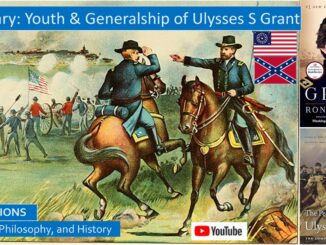
Summary of Youth and Military Career of Ulysses S Grant
Civil War Memories

Summary of Youth, West Point, and Generalship of Ulysses S Grant, From Mexican-American War to Civil War

Those who fought the Civil War grew up in the America of Andrew Jackson, when the giants of the second generation of American leaders fought to hold the United States together. These great orators, including Henry Clay and Daniel Webster, would later inspire Union soldiers to fight and die to preserve the Union. These were the years when the slave-owning Southern President Andrew Jackson threatened to deploy federal troops to prevent the secession of South Carolina over tariffs during the Nullification Crisis in the 1830s. […]
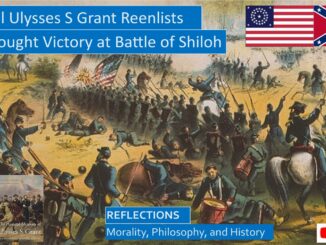
General Ulysses S Grant’s Victory at the Bloody Battle of Shiloh, and His Earlier Civil War Battles
Civil War Memories

General Ulysses S Grant’s Victory at the Bloody Battle of Shiloh, and His Earlier Civil War Battles

Chernow recounts: “Before Shiloh, Grant had nursed hopes for a titanic battle that would triumphantly crush the rebellion. Now, stunned by the combative spirit of his foes, he knew there would be many more bloodbaths in a long, grinding war of attrition. This began is conversion to a theory of total warfare in which all of southern society would have to be defeated.”
Chernow continues: “For Grant, Shiloh represented a personal victory. He had rescued his army from his own errors, showing a gumption and an audacity that altered the battle’s course. He had shown coolness under fire and a willingness to take monumental gambles. The battle also instilled lasting confidence in the Army of the Tennessee, shattering anew the fighting mystique of rebel soldiers.” […]

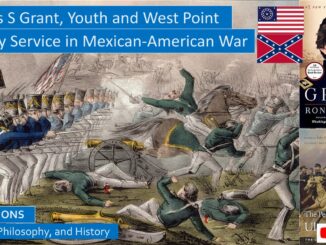
Early Life and Career of Ulysses S Grant Through His Service in the Mexican American War
Civil War Memories

Early Life and Career of Ulysses S Grant Through His Service in the Mexican American War

What was young Ulysses like? Chernow says that in his youth, Ulysses “seemed forgettable and colorless,” was not wayward or rambunctious or mischievous. “Like his mother, he was self-contained, as if he had trained his face to mask emotion and keep his inner life secret. Like Hannah, he was uncommonly even-tempered.” Unlike many great men of history, Ulysses in his youth had no vision of a great future and was prepared to live his life in obscurity. He was underestimated by many who met him.
Chernow describes traits that would serve him well later in life. “Never one to initiate a fight, he refused to back down when bullied. He was roused to fury if sadistic boys tormented an innocent child or a defenseless horse, and small boys embraced him as their steadfast protector.”
Ulysses was born with a love for horses. Chernow notes: “He liked to ride without a saddle or stirrups, sitting astride a blanket on the horse’s back, and he was so expert at handling horses that he began riding at age five. He became known for breaking in wild horses for local farmers.” “He tamed even the most refractory horses through a fine sensitivity to their nature rather than by his physical prowess.” […]

Brutalities Suffered By Slaves on the Plantations of the Antebellum South
Civil War Memories

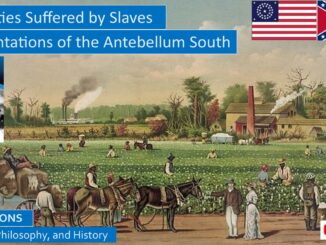
Brutalities Suffered By Slaves on the Plantations of the Antebellum South

In most systems of slavery, in both the ancient world and the Antebellum South, masters could beat, maim, and even murder their slaves, since slaves were property. However, abuse of slaves eased somewhat under the influence of the Stoic Philosophers and early Church Fathers. But it was common, in the Antebellum South, for masters to abuse their slaves, though they rarely killed them, since they were valuable property. But no mercy was shown to slaves who were brutally whipped by their masters, which Frederick Douglass often witnessed. No mercy was shown to suffering slaves in the Antebellum South. […]

Margaret Fleeing to Freedom With Help From Watch, Her Mastiff, and Epictetus on True Freedom
Civil War Memories

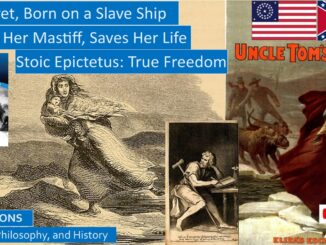
Margaret Ward Fleeing to Freedom With Help From Watch, Her Mastiff, and Epictetus on True Freedom

Margaret was willing to make the best of her situation, she was willing to serve her master’s family as she served Jesus, she compassionately cared for her master’s family, as long as they respected her human dignity. Once they crossed the line, without hesitation, she immediately fled for freedom with her infant, guided and protected only by God and the North Star.
Epictetus discusses how the Spartan lawgiver Lycurgus that “slavery is no more bad than good, and freedom no more good than bad,” he proclaims proudly: “If I were a slave and one of these men was my master, I would torment him, even if it earned me a thrashing a day.” […]

Arnold Gragston: Slave Conductor on the Underground Railroad Assists Runaway Slaves
Civil War Memories

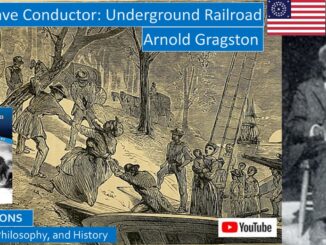
Arnold Gragston: Slave Conductor on the Underground Railroad Assists Runaway Slaves

Gragston remembers: “Mr Tabb was a pretty good man. He used to beat us, sure; but not nearly so much as others did, some of his own kin people, even. But he was kinda funny sometimes; he used to have a special slave who didn’t have nothing to do but teach the rest of us—we had about ten on the plantation, and a lot on the other plantations near us—how to read and write and figger. Mr Tabb liked us to know how to figger. But sometimes when he would send for us and we would be a long time coming, he would ask us where we had been. If we told him we had been learning to read, he would near beat the daylights out of us—after getting somebody to teach us; I think he did some of that so that the other owners wouldn’t say he was spoiling his slaves.” […]

General Grant’s Memoirs, Civil War Diplomacy, Post-War Events in Mexico and Santo Domingo
Civil War Memories

General Grant’s Memoirs, Civil War Diplomacy, Post-War Events in Mexico and Santo Domingo

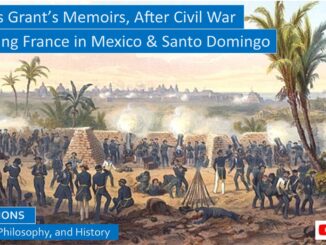
Grant assures us: “The cause of the Great War of the Rebellion against the United States will have to be attributed to slavery. For some years before the war began, it was a trite saying among some politicians,” including Lincoln in his House Divided Speech, “that a state half slave and half free cannot exist. All must become slave or all free, or the state will go down.” “Slavery was an institution that required unusual guarantees for its security wherever it existed.” Grant then criticizes the Fugitive Slave Law, in force before the Civil War, that compelled Northerners to help apprehend and return runaway slaves. […]

Surrender at Appomattox Courthouse, Ending the American Civil War
Civil War Memories

Surrender at Appomattox Courthouse, Ending the American Civil War

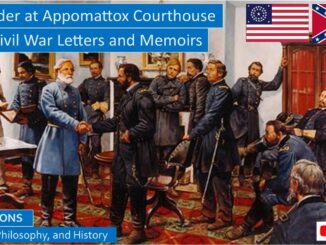
Robert E Lee ceremoniously offered his sword, but Grant refused it. Grant wrote out the terms, which paroled the Confederates on the condition that they “would not take arms against the Government of the United States.” “The arms, artillery and public property are to be parked and stacked.” “This will not embrace the side-arms of the officers, nor their private horses or baggage. This done, each officer and man will be allowed to return to their homes, not to be disturbed by the United States authority as long as they observe their paroles and the laws in force where they may reside.”
Grant recalls that when General Lee “read over that part of the terms about side arms, horses, and private property of the officers, he remarked, with some feeling, I thought, that this would have a happy effect upon his army.” […]

Gettysburg: Ordinary Soldiers and Generals Pickett and Longstreet Remember the Bloody Charges
Civil War Memories

Gettysburg: Ordinary Soldiers and Generals Pickett and Longstreet Remember the Bloody Sacrifices

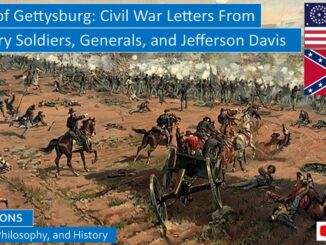
Confederate General George Pickett wrote a doleful letter to his fiancée on July 4th, 1863, the day after his disastrous Pickett’s Charge. Pickett remembered: “A little before three o’clock I rode up to Old Peter,” the nickname for General James Longstreet, “for orders. I found him like a great lion at bay. I have never seen him so grave and troubled. For several minutes after I had saluted him, he looked at me without speaking. Then, in an agonized voice, the reserve all gone, he said:
‘Pickett, I am being crucified at the thought of the sacrifice of life which this attack will make. I have instructed Alexander to watch the effect of our fire upon the enemy, and when it begins to tell he must take the responsibility and give you your orders, for I cannot.’” […]

Fleeing Female Slave Impersonates Planter, Husband Posing As Trusty Servant: William & Ellen Craft
Civil War Memories

Fleeing Female Slave Impersonates Planter, Husband Posing As Trusty Servant: William & Ellen Craft

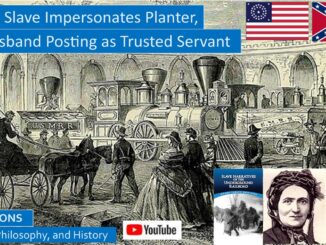
In the 1850s, “William and Ellen Craft were slaves in the State of Georgia.” Their “desire to be free was very strong.” It was rare for slaves that deep in the Confederacy to successfully flee, but it “occurred to William and Ellen, that she might act the part of master and her husband the part of servant.”
“Ellen was fair enough to pass for white,” but how to transform her into a young planter? She needed to “dress elegantly in a fashionable suit of male attire, and have her hair cut in the style usually worn by young planters.” But she was beardless. So, they muffled up the face of the young planter as if he were “suffering badly with a toothache.” […]