Good Friday, Easter, and the Trinity SMALL CS Lewis Mere Christianity, the Chronciles of Narnia, and St Augustine
CS Lewis

Good Friday, Easter, and Trinity: CS Lewis’ Mere Christianity, Narnia, & St Augustine’s Confessions

How can we make sense of Jesus’ crucifixion on Good Friday and his resurrection on Easter Sunday? CS Lewis proclaims, “The central Christian belief is that Christ’s death has somehow put us right with God and given us a fresh start.” “We are told that Christ was killed for us, that His death has washed out our sins, and that by dying He disabled death itself. That is the formula. That is Christianity.” CS Lewis discusses how atonement erases the stain of original sin from mankind, but he avoids using these Catholic-sounding words. […]
Was CS Lewis a Closet Catholic- Reflections on Mere Christianity
CS Lewis

Was CS Lewis a Closet Catholic? Reflections on his Mere Christianity

In the Preface, CS Lewis states that “the reader should be warned that I offer no help to anyone who is hesitating between two Christian denominations. You will not learn from me whether you ought to become an Anglican, a Methodist, a Presbyterian, or a Roman Catholic.” “There is no mystery of my own position. I am a very ordinary layman of the Church of England, not especially high, nor especially low, nor especially anything else.” He states he avoids discussions that divide, such as the controversies on the exact nature of the Virgin Mary, and avoiding topics like birth control. […]

Preparing the Way for Vatican II: CS Lewis' Mere Christianity
CS Lewis

Preparing the Way for Vatican II: CS Lewis’ Mere Christianity

CS Lewis did not wave the flag of ecumenicism, attending this conference or that on interfaith dialogues, but instead prepares the way, saying that what denominational creed you profess is less important than whether you truly believe the core Christian teaching of the two-fold Love of God and neighbor. This was the key change wrought by Vatican II, no longer did the Catholic Church believe you needed to be Catholic to be saved. Likewise, CS Lewis is against the notion that Catholics cannot be saved. […]

Facing the Nazi Menace: CS Lewis' Mere Christianity and Viktor Frankl's Man's Search for Meaning
CS Lewis

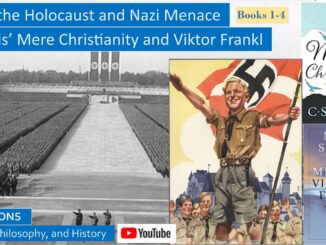
Facing the Nazi Menace: CS Lewis’ Mere Christianity and Viktor Frankl’s Man’s Search for Meaning

Mere Christianity was compiled from a series of radio addresses by CS Lewis explaining the tenets of Christianity which were broadcast during the dark days of World War II, when Londoners fled to the safety of the underground subway tunnels while Nazi bombers destroyed their homes above. We will reflect on the many instances where CS Lewis referred often to this monumental struggle, one of the rare political struggles that actually pitted the forces of good and evil against each other, in Mere Christianity. […]

Fleeing Female Slave Impersonates Planter, Husband Posing As Trusty Servant: William & Ellen Craft
Civil War Memories

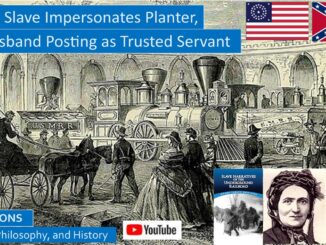
Fleeing Female Slave Impersonates Planter, Husband Posing As Trusty Servant: William & Ellen Craft

In the 1850s, “William and Ellen Craft were slaves in the State of Georgia.” Their “desire to be free was very strong.” It was rare for slaves that deep in the Confederacy to successfully flee, but it “occurred to William and Ellen, that she might act the part of master and her husband the part of servant.”
“Ellen was fair enough to pass for white,” but how to transform her into a young planter? She needed to “dress elegantly in a fashionable suit of male attire, and have her hair cut in the style usually worn by young planters.” But she was beardless. So, they muffled up the face of the young planter as if he were “suffering badly with a toothache.” […]

Horses and Cavalry from Xenophon in Ancient Greece to the American Civil War, and in New York City
Greek and Roman History

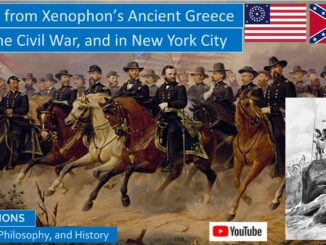
Horses and Cavalry from Xenophon in Ancient Greece to the American Civil War, and in New York City

From antiquity, in combat, horses had three roles: hauling supplies, fighting in highly mobile cavalry regiments, sometimes pulling chariots in ancient times, and enabling generals to quickly survey the battlefield. From ancient times, in both war and peace time, technological improvements meant horses could be used more effectively. Improved harnesses made chariot warfare common throughout the Ancient Near East, quite often several archers would ride in the chariot. In the Old Testament, we read that King Ahab died when an arrow struck him in his chariot, likely he was standing next to an archer. […]

Why I Joined Rotary
Business and Science

History and Philosophy of Rotary International, and My Personal Experience

Early in its history, the Rotary Clubs adopted the Four Way Test. The Rotary website states that “the Four-Way Test is a nonpartisan and nonsectarian ethical guide for Rotarians to use for their personal and professional relationships.
Of the things we think, say, or do:
Is it the TRUTH?
Is it FAIR to all concerned?
Will it build GOODWILL and BETTER FRIENDSHIPS?
Will it be BENEFICIAL to all concerned?” […]

Margaret Garner, Slave Mother Who Killed Her Child to Avoid Slavery, Inspiration for Beloved
Civil War Memories

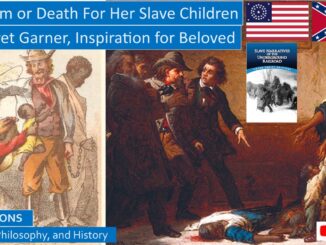
Margaret Garner, Slave Mother Who Killed Her Child to Avoid Slavery, Inspiration for Beloved

Our author Levi Coffin remembers, “Perhaps no case” regarding “fugitive slaves attracted more attention and aroused deeper interest and sympathy than the case of Margaret Garner, the slave mother, who killed her child rather than see it taken back to slavery.” This is a troubling story. I do not wish […]

Siege of Vicksburg: Ordinary Union Soldiers and Generals Grant and Sherman Recount the Struggle
Civil War Memories

Siege of Vicksburg: Ordinary Union Soldiers and Generals Grant and Sherman Recount the Struggle

General Grant remembers: “The North had become very much discouraged. Many strong Union men believed that the war must prove a failure. The elections of 1862 had gone against the party which was for the prosecution of the war to save the Union if it took the last man and the last dollar. Voluntary enlistments had ceased through the greater part of the North, and the draft had been adopted to fill up the ranks. It was my judgment at the time that to make a backward movement from Vicksburg to Memphis, would be interpreted, by many of those yet full of hope for preservation of the Union, as a defeat, and that the draft would be resisted, desertions ensue, and the power to capture and punish deserters lost. There was nothing left to be done but to go forward to a decisive victory.” […]

Underground Railroad: Henry Box Brown, Who Escaped From Slavery Via Mail Express
Civil War Memories

Underground Railroad: Henry Box Brown, Who Escaped From Slavery Via Mail Express

How did Henry Box Brown escape from slavery? Simple, in 1849 he “had himself boxed up and forwarded to Philadelphia direct by express.” The box was “made to fit him most comfortably,” it was “two feet eight inches deep, two feet wide, and three feet long.” With him were “one bladder of water and a few small biscuits,” with but one hole for breathing.
After he “entered his box, it was safely nailed up and hooped with five hickory hoops and was addressed” by a friend to William Johnson in Philadelphia marked, “This side up with care.” The box was transported right side up, but for many miles it was transported upside down, which “had him on his head for miles.” This box went from steamboat to wagon to railroad, the delivery time was a little more than a day. […]